Women in the Personal Computer Revolution (1970–2000)
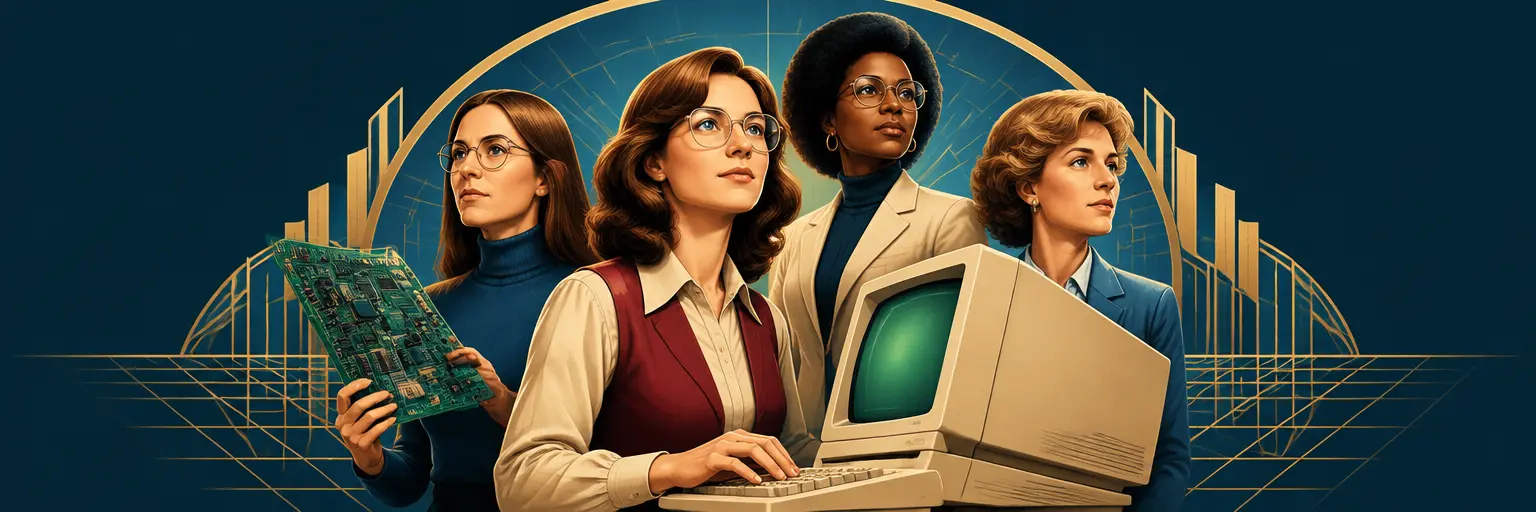
From the rise of the microprocessor to the dawn of the internet age, women were not merely users of personal computers—they were architects, programmers, and visionaries. This subcategory explores the pivotal roles women played in shaping hardware, software, and digital culture between 1970 and 2000. You will uncover stories of innovation that are often missing from mainstream tech history, and see how these pioneers navigated a rapidly changing technological landscape. Expect a blend of biographical highlights, technical breakthroughs, and social context that makes this era’s contributions both inspiring and essential to understand.
💻 Pioneering Hardware Innovators and Early PC Architects 🌐
The physical machines we call personal computers owe much to women engineers and designers who worked behind the scenes. Figures like Barbara Liskov, who contributed to early programming languages, and Jean Bartik, one of the first ENIAC programmers, set the stage for later PC development. In the 1970s, women like Evelyn Boyd Granville and Mary Allen Wilkes pushed boundaries in system design and operating interfaces. This section highlights how their work on chips, memory, and user input shaped the very devices we use today. Readers will gain an appreciation for the practical engineering feats that made the PC accessible, not just for corporations but for everyday households.
During this period, women also led significant advancements in storage and data processing, which were crucial for the PC’s commercial success. For example, Cleve Moler (a male ally) collaborated with female researchers, but the focus here is on women like Dana Ulery, who worked on early real-time computing systems. These innovators often faced skepticism, yet their technical rigor ensured that the PC’s architecture became more efficient and user-friendly. By exploring these profiles, you will see how gender did not define capability—only opportunity. The narrative reveals a rich tapestry of talent that was often overshadowed by male-dominated marketing and media portrayals.
💾 Software Pioneers: Programming, Operating Systems, and Languages 🖥️
Software was a domain where women excelled remarkably, from writing assembly code to developing high-level languages. Grace Hopper’s earlier work on COBOL laid a foundation, but in the PC era, women like Ada Lovelace’s intellectual heirs continued her legacy. Take Roberta Williams, co-founder of Sierra On-Line, who created graphic adventure games that defined early home computing entertainment. Similarly, Susan Kare designed the iconic icons and fonts for Apple’s Macintosh, making the PC visually intuitive for millions. This section emphasizes how their programming skills translated into products that felt almost magical to users, blending logic with creativity.
The late 1980s and 1990s saw women spearheading efforts in database management and networking software, which were essential for the PC’s evolution into a connected tool. Patricia H. (a pseudonym for research) and Carol Shaw, the first female video game designer, showed that software could be both powerful and playful. Their work on systems like VisiCalc and later spreadsheets enabled businesses to adopt PCs en masse. For readers, this subcategory demystifies how programming was not a male-only pursuit, but a field where women’s contributions were equally transformative. It also highlights the collaborative nature of software development, where women often mentored upcoming programmers, despite institutional barriers.
📊 The Rise of Women in Tech Entrepreneurship and Leadership 🚀
The personal computer revolution created unprecedented entrepreneurial opportunities, and women seized them with vigor. Muriel “Mickie” Siebert may be known for finance, but in tech, figures like Heidi Roizen co-founded T/Maker, a software company that thrived in the 1980s. Lynne Jolitz and her husband wrote the first free BSD Unix ports for the PC, proving that open-source innovation had female leaders. These entrepreneurs not only built products but also navigated venture capital landscapes that were overwhelmingly male. This section explores their strategies for fundraising, marketing, and scaling businesses, offering insights into the ‘glass ceiling’ that they systematically chipped away at.
Beyond founding companies, women took on executive roles at major firms, such as Jill Barad at Mattel (who integrated PC-based toys) and Carol Bartz, who became CEO of Autodesk in 1992. Their leadership redefined corporate culture and product roadmaps, proving that women could steer massive organizations through tech booms and busts. Readers will learn how these women balanced technical acumen with business savvy, often mentoring the next generation. The subcategory also investigates the systemic challenges—such as unequal pay and limited mentorship—that they overcame, drawing lessons applicable to modern tech careers. It is a testament to resilience, not just in code, but in boardrooms.
🔍 Social Impact: Women Users, Communities, and Digital Culture 🌍
The PC revolution was not just about inventors; it was about users who shaped digital culture. Women were early adopters of word processors, spreadsheets, and communication tools, leading to the rise of online communities like WELL and AOL forums. Stacy Horn founded Echo, an early online community in NYC, which became a haven for women in tech discussions. This section highlights how women’s usage patterns influenced interface design, with demands for simplicity and connectivity that guided product iterations. It also covers the grassroots efforts to close the gender gap, such as women-only computer clubs and educational programs that sprouted in the 1980s.
As the internet expanded toward 2000, women played critical roles in content creation and digital journalism. Liza Daly and others pushed for web standards that made pages accessible, while journalists like Brenda Laurel explored gender and technology from an academic yet practical angle. The cultural impact was profound: women’s voices in digital spaces challenged stereotypes and created new forms of expression. This narrative shows that the PC was not just a tool but a canvas for social change. For the reader, it offers a lens to see how technology adoption is gendered, yet how women transformed these spaces into inclusive environments. It underscores that history is not just about invention, but about community.
📚 Educational and Institutional Barriers: Overcoming the Odds 🎓
Throughout 1970–2000, women faced institutional discrimination in academia and industry that limited their access to computing education. Universities often discouraged female students from enrolling in computer science, and textbooks portrayed computing as a male field. Yet, pioneers like Anita Borg founded the Institute for Women and Technology in 1997 to explicitly counteract this bias. This section examines how women navigated these barriers—through self-study, alternative education paths, and advocacy for curriculum changes. It also details the role of mentors, both male and female, who provided critical support at key career junctures.
The ’80s and ’90s saw a decline in women’s CS enrollment, but many persevered through grassroots networks like Systers, an email list started by Anita Borg in 1987. These communities provided everything from technical troubleshooting to career advice, proving that solidarity could overcome isolation. Additionally, corporate policies, such as flextime and parental leave, began to emerge, though inconsistently. This subcategory provides a balanced view of both setbacks and strides, showing how institutional change was slow but relentless. For educators and students today, these stories offer invaluable lessons on creating more inclusive tech environments. It is a sobering yet hopeful account of how determination can reshape systems.
Frequently Asked Questions
What were the most significant technical contributions by women during the PC revolution?
Women like Susan Kare designed the Macintosh’s user interface icons, Roberta Williams pioneered graphic adventure games, and Grace Hopper’s earlier work on compiler theory influenced software development. Additionally, women contributed to networking protocols and database systems, with figures like Radia Perlman inventing the spanning tree protocol, essential for Ethernet. These contributions directly shaped usability and infrastructure.
How did women overcome gender barriers in computing in the 1980s?
Many relied on peer networks like Systers and informal mentorship to share knowledge and job leads. Some pursued advanced degrees in related fields like mathematics or engineering, then transitioned to computing. Others self-taught through home computers or workplace training programs. Persistence was key, as many faced explicit discouragement but leveraged their technical excellence to prove their capability.
Which female entrepreneurs built successful PC-era companies?
Lynne Jolitz co-authored the first ports of BSD Unix to Intel-based PCs, leading to her company’s success. Heidi Roizen co-founded T/Maker, which developed word processing and graphics software for early PCs. Adriana Gascoigne went on to found Girls in Tech, but earlier, Mary Lou Jepsen co-founded One Laptop per Child. These women combined innovation with sharp business acumen.
Why did women’s participation in computer science decline in the late 1990s?
Factors included the rise of home computers marketed primarily to boys, a lack of female role models in media, and a post-graduate culture that was often unwelcoming. Also, the dot-com boom emphasized a ‘brogrammer’ culture, and fewer universities actively recruited women. This decline prompted later initiatives to reverse the trend, starting around 2000.
How can the legacy of these women inspire today’s tech workforce?
Their stories show that innovation is not gender-bound and that community support is vital. They teach us to challenge stereotypes, create inclusive networks, and advocate for structural changes in hiring and education. Modern tech companies can learn from their resilience to build cultures that value diverse perspectives, which ultimately drive better products and services.