Beyond HTML: The Forgotten Women Who Shaped Web Content and Community
🌟 Women shaping early web content played crucial roles in community building and digital innovation, yet their stories remain largely overlooked. Celebrating…
Read article
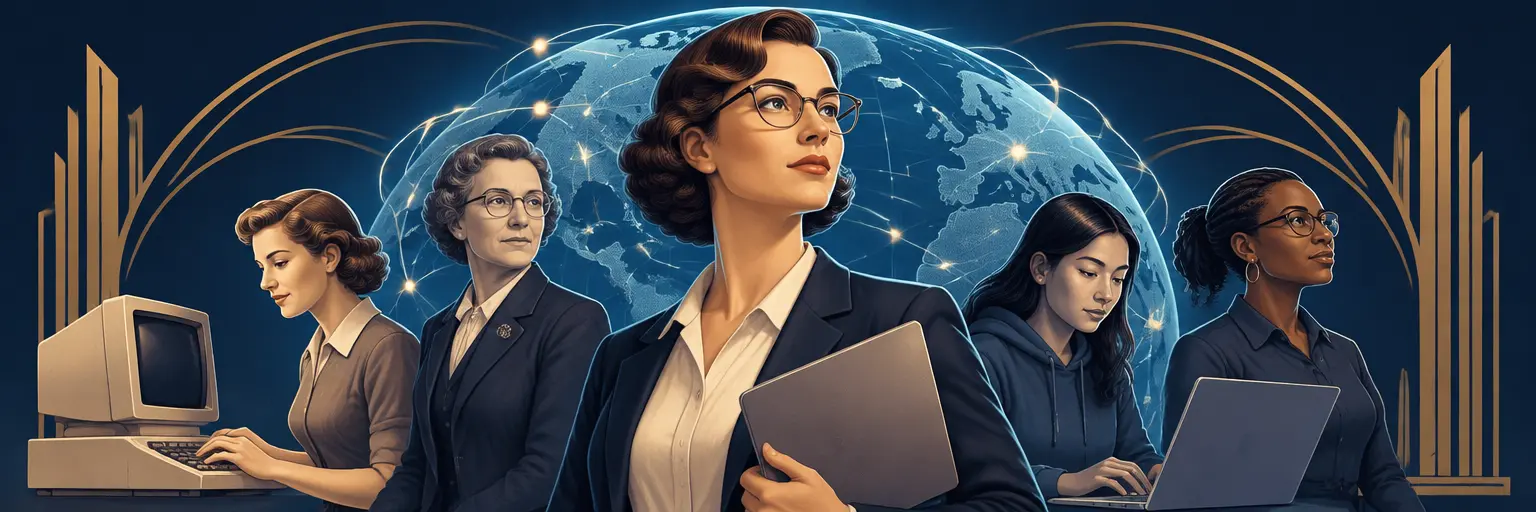
Women & Internet/Web Technologies explores the trailblazing female computer scientists, engineers, and visionaries who shaped the digital world—from early programming pioneers to modern web architects. These women broke barriers in coding, network design, and human-computer interaction, proving that innovation knows no gender. Discover how their contributions underpin today’s online experiences, and be inspired by their resilience in overcoming systemic obstacles. Their stories highlight the essential role of women in building the very fabric of the internet, making technology more inclusive and accessible for all.

🌟 Women shaping early web content played crucial roles in community building and digital innovation, yet their stories remain largely overlooked. Celebrating…
Read article
🌟 Celebrating women’s ethical internet advocacy, this article highlights pioneering women who champion inclusive digital spaces, overcoming barriers in male-dominated fields. Their…
Read article
🌟 Celebrating Ada Lovelace’s pioneering role in the history of algorithm development, her visionary ideas continue to influence today’s web algorithms. Her…
Read article
🌟 Women shaping web information history have revolutionized how we share and access knowledge online. These pioneering women break barriers, inspire future…
Read article
🌟 Celebrating female web founders success, this article showcases inspiring women who transformed pixels into powerful platforms, overcoming challenges in male-dominated tech…
Read article
🌐 Celebrating Women’s Internet Protocol History Pioneers, this article honors the women who navigated and shaped the early internet, overcoming barriers in…
Read article
🌟 Women mentoring web tech careers are empowering the next generation of female innovators, breaking barriers, and inspiring future leaders in technology.…
Read articleExplore the remarkable contributions of women who shaped the internet, web technologies, and digital infrastructure. From early programming breakthroughs to modern software engineering, this subcategory celebrates the female computer scientists, engineers, and visionaries whose work underpins our connected world, offering insights into their innovations, struggles, and enduring legacies. Discover how these trailblazers overcame barriers to build the very fabric of online life.
This section delves into the foundational figures like Ada Lovelace, whose 19th-century algorithms anticipated computer programming, and Grace Hopper, who invented the first compiler and coined the term "debugging." You will learn about the women who programmed ENIAC during WWII, such as Jean Jennings Bartik and Betty Snyder, and their critical roles in networking protocols. Their work laid the groundwork for ARPANET and the modern internet, proving that women were central to computing from its inception.
Readers can expect detailed biographies that highlight not only technical genius but also the institutional sexism these women faced. We emphasize how their collaborative efforts in machine code, predictive algorithms, and early data transmission systems were indispensable to later web technologies. This segment also covers lesser-known figures like Evelyn Boyd Granville and her work on orbital computations, connecting pre-internet computing to the digital revolution that followed.
Here, we focus on women who defined the web’s structure and usability, including Vint Cerf’s key collaborator, Radia Perlman, known as the "Mother of the Internet" for her spanning tree protocol, which made Ethernet robust. We also celebrate Håkon Wium Lie’s contributions are complemented by women like Jutta Degener, who worked on web accessibility standards, and Brenda Laurel, a pioneer in human-computer interaction design. Their stories reveal how web technologies evolved from text-based systems to dynamic, user-friendly interfaces.
Expect insights into the development of HTML, CSS, and JavaScript from a female perspective, highlighting contributors like Rachele DeMeo, who pushed for open web standards, and Cathy Hughes, who applied web tech in media. This H3 section explains how these women’s advocacy for semantic markup, secure HTTP protocols, and cross-platform compatibility shaped current digital experiences. You’ll also find resources for further study on their patents and publications.
This part celebrates women who led large-scale software projects and open source communities, such as Jennifer Pahlka, founder of Code for America, and Kim Polese, who championed Java at Sun Microsystems. We also profile Linux Foundation leaders like Sarah Sharp, who advanced USB 3.0 support, and Mishi Choudhary, a legal advocate for open source. Their leadership demonstrates how women influence not only code but the governance and ethics of digital collaboration.
Readers will gain understanding of agile methodologies, version control systems, and the cultural challenges of tech industries. We include interviews with modern trailblazers like Danielle Foreman, who develops accessible web apps, and case studies on how women’s open source contributions—from networking libraries to CMS platforms—have improved security and performance. This section also addresses the gender gap in tech and offers strategies for mentoring future female engineers.
Here, we explore women like Fei-Fei Li, whose work in computer vision democratized AI, and Cynthia Breazeal, a leader in social robotics. Also featured are Joy Buolamwini, who exposed algorithmic bias, and Rumman Chowdhury, an expert in responsible AI. This section ties internet technologies to data ethics, showing how women shape machine learning models that power web searches, recommendation systems, and personalized content.
Expect an in-depth look at neural networks, natural language processing, and big data analytics from a historical and modern lens. We highlight the contributions of Margaret Boden, a philosopher of AI, and Genevieve Bell, an anthropologist studying human-technology interaction. Learn how these women’s insights drive fair algorithms, transparent AI policies, and inclusive user experiences on global platforms, with practical examples from recent research and industry deployments.
This section focuses on women who expand internet access to underserved communities, like Kanta Kapoor, founder of a telecom company, and Telle Whitney, co-founder of the Grace Hopper Celebration. We profile pioneers in satellite internet and wireless technologies, such as Diana Trujillo, who developed NASA’s robotics software, and ITU leaders like Doreen Bogdan-Martin, who promote digital equality. Their work bridges the digital divide, ensuring women and marginalized groups benefit from web technologies.
Readers will discover stories of women building community networks in rural Africa, creating low-cost mesh Wi-Fi solutions, and advocating for net neutrality. We also cover the role of women in developing assistive technologies for disabled users. This segment provides actionable insights for students and professionals interested in internet policy, infrastructure development, and humanitarian tech, backed by case studies and impact statistics.
Ada Lovelace is widely regarded as the first programmer for her work on Charles Babbage’s Analytical Engine in the 1840s. She wrote algorithms and envisioned computers handling more than numbers, including symbolic logic. Her notes inspired later computing pioneers, and her legacy is celebrated annually on Ada Lovelace Day.
Grace Hopper developed the first compiler, A-0, and the COBOL programming language, which made computers accessible for business and internet applications. Her concept of machine-independent languages enabled software to run across different systems, a foundational principle for web development and cloud computing today.
Women programmed early networking systems, such as the ENIAC team and ARPANET projects. Radia Perlman invented the spanning tree protocol, crucial for robust Ethernet. Others like Elizabeth Feinler managed the Internet Assigned Numbers Authority, standardizing domains and addresses, thus directly shaping the internet’s structure.
Historical records downplayed female contributions due to systemic sexism in media and academia. For example, the ENIAC programmers were rarely credited, and many women worked as “computers” without recognition. Modern scholarship corrects this by re-examining archives, much like this website documents their true impact.
Organizations like AnitaB.org, Women Who Tech, and the Linux Foundation’s Women in Open Source initiative offer mentorships, grants, and conferences. Universities also fund fellowships for women in cybersecurity and AI. Additionally, online platforms such as Girls Who Code provide free curricula, fostering the next generation of female web innovators.