The PreHistory of Code: Women Who Wrote the Rules for Machines Unbuilt
🌟 Discover the fascinating early history of women coding, revealing how pioneering women shaped the foundational rules for machines long before modern…
Read article
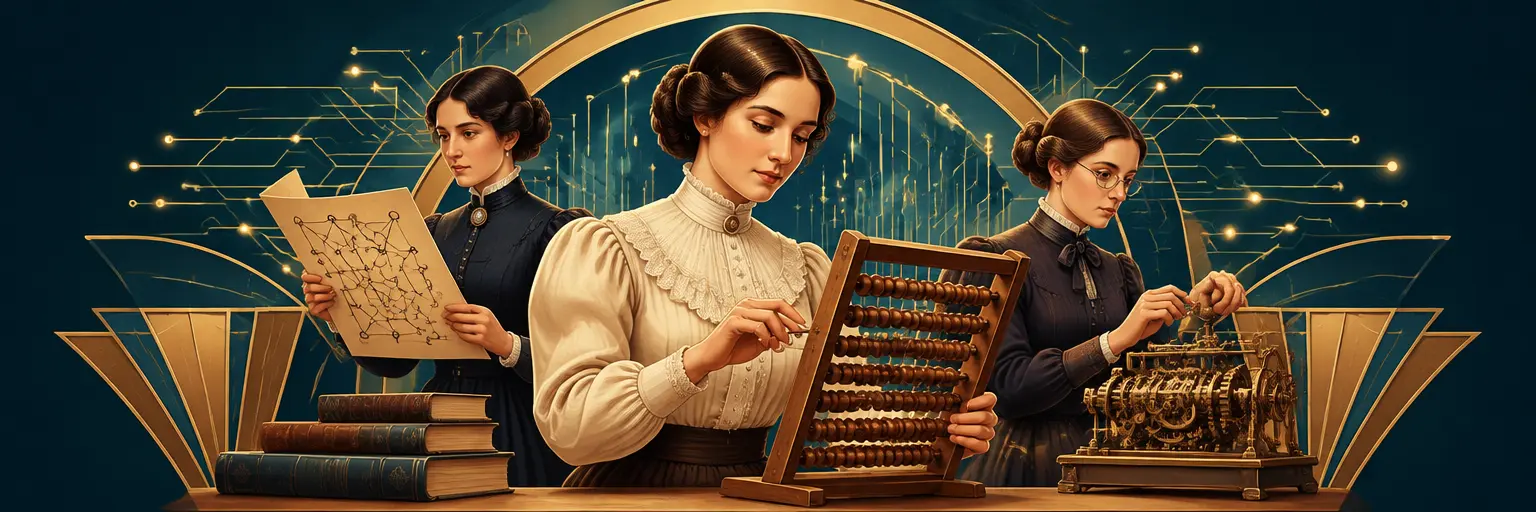
Discover the untold stories of the brilliant minds who laid the groundwork for modern computing long before the digital age. In this deep dive, we celebrate the early women in computing who defied societal norms and revolutionized mathematics, logic, and mechanical calculation from ancient times through the 19th century. From the first programmers who wrote algorithms for Charles Babbage’s Analytical Engine to the visionary mathematicians who created foundational theories of computation, these pioneers overcame immense barriers in a male-dominated field. Explore their groundbreaking contributions, the ingenious devices they designed, and the intellectual rigor that earned them recognition as true foremothers of computer science. Learn how their work on punched cards, binary logic, and early mechanical calculators not only solved complex problems but also inspired generations of women to pursue STEM. With rich biographies, historical context, and insights into the challenges they faced, this collection spotlights figures like Ada Lovelace, whose visionary notes anticipated modern programming, and other lesser-known trailblazers whose legacies are finally being honored.
🌟 Discover the fascinating early history of women coding, revealing how pioneering women shaped the foundational rules for machines long before modern…
Read article
🌟 Women’s early computer science struggles in the 19th century were often overlooked, but pioneering women challenged gender prejudice, shaping the future…
Read article
🌟 Explore how women in computer science history are breaking barriers and pioneering new frontiers in a nascent field. Their stories of…
Read article
🌟 Explore how women’s role in astronomy, especially through early astronomical computation before 1900, was vital yet often overlooked. This article highlights…
Read article
🌟 Discover how 19th century programming women revolutionized computing, bridging traditional craftsmanship with emerging logic, and paving the way for women’s vital…
Read articleBefore the digital age, the foundations of computer science were laid by extraordinary women whose mathematical insights and analytical brilliance predated the first electronic machines. This subcategory explores the lives, works, and enduring legacies of female intellectuals from antiquity through the 19th century who tackled computation, algorithmic thinking, and mechanical design. By uncovering these narratives, you’ll discover how their contributions shaped the very concepts that power today’s technology, challenging the myth that computing’s history is exclusively male.
Explore the intellectual journeys of women who wrote foundational texts on algebra, calculus, and number theory. Hypatia of Alexandria (c. 360–415 CE) was a renowned teacher and commentator on Diophantus and Apollonius, while Maria Gaetana Agnesi (1718–1799) authored the influential Analytical Institutions, a comprehensive calculus treatise. These women didn’t just memorize formulas—they developed new proofs and educational methods, making complex mathematics accessible to broader audiences.
Their work was often dismissed or attributed to male relatives, yet their manuals remained standard references for decades. Agnesi’s “witch of Agnesi” curve, for instance, became a staple in mathematical pedagogy. By examining their primary texts and correspondence, you’ll see how they bridged abstract theory and practical problem-solving, laying the groundwork for algorithmic reasoning that modern programmers take for granted.
No discussion of early computing is complete without Ada Lovelace (1815–1852), who collaborated with Charles Babbage on his Analytical Engine. Her detailed notes, particularly “Note G,” describe an algorithm for computing Bernoulli numbers—often cited as the first computer program. Lovelace envisioned the machine’s potential beyond mere calculation, speculating on its ability to manipulate symbols and even compose music.
This section dives into her visionary essays, her mathematical education under Augustus De Morgan, and her translation of Luigi Menabrea’s article. You’ll learn why she insisted the engine could be a “thinking” device in a philosophical sense, and how her insights anticipated modern concepts of software and general-purpose computing—centuries before hardware caught up.
In the 18th and 19th centuries, many women worked as human computers, manually calculating astronomical tables, nautical almanacs, and actuarial data. Figures like Nicole-Reine Lepaute (1723–1788) computed the return of Halley’s Comet, while Mary Edwards (1750–1815) was a paid “computer” for the British Nautical Almanac. Their painstaking accuracy underpinned navigation and celestial mechanics.
This segment also highlights the anonymous female assistants in observatories and survey offices, whose labor was essential yet uncredited. By reconstructing their daily routines—long hours of arithmetic, error-checking, and table interpolation—you’ll gain a new appreciation for the precision that enabled scientific progress. These roles prefigured the programming and data-entry positions women would dominate later, revealing a continuous thread of computational work.
Long before electronic computers, women encoded instructions into physical media. Jacquard looms used punched cards to automate weaving patterns, a process that directly inspired Babbage’s engines. Women like Marie Curie’s mother and countless textile workers mastered these systems, effectively programming complex designs. Meanwhile, George Boole’s wife, Mary Everest Boole (1832–1916), wrote on logic and education, applying mathematical reasoning to childhood learning.
This section connects these mechanical and educational practices to modern computing’s binary logic. You’ll learn how the transition from punch-card looms to stored-program computers borrowed from this legacy, and how women’s expertise in pattern recognition and systematic procedure contributed to early software design—even if their names rarely appear in standard histories.
Computing’s prehistory extends beyond Europe. In the Islamic Golden Age, female scholars like Sutayta al-Mahamali (10th century) excelled in arithmetic and inheritance law, which required complex fractional calculations. In India, women like Lilavati (as named in Bhaskara II’s text) were celebrated for their grasp of number theory, though historical records are sparse.
This section broadens the narrative, emphasizing that computational thinking was a global endeavor. You’ll explore how cultural norms both restricted and sometimes enabled women’s participation, and how these diverse contributions influenced trade, astronomy, and architecture. By acknowledging these figures, we reconstruct a richer, more inclusive history of computing that honors all pioneers.
Ada Lovelace is widely regarded as the first programmer for her 1843 algorithm on Charles Babbage’s Analytical Engine. She wrote detailed notes explaining how the machine could compute Bernoulli numbers, going beyond Babbage’s own work. Her foresight about machines processing symbolic logic made her a pioneer, though she never saw the engine built.
Yes, many women worked as human computers, manually calculating tables for astronomy, navigation, and engineering. Notable examples include Nicole-Reine Lepaute for Halley’s Comet and Mary Edwards for the Nautical Almanac. Their roles required extreme precision and were often poorly paid or uncredited, but their work was vital to scientific advances.
Hypatia was a mathematician and philosopher who edited and commented on works by Diophantus and Apollonius, preserving and clarifying earlier Greek mathematics. Her notes on algebra and geometry helped transmit classical knowledge to later civilizations. While not a programmer, her rigorous analytical methods influenced how problems were approached in science.
Jacquard looms used punched cards to control weaving patterns, which directly inspired Charles Babbage’s Analytical Engine. Women often operated these looms, effectively implementing complex sequences of instructions. This mechanical encoding of data and instructions is a direct ancestor of modern programming, demonstrating that women were integral to early information processing.
Historical biases often attributed women’s work to male colleagues or dismissed it as “assistance.” Many women published anonymously or under male pseudonyms, and academic institutions excluded them from formal recognition. Additionally, early computing was seen as clerical rather than intellectual, so recorded histories focused on male inventors. This subcategory aims to correct that erasure by spotlighting their true roles.