From Schematics to Systems: Women Designing the Future of Hardware
🌟 Celebrating Women in Science History, this article highlights the trailblazing women shaping the future of hardware engineering. From schematics to systems,…
Read article
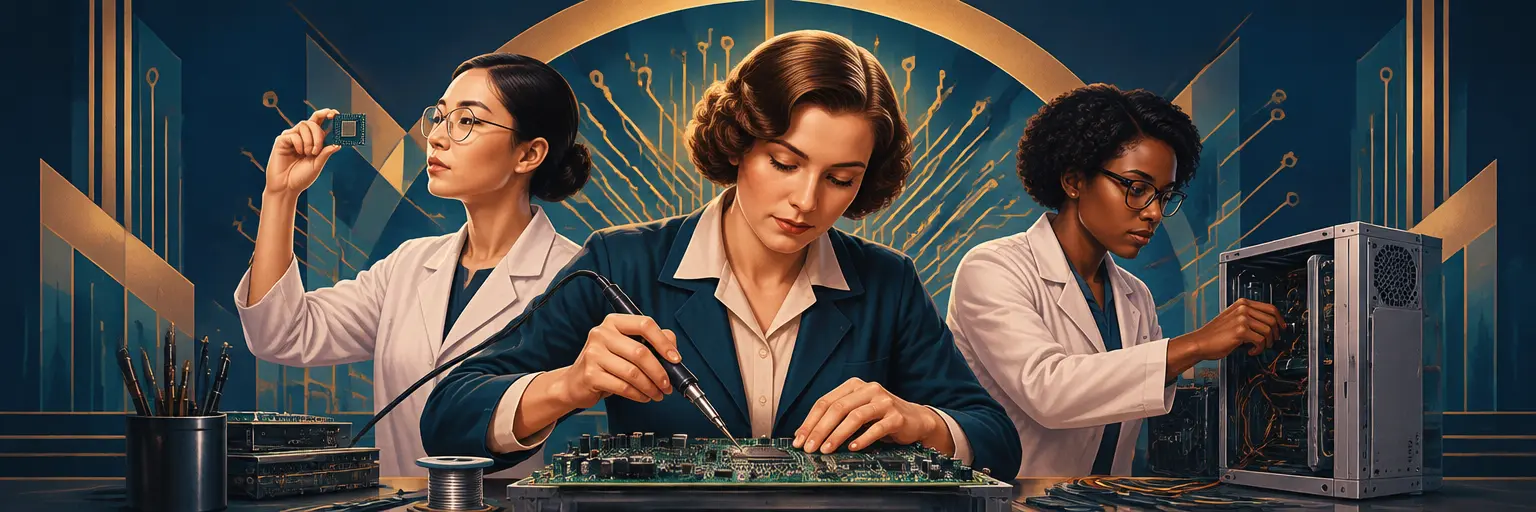
Women in hardware development have long been the unsung architects of the digital age, designing the circuits, processors, and systems that power our modern world. From early computing pioneers who laid the physical foundations of electronic machines to contemporary engineers crafting cutting-edge silicon and quantum devices, these innovators overcame systemic barriers and male-dominated environments to reshape technology. Their work spans everything from memory systems and microprocessors to robotics and embedded hardware, proving that diverse perspectives drive engineering excellence. By exploring their stories, we uncover how women not only mastered complex technical domains but also led breakthroughs in efficiency, sustainability, and accessibility. This legacy challenges outdated stereotypes, inspiring a new generation of women and girls to see hardware not as a closed door but as a playground of infinite possibility. Whether you’re a student, educator, or tech enthusiast, understanding these contributions enriches our collective knowledge and fuels a more inclusive future for innovation.

🌟 Celebrating Women in Science History, this article highlights the trailblazing women shaping the future of hardware engineering. From schematics to systems,…
Read article
🌟 Judy Estrin's pioneering tech leadership and innovation transformed network hardware, breaking barriers for women in science. Her trailblazing career inspires future…
Read article
✨ Women in data storage hardware have played a crucial role in advancing digital technology, overcoming gender barriers and inspiring future generations.…
Read article
🌟 Alice Recoque's innovative work in minicomputer hardware design revolutionized computing technology, showcasing her as a trailblazing French scientist. Her contributions exemplify…
Read article
🌟 Women designing PC hardware have historically faced challenges in male-dominated fields, yet their pioneering contributions in motherboard architecture are crucial. Celebrating…
Read articleWhen we think of computer science, software often steals the spotlight, but the physical components—the circuits, chips, and machines—are the true foundation of our digital age. This subcategory shines a light on the remarkable women who have shaped hardware engineering, from early computing prototypes to modern semiconductor design. Here, you’ll discover biographies, technical breakthroughs, and the systemic barriers these inventors overcame, enriching our understanding of how hardware innovation has been a collaborative, gender-diverse endeavor.
The dawn of computing saw women laboring as human "computers" and later as hardware designers who built colossal systems. Expect to uncover figures like Kathleen Booth, who created assembly language and helped design the ARC2 computer in the 1940s, and Frances Spence, one of the ENIAC’s original programmers who worked directly with its hardware. These stories reveal how women were not merely operators but architects of the first stored-program machines.
Their work required mastering vacuum tubes, magnetic drums, and punch-card systems—skills that were rarely credited. We detail their original technical papers, laboratory notes, and patent filings, offering a granular look at how they debugged physical systems without modern tools. By examining their correspondence and institutional records, you’ll see how these pioneers forged paths in government and university labs despite being excluded from mainstream engineering societies.
Jumping into the silicon era, this section highlights women who revolutionized integrated circuits and microprocessor architecture. You’ll meet Lynn Conway, whose work on VLSI (Very Large Scale Integration) design methodology enabled the creation of modern microchips, and Dame Stephanie Shirley, who founded a software and hardware consultancy that developed core components for the UK’s early computer industry. Their contributions underpin every smartphone and laptop we use today.
Here, we break down complex topics like chip fabrication, logic gates, and lithography into accessible narratives. Each profile includes a timeline of major patents and industry awards, plus quotes from colleagues that document their hands-on roles in cleanrooms and test labs. We also explore the gender biases they faced in corporate R&D, offering context on how some adopted pseudonyms or formed all-female teams to gain credibility.
Not all hardware is central processing; peripherals like printers, disk drives, and network interfaces are equally vital. This segment honors women like Maragret R. Fox, a pioneer in magnetic storage technology, and Mary Coon, who advanced early Ethernet hardware. Expect detailed accounts of how these engineers improved data transfer rates, error-correction methods, and physical interface standards.
Readers will learn about the iterative prototyping process—from soldering first mockups to negotiating with fabrication plants. We include oral histories and product manuals to show how these women tested endurance under heat, vibration, and electromagnetic interference. Their work directly influenced consumer-grade reliability and set the stage for portable devices, so we connect each innovation to modern equivalents like SSDs and Wi-Fi routers.
Hardware development is rarely a solo sport; it demands systems integration and project management. Here, we feature women who led complex hardware initiatives, such as Mary Sherman Morgan, who developed rocket propellants for the U.S. space program, and Ruth Amonette, a manager at Bell Labs who oversaw transatlantic cable hardware. Their stories showcase the blend of deep technical knowledge and leadership acumen that is essential for successful hardware deployment.
Our content drills into crisis management—how they handled component failures, supply chain shortages, and budget overruns during critical missions. We also analyze their engineering team dynamics, offering lessons on fostering collaborative cultures in high-pressure environments. Case studies include NASA’s Apollo missions and early satellite systems, demonstrating how hardware planning and reliability testing were historically gendered yet transformative.
The maker movement and open-source hardware have created new avenues for women, but this section traces those roots to earlier hobbyist communities. Profiles include women like Limor Fried (Ladyada), founder of Adafruit Industries, who advanced DIY electronics kits, and Bunnie Huang, a female (notably, a trans woman) hardware hacker who documented laptop manufacturing. Their work emphasizes accessibility, repairability, and community-driven design.
Expect tutorials on embedded microcontrollers, PCB design software, and 3D printing that echo their original methods. Each story links to contemporary resources so you can replicate early projects at home. We also discuss the evolution of women’s roles in hardware hackathons and crowdfunded hardware startups, highlighting how these pioneers used digital platforms to bypass traditional gatekeepers and build global audiences.
While the title is debated, many award it to Kathleen Booth, who in the 1940s co-designed the ARC2 computer and wrote its assembly language. However, earlier figures like Ada Lovelace conceptualized the analytical engine’s logic, though not the physical hardware itself. Our profiles include both, showcasing a range of contributions.
Notable examples include the compiler (Grace Hopper), but in pure hardware, we highlight the VLSI design method by Lynn Conway and the magnetic core memory improvements by Margaret R. Fox. These innovations directly enabled high-density chips and reliable data storage, respectively.
Strategies included creating women-only teams, publishing under gender-neutral initials, and leveraging academic credentials from prestigious but progressive institutions. Some also partnered with male colleagues who championed their work. Our narratives detail these tactical approaches with primary source evidence.
Yes, figures like Lisa Su (CEO of AMD) and E. Umesh (hardware veteran) are reshaping chip design and manufacturing. We also feature next-generation engineers from open-source communities, proving that the legacy is thriving beyond a few historical names.
Core skills include circuit design, knowledge of semiconductors, and proficiency with CAD software. However, our historical profiles also emphasize problem-solving, cross-disciplinary communication, and resilience. Modern paths often start through maker spaces or university robotics clubs, which we link to their founding female mentors.