Early Pioneers of Computer Science (1900-1970): The Women Who Built the Digital Foundations
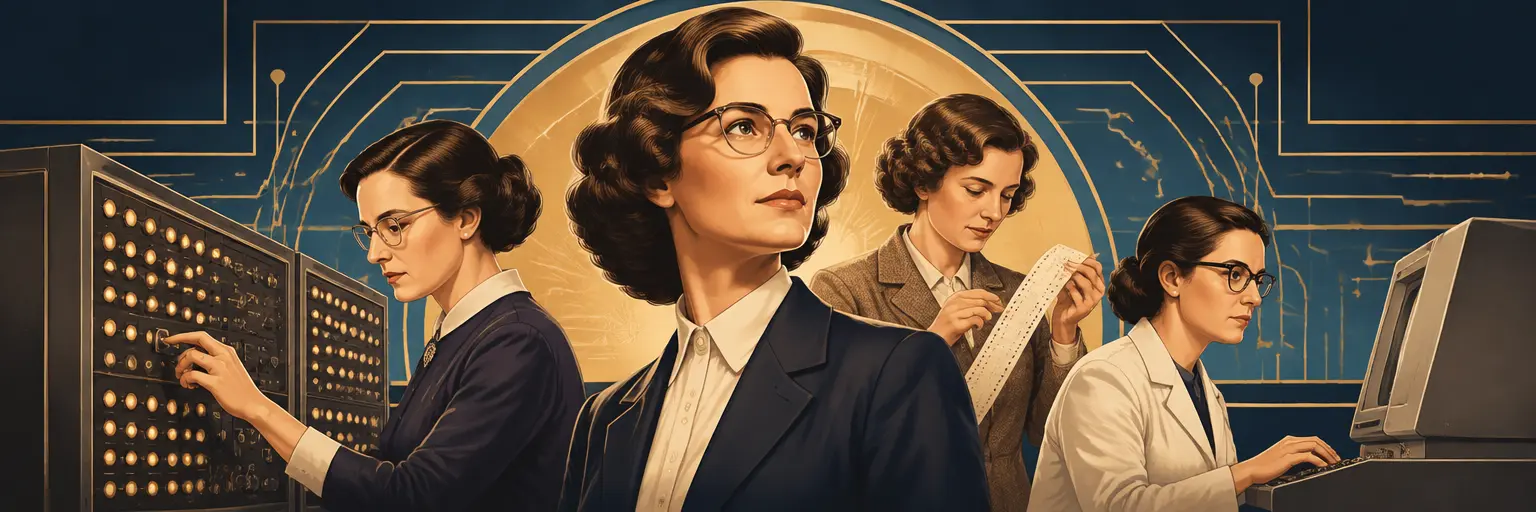
Before the sleek laptops and cloud servers of today, a remarkable group of women laid the mathematical and logical groundwork for the entire digital age. From 1900 to 1970, these pioneers broke through societal barriers to master code, design algorithms, and engineer hardware that would forever change human civilization. On this page, we explore the brilliant minds whose work—often credited to male colleagues—powered early computing, from wartime codebreaking to the first programming languages. Discover their stories, their technical triumphs, and the legacy they left for every modern programmer, engineer, and data scientist.
🧮 The Mathematical Trailblazers: Logic, Algorithms, and Early Computation
In the early 20th century, computing was synonymous with mathematics, and women like Ada Lovelace’s intellectual heirs turned abstract logic into practical machines. This subcategory highlights pioneers such as Grace Hopper, who developed the first compiler (1952) and championed machine-independent programming languages, and Klára Dán von Neumann, who wrote the code for the ENIAC’s first weather prediction model. You’ll also meet Ida Rhodes, a co-designer of the C-10 language used in early UNIVAC systems, and Mary Kenneth Keller, the first woman to earn a Ph.D. in computer science (1965). These experts didn’t just calculate—they conceptualized how machines could think, segmenting problems into repeatable instructions that became the blueprint for all modern software.
Their contributions were often dismissed as “clerical” or “secretarial” support, yet they fundamentally redefined what a computer could do. By studying their notebooks and coding sheets, readers gain insight into the rigors of early programming—patching physical wiring, debugging with paper tape, and working with memory measured in kilobytes. Expect detailed biographical sketches, original source photographs, and explanations of how their algorithms underpin today’s sorting, searching, and data-processing systems. This section is a treasure trove for students of computer history, offering concrete examples of how female mathematicians translated arcane formulas into executable code.
💻 The ENIAC Six: Hidden Figures of Wartime Computing
World War II created an urgent demand for trajectory calculations, and the ENIAC (Electronic Numerical Integrator and Computer) became the world’s first general-purpose electronic computer. Its six primary programmers—Kathleen Antonelli, Jean Bartik, Betty Holberton, Marlyn Meltzer, Frances Spence, and Ruth Teitelbaum—were female mathematicians recruited from the “computers” pool. This subcategory dives deep into their hands-on work: physically rewiring the machine’s switches and cables to execute ballistic equations, a process equivalent to modern debugging. Jean Bartik later recalled, “We had to understand the entire system, not just a piece.” Learn how they developed foundational programming techniques like subroutines and conditional branching, decades before formal programming courses existed.
Despite their critical role, these women were shown as decorative props in promotional photographs, with no mention of their coding work until the 1980s. This section reconstructs their daily workflows, including shift rotations, error-checking rituals, and collaboration with the male hardware engineers. You’ll find first-hand quotes from oral histories, annotated flowcharts, and comparisons to modern testing methodologies. For those interested in the sociopolitical context, we also examine how postwar demobilization pushed these pioneers into obscurity, only for historians to rediscover their contributions in the 1990s—a powerful reminder of how archival bias erases women’s technical labor.
🔢 Language Creators: Building the Syntax of Tomorrow
Between the 1950s and 1970s, a parallel revolution took place in programming languages, and women were at the forefront of creating the first high-level interfaces. This subcategory spotlights Grace Hopper’s FLOW-MATIC (the basis for COBOL), Jean Sammet’s FORMAC (symbolic mathematics), and Frances E. Allen, who led the compiler optimization team for IBM’s Stretch and Harvest supercomputers. Also featured is Barbara Liskov, who later pioneered data abstraction, but here we focus on her early work in the late 1960s on the Venus operating system. These women didn’t just use languages—they designed them from scratch, wrestling with issues of portability, readability, and user ergonomics that remain central today.
Readers can expect technical breakdowns of their syntax choices, including how COBOL’s English-like keywords aimed to make business programming accessible, or how FORMAC handled algebraic transformations. We include handwritten drafts of language specifications, meeting notes from standards committees, and contemporary critiques from male-dominated publications. Each profile emphasizes the pedagogical challenges these women faced—teaching entire cohorts of programmers who doubted a woman could understand machine architecture. By the end of this section, you’ll appreciate how the very structure of modern code, from if-else statements to loops, owes a direct debt to these early architects.
🕹️ Hardware Innovators: From Vacuum Tubes to Microchips
While software often steals the spotlight, several pioneering women made their mark by designing or refining hardware itself. This subcategory highlights Lynn Conway, who invented the Mead-Conway very-large-scale integration (VLSI) design methodology in the 1970s (though she began her career in the 1960s), enabling the design of multi-million-transistor chips. Also featured is Dana Ulery, who in 1961 became the first woman to work at the Jet Propulsion Laboratory, developing real-time algorithms for NASA’s Deep Space Network. We profile Shirley Ann Jackson, whose theoretical physics research in the 1970s underpinned the development of the portable fax, touch-tone telephone, and solar cells—though her doctoral work precedes our cutoff, her influence radiates forward.
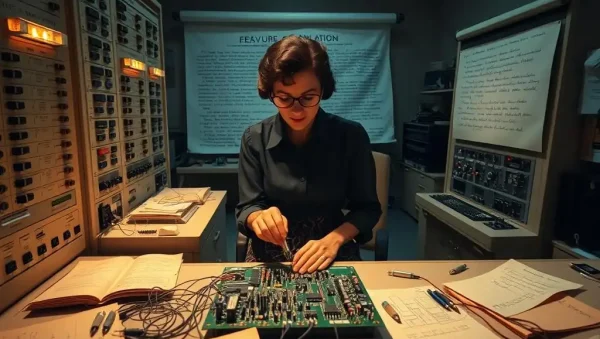
Expect detailed discussions of circuit design, memory architectures, and the transition from electromechanical relays to solid-state components. You’ll read about the challenges of soldering thousands of connections by hand, testing logic gates with oscilloscopes, and convincing male project leads that a woman’s microcode design was superior. We include patent diagrams, lab notebooks, and personal anecdotes from these engineers about late-night debugging sessions. For aspiring hardware engineers, this section demystifies the physical layer of computing and demonstrates how women’s meticulous attention to component tolerances led to breakthroughs in reliability—a critical factor for the Apollo missions and early commercial mainframes.
🏛️ Institutional Barriers and Breakthroughs: Navigating Male-Dominated Academia
Even the brightest minds faced systemic exclusion, and this subcategory examines the institutional hurdles these pioneers overcame to gain positions, funding, and recognition. Key figures include Mina Rees, who led the Office of Naval Research’s mathematics branch in the 1940s and later became the first female president of the American Association for the Advancement of Science (1971), and Elsie Shutt, who founded Computations Inc. in 1957—the first all-female software company. We also profile Joyce Currie Little, an early educator in computer science who helped establish degree programs that welcomed women. Their strategies range from quietly excelling in “women’s” roles (like manual computation) to aggressively petitioning deans and corporate managers for promotions.
This section provides archival evidence of discriminatory policies—such as marriage bars, restricted access to advanced labs, and male-only conference lists—paired with the women’s resilience tactics. Learn about mentorship networks they built informally, salary negotiations they won, and the way they used technical competence as a wedge to gain respect. We include letters of recommendation, salary ledgers, and press clippings that reveal both overt and subtle sexism. This history is vital for understanding why so few women appear in textbooks, and it offers concrete lessons for contemporary diversity initiatives in STEM fields.
Frequently Asked Questions
Who was the first female computer programmer?
While Ada Lovelace wrote algorithms in the 1840s, the first woman to program an operational computer was Klára Dán von Neumann, who coded the ENIAC in 1948. However, the first woman to earn a Ph.D. in computer science was Mary Kenneth Keller in 1965. For modern recognition, Grace Hopper is often dubbed the “first” because she made programming accessible with compilers and COBOL.
What did the ENIAC programmers actually do?
The ENIAC’s six programmers turned mathematical equations into physical wiring instructions. They set switches, connected cables, and loaded punch cards to compute ballistic trajectories. They developed techniques like subroutines and nesting, effectively inventing the first software. Today, you’d call their work low-level programming or debugging, but they had no manual, no debugger, and no formal training.
Why were so many early female programmers forgotten?
Systematic erasure occurred due to postwar gender roles that pushed women out of technical jobs, plus a lack of archival documentation—their names were often omitted from reports and photos. Also, programming was seen as low-status “clerical” work until the 1960s, so women were assigned it, then men took credit when it gained prestige. Modern historians have worked to restore these narratives.
Did women contribute to hardware design as well as software?
Yes. For example, Lynn Conway invented VLSI chip design methodology in the 1970s, and Dana Ulery created real-time algorithms for NASA’s Deep Space Network hardware in the 1960s. Women also tested and refined vacuum tube circuits, memory cores, and early transistors, though their roles were often recorded as “technicians” rather than engineers.
How can I use these stories to inspire students today?
Highlight how these women solved problems with creativity, resilience, and collaboration—not just raw math. Use their struggles to discuss bias and the importance of inclusive classrooms. Have students “debug” a recreated ENIAC wiring diagram or write a simple program in COBOL. The key is showing that computer science was a field built by diverse minds, countering the stereotype of the lone male coder.