
Breaking the Binary Ceiling: Women's Journeys in MaleDominated 1950s Tech

Welcome to WomenInScienceHistory.com!
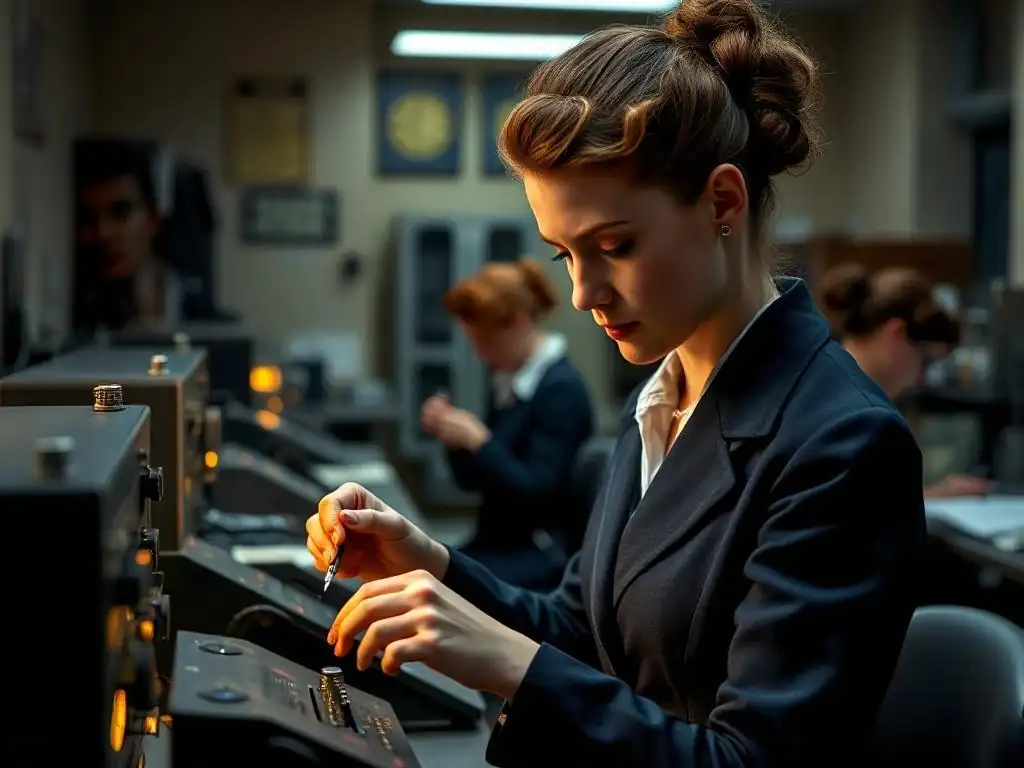
Step back in time and discover the untold stories of brilliance and perseverance. Breaking the Binary Ceiling, we delve into the inspiring journeys of Women in 1950s Tech, exploring their pivotal roles and the formidable obstacles they overcame in a field then dominated by men. Ready to uncover the hidden figures who shaped the digital landscape? Prepare to be amazed.
- Introduction: Unsung Heroines of 1950s Computing
- Overcoming Obstacles: Challenges Faced by Women in Tech During the 1950s
- Trailblazing Women in 1950s Tech: Profiles in Courage and Innovation
- The Impact of Women's Contributions on 1950s Technological Advancements
- Beyond the Numbers: The Human Stories of 1950s Women in Tech
- Legacy and Recognition: Honoring the Women of 1950s Tech
- Conclusion: The Enduring Impact of Women in Early Computer Science
-
Frequently Asked Questions
- What were some of the biggest obstacles women faced in 1950s tech?
- What types of roles did women typically hold in the tech industry during the 1950s?
- How did societal expectations impact women's careers in 1950s tech?
- Were there any notable women who broke through the barriers in 1950s tech?
- How can learning about women in 1950s tech inspire future generations?
- Final Reflection: Echoes of Innovation, Seeds of Change
- Embrace Your Inner Pioneer: Spark Your Tech Legacy!
Introduction: Unsung Heroines of 1950s Computing
The Underrepresented Pioneers: Women's Roles in Early Computer Science
The narrative of early computer science often spotlights male figures, yet a closer examination reveals that women were indispensable architects and engineers of this burgeoning field. From the initial "human computers" who performed complex calculations by hand to the pioneering programmers who breathed life into the first electronic machines, women's intellectual contributions were foundational. These unsung heroines developed algorithms, debugged intricate systems, and designed programming languages, often operating behind the scenes in roles that were initially deemed suitable for female clerical staff before their profound technical complexity was fully understood.
Their work, though frequently marginalized in historical accounts, directly enabled the monumental leaps in computing capabilities witnessed in the mid-20th century. Without the meticulous dedication and sharp analytical minds of these early female programmers and systems analysts, the rapid advancement of electronic computation would have been significantly hampered. The foundational period of computing, particularly the 1950s, was uniquely shaped by the often-invisible labor and innovation of these remarkable women.
Setting the Stage: The Technological Landscape of the 1950s
The 1950s marked a pivotal decade in technological history, characterized by the transition from rudimentary electronic calculators to sophisticated, commercially viable mainframe computers. Machines like the UNIVAC I, introduced in 1951, and IBM's 701, unveiled in 1953, began to revolutionize data processing for government agencies, research institutions, and large corporations. This era saw the nascent stages of digital computing, where hardware was enormous, expensive, and temperamental, requiring highly specialized personnel to operate and program.
Programming itself was in its infancy, often involving direct manipulation of machine code or assembly language. The concept of higher-level programming languages was just emerging, making the logical design and implementation of software an incredibly demanding and often tedious task. It was within this challenging and undefined landscape that many women found their entry point, as the field was so new that traditional gender barriers had not yet fully solidified, allowing their talents to shine in the development of sophisticated computing systems.
Overcoming Obstacles: Challenges Faced by Women in Tech During the 1950s
Societal Expectations and Gender Bias in STEM Fields
In the 1950s, prevailing societal norms largely confined women to domestic roles, with career aspirations often viewed as secondary to marriage and family. STEM fields, including the nascent computer science, were overwhelmingly perceived as male domains, reinforced by educational systems and cultural narratives. Girls were subtly, and sometimes overtly, discouraged from pursuing advanced mathematics and science, channeling them instead towards fields deemed more "feminine" like teaching or nursing. This pervasive gender bias meant that women entering technology often faced skepticism regarding their capabilities and commitment, battling preconceived notions about their intellectual suitability for demanding technical work.
Even within the workplace, these expectations manifested as an uphill battle for professional respect and recognition. Women in 1950s tech were frequently relegated to positions that were initially seen as clerical or supportive, such as "coders" or "operators," even when their tasks involved complex logical design and problem-solving. This subtle but powerful prejudice often limited their career progression and the acknowledgment of their intellectual contributions, creating a challenging environment where their talents had to constantly overcome entrenched biases.
Limited Educational and Professional Opportunities for Women
Formal educational pathways for women aspiring to careers in computing were severely restricted during the 1950s. Very few universities offered dedicated computer science programs, as the discipline was still evolving, often nested within mathematics or electrical engineering departments that had historically low female enrollment. Scholarships and institutional encouragement for women in these technical fields were scarce, further narrowing the pipeline of female talent. This lack of formal training often meant that women entering computing had to be self-taught or learn on the job, relying on their innate mathematical aptitude and problem-solving skills.
Professionally, the landscape was equally challenging. Hiring practices often favored men, and even when women secured positions, they frequently encountered glass ceilings that prevented advancement into management or leadership roles. Pay disparities were common, with women typically earning less than their male counterparts for similar work. The professional networks and mentorship opportunities that were crucial for career growth were predominantly male-dominated, leaving women isolated and with fewer avenues for professional development and recognition within the burgeoning tech industry.
The "Hidden Figures" phenomenon, famously depicted in the story of African American women mathematicians at NASA, was a broader reality for many women in 1950s tech. Their essential contributions, particularly in programming and systems analysis, were frequently uncredited or attributed to male supervisors.
This was partly due to the perception of programming as a "feminine" clerical task in the early days of computing, akin to typing or data entry. As the strategic importance and intellectual rigor of programming became undeniable, these roles were increasingly masculinized, and the historical record often shifted credit away from the women who pioneered the work.
For instance, many of the original programmers of early machines like the ENIAC were women, yet their names were largely absent from official historical accounts for decades. Their work was often seen as merely implementing the designs of male engineers, rather than being recognized as innovative problem-solving in its own right. This systemic erasure meant that generations passed without fully understanding the profound impact of these women, perpetuating a skewed narrative of technological progress that overlooked the critical intellectual labor performed by countless female innovators.
Trailblazing Women in 1950s Tech: Profiles in Courage and Innovation
Grace Hopper: A Pioneer in Programming Languages
Contributions to COBOL and Computer Architecture
Grace Hopper, a Rear Admiral in the U.S. Navy and a visionary computer scientist, was a towering figure among women in 1950s tech. Her most significant contribution during this period was her groundbreaking work on compilers. In 1952, she developed the A-0 System, the first compiler, which translated symbolic mathematical code into machine code, dramatically simplifying the programming process. This innovation paved the way for higher-level programming languages. Building on this, her team at Remington Rand developed FLOW-MATIC in 1955, arguably the first English-like data processing language, which was designed to be user-friendly for business applications.
FLOW-MATIC directly influenced the development of COBOL (Common Business-Oriented Language), a standardized programming language that became dominant in business and government applications for decades. Hopper advocated fiercely for machine-independent programming languages, believing that code should be written once and run on various machines, a concept that underpins modern software development. Her insights into computer architecture also extended to debugging, famously coining the term "bug" after discovering a moth inside a relay of the Harvard Mark II computer in 1947.
Overcoming Gender Barriers in the Navy and Computing
Hopper's career trajectory was remarkable, not least because she navigated the male-dominated environments of both the U.S. Navy and early computing. Commissioned during World War II, she continued her service in the Naval Reserve, rising to the rank of Rear Admiral by the time of her retirement in 1986, becoming one of the highest-ranking women in the Navy. Her ability to command respect and lead technical teams in such an environment was a testament to her intellect and resolve.
Within the computing world, she championed the idea that computers should be accessible to a broader audience, not just mathematicians and engineers. Her relentless advocacy for user-friendly programming languages directly challenged the prevailing technical elitism of the era. Despite facing skepticism and resistance from those who preferred complex machine code, Hopper's vision for practical, business-oriented computing ultimately prevailed, making her a pivotal figure in shaping the future of software development and inspiring countless women in 1950s tech and beyond.
Kathleen Booth: A Pioneer of Assembly Language
Early Contributions to Computer Programming and Architecture
Kathleen Booth was a British mathematician and computer scientist whose foundational work in the 1950s significantly shaped the architecture and programming of early electronic computers. Working at Birkbeck College, London, alongside her husband Andrew Booth, she developed the assembly language for the ARC (Automatic Relay Calculator) and SEC (Simple Electronic Computer) machines. Her contributions included designing the instruction sets and writing the code that allowed these early computers to perform calculations. This was a critical step in making computers more programmable and efficient, moving beyond manual wiring or direct binary input.
Booth's meticulous approach to programming involved creating detailed flowcharts and logical structures for the machines' operations. Her work on these early systems, particularly the SEC, which was one of the first computers to use a magnetic drum memory, demonstrated her profound understanding of both hardware and software interaction. She was also instrumental in designing the architecture for the APE(X)C (All Purpose Electronic X-ray Computer), a more advanced machine developed at Birkbeck, further solidifying her role as a key innovator in the nascent field of computer design and programming.
The Importance of Documentation and Knowledge Sharing
Beyond her direct programming contributions, Kathleen Booth was a strong advocate for comprehensive documentation and the systematic sharing of knowledge in the rapidly evolving field of computing. In the 1950s, much of the understanding of how to operate and program computers existed only in the minds of a few experts. Booth recognized the critical need to formalize this knowledge. She co-authored several seminal books, including "Automatic Digital Calculators" (1953) with Andrew Booth, which became one of the earliest textbooks on computer design and programming.
These publications were vital for disseminating information about computer architecture and the principles of assembly language to a wider audience, helping to educate the next generation of computer scientists and engineers. Her emphasis on clear, accessible documentation not only made the complex world of early computing more comprehensible but also laid the groundwork for standardized practices that would become essential as the industry grew. Her dedication to knowledge sharing was a quiet but powerful contribution that benefited the entire field, underscoring the intellectual rigor of women in 1950s tech.
Ida Rhodes: A Pioneer in Systems Analysis and Programming
Contributions to the Social Security Administration's Early Computing Systems
Ida Rhodes, an American mathematician, was a pivotal figure in the application of early electronic computers to large-scale data processing for governmental use during the 1950s. Working at the National Bureau of Standards (NBS), she was instrumental in the development and implementation of the UNIVAC I system for the U.S. Social Security Administration (SSA). This project was one of the earliest and most ambitious attempts to automate record-keeping for millions of citizens, requiring sophisticated systems analysis and programming to manage vast amounts of data.
Rhodes designed and programmed complex algorithms for data storage, retrieval, and analysis, which were critical for the SSA's ability to process benefit payments efficiently. Her work involved not just coding but also understanding the intricate logical flow of an organization's operations and translating that into machine-executable instructions. She was known for her meticulous attention to detail and her ability to troubleshoot complex systems, ensuring the reliability and accuracy of the SSA's groundbreaking automated processes.
Development of Programming Techniques and Algorithms
Beyond her direct work for the SSA, Ida Rhodes made broader contributions to programming techniques and algorithms that had a lasting impact. In 1957, she and her colleague F.L. Alt created the C-10 language, one of the earliest programming languages designed for non-technical users to access and manipulate data. This innovation aimed to democratize access to computing power, allowing subject matter experts to interact with machines without needing deep programming knowledge, a foresight that predated many similar developments.
Rhodes was also a pioneer in the field of machine translation, working on projects to translate languages using computers as early as the mid-1950s. Her algorithms for analyzing linguistic structures and automating translation processes were cutting-edge for the time and contributed to the foundational research in natural language processing. Her diverse contributions highlight the intellectual breadth and pioneering spirit of women in 1950s tech, who were not only coders but also conceptual designers of future computing applications.
The Impact of Women's Contributions on 1950s Technological Advancements
Shaping the Development of Early Computers
The contributions of women in 1950s tech extended beyond mere programming to fundamentally shape the development of early computers themselves. As the primary users and debuggers of these nascent machines, female programmers often provided invaluable feedback to hardware engineers. Their intimate understanding of the machines' limitations, quirks, and bottlenecks directly informed design improvements, leading to more efficient architectures, better memory management, and enhanced input/output systems. For instance, the challenges they faced in writing complex programs in machine code often spurred the development of more user-friendly instruction sets and higher-level languages.
Moreover, their logical insights into how information should be processed and organized influenced the very conceptual framework of computing. Women like Grace Hopper pushed for the creation of compilers and machine-independent languages, which dramatically altered how software was conceived and developed. This iterative feedback loop between the "human computers" and the machine designers meant that women were not just operating technology but were actively involved in its evolution, ensuring that early computers were practical and adaptable for a wide range of applications.
Advancements in Programming and Software Development
The 1950s were a crucible for software development, and women were at the forefront of this revolution. Their work laid the bedrock for modern programming paradigms. They pioneered concepts such as subroutines, debugging techniques, and structured programming, which are now standard practices in software engineering. The creation of the first compilers and early high-level languages, driven significantly by women like Grace Hopper, transformed programming from a highly specialized, machine-specific task into a more accessible and portable discipline. This shift enabled a broader range of applications, moving computing beyond scientific calculations to business and administrative data processing.
Furthermore, the meticulous documentation and systematic approaches advocated by women such as Kathleen Booth were crucial for the formalization of software development. In an era where knowledge was fragmented and often undocumented, their efforts to create textbooks and detailed operational manuals helped standardize practices and educate a new generation of programmers. These foundational advancements in programming and software development, largely spearheaded by women in 1950s tech, were indispensable for the rapid growth and widespread adoption of computer technology in subsequent decades.
Laying the Foundation for Future Generations of Women in Tech
While often unrecognized at the time, the pioneering efforts of women in 1950s tech quietly laid a crucial foundation for future generations of female scientists and technologists. Their very presence in a male-dominated field, even if often in unheralded roles, demonstrated that women were capable of excelling in complex technical pursuits. Although formal mentorship programs were rare, these women served as silent role models, proving that intellectual curiosity and rigorous problem-solving knew no gender.
Their technical innovations, from developing the first compilers to designing sophisticated data processing systems, created a body of knowledge and precedent that future female scientists could build upon. By successfully navigating the societal and professional barriers of their era, these women carved out spaces for themselves and, in doing so, subtly opened doors for those who would follow. Their legacies, now being brought to light, serve as powerful reminders of the enduring impact of women in early computer science and continue to inspire young women to pursue careers in STEM today.
Beyond the Numbers: The Human Stories of 1950s Women in Tech
Personal Sacrifices and Perseverance
The journeys of women in 1950s tech were often marked by significant personal sacrifices and extraordinary perseverance. Many balanced demanding careers with societal expectations to manage households and raise families, frequently working long hours in highly technical and intellectually challenging environments. The nascent nature of computing meant that workdays could be unpredictable, involving late nights troubleshooting complex systems or racing to meet tight deadlines for critical projects, such as those for government agencies or military applications.
Beyond the workload, these women often faced intellectual isolation and professional skepticism. They had to constantly prove their competence in fields where their gender was considered an anomaly, enduring subtle biases or outright dismissals of their ideas. Despite these systemic challenges, their unwavering dedication to their scientific pursuits and their belief in the transformative power of computing propelled them forward. Their stories are a testament to their resilience and unwavering commitment to their passions, often at considerable personal cost.
Finding Community and Support in a Male-Dominated World
Despite the pervasive male dominance in 1950s tech, many women found ways to forge informal communities and support networks. In some early computing centers, where women were initially hired in larger numbers for programming roles, a sense of camaraderie developed among them. They shared knowledge, offered mutual encouragement, and collectively navigated the challenges of working in a new and demanding field. These informal networks provided a crucial buffer against professional isolation and fostered an environment where their intellectual contributions could be recognized and valued by peers.
While formal professional organizations for women in computing were nascent, the existence of pioneering figures like Grace Hopper, who actively mentored younger programmers, provided invaluable guidance and inspiration. Even in the absence of explicit support structures, the shared experience of being a woman in a technical role often created unspoken bonds. These connections, whether through shared office spaces or professional interactions, were vital in sustaining the careers and intellectual vitality of these remarkable women in an otherwise challenging environment.
Inspiring Future Generations: Legacies of Resilience and Innovation
The human stories of women in 1950s tech, once obscured, now serve as powerful beacons of resilience and innovation, inspiring future generations. Their journeys underscore that groundbreaking scientific and technological advancements are not limited by gender. By overcoming formidable societal and professional barriers, these women demonstrated immense intellectual prowess, strategic thinking, and unwavering determination. Their narratives highlight the importance of perseverance in the face of adversity and the profound impact that dedicated individuals can have on shaping the future.
These stories, now being actively researched and celebrated, offer tangible examples for young women contemplating careers in STEM. They illustrate that the path to innovation is often paved with challenges, but also with the immense satisfaction of contributing to something truly transformative. The legacies of these pioneering women continue to resonate, encouraging today's aspiring female scientists and engineers to pursue their passions with confidence, knowing they stand on the shoulders of giants who broke the binary ceiling in early computing.
Legacy and Recognition: Honoring the Women of 1950s Tech
The Importance of Acknowledging Unsung Contributions
Acknowledging the unsung contributions of women in 1950s tech is not merely an act of historical revisionism; it is essential for a complete and accurate understanding of technological progress. For too long, the narrative of computing's origins has been incomplete, overlooking the critical intellectual labor performed by female programmers, mathematicians, and systems analysts. Recognizing these women corrects the historical record, ensuring that their ingenuity and perseverance are properly credited. This re-evaluation enriches our collective understanding of how technology evolved and highlights the diverse talent pools that have always driven innovation.
Furthermore, the recognition of these pioneering women has profound contemporary relevance. It challenges preconceived notions about who is capable of excelling in STEM fields and demonstrates that talent knows no gender. By bringing their stories to light, we provide powerful role models for current and future generations of women and girls, inspiring them to pursue careers in technology and science. This acknowledgment is a vital step in fostering a more inclusive and equitable environment in today's tech industry, ensuring that all contributions are valued and celebrated.
Reclaiming the Narrative: Celebrating Women's History in Computer Science
Reclaiming the narrative of computer science history involves actively researching, documenting, and celebrating the contributions of women who were systematically marginalized or forgotten. For decades, the focus remained primarily on male engineers and hardware developers, often overlooking the indispensable work of software pioneers. Institutions, academics, and dedicated platforms like WomenInScienceHistory.com are now playing a crucial role in unearthing these stories from archives, personal testimonies, and overlooked publications. This effort is transforming the collective memory of computing, revealing a richer, more diverse tapestry of innovation.
This process of reclamation is more than just academic; it is a cultural imperative. By highlighting the achievements of women in 1950s tech, we dismantle the myth of the lone male genius and showcase the collaborative and diverse nature of scientific progress. Celebrating these women means not only remembering their individual accomplishments but also understanding the systemic barriers they faced and overcame. It provides a more nuanced and empowering history that resonates deeply with contemporary discussions about gender equality and representation in technology.
Resources for Further Learning about Women in 1950s Technology
For those eager to delve deeper into the fascinating stories of women in 1950s tech, a wealth of resources is becoming increasingly available. Academic books and scholarly articles provide detailed analyses of their technical contributions and the societal context of their work. Biographies of pioneers like Grace Hopper, Kathleen Booth, and Ida Rhodes offer intimate glimpses into their lives and careers. Many university archives and historical societies specializing in computing history hold collections of personal papers, oral histories, and project documentation that shed light on their roles.
Furthermore, documentaries and online historical projects continue to bring these narratives to a wider audience. Specialized websites and digital libraries compile information on early female programmers, often featuring interviews with contemporaries or descendants. Exploring these resources allows for a more comprehensive understanding of the challenges faced and the enduring legacy of these extraordinary women who shaped the digital world we inhabit today.
Conclusion: The Enduring Impact of Women in Early Computer Science
Reflecting on the Past, Inspiring the Future of Women in STEM
Reflecting on the journeys of women in 1950s tech reveals a profound and often unacknowledged legacy. These pioneering figures did not just operate machines; they conceptualized, designed, and debugged the very foundations of modern computing. Their ingenuity in developing compilers, assembly languages, and sophisticated data processing systems laid the groundwork for the digital age. Their struggles against societal expectations and gender bias underscore the immense perseverance required to pursue intellectual passions in a restrictive era.
Their stories serve as a powerful inspiration for the future of women in STEM. They demonstrate that talent and innovation are boundless, regardless of gender, and that overcoming adversity can lead to groundbreaking achievements. By understanding their past, we can better appreciate the ongoing efforts to promote gender equality in technology and ensure that future generations of female scientists and engineers find environments that fully support and celebrate their contributions.
Call to Action: Supporting Gender Equality in Technology Today
The legacy of women in 1950s tech is a compelling call to action for supporting gender equality in technology today. While significant progress has been made, disparities persist in representation, leadership, and recognition within STEM fields. We must actively work to dismantle remaining barriers, foster inclusive environments, and ensure equitable opportunities for all. This involves advocating for comprehensive STEM education for girls, providing mentorship and sponsorship for women in tech careers, and challenging unconscious biases in hiring and promotion.
By continuing to highlight the historical contributions of women and actively promoting diversity, we can ensure that the technological advancements of tomorrow are truly representative of all human ingenuity. Celebrating the "hidden figures" of the past empowers the visible leaders of the present and inspires the innovators of the future, creating a more vibrant, equitable, and ultimately more innovative technological landscape for everyone.
Frequently Asked Questions
What were some of the biggest obstacles women faced in 1950s tech?
Women encountered significant gender bias and limited opportunities for advancement. They were often relegated to lower-paying, less prestigious roles.
What types of roles did women typically hold in the tech industry during the 1950s?
Women frequently worked as computers (human calculators), programmers, and data entry clerks. These roles, while crucial, were often viewed as less skilled than engineering positions.
How did societal expectations impact women's careers in 1950s tech?
Prevailing societal norms emphasized domesticity and family responsibilities for women. This often led to career interruptions and limited professional advancement, as women were pressured to leave the workforce after marriage or childbirth.
Were there any notable women who broke through the barriers in 1950s tech?
Yes, despite the challenges, some women like Grace Hopper and Kathleen Booth made significant contributions to computer science and programming. Their achievements helped pave the way for future generations.
How can learning about women in 1950s tech inspire future generations?
By highlighting their resilience, innovation, and contributions, we can inspire young women to pursue STEM careers. Understanding their stories promotes gender equality and recognizes the diversity that enriches the field.
Final Reflection: Echoes of Innovation, Seeds of Change
The stories unearthed in "Breaking the Binary Ceiling" resonate powerfully today, reminding us that the fight for equality in STEM is not a recent phenomenon, but a continuation of battles fought decades ago. The resilience and ingenuity of women in 1950s tech serve as a potent reminder that talent knows no gender, and that systemic barriers, not inherent limitations, are the true obstacles to progress. Their contributions, often overlooked, laid the groundwork for the advancements we celebrate today, and their struggles illuminate the path forward.
The impact of these pioneering women extends far beyond the technical innovations they contributed. Their very presence in a male-dominated field challenged societal norms and planted the seeds of a more inclusive future. Their courage to defy expectations and pursue their passions serves as an enduring inspiration for generations. Well-behaved women seldom make history,
a sentiment often attributed to Laurel Thatcher Ulrich, perfectly encapsulates the spirit of these women who dared to break the mold and redefine what was possible.
As we reflect on the journeys of these remarkable women, let us not simply admire their past achievements, but actively work to build a future where their struggles are no longer necessary. Consider how you can champion inclusivity in your own sphere of influence, whether it's mentoring young women in STEM, advocating for equitable policies, or simply amplifying the voices of those who are often unheard. The legacy of these women demands that we continue to break down barriers and create a world where everyone has the opportunity to reach their full potential.
Embrace Your Inner Pioneer: Spark Your Tech Legacy!
Thank you for exploring these inspiring stories of women who defied expectations in the 1950s tech world. Their courage and innovation paved the way for future generations, and now it's your turn to carry the torch!
Here are a few ways you can get involved:
- Share this article to amplify the voices of these forgotten heroines and inspire others to celebrate women in STEM.
- Rediscover hidden narratives: Research a lesser-known woman in technology history and share her story on social media.
- Reflect on your own experiences or observations regarding gender dynamics in tech – document and share them with friends.
What steps will you take to honor these trailblazers and contribute to a more inclusive future in technology?