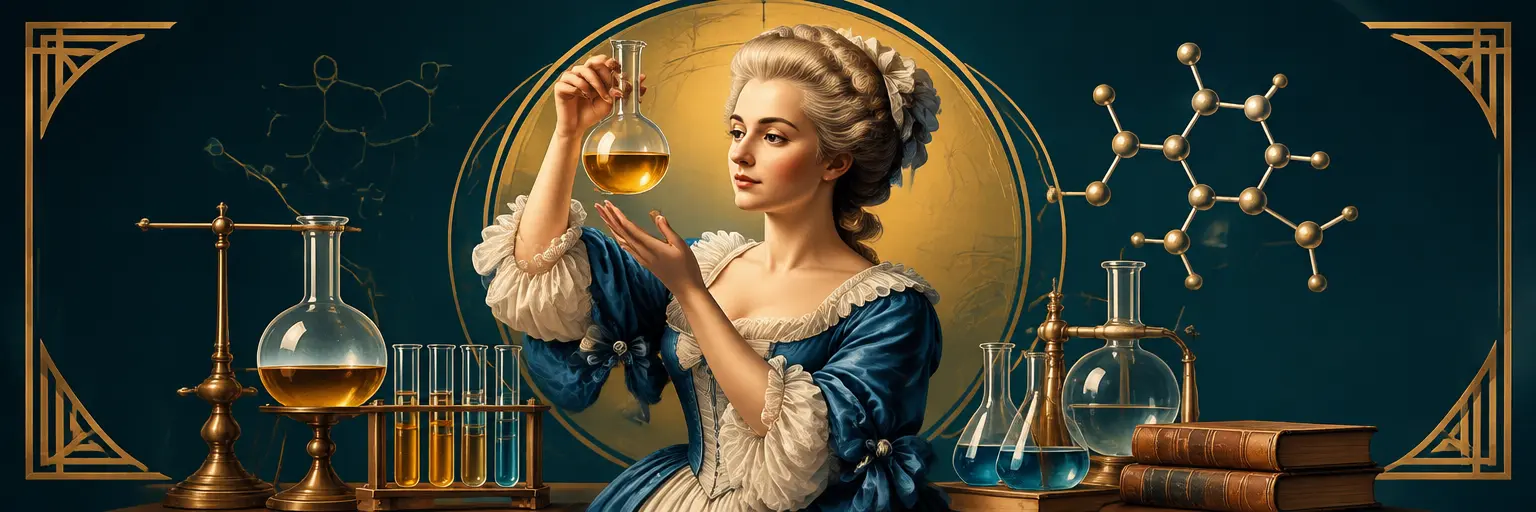
18th Century Women in Chemistry: Pioneers of a Scientific Revolution
The 18th century was a transformative era for chemistry, shifting from alchemy to a rigorous empirical science—yet the women who contributed to this revolution are often omitted from mainstream narratives. On WomenInScienceHistory.com, our subcategory on 18th Century Women in Chemistry uncovers the hidden figures who conducted experiments, wrote influential texts, and challenged scientific orthodoxy. Here, you’ll explore their laboratories, their struggles for recognition, and their lasting influence on modern chemical practices. From aristocratic salon hosts to dedicated household researchers, these women proved that scientific curiosity knows no gender.
🔬 Household Laboratories: The Domestic Roots of Chemical Discovery
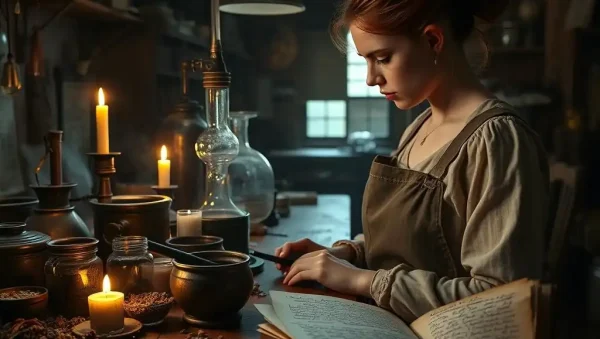
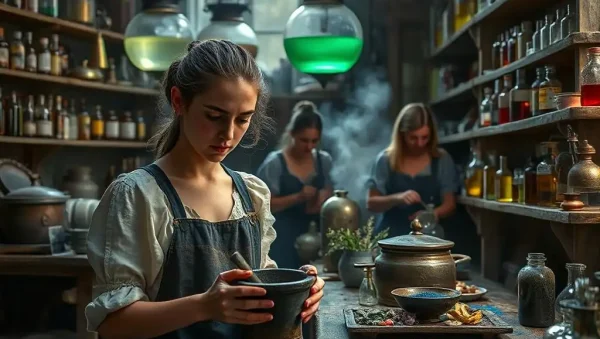
In the 18th century, formal scientific institutions were largely closed to women, so many conducted their work in kitchens, still rooms, and private libraries. These domestic spaces became de facto laboratories where women like Marie-Anne Paulze Lavoisier meticulously recorded experiments and translated key texts, enabling her husband’s revolutionary phlogiston theory critiques. Their work often involved distillation, crystallization, and precise measurement—skills that were dismissed as “housekeeping” but were, in fact, cutting-edge chemistry.
Visitors to this section will discover how the boundaries between home and lab were porous, allowing women to pioneer techniques in pigment production, soap making, and medicinal remedies. These practical applications not only advanced chemical knowledge but also provided economic stability for their families. By examining letters, recipe books, and laboratory notebooks, we reveal the systematic rigor hidden within domestic chores, challenging the notion that professional chemistry only happened in university halls.
📚 Scientific Translation and Communication: Women as Gatekeepers of Knowledge
Language barriers often isolated continental European chemistry from English-speaking audiences, and women translators became vital bridges for knowledge dissemination. The most famous is Marie-Anne Paulze Lavoisier, who translated Richard Kirwan’s “Essay on Phlogiston” and Joseph Priestley’s works into French, allowing Antoine Lavoisier to critique and refute them. Similarly, Jane Marcet (though early 19th century) built on 18th-century traditions, but her precursor, Mrs. Fulhame, published “An Essay on Combustion” in 1794, which introduced novel ideas on reduction and oxidation.
This segment explores how women used translation, correspondence, and public demonstrations to shape chemical discourse. They were not passive copyists; their footnotes, prefaces, and experimental annotations often corrected male scientists’ errors. For example, Elizabeth Fulhame proposed that water participates in combustion, an idea later confirmed. Readers will learn how these intellectual exchanges forged networks across nations, proving that women were central to the creation of a global scientific community.
⚗️ Experimentation and Original Discoveries: Breaking Empirical Barriers
While many women assisted male relatives, others conducted independent research with remarkable originality. Marie-Anne Paulze Lavoisier performed countless experiments on respiration and combustion, producing detailed drawings that illustrated apparatus setups. Her collaborative work with her husband on the “Traité Élémentaire de Chimie” (1789) was instrumental in establishing chemistry’s nomenclature. Meanwhile, in Germany, Dorothea Erxleben (though primarily a physician) applied chemical principles to medicine, and Maria Sibylla Merian (a century earlier) influenced entomological chemistry through her studies of metamorphosis and plant toxins.
Here, we spotlight women like Marie Meurdrac, whose 1666 “La Chymie Charitable” was reprinted in the 18th century, offering practical chemical recipes for medicine and cosmetics. We also examine unknown apothecaries and midwives who experimented with herbal extractions and mineral compounds. These women developed new methods for purifying salts, creating dyes, and testing air quality—contributions that later formalized into analytical chemistry. This section proves that empirical discovery thrived beyond institutional walls.
👩🔬 Social Networks and Patronage: The Role of Salons and Academies
Excluded from universities and guilds, women leveraged aristocratic salons and courtly patronage to access scientific instruments and audiences. In Paris, Madame de Genlis and Madame Lavoisier hosted gatherings where chemists like Berthollet and Laplace debated theories. In England, Lady Mary Wortley Montagu (though more a traveler) promoted inoculation, which involved chemical preparation of variolation material. These salons were not mere social events; they were vital arenas for hypothesis testing, where women acted as critics and catalysts.
This subcategory reveals how female patrons funded equipment, commissioned illustrations, and even replicated published experiments for verification. For instance, the Duchess of Portland maintained a natural history collection that included chemical samples, and her support enabled male scientists to access rare minerals. By examining correspondence between women and their male colleagues, we see a collaborative ecosystem, not a unidirectional mentorship. Readers will understand that scientific progress in the 18th century was a networked endeavor, with women as indispensable nodes.
🧪 Challenges to Authority: Gender Bias and Intellectual Resistance
Despite their contributions, women in 18th-century chemistry faced relentless accusations of plagiarism, superficiality, and even irrationality. Publications like the “Philosophical Transactions” often excluded female authors, forcing them to publish anonymously or under male pseudonyms. For example, Mrs. Foster, who wrote on mineral waters, was initially dismissed as a dilettante. Moreover, when women like Anna Morandi Manzolini (a wax anatomical modeler) and Marie-Anne Paulze Lavoisier presented findings, they were often relegated to “assistant” roles despite their intellectual leadership.
This section addresses the institutionalized sexism that undermined female credibility, yet highlights how these women countered with meticulous documentation and rigorous methodology. We explore legal battles over property rights to experiments, as well as the societal pressure to prioritize marriage over science. Additionally, we discuss how some women made strategic compromises, such as writing popular science books for children (which were ironically considered “appropriate” for women), but used these platforms to subtly teach advanced chemistry. Here, resilience shines as a recurrent theme in their biographies.
Frequently Asked Questions
Who was the most prominent female chemist of the 18th century?
Marie-Anne Paulze Lavoisier is widely regarded as the most prominent, not only for her systematic experimental work alongside her husband Antoine Lavoisier but also for her translations, illustrations, and editorial contributions to “Traité Élémentaire de Chimie,” which established modern chemical nomenclature.
Did any 18th-century women publish original chemical research under their own names?
Yes, though rarely. Elizabeth Fulhame published “An Essay on Combustion” under her own name in 1794, proposing that water plays a role in combustion. Marie Meurdrac, though earlier, published “La Chymie Charitable” in 1666 under her own name, and her work was republished into the 18th century.
What were common obstacles for women in 18th-century chemistry?
They faced exclusion from universities and scientific academies, lack of access to formal equipment, and gender-based accusation of superficiality if they succeeded. Additionally, copyright laws often prevented them from owning or publishing findings independently, and many had to rely on male relatives to submit work.
How did women contribute to chemistry without formal education?
They used self-directed study, translation of foreign texts, and replication of published experiments. Domestic spaces served as laboratories, and they developed expertise through trial and error in practical applications like dyeing, medicine, and metallurgy, which were also crucial to commerce at the time.
Why is the study of 18th-century women in chemistry important today?
It corrects historical bias, offers role models for young female scientists, and deepens our understanding that scientific discovery is collective. Recognizing these women’s contributions also highlights the systemic barriers that persist today, inspiring ongoing advocacy for gender equity in STEM fields.