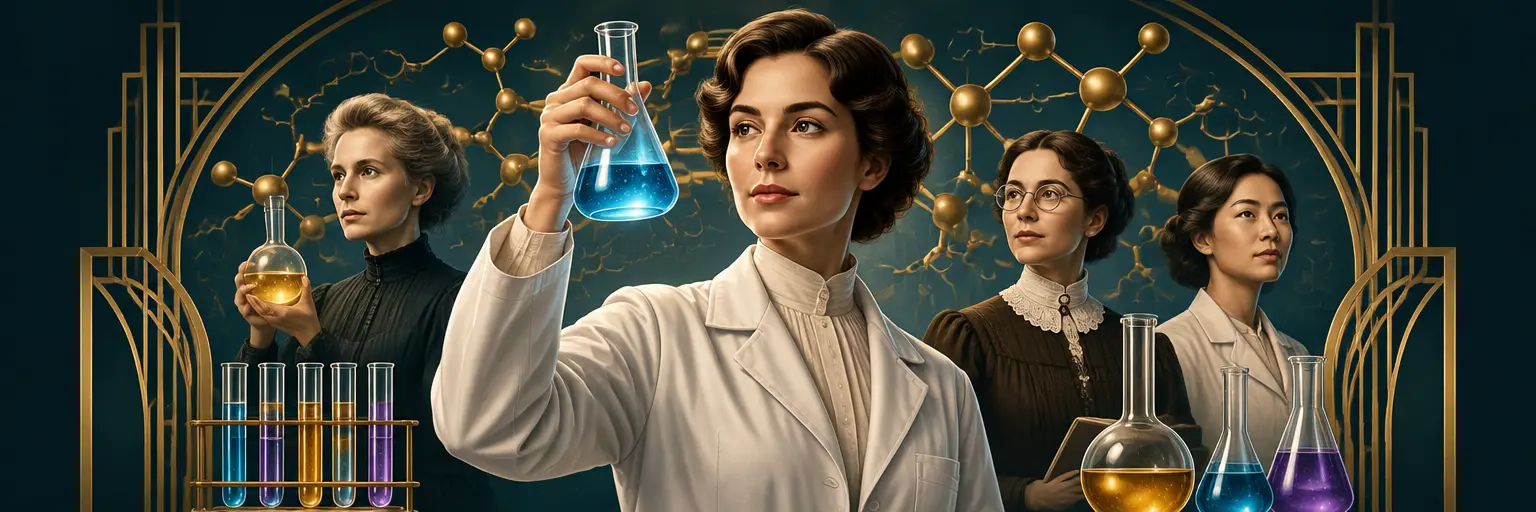
Women & Chemical Discoveries: Pioneers Who Transformed the Molecular World
Explore the remarkable stories of female chemists whose discoveries reshaped our understanding of matter, medicine, and materials. From radium to DNA, these women defied societal barriers to unlock the secrets of the atomic and molecular realm. This subcategory dives deep into their experimental triumphs, the scientific contexts that fueled their breakthroughs, and the enduring legacies they left for modern chemistry. Whether you're a student, educator, or history enthusiast, you'll find detailed insights into how women not only participated in but often led revolutionary chemical advancements.
🔬 Trailblazers of Radioactivity and Elemental Discovery
Here, we spotlight Marie Curie, Lise Meitner, and Marguerite Perey, whose work on radioactive elements fundamentally changed both chemistry and physics. Curie’s isolation of polonium and radium, Meitner’s co-discovery of nuclear fission, and Perey’s identification of francium are presented with historical context and technical clarity. You’ll learn about their meticulous laboratory methods, the scientific debates they navigated, and the profound implications for atomic theory and medical radiotherapy.
Beyond biography, this section examines how these discoveries were received by male-dominated institutions. We analyze the Nobel Prize controversies, the gender-based exclusion from formal credit, and the persistence these women showed in claiming their scientific space. Expect detailed timelines, primary source references, and explanations of why their elemental work remains foundational to modern nuclear chemistry and environmental science.
🧪 Organic Chemistry Innovators: Synthesis and Structure
Delve into the contributions of Dorothy Crowfoot Hodgkin, Alice Ball, and Gertrude Elion, who transformed organic and pharmaceutical chemistry. Hodgkin’s X-ray crystallography of penicillin and vitamin B12, Ball’s revolutionary chaulmoogra oil treatment for leprosy, and Elion’s rational drug design for leukemia and herpes are unpacked with step-by-step explanations. We highlight their experimental protocols, molecular modeling techniques, and collaborative approaches that broke new ground in chemical research.
This segment also addresses the industrial and clinical impacts of their work. You’ll see how Hodgkin’s structures enabled synthetic antibiotics, how Ball’s esters provided a scalable cure, and how Elion’s methodology pioneered the concept of targeted therapies. Each story includes measurable outcomes, such as lives saved and drugs approved, making the scientific significance tangible for contemporary readers interested in medicinal chemistry.
⚗️ Analytical Chemistry and Spectroscopic Breakthroughs
Focus on women like Ellen Swallow Richards, who founded water quality analysis, and Katharine Burr Blodgett, whose monolayer films enabled advanced optics. Richards’ sanitary chemistry established environmental testing standards, while Blodgett’s non-reflective glass and Langmuir-Blodgett films opened new avenues in surface chemistry. We explain the chemical principles behind their methods, including titration, spectroscopy, and interfacial phenomena, with accessible analogies for non-specialists.
Additionally, we cover modern analytical pioneers like Mildred Cohn, whose NMR studies revealed metabolic pathways, and Jeanette Grasselli Brown, a spectroscopy champion. This section links their technical innovations to broader industrial and environmental applications, showing how women drove accuracy, sensitivity, and reproducibility in chemical measurements. Expect career trajectories, patent histories, and the evolution of instrumentation they influenced.
🌿 Inorganic Chemistry and Novel Materials
Here, we explore the work of Ruth Rogan Benerito, inventor of wrinkle-resistant cotton via chemical crosslinking, and Edith Flanigen, who synthesized zeolites for catalysis. Their contributions to materials chemistry are detailed, including the molecular mechanisms of fabric treatment and the templated crystallization of aluminosilicates. You’ll gain insight into how these discoveries commercialized into everyday products, from durable clothing to petrochemical cracking agents.
This segment also honors women in solid-state chemistry, such as Frances Arnold, who engineered enzymes for greener chemical synthesis. We explain directed evolution, the role of inorganic cofactors, and how these catalysts replaced toxic heavy metals in industrial processes. The narrative emphasizes sustainable chemistry, renewable feedstocks, and the global economic impact of these innovations, offering a clear link between lab research and real-world pollution reduction.
📜 The Social and Educational Context of Women in Chemistry
Understand the structural barriers and mentorship networks that shaped these scientists’ paths. Starting with the exclusion from universities like Cambridge, we trace how women formed informal study circles, fought for degrees, and later established research labs. This section profiles organizations such as the International Women’s Chemical Congress and modern initiatives like COACh, which foster professional development and advocacy.
We also discuss pedagogical shifts in chemistry education, from household science courses to Ph.D. programs, and their role in creating opportunities. By examining citation rates, lab climate surveys, and pipeline data, we illuminate the persistent underrepresentation while celebrating recent progress. Readers will find actionable insights for promoting equity in STEM, along with primary sources like letters and lab notebooks that reveal the day-to-day resilience of these pioneers.
Frequently Asked Questions
Who was the first woman to win a Nobel Prize in Chemistry?
Marie Curie was the first woman to win a Nobel Prize in Chemistry in 1911, for her discovery of radium and polonium. She had previously won the 1903 Nobel Prize in Physics with her husband Pierre and Henri Becquerel. Her dual recognition remains a landmark in scientific history.
What did Dorothy Crowfoot Hodgkin discover?
Dorothy Crowfoot Hodgkin used X-ray crystallography to determine the three-dimensional structures of penicillin, vitamin B12, and insulin. For this work, she won the 1964 Nobel Prize in Chemistry. Her techniques became essential for drug design and biochemistry research.
How did Alice Ball contribute to leprosy treatment?
Alice Ball developed the first injectable treatment for leprosy using chaulmoogra oil. She isolated its active chemical ingredients and created an ethyl ester form that was water-soluble and effective. Her method, known as the "Ball Method," was used for decades until sulfone drugs replaced it.
What is Gertrude Elion's most famous discovery?
Gertrude Elion developed acyclovir, an antiviral drug for herpes, and 6-mercaptopurine, a leukemia treatment. Her rational design approach, based on biochemical differences between healthy and diseased cells, earned her the 1988 Nobel Prize in Physiology or Medicine, alongside fellow chemist George Hitchings.
What was Ellen Swallow Richards' major achievement?
Ellen Swallow Richards pioneered water quality analysis, creating the first modern sewage treatment standards in the United States. She also established the public health framework for sanitary chemistry, testing food and air pollutants. Her work led to the creation of the field of ecological chemistry and environmental science.