
Émilie du Châtelet on Fire & Elements: An 18th Century Physicist's Foray into Chemical Thought


Welcome to WomenInScienceHistory.com!
Delve into the fascinating world of science through the lens of remarkable women. Today, we ignite your curiosity with the story of Émilie du Châtelet, a brilliant 18th-century physicist who dared to explore the uncharted territories of chemical physics. But what groundbreaking insights did she bring to the understanding of fire and elements, and how did her work challenge the scientific norms of her time? Prepare to uncover a captivating narrative that sheds light on her intellectual prowess and lasting legacy.
- Introduction: Émilie du Châtelet, More Than Just a Translator of Newton
- Émilie du Châtelet's Scientific Context: Physics in the 18th Century
- Du Châtelet's Chemical Investigations: A Deep Dive into Fire and Elements
- Du Châtelet and the Science of Combustion: A Chemical Physics Perspective
- Du Châtelet's Methodology: Combining Physics and Chemistry
- The Influence of Alchemy on Émilie du Châtelet's Chemical Thinking
- Émilie du Châtelet's Impact on Chemical Physics: Legacy and Recognition
- Émilie du Châtelet: A Pioneer in Chemical Physics for Women in Science History
- Conclusion: Émilie du Châtelet's Enduring Relevance to Chemical Physics
-
Frequently Asked Questions
- What is Émilie du Châtelet best known for?
- Did Émilie du Châtelet only focus on physics?
- What challenges did Émilie du Châtelet face as a woman in science?
- How did Émilie du Châtelet contribute to chemical physics, specifically regarding fire and elements?
- Why is it important to study Émilie du Châtelet in the history of science?
- Final Reflection: Igniting Scientific Curiosity
- Ignite Your Scientific Curiosity: Continue Émilie's Legacy!
Introduction: Émilie du Châtelet, More Than Just a Translator of Newton
Émilie du Châtelet, born Gabrielle Émilie Le Tonnelier de Breteuil, Marquise du Châtelet, is often celebrated primarily for her seminal translation and commentary on Isaac Newton’s Principia Mathematica, a monumental work that introduced Newtonian physics to the French-speaking world. However, to confine her intellectual legacy to this singular achievement would be to overlook her profound original contributions to science and philosophy. Du Châtelet was a formidable scholar in her own right, engaging deeply with the most complex scientific debates of the 18th century, particularly in the realm of physics and metaphysics.
Beyond her role as a translator, Émilie du Châtelet pursued her own scientific investigations, venturing into areas that anticipated the nascent field of chemical physics. Her work explored the fundamental nature of matter, the principles governing interactions, and the mechanics of phenomena like fire and heat. This article delves into her lesser-known but equally significant contributions to Émilie du Châtelet chemical physics, revealing a mind that sought to bridge the gap between mechanical philosophy and the emerging understanding of chemical processes.
Émilie du Châtelet's Scientific Context: Physics in the 18th Century
The Scientific Landscape Before Du Châtelet: Newtonianism and Experimental Philosophy
The intellectual landscape of the early 18th century was dominated by a significant paradigm shift from Cartesian vortex theory to Newtonian mechanics, particularly in Great Britain and increasingly on the European continent. Isaac Newton's Philosophiæ Naturalis Principia Mathematica, first published in 1687, established universal laws of motion and gravitation, profoundly influencing how natural philosophers approached the universe. By the 1730s and 1740s, when Émilie du Châtelet was actively engaged in science, Newtonianism was gaining significant traction in France, often championed by figures like Voltaire, despite initial resistance from Cartesian adherents within the French Academy of Sciences.
This era also saw the rise of experimental philosophy, emphasizing empirical observation and quantitative measurement. Scientists like Robert Boyle (1627–1691) had already laid critical groundwork with their systematic experiments on gases and combustion, advocating for a mechanical explanation of chemical phenomena.
The emphasis shifted from purely theoretical speculation to observations that could be replicated and quantified, paving the way for a more rigorous approach to natural philosophy. Émilie du Châtelet's intellectual development occurred within this dynamic environment, where the precision of Newtonian physics was increasingly seen as the gold standard for understanding the natural world, including the phenomena that would later be categorized under Émilie du Châtelet chemical physics.
Du Châtelet's Contribution to Newtonian Physics: Institutions de Physique
Émilie du Châtelet's original scientific treatise, Institutions de Physique (Foundations of Physics), published in 1740, stands as a testament to her profound understanding and innovative synthesis of 18th-century scientific thought. Initially conceived as a textbook for her son, the work quickly evolved into a comprehensive and critically acclaimed exposition of Newtonian physics, notably integrating it with the metaphysical principles of Gottfried Wilhelm Leibniz, particularly the concept of force vivante (living force). This synthesis was a groundbreaking intellectual endeavor, demonstrating her ability to not only comprehend but also reconcile seemingly disparate philosophical and scientific systems.
The Institutions de Physique was not merely a pedagogical tool; it was a significant contribution to the European scientific discourse. The work was translated into German in 1741 and Italian in 1743, underscoring its broad international appeal and intellectual impact. Du Châtelet meticulously explained complex concepts such as gravity, motion, and the nature of matter, applying mathematical rigor to physical phenomena. Her sophisticated approach in this work laid the intellectual groundwork for her later considerations on the nature of chemical reactions and elements, highlighting her burgeoning interest in what we now recognize as Émilie du Châtelet chemical physics.
Du Châtelet's Chemical Investigations: A Deep Dive into Fire and Elements
The Nature of Fire: Caloric Theory and Experimental Observations
In the 18th century, the nature of fire was a central enigma in both physics and chemistry, with various theories attempting to explain its properties and role in transformations. One prominent concept gaining traction was the idea of fire as a distinct, imponderable fluid, later formalized as caloric theory by Lavoisier.
Émilie du Châtelet engaged with these debates, viewing fire not just as a destructive agent but as a fundamental element or principle involved in all physical and chemical changes. Her writings, particularly within Institutions de Physique and her later notes, reflect a keen interest in understanding heat, light, and their interactions with matter.
Du Châtelet approached the subject with a physicist's precision, seeking to understand the underlying mechanical principles of fire. She considered whether fire was composed of particles, its relationship to the elasticity of air, and its role in phenomena like combustion and expansion.
While not a direct proponent of caloric theory in its fully developed form, her inquiries into the quantitative aspects of heat and its conservation in systems anticipated later developments. She engaged with the works of contemporary natural philosophers like Hermann Boerhaave, whose Elementa Chemiae (1732) was a standard text of the time, and she sought to apply rigorous physical reasoning to what were then considered chemical mysteries, contributing to the early discourse of Émilie du Châtelet chemical physics.
Exploring the Elements: Challenging Stahl's Phlogiston Theory
The dominant chemical theory of the 18th century, particularly concerning combustion and calcination, was Georg Ernst Stahl's phlogiston theory, which postulated the existence of a fire-like element, phlogiston, released during burning or calcination. While Émilie du Châtelet did not explicitly formulate an alternative to phlogiston theory, her physical approach to matter and change implicitly questioned its premises. She moved beyond the traditional four Aristotelian elements (earth, air, fire, water) towards a more nuanced understanding of fundamental constituents, influenced by corpuscularianism and the concept of forces acting between particles.
Du Châtelet's emphasis on the conservation of matter and the precise measurement of weight in reactions, though not fully elaborated into a comprehensive chemical theory, pointed towards the limitations of phlogiston. For instance, the observation that metals gain weight upon calcination (a process explained by phlogiston as a loss of the imponderable substance) was a significant challenge that she, among others, would have grappled with.
Her rigorous physical perspective, demanding quantifiable explanations for observed phenomena, inadvertently laid groundwork for the later overthrow of phlogiston by Antoine Lavoisier. This critical approach to fundamental chemical concepts, rooted in physics, was a key aspect of her contributions to Émilie du Châtelet chemical physics.
Du Châtelet and the Science of Combustion: A Chemical Physics Perspective
Investigating Heat and Light in Chemical Reactions: Affinity and Attraction
Émilie du Châtelet's intellectual framework allowed her to analyze the complex phenomena of heat and light in chemical reactions through the lens of physical principles. She was particularly interested in how these manifestations related to the underlying forces of attraction and repulsion between particles, a concept deeply rooted in Newtonian mechanics. While the term "chemical affinity" was becoming more widely used by chemists like Étienne-François Geoffroy, who published his influential affinity tables in 1718, Du Châtelet sought to understand this affinity not merely as a qualitative preference but as a consequence of fundamental physical forces.
She theorized that the release of heat and light during combustion or other reactions could be explained by the rearrangement of particles and the associated changes in their kinetic or potential energies. For example, if particles formed new, more stable configurations, the excess energy might be emitted as heat or light.
Her thinking thus linked the macroscopic observations of chemical change to the microscopic world of interacting particles and forces, bridging the gap between physics and chemistry. This approach, which sought to apply the mathematical precision of physics to the qualitative observations of chemistry, was a hallmark of her pioneering work in Émilie du Châtelet chemical physics.
Émilie du Châtelet's Views on Chemical Composition: Atomism and Matter Theory
Émilie du Châtelet's understanding of chemical composition was deeply intertwined with her broader philosophical and physical theories of matter. While she did not explicitly endorse a full-fledged atomic theory in the modern sense, her work was informed by corpuscularianism, the idea that matter is composed of small, indivisible particles.
She grappled with the implications of this view for how substances combine and transform. Her Institutions de Physique discusses the properties of fundamental particles and the forces that govern their interactions, such as attraction and repulsion, which she believed were responsible for the formation of compounds and the changes observed in chemical reactions.
She proposed that the various "elements" or principles of chemistry, such as salts, acids, and alkalis, could be understood as different arrangements or combinations of more fundamental, perhaps simpler, particles. This perspective moved away from purely qualitative descriptions of chemical substances towards a more mechanistic and quantitative understanding of their composition. Her engagement with debates on the divisibility of matter and the nature of fundamental forces positioned her at the forefront of discussions that would eventually lead to modern atomic theory, solidifying her place as a crucial figure in the early development of Émilie du Châtelet chemical physics.
Du Châtelet's Methodology: Combining Physics and Chemistry
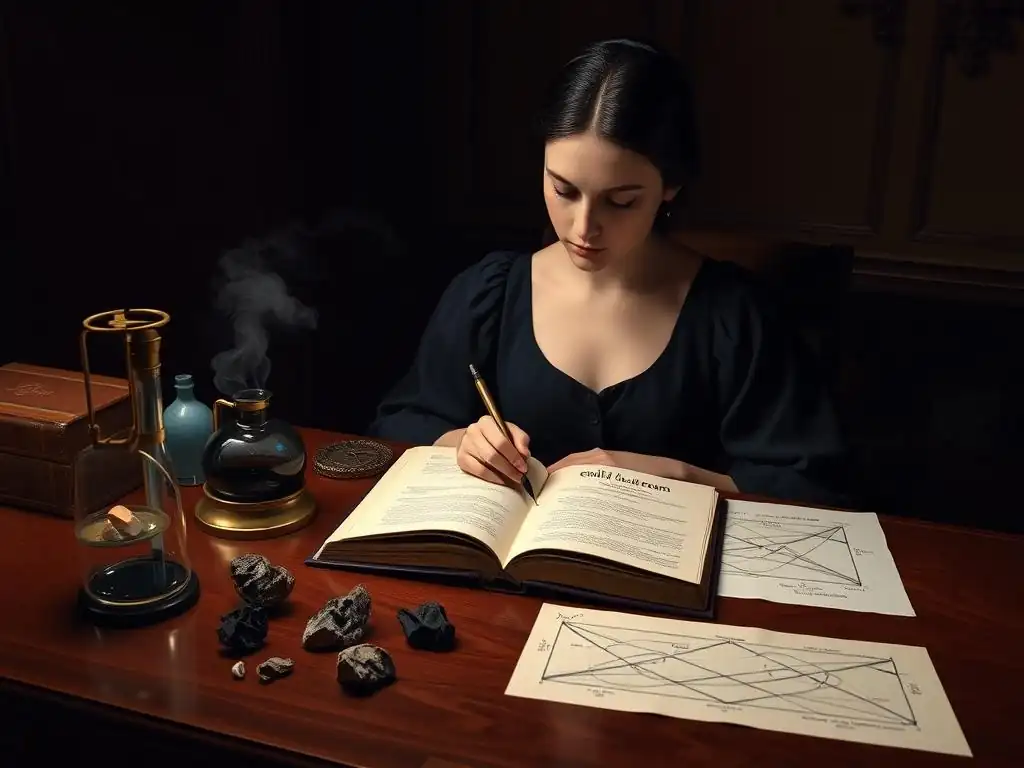
How Émilie du Châtelet Merged Physics and Chemical Thought: Mathematical Principles and Experimentation
Émilie du Châtelet's most distinctive contribution to scientific methodology lay in her unwavering commitment to applying the rigorous, mathematical principles of Newtonian physics to the burgeoning field of chemistry. She believed that chemical phenomena, much like astronomical motions, were ultimately governed by universal laws and could be understood through the application of quantitative analysis and mechanical explanations. This conviction was central to her approach, as she sought to move chemistry beyond qualitative descriptions and empirical observations towards a more predictive and explanatory science.
Her method involved synthesizing theoretical frameworks with empirical data. While she did not conduct extensive laboratory experiments herself, she meticulously studied and critiqued the experimental results of others, seeking to explain them through her sophisticated physical models. For instance, in discussing the properties of air or the effects of heat, she would draw upon observed phenomena but then strive to deduce the underlying physical forces and mathematical relationships. This interdisciplinary approach, merging the precision of physics with the observational focus of chemistry, was a cornerstone of her pioneering efforts in Émilie du Châtelet chemical physics.
Experimentation and Observation in Du Châtelet's Work: Focus on Quantitative Analysis
Despite her primary identity as a theoretical physicist and philosopher, Émilie du Châtelet placed a significant emphasis on experimentation and observation as foundational to scientific inquiry. She recognized that any theoretical construct, no matter how elegant, must ultimately be validated by empirical evidence. Her writings frequently refer to the importance of accurate measurements and the careful design of experiments, anticipating the quantitative revolution that would transform chemistry later in the 18th century.
For example, in her discussions on the nature of fire and heat, she would consider the effects of temperature changes on substances, implying the need for precise thermometric measurements. While she might not have been in the laboratory performing complex titrations, her intellectual framework demanded that chemical changes be understood through measurable quantities, such as weight, volume, and temperature. This insistence on quantitative analysis, rather than mere qualitative description, demonstrates her forward-thinking approach and her significant contribution to the methodological underpinnings of Émilie du Châtelet chemical physics.
The Influence of Alchemy on Émilie du Châtelet's Chemical Thinking
Exploring the Alchemical Roots in 18th-Century Chemistry: Transmutation and Principles
The 18th century, while witnessing the rise of modern scientific thought, was still deeply intertwined with its alchemical past. Many natural philosophers, including towering figures like Isaac Newton, engaged extensively with alchemical texts and ideas, seeking to uncover the fundamental principles governing matter and its transformations.
Concepts such as the transmutation of metals, the search for a universal solvent, or the belief in a prima materia (first matter) were still present in chemical discourse, albeit gradually being reinterpreted or discarded. Alchemy provided a conceptual framework for understanding the composition and change of substances, influencing how chemists thought about elements, compounds, and reactions.
The lines between "chemistry" and "alchemy" were often blurred, with many chemical investigations of the era still driven by the pursuit of fundamental principles that had roots in alchemical traditions. For instance, the quest to identify the "elements" that composed all substances often echoed alchemical principles like sulfur, mercury, and salt. This historical context is crucial for understanding the intellectual environment in which Émilie du Châtelet operated, where even the most forward-thinking minds might still engage with ideas that, to modern eyes, seem distinctly alchemical.
Did Émilie du Châtelet Embrace Alchemical Ideas? Weighing Evidence From Her Writings
When examining Émilie du Châtelet's writings for alchemical influences, it becomes clear that she largely positioned herself within the emerging mechanistic and empirical tradition, moving away from explicit alchemical pursuits. While she would have been aware of alchemical concepts given their prevalence in the scientific literature of her time, her intellectual rigor and adherence to Newtonian principles guided her towards a more rational and quantifiable understanding of matter. Her focus was on observable phenomena and the underlying physical forces, rather than mystical transformations or the pursuit of the philosopher's stone.
However, it's important to note that the very concept of "elements" and their interactions, which she explored in the context of Émilie du Châtelet chemical physics, could be seen as a continuation of the alchemical quest for fundamental principles, albeit stripped of its esoteric trappings. She sought to understand the composition of substances and the mechanisms of their change through a physical lens, a distinct departure from the more speculative and non-empirical methods of traditional alchemy.
Her work reflects a transition point, where the last vestiges of alchemical thought were being shed in favor of a new, physically grounded chemistry.
Émilie du Châtelet's Impact on Chemical Physics: Legacy and Recognition
Émilie du Châtelet's Influence on Subsequent Scientific Thought: Impact on Later Chemists and Physicists
Émilie du Châtelet's direct influence on subsequent chemists and physicists, while not always explicitly acknowledged in historical texts, was significant in shaping the intellectual climate for the development of Émilie du Châtelet chemical physics. Her Institutions de Physique served as a crucial bridge for the dissemination of Newtonian ideas in France, providing a clear and accessible exposition of complex physical principles. By synthesizing Newtonian mechanics with Leibnizian metaphysics, she presented a coherent framework for understanding the natural world that encouraged a rigorous, analytical approach to all scientific inquiry, including chemical phenomena.
Her emphasis on quantitative analysis, the search for underlying physical forces in chemical reactions, and her critical engagement with prevailing theories like phlogiston, subtly influenced the intellectual trajectory that would culminate in the chemical revolution led by Antoine Lavoisier. While Lavoisier may not have directly cited her, her work contributed to the broader shift towards a more physically grounded and quantitatively oriented chemistry. Her intellectual contributions helped pave the way for a generation of scientists who sought to apply the precision of physics to the mysteries of chemical change, thereby fostering the very field of chemical physics.
Why Émilie du Châtelet's Chemical Contributions Are Often Overlooked: Gender and Historical Bias
Despite her profound intellectual capabilities and significant contributions to science, Émilie du Châtelet's original work, particularly in Émilie du Châtelet chemical physics, has historically been overshadowed and overlooked. A primary reason for this marginalization is the pervasive gender bias prevalent in 18th-century scientific circles and perpetuated by later historical narratives. Women were largely excluded from formal academic institutions and scientific societies, making it difficult for their work to gain official recognition or be widely disseminated under their own names.
Furthermore, her close association with Voltaire, who frequently promoted her as a brilliant intellect but also inadvertently contributed to her being seen more as his intellectual companion than an independent scholar, further obscured her individual achievements. For centuries, her monumental translation of Newton's Principia often served as the sole marker of her scientific prowess, overshadowing her original theoretical work and her pioneering engagement with chemical concepts.
It is only in recent decades, with the rise of feminist scholarship and a more nuanced approach to the history of science, that Émilie du Châtelet's full intellectual breadth, including her vital role in the early development of Émilie du Châtelet chemical physics, has begun to receive the recognition it rightly deserves.
Émilie du Châtelet: A Pioneer in Chemical Physics for Women in Science History
Breaking Barriers: Émilie du Châtelet's Challenges as a Woman in Science
Émilie du Châtelet's pursuit of science was an extraordinary feat in an era where women were largely excluded from formal education and public intellectual life. She faced immense societal barriers that sought to confine women to domestic roles, making her dedication to mathematics, physics, and philosophy a radical act. While she maintained an intellectual salon at Cirey, which became a hub for Enlightenment thinkers like Voltaire, her access to scientific institutions was severely limited. For instance, despite her significant intellectual contributions, she was not admitted to the French Academy of Sciences, a common barrier for women of her time.
Her intellectual journey required immense self-discipline and resourcefulness, often involving private study, extensive correspondence with leading scholars, and the establishment of her own informal intellectual networks. She challenged the prevailing norms that deemed women intellectually inferior or incapable of rigorous scientific thought. Her very existence as a serious natural philosopher, actively engaging with complex theories of Émilie du Châtelet chemical physics and publishing original works, served as a powerful, albeit often unacknowledged, testament to women's intellectual capabilities, inspiring future generations by example.
Émilie du Châtelet's Place in the History of Women in Chemistry: A Role Model and Intellectual Force
Émilie du Châtelet holds an indispensable position in the history of women in chemistry and science more broadly. She was not merely a passive recipient of knowledge but an active, critical participant in the scientific debates of her time, contributing original ideas that bridged disciplines. Her work in Émilie du Châtelet chemical physics exemplifies her unique intellectual approach, combining the mathematical rigor of physics with the observational focus of chemistry. She demonstrated that women could not only comprehend but also significantly advance the most complex scientific theories of the Enlightenment.
As a role model, her story illuminates the perseverance and intellectual audacity required for women to pursue scientific careers against overwhelming societal odds. Her intellectual salon at Cirey provided a rare space for women, including herself, to engage in serious scientific discourse.
Émilie du Châtelet's legacy extends beyond her specific scientific findings; she stands as an intellectual force who broke through gender barriers, proving that brilliance knows no gender. Her pioneering explorations in Émilie du Châtelet chemical physics ensure her place as a foundational figure for women in science history, whose contributions continue to inspire those who seek to understand and transform the world through scientific inquiry.
Conclusion: Émilie du Châtelet's Enduring Relevance to Chemical Physics
Frequently Asked Questions
What is Émilie du Châtelet best known for?
Émilie du Châtelet is best known for her translation and commentary on Isaac Newton's Principia Mathematica, which remains the standard French translation today. She also made significant contributions to understanding kinetic energy.
Did Émilie du Châtelet only focus on physics?
No, while primarily a physicist, Émilie du Châtelet also explored other fields. She demonstrated a keen interest in and made contributions to philosophical debates and even speculated on chemical processes related to fire and elements.
What challenges did Émilie du Châtelet face as a woman in science?
As a woman in the 18th century, Émilie du Châtelet faced immense societal hurdles. She had to overcome limited access to education and prejudice against women participating in intellectual pursuits and scientific inquiry.
How did Émilie du Châtelet contribute to chemical physics, specifically regarding fire and elements?
While not a formal chemist, Émilie du Châtelet engaged with the contemporary debates surrounding the nature of fire and the composition of elements. Her writings reveal an attempt to integrate Newtonian physics with chemical thought.
Why is it important to study Émilie du Châtelet in the history of science?
Studying Émilie du Châtelet is crucial because she represents a pioneering figure who challenged gender norms. She also highlights the interdisciplinary nature of scientific inquiry even in the 18th century, connecting physics with nascent chemical understanding.
Final Reflection: Igniting Scientific Curiosity
The exploration of Émilie du Châtelet's work reveals not just a historical account, but a potent reminder of the enduring power of interdisciplinary thinking. Her foray into chemical physics, a field not yet fully defined in her time, highlights the crucial role of curiosity and intellectual courage in scientific advancement, a lesson profoundly relevant in our increasingly specialized world.
Du Châtelet's relentless pursuit of knowledge, bridging the seemingly disparate fields of physics and chemistry, continues to resonate deeply. Her story is a testament to the importance of challenging conventional boundaries and embracing intellectual freedom. Judge me for my own merits, or lack of them, but do not look upon me as a mere appendage to this great man.
This quote perfectly encapsulates her fight for recognition and her unwavering commitment to her own intellectual pursuits, a fight that continues to inspire women in STEM fields today.
As we reflect on Émilie du Châtelet's legacy, let us be inspired to cultivate our own intellectual curiosity. Embrace the unknown, challenge established norms, and dare to explore the intersections of knowledge. Let her example ignite within you a passion for learning and a commitment to pushing the boundaries of understanding, for it is in these acts of intellectual bravery that true progress lies.
Ignite Your Scientific Curiosity: Continue Émilie's Legacy!
Thank you for diving into the fascinating world of Émilie du Châtelet and her contributions to science! We hope you've gained a new appreciation for her groundbreaking work and the challenges she overcame. Now, let's put that inspiration into action!
Here are a few ways you can further explore Émilie's legacy:
- Embrace Châtelet's spirit: Conduct your own mini science experiment!: Find a simple physics or math problem and try to solve it using the resources available to you.
- Delve deeper: Recommend one book by or about Émilie du Châtelet to your local library, helping others discover her brilliance.
- Share the knowledge: Tell at least three friends or family members about Émilie du Châtelet and what you learned from this article.
What simple experiment, inspired by Châtelet's scientific curiosity, will you try first?