Pauline Beery Mack: From Home Economics to Leading Chemical Research (1920s1950s)
🌟 Pauline Beery Mack's pioneering work in chemical research from the 1920s to 1950s exemplifies women's vital contributions to science, overcoming gender…
Read article
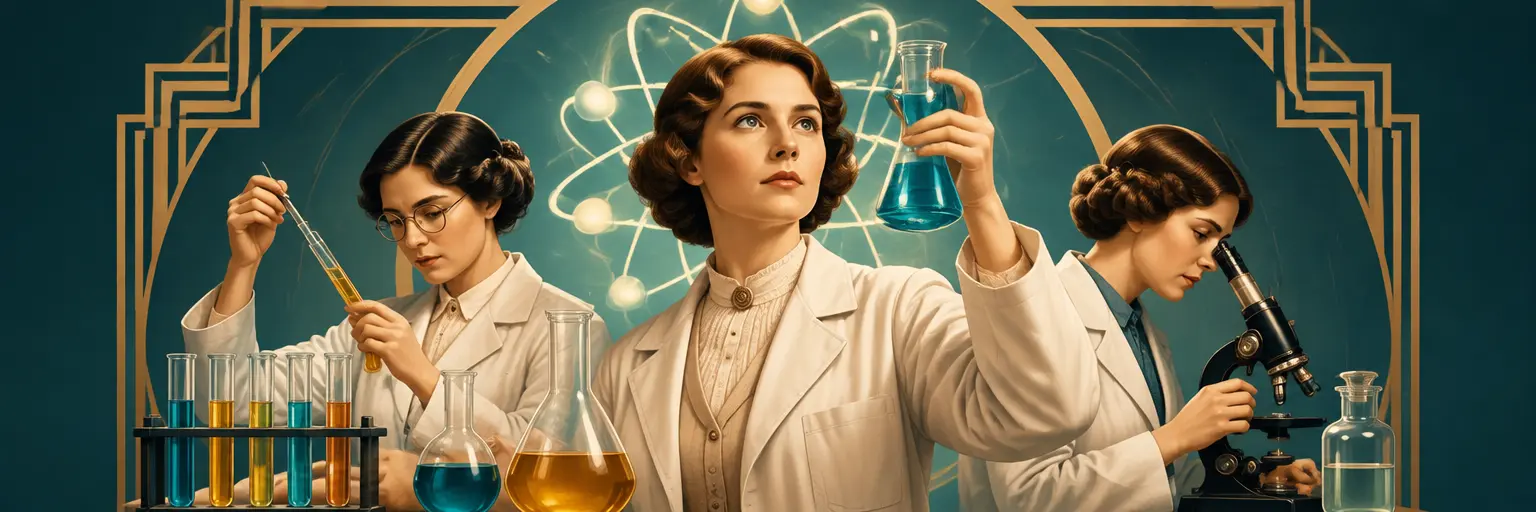
Discover the remarkable yet often overlooked stories of early 20th century women in chemistry (1900–1950), a transformative era when female pioneers shattered glass beakers and societal barriers alike. From Marie Curie’s Nobel-winning radioactivity research to Gerty Cori’s groundbreaking work on carbohydrate metabolism, these trailblazers redefined what was possible in the lab. Despite limited access to education, funding, and professional recognition, they made indispensable contributions to organic synthesis, crystallography, industrial chemistry, and nuclear science—often working as unpaid assistants or in segregated facilities. This collection highlights their resilience, intellect, and unwavering passion for discovery, revealing how they navigated institutional sexism to leave an enduring legacy. Whether you’re a student, educator, or history enthusiast, these profiles offer inspiring role models and a richer understanding of chemistry’s evolution. Dive into the challenges they overcame, the innovations they pioneered, and the subtle yet powerful ways they shaped modern science—proving that genius knows no gender.
🌟 Pauline Beery Mack's pioneering work in chemical research from the 1920s to 1950s exemplifies women's vital contributions to science, overcoming gender…
Read article
🌟 Discover the inspiring story of Dorothy Hodgkin, a trailblazing scientist whose groundbreaking work in X-ray crystallography revolutionized our understanding of life's…
Read article
🌟 Women chemists played a crucial role in element discovery during 1900-1950, breaking barriers in a male-dominated field. Their pioneering efforts in…
Read article
🌟 Discover the untold stories of women chemists early 20th century, who balanced groundbreaking scientific achievements with personal challenges, paving the way…
Read article
🌟 Celebrating Marguerite Perey, the pioneering woman scientist behind the discovery of Francium—the last natural element. Her groundbreaking work exemplifies the vital…
Read article
🌟 Celebrating Gerty Cori Nobel Prize laureate, her groundbreaking research unraveled the complexities of sugars and glycogen, inspiring women in science and…
Read article
🌟 Gertrud Woker, the renowned Swiss chemist and poison gas advocate, challenged societal barriers from 1900 to 1950, pioneering research that highlighted…
Read article
🌟 Discover how Mary Engle Pennington revolutionized food preservation with her innovative chemical techniques, overcoming gender barriers to ensure safer, longer-lasting food—her…
Read article
🌟 Discover how Alice Ball's groundbreaking work in the Alice Ball leprosy treatment history revolutionized medicine, showcasing her as a pioneering woman…
Read articleBetween 1900 and 1950, a remarkable cohort of women shattered glass beakers and glass ceilings alike, transforming chemistry from a male-dominated laboratory into a field enriched by their genius. From radioactivity to crystallography, these scientists not only made Nobel-worthy discoveries but also pioneered techniques that still underpin modern research. This subcategory explores their triumphs, struggles against institutional sexism, and the enduring legacy of their work.
The early 20th century saw women at the forefront of nuclear chemistry, most famously Marie Curie, who became the first person to win Nobel Prizes in two different sciences. Her daughter Irène Joliot-Curie continued this legacy, co-discovering artificial radioactivity with her husband Frédéric in 1934. These women didn’t just work with radioactive elements; they redefined atomic theory, developed mobile X-ray units in WWI, and laid groundwork for modern medical imaging and cancer treatment.
Beyond the Curies, Lise Meitner’s co-discovery of nuclear fission (though uncredited in the 1944 Nobel for Otto Hahn) was a theoretical masterstroke that opened the atomic age. Her refusal to return to Nazi Germany and subsequent calculation of fission energy demonstrated unusual courage and precision. Readers will discover how these women’s meticulous, often thankless lab work fundamentally shifted our understanding of matter while they navigated labs that often denied them titles, salaries, or even entry.
This era saw the rise of X-ray crystallography as a revolutionary tool, and women were central to its development. Kathleen Lonsdale, elected the first female Fellow of the Royal Society in 1945, proved the planar structure of the benzene ring using crystallographic methods—a foundational insight for organic chemistry. Similarly, Dorothy Crowfoot Hodgkin mapped the structures of penicillin, vitamin B12, and insulin, earning the 1964 Nobel Prize in Chemistry for her three-dimensional imagery of biomolecules.
These crystallographers faced immense technical challenges with rudimentary equipment, yet their visual interpretations solved problems too complex for their male peers. Their work bridged chemistry and biology, enabling targeted drug design and protein studies. Here, you’ll explore how their innovative photographic plates and mathematical models turned atomic coordinates into usable knowledge, and how patience with tedious calculations allowed them to outperform faster, less meticulous contemporaries.
While academic labs often marginalized women, industrial and analytical chemistry offered alternate pathways. For example, Mary Engle Pennington, known as the “Ice Lady,” became a leading authority on food preservation at the U.S. Department of Agriculture, developing safety standards that cut spoilage and disease in a pre-refrigeration America. Meanwhile, Emma P. Carr pioneered spectrometric analysis, co-developing vacuum ultraviolet spectroscopy to study hydrocarbons—a technique vital for petrochemical and pharmaceutical industries.
These women thrived in applied settings, translating complex chemical principles into practical solutions for food safety, fuel quality, and public health. Their innovations often went unpatented or attributed to male supervisors, yet they established protocols that became industry standards. This section also highlights educators like Nessa Cohen, who trained thousands of workers during both World Wars, proving that women could perform high-stakes analytical tasks—like calibrating explosives—with unmatched precision.
Securing academic positions was an uphill battle, but several women managed to carve tenured niches, effectively mentoring future generations. Gertrude B. Elion, though she became famous later, began her career in this period, working as a lab assistant before developing the 6-mercaptopurine leukemia treatment—she never earned a doctorate but won a Nobel in 1988. Another example is Gladys Dick, who co-developed the scarlet fever antitoxin with her husband, then fought for equal professional recognition.
These women built networks, served as unpaid assistants, and used strategic collaborations to gain resources for their research. Institutions like the University of California, Berkeley and the University of London opened limited doors, yet quotas capped female enrollment in many graduate programs. Readers will learn how persistence, private funding, and even personal wealth supported these scientists, and how they navigated hostile climates without losing their scientific rigor or humanitarian vision.
World Wars served as catalysts, temporarily welcoming women into chemical industries and defense projects. The Manhattan Project, for instance, employed hundreds of female chemists, including Leona Woods, who built the world’s first nuclear reactor with Fermi. Beyond military applications, women chemical engineers like Susan Bulgarelli pioneered synthetic rubber and plastics, vital for wartime supply chains. Post-war, however, many were forced to relinquish positions to returning men, yet their wartime contributions demonstrated undeniable capability.
This period also brought increased activism, as women like Anna J. Harrison founded professional organizations like the ACS Women Chemists Committee in 1927, advocating for equal pay and advancement. Their advocacy led to broader inclusion, though slowly. This subcategory examines how these women balanced family, social expectations, and national emergencies, and how their legacies—from improved baby formula to safer food—still benefit millions daily. It’s a testament to resilience and adaptive genius.
Institutional discrimination was widespread; many universities and industries refused to hire women for senior positions, believing they belonged in domestic roles. Women often worked unpaid or as assistants to male relatives, and were barred from faculty clubs or access to expensive equipment. Their contributions were sometimes credited to male colleagues, as seen with Lise Meitner and many others.
Marie Curie’s isolation of radium and polonium, and her pioneering work on radioactivity, fundamentally changed chemistry and physics, founding nuclear medicine. However, Dorothy Hodgkin’s crystallography of biomolecules enabled modern drug design. Both are equally transformative, though Curie’s dual Nobel prizes make her symbolically unparalleled.
Some, like Curie and Hodgkin, received Nobel Prizes, but many, like Meitner or Ellen Swallow Richards (who coined “ecology”), were overlooked. Journals sometimes refused to publish female-authored papers, so recognition often came late, if at all. Posthumous rehabilitations, such as naming labs or elementary particles after them, have only partially corrected historical gaps.
World Wars opened unprecedented job opportunities, as male chemists left for battle. Women suddenly managed labs, synthetic materials, and explosives development. Yet, after the wars, many were dismissed to make room for returning veterans, leaving few permanent positions. The transient nature of these roles reinforced the idea of women as temporary workers, slowing long-term progress.
They teach persistence in the face of systemic bias, collaboration over individualism, and the value of precise, tedious experimental work. Their habit of documenting everything, sharing data generously, and mentoring younger scholars remains instructive. Additionally, their ability to reframe failures into novel insights—like Hodgkin’s repeated protein crystallization attempts—offers a timeless model for scientific curiosity.