Discover the Pioneering Women of Early Chemistry and Alchemy
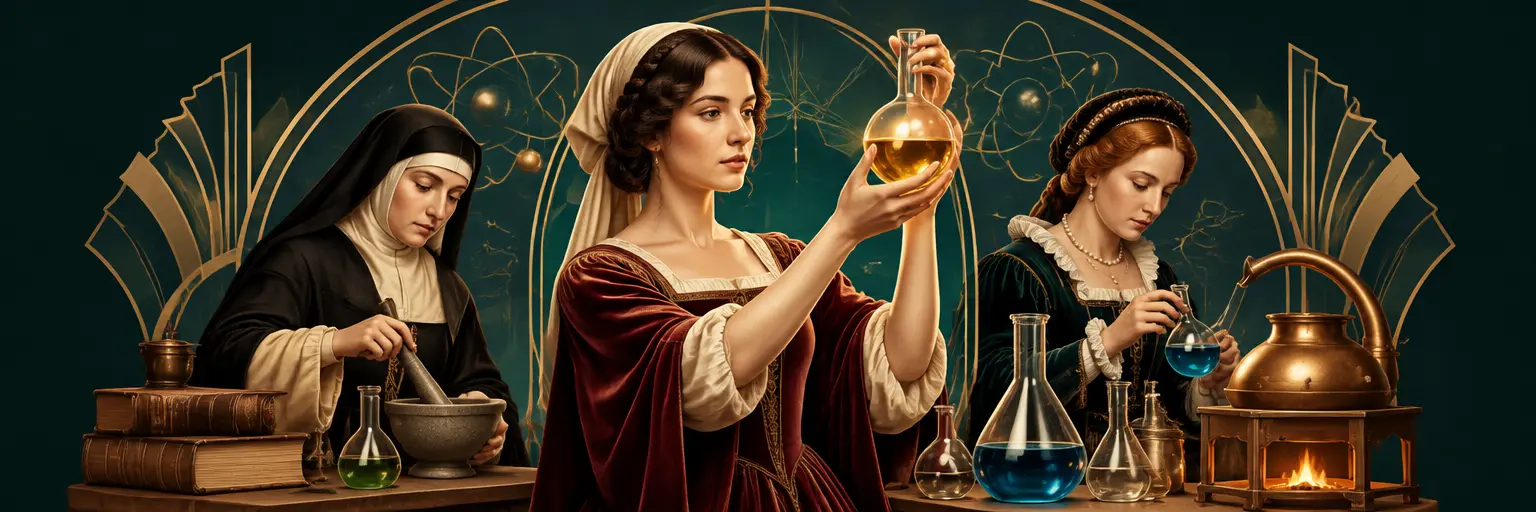
The subcategory Early Women in Chemistry & Alchemy (Pre-18th Century) on WomenInScienceHistory.com delves into the forgotten female innovators who shaped the foundations of chemical science. From ancient Egypt to the Renaissance, these women practiced alchemy, developed medicinal remedies, and advanced early chemistry despite legal, social, and religious barriers. Here, you’ll explore their lives, their laboratories, and their lasting impact on modern science—a rich, untold narrative that enriches our understanding of both chemistry and women’s history.
🧪 The Earliest Known Female Alchemists
This section highlights figures like Mary the Jewess, often credited as the first true alchemist in Western history, who invented the kerotakis (a heating device) and the water bath, still used in laboratories today. You’ll also meet Cleopatra the Alchemist (not the queen) and Paphnutia, who wrote on metallurgy and the transmutation of metals. These women operated in male-dominated Hellenistic Egypt, yet their works were copied and studied for centuries. Expect detailed biographies, translated fragments of their writings, and analysis of their techniques, including distillation and sublimation. Understanding these pioneers is crucial because they laid the methodological groundwork for later experimental chemistry, proving that the discipline’s origins are not exclusively male.
We also examine the broader context of ancient alchemy, where women often served as priestesses, healers, and artisans. Their practical knowledge of dyes, perfumes, and alloys was essential for economic and religious life. By focusing on these figures, we challenge the narrative that science began in European universities, showing instead a diverse, global heritage. Each biography is paired with historical sources, such as Zosimos of Panopolis’s accounts, to separate fact from myth. For educators and enthusiasts, this section offers ready-to-use insights into how women’s hands shaped the earliest chemical instruments and processes, making it an invaluable resource for rethinking the history of science.
⚗️ Medieval Mystics and Practical Chemists
During the medieval period, women like Hildegard of Bingen (1098–1179) combined spiritual visions with systematic botanical and mineral knowledge, authoring works like Physica that catalogued natural substances and their medical uses. You’ll also discover anonymous nuns who brewed medicinal tinctures and beer, effectively running small-scale chemical workshops within convents. This section covers the transition from mystical alchemy to more empirical practices, highlighting how women’s roles as healers gave them hands-on access to chemical reactions. We analyze monastic records, recipe books, and herbals to reconstruct their methods, including the distillation of essential oils and the preparation of metallic compounds. These women were not amateur dabblers; they were systematic observers who documented their results with impressive precision.
Expect a deep dive into the social constraints they faced—such as prohibitions on university education—and how they circumvented these limits through apprenticeships, family businesses, and religious communities. The section also discusses the dangers of being labeled a witch or heretic, which led many to work in secrecy. By examining their notebooks, we uncover a parallel tradition of chemical knowledge that fed into early pharmacy and alchemy. This content is perfect for readers interested in the intersection of gender, religion, and science history. Moreover, it provides practical examples of how medieval women’s protocols anticipated modern lab procedures, from solvent extraction to crystallization, reinforcing that their contributions were scientifically substantive, not merely domestic chores.
🔥 Renaissance Women in Laboratories and Courts
The Renaissance saw women like Catherine de’ Medici (1519–1589) and Isabella Cortese, whose The Secrets of Lady Isabella Cortese (1565) was a bestseller offering recipes for cosmetics, alchemical medicines, and even gold-making. This section explores how noblewomen and courtiers used their patronage to fund laboratories and sponsor experiments, often collaborating with male alchemists. You’ll learn about Sophia Brahe (1556–1643), who, though known for astronomy, also practiced chemistry to support her brother Tycho’s research, creating medicines and pigments. We profile these figures with attention to their practical output—such as the development of mineral acids, new pigments for art, and remedies for plague—while also analyzing their written correspondence and manuscripts. This era marked a rise in printed books by and for women, making their chemical knowledge more accessible than ever before.
This segment also addresses the gendered politics of scientific credit, showing how male contemporaries often erased women’s roles in landmark discoveries. For example, we dissect the case of Marie Meurdrac (c. 1610–1680), who wrote La Chymie Charitable et Facile to help poor women make their own medicines, yet faced criticism for female audacity. By comparing her work with that of male contemporaries, we reveal the precise chemical processes she documented—from acid-base reactions to distillation—that were highly advanced. You’ll find a curated timeline of Renaissance female chemists, their patrons, and their published works, plus practical guides to reproducing their experiments safely. For history of science students, this is a goldmine of primary-source analysis, demonstrating how women moved from the kitchen to the lab as skilled professionals.
📜 Primary Sources and Manuscript Analysis
For those wanting to verify the historical record, this section provides an overview of key manuscripts attributed to early female alchemists, including the Dialogue of Cleopatra and the Philosophers and the Chrysopoeia of Kleopatra. We explain how scholars authenticate authorship through handwriting, style, and material evidence, acknowledging that some attributions remain debated. You’ll also learn about the transmission of these texts through Arabic and Latin translations, which preserved women’s work even when their names were altered or omitted. This resource is invaluable for researchers, as we link to open-access digitized copies, translation notes, and critical editions. We also discuss the challenges of interpreting symbolic alchemical language, offering a glossary of terms like “philosopher’s stone,” “elixir,” and “prima materia” as used by women practitioners.
Moreover, we examine the material culture of early chemical practice—glassware, furnaces, and reagents—that women used, based on archaeological finds and illustrated manuscripts. By cross-referencing texts with surviving artifacts, we can infer their actual working conditions and levels of expertise. This section also addresses the historiography of women in alchemy, exploring why early historians like Marcellin Berthelot downplayed female contributions. We offer a critical reading of these biases and propose new methodologies, such as gender-sensitive analysis of recipe collections. Whether you’re a teacher creating lesson plans or a student writing a thesis, this section equips you with the tools to engage critically with primary sources, ensuring that these women’s voices are heard accurately and respectfully in modern scholarship.
🌍 Cross-Cultural Perspectives: Islamic and Asian Women Alchemists
While European figures are often spotlighted, this section expands the lens to Rufaida Al-Aslamia (7th century), a pioneering Muslim nurse and chemist who prepared antiseptics and medical compounds, and Károly Zsuzsanna from Central Asia, whose apothecary notes influenced Persian pharmacology. We explore how Islamic golden-age science embraced female practitioners as scribes, perfumers, and physicians, with texts like the Kitab al-Atar referencing women’s extraction techniques. Similarly, in China and India, women were integral to dyeing, metallurgy, and traditional medicine—though their names often remain anonymous. This segment compares their methodologies across cultures, showing convergent discoveries of calcination, fermentation, and crystallization. By highlighting these diverse traditions, we correct the Eurocentric bias in chemistry history and demonstrate a truly global heritage of female scientific work.
We also investigate the trade routes that allowed the exchange of chemical knowledge, such as the Silk Road and Indian Ocean networks, where women served as knowledge brokers. For example, we detail the practice of Chinese female alchemists who developed gunpowder-based medicine, and Indian women’s use of mercury in Ayurvedic preparations. Each culture’s unique constraints and opportunities are analyzed, from veiling norms to inheritance laws that affected women’s access to resources. This section includes comparative tables, maps of knowledge diffusion, and case studies of individual practitioners where records survive. It’s designed to foster a more inclusive curriculum, offering ready-made discussion points for classrooms and public lectures. Ultimately, by viewing early chemistry through a cross-cultural, female-centric lens, we gain a richer, more accurate picture of how science actually developed—collaboratively, globally, and often in the hands of women.
Frequently Asked Questions
Who is considered the first female alchemist in history?
Mary the Jewess (or Maria Hebraea), active in Alexandria around the 1st to 3rd century CE, is widely recognized as the first female alchemist. She invented the water bath (balneum Mariae) and a distillation apparatus (tribikos), which are still referenced in modern chemistry. Her writings, though fragments, were preserved by later alchemists like Zosimos.
Did early women alchemists face legal restrictions on practicing chemistry?
Yes, many faced legal and social restrictions. In medieval Europe, university attendance was generally prohibited for women, and alchemical guilds often excluded them. However, some operated under noble patronage or within convents, which offered some protection. In contrast, Islamic and Byzantine contexts sometimes allowed women to practice as physicians and apothecaries with fewer formal barriers.
What are the most famous texts written by pre-18th century female alchemists?
Key works include Cleopatra’s Chrysopoeia (an illustrated treatise on gold-making), Isabella Cortese’s I Segreti (1565), and Marie Meurdrac’s La Chymie Charitable (1666). Hildegard of Bingen’s Physica (c. 1150) also contains extensive chemical and botanical knowledge. These texts are available in modern translations and academic editions.
How did women’s chemical knowledge differ from men’s in early history?
Women’s practice often emphasized practical applications—medicines, cosmetics, dyes, and food preservation—because they were excluded from theoretical university discourse. They relied heavily on empirical trial-and-error and oral transmission. This hands-on approach led to innovations in distillation and compound preparation that later became standardized in pharmacy and metallurgy.
Why were many early female alchemists’ contributions erased from history?
Contributions were often erased due to patriarchal biases in historiography, the use of pseudonyms, and the fact that many women worked anonymously in family workshops or convents. Early historians like Berthelot rarely attributed works to women without male corroboration. Modern scholarship, however, uses manuscript analysis to recover these lost voices, revealing a richer history.