Decoding DNA's Language: The Unsung Heroines of Molecular Biochemistry
🔬 Celebrating women in science, this article highlights Rosalind Franklin’s DNA work, showcasing her pivotal role in decoding DNA's language. Her groundbreaking…
Read article
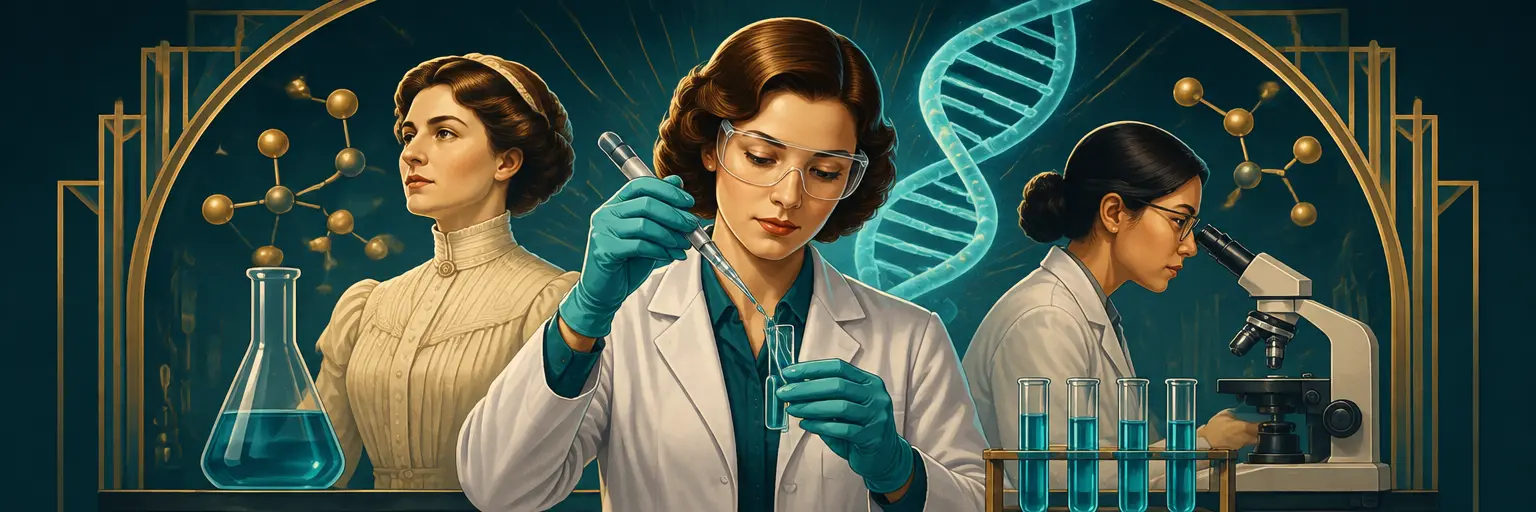
Women in biochemistry have fundamentally transformed our understanding of life at the molecular level, yet their stories are often overshadowed. From unraveling the structure of DNA to pioneering enzymes that power medicine, these brilliant minds overcame systemic barriers to make groundbreaking discoveries that save millions of lives today. At WomenInScienceHistory.com, we spotlight the relentless curiosity and resilience of female biochemists—like those who deciphered metabolic pathways, developed life-saving drugs, and advanced genetic engineering. Their work in protein chemistry, cellular signaling, and biocatalysis not only solved century-old puzzles but also shattered glass ceilings in laboratories worldwide. By delving into their biographies, you’ll uncover the hidden narratives of perseverance, intellectual brilliance, and collaborative spirit that shaped modern biochemistry. Explore how these women navigated exclusion, secured funding against all odds, and mentored future generations—ensuring their legacy extends beyond the bench.
🔬 Celebrating women in science, this article highlights Rosalind Franklin’s DNA work, showcasing her pivotal role in decoding DNA's language. Her groundbreaking…
Read article
🌟 Celebrating Women’s nutrition biochemistry historical figures, this article honors pioneering women who linked diet to health, overcoming obstacles in male-dominated fields,…
Read article
🌟 Celebrating the trailblazing women in biochemistry history, this article highlights their groundbreaking contributions and enduring legacies, inspiring future generations to pursue…
Read article
🌸 Celebrating women’s phytochemistry historical discoveries, this article highlights pioneering female scientists who turned plant pigments into essential vitamins, overcoming gender barriers…
Read article
🌟 Celebrating women who isolated and characterized vital proteins, this article highlights their groundbreaking contributions to protein research and the pivotal role…
Read articleBiochemistry, the study of chemical processes within living organisms, owes an immense debt to the brilliant women who broke barriers in laboratories and lecture halls. At WomenInScienceHistory.com, our “Women in Biochemistry” subcategory uncovers the stories of female scientists—from Gerty Cori’s Nobel-winning metabolism work to Dorothy Hodgkin’s X-ray crystallography—who transformed our understanding of enzymes, vitamins, and DNA. This page is your gateway to their discoveries, struggles, and enduring legacies.
Here, you’ll meet women whose groundbreaking experiments earned the highest scientific honors. Gerty Cori became the first woman to win a Nobel Prize in Physiology or Medicine (1947) for elucidating the Cori cycle—the metabolic pathway of glycogen breakdown. Dorothy Crowfoot Hodgkin, a 1964 Nobel laureate in Chemistry, mapped the structures of penicillin, vitamin B12, and insulin using X-ray crystallography, a feat that revolutionized drug design. Their stories are not just about awards but about persistence in male-dominated institutions.
Expect detailed biographical profiles, historical context, and primary-source excerpts that bring their lab notebooks to life. We also explore how these women trained future generations—Cori mentored many female students at Washington University, and Hodgkin championed scientific collaboration across Cold War divides. This section serves as both an educational resource and an inspiration for aspiring biochemists.
Not every pioneer received a Nobel. This section shines a light on women like Maud Menten, who co-developed the Michaelis-Menten equation—a cornerstone of enzyme kinetics—yet remained underrecognized for decades. Gertrude B. Elion, though a Nobel winner, spent years developing drugs for leukemia and herpes while facing gender-based hiring discrimination. We also cover biochemists like Gladys Anderson Emerson, who isolated vitamin E, and Chien-Shiung Wu’s influential work on beta decay, which indirectly aided biochemistry.
You’ll discover detailed timelines of their experiments, the barriers they overcame (e.g., being denied lab space or academic posts), and the societal factors that erased their names from textbooks. Each profile includes a “Why It Mattered” section linking their findings to modern medical and industrial applications, such as antiviral therapies or nutritional supplements. This content is meticulously sourced from archival papers and oral histories.
After World War II, biochemistry expanded rapidly, yet few women gained leadership roles. This section profiles those who did: Severo Ochoa’s collaborator Marianne Grunberg-Manago, who co-discovered RNA polymerase; and Mildred Cohn, who pioneered nuclear magnetic resonance (NMR) in biochemistry at the University of Pennsylvania. We also examine lesser-known figures like Hilda Neatby, who led Canadian agricultural biochemistry research, and Ruth Hubbard, who critiqued the politics of scientific funding while heading a lab at Harvard.
Expect case studies of institutional practices—such as tenure policies that penalized marriage or maternity—and how these women navigated them. We include excerpts from grant proposals, lab meeting minutes, and personal correspondence to give you a feel for their daily realities. This is especially valuable for historians and science-policy students seeking to understand gendered leadership dynamics in mid-century science.
Many women biochemists found career niches in applied fields like nutrition and agricultural chemistry, where practical outcomes were valued. This section covers pioneers like Mary Swartz Rose, who established dietary standards for vitamins and minerals, and Hazel Stiebeling, who directed the USDA’s food composition studies. We also profile Elizabeth Thacker, who developed soy protein isolates, and Doris Calloway, a metabolic researcher who revolutionized military ration design.
Here, you’ll find detailed narratives of how these women linked molecular biochemistry to real-world problems—from preventing pellagra to wartime food preservation. Each profile includes a “Legacy in the Field” box, explaining how modern nutritional labels or agricultural biotechnology trace back to their work. We also address the politics of funding, as many were channeled into “feminine” applied fields rather than pure research, yet made outsized impacts.
Access to education was the first hurdle. This section explores how women like Gerty Cori (University of Prague) and Dorothy Hodgkin (Oxford) gained entry to top institutions, often despite explicit quotas or familial opposition. We cover the rise of women’s colleges like Mount Holyoke and Bryn Mawr, which became pipelines for biochemistry talent, and the training networks—such as Gertrude Stein’s lab meetings—that provided mentorship. Also highlighted are women who self-funded studies or later earned degrees as mature students.
Expect statistics, university archival records, and personal testimonies about rejection letters, scholarship denials, and the eventual loosening of restrictions. We connect this history to contemporary debates about STEM retention for women, showing how past strategies—like peer-study groups or interdisciplinary labs—still inform modern mentorship programs. Each profile ends with a “Further Reading” list for educators and students.
Gerty Cori was the first American woman—and first woman overall—to win a Nobel in Physiology or Medicine in 1947, alongside her husband Carl, for discovering how glycogen is converted into glucose. She faced institutional nepotism rules but persisted, later directing a research lab at Washington University.
Dorothy Hodgkin determined the 3D atomic structures of penicillin, vitamin B12, and insulin using X-ray crystallography. Her B12 work in the 1950s solved a crucial medical puzzle, while her insulin structure (1969) aided diabetes treatment. She won the 1964 Nobel Prize in Chemistry.
Menten co-developed the Michaelis-Menten equation (1913), which describes enzyme reaction rates. It remains fundamental in pharmacology for calculating drug dosages and enzyme kinetics. She later contributed to histochemistry and electrophoretic techniques, despite limited academic recognition during her lifetime.
Yes, the site includes living biochemists like biochemist and physician Carolyn Bertozzi, a 2022 Nobel laureate for bioorthogonal chemistry, and structural biologist Venki Ramakrishnan’s collaborators. However, the primary focus remains on historical figures, with periodic updates on legacy and mentorship.
Many were denied full lab memberships, publishing rights, or funding. For example, Gerty Cori could only take an unpaid research position at Washington University, while Dorothy Hodgkin often had to request lab space from male colleagues. Institutional policies often required marriage to be approved or pregnancies hidden.