The Social Reaction: Public and Peer Perception of Women Chemists in the 1800s
🌟 Explore how women chemists in the 1800s faced societal skepticism and evolving public perception, revealing the challenges and breakthroughs that shaped…
Read article
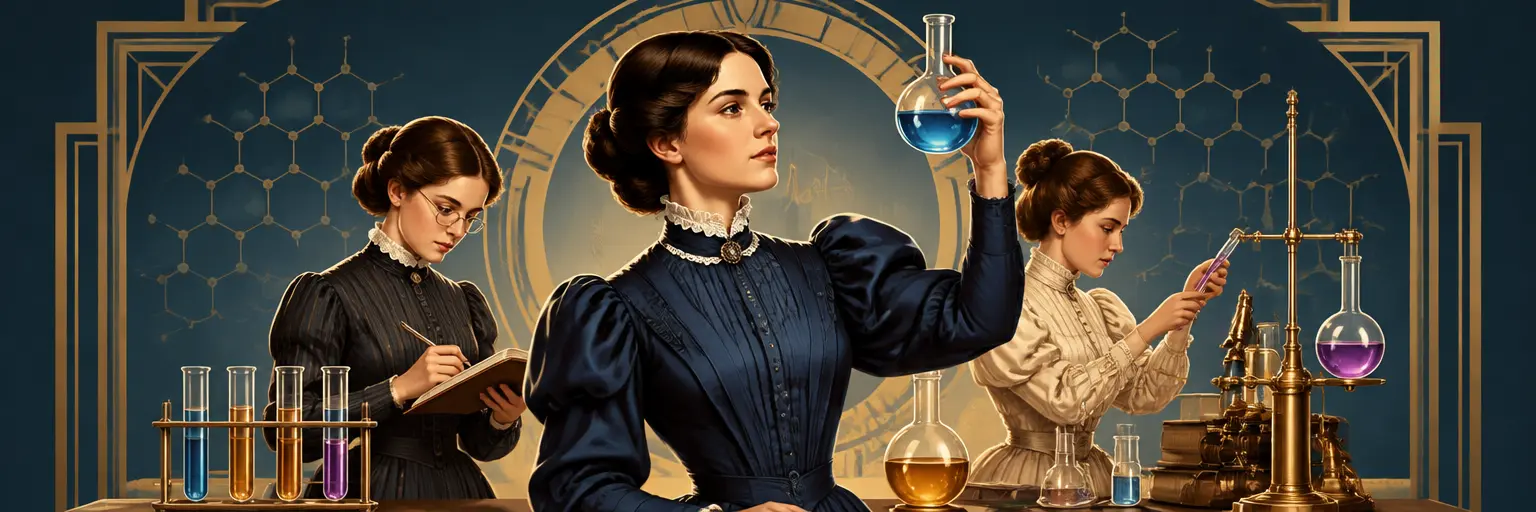
Discover the remarkable yet often overlooked stories of 19th century women in chemistry, who defied societal norms to make groundbreaking contributions in an era when science was overwhelmingly male-dominated. From the laboratory to the lecture hall, these pioneering figures—such as Marie Curie, whose early work laid foundations for radioactivity research, and Ellen Swallow Richards, a trailblazer in sanitary chemistry—overcame educational barriers and institutional exclusion to advance chemical knowledge. Explore their struggles, from denied degrees to unpaid research roles, and celebrate their enduring legacy in shaping modern chemistry. This collection highlights how their determination not only transformed scientific understanding but also paved the way for future generations of women in STEM. Dive into these inspiring biographies, detailed analyses of their experimental work, and the historical context that made their achievements all the more extraordinary. Perfect for educators, students, and history enthusiasts, this resource illuminates the vital, yet often hidden, role of women in the chemical sciences during a pivotal century of discovery.
🌟 Explore how women chemists in the 1800s faced societal skepticism and evolving public perception, revealing the challenges and breakthroughs that shaped…
Read article
😊 Discover how women’s role in table creation during the 19th century contributed to the development of the periodic table, highlighting pioneering…
Read article
🌟 Discover how 19th century women chemists transformed from domestic science enthusiasts to pioneering experts, overcoming societal barriers to make groundbreaking contributions…
Read article
🌟 Discover how 19th-century female chemists challenged prevailing dogmas, demonstrating extraordinary courage and curiosity. Their groundbreaking work paved the way for future…
Read article
🌟 Discover how 19th-century women chemists broke barriers and laid the foundation for modern science, inspiring future generations. Their pioneering work in…
Read article
🌟 Discover the inspiring stories of 19th century women chemists whose groundbreaking contributions were long overshadowed. WomenInScienceHistory.com celebrates these pioneering female scientists,…
Read article
🌟 Discover the inspiring stories of lesserknown 19th century chemists—pioneering women whose groundbreaking work often went unrecognized but fundamentally shaped the evolution…
Read articleExplore the remarkable yet often overlooked contributions of women who shaped the foundations of modern chemistry during the 1800s. This subcategory of Women in Science History focuses on the lives, struggles, and breakthroughs of female chemists—from Marie Curie’s early work to the analytical brilliance of Ellen Swallow Richards. Here, you’ll discover how these visionaries navigated a field that actively excluded them, laid the groundwork for entire disciplines, and inspired future generations. Dive into their stories of perseverance, innovation, and scientific courage.
In the 19th century, women chemists made pioneering strides despite being barred from universities and laboratories. Figures like Marie-Anne Paulze Lavoisier, who translated and illustrated her husband Antoine Lavoisier’s chemical treatises, and Agnes Pockels, who self-taught surface chemistry without formal education, exemplify this resilience. Their work in oxidation, surface tension, and atomic theory directly influenced modern chemistry. This section highlights their specific publications, experimental methods, and the scientific debates they engaged in, offering a rare window into how these women both absorbed and challenged contemporary chemical knowledge.
You’ll also learn about Mary Somerville, who synthesized disparate chemical concepts into accessible textbooks, and Marie Curie, whose doctoral research on radioactivity began in the late 1890s. Each biography includes primary source excerpts, patent records, and correspondence with male colleagues, revealing the collaborative yet unequal dynamics of the era. Expect detailed timelines, laboratory notes, and interactive maps showing where these women worked, from home labs to foreign academies—all essential for understanding the incremental, often invisible, nature of their contributions.
The 19th century denied women formal chemistry education, yet many carved their own paths through private tutoring, self-study, and audited lectures. This section examines how Ellen Swallow Richards became the first woman admitted to MIT, albeit as a “special student,” and how Laura Bassi—though earlier—set a precedent for academic women. We explore the founding of women’s colleges like Mount Holyoke and Vassar, which offered early chemistry labs, and the informal networks women built to share knowledge. You’ll find case studies of women who published under male pseudonyms or had their work credited to male relatives, revealing the systemic sexism that shaped their careers.
Furthermore, we analyze the scientific societies that denied them membership, such as the Royal Society, which only admitted women in 1945, and the alternative organizations women created, like the Women’s Medical College of Pennsylvania. Personal letters and diary entries illustrate the emotional toll of exclusion, alongside strategic responses—some women chose public advocacy, others quiet persistence. This section provides a nuanced look at how these barriers forced innovation in independent research methods, setting the stage for future laboratory reforms and gender equity movements in science.
Women in 19th-century chemistry often translated their knowledge into applied fields, notably sanitation, nutrition, and environmental analysis. Ellen Swallow Richards pioneered water quality testing and coined the term “ecology” in its modern sense, while Lydia E. Pinkham used chemistry to formulate herbal remedies—albeit controversially. This section delves into how women created entire branches like home economics or “domestic science,” which legitimized their expertise while simultaneously reinforcing gender roles. You’ll see how they combined quantitative analysis with public health advocacy, influencing public policy on food safety and waste management.
We also highlight Demeunynck’s and other overlooked figures who improved indigo dye synthesis and organic analysis for industrial use. Their work in food adulteration testing and mineral analysis directly fed into the Progressive Era’s reform movements. Detailed case studies show how these women used their unique positions—granted because the field was “unimportant”—to establish credibility in universities and government agencies. This section uncovers the strategic dual-use of “feminine” care and rigorous science, challenging readers to reconsider traditional definitions of chemical research.
For history enthusiasts and researchers, this subcategory offers annotated excerpts from 19th-century women’s lab notebooks, patents, and published papers. You’ll find transcriptions of Marie Curie’s early radioactivity notes, Agnes Pockels’ letters to Lord Rayleigh about surface films, and James Joule’s correspondence with female colleagues. Each document is contextualized with historical commentary, explaining chemical terminology, instrumentation, and societal backdrop. A dedicated translator’s note clarifies archaic terms like “phlogiston” and “oxygenated muriatic acid,” making primary texts accessible to modern readers.
Additionally, we provide a curated guide to international archives, museums, and digital collections—from the Women’s History Museum to the Royal Society’s online library—where you can locate original materials. We explain how to cross-reference marriage and census records to track a woman chemist’s career changes, a technique often necessary due to name changes. For educators, this section includes copyright-free diagrams and facsimiles suitable for classroom use. Whether you’re a student writing a thesis or a curious reader, this archival toolkit will empower your own exploration of these hidden histories.
While most known 19th-century women chemists worked in Western Europe and the U.S., this section expands the map to include Zinaida Ermolieva (Russia), Axolotl researchers in Mexico, and Chandra Mukhi Bose (India), who brought chemical techniques to their home countries. We examine how colonialism and nationalism affected their opportunities, with some women studying at European universities (like the Zurich Polytechnic, which admitted women earlier) and then returning to establish labs abroad. The influence of indigenous chemical knowledge—dyeing, metallurgy, pharmacy—on these scientists’ work is also explored, showing a two-way exchange that mainstream history often ignores.
You’ll discover lesser-known figures like Fanny Angelina Hesse, whose suggestion to use agar-agar as a medium in microbiology—from her kitchen—revolutionized bacterial culture. Also featured are Japanese chemist Kikunae Ikeda’s female collaborators who helped identify umami. Each profile includes immigration records, travel writings, and local newspapers, revealing how these women bridged cultures and methods. This global focus enriches the narrative, demonstrating that women’s chemistry was not confined to the Global North but was a worldwide movement of ingenuity and determination.
The 19th-century women chemists laid critical groundwork for modern disciplines, from radiochemistry to environmental science. This section traces direct intellectual genealogies—for example, how Marie Curie mentored early female scientists, leading to the Marie Curie Fellowships today. We analyze how the “domestic science” field evolved into modern nutrition and food safety regulation, and how the exclusionary practices of the past informed current diversity initiatives in STEM. You’ll see how their use of self-publishing and women’s networks prefigured today’s open-access scientific communication and mentoring of female academics.
Furthermore, we commemorate their posthumous recognitions, such as the naming of craters on Venus after Richards and Pockels, and the establishment of awards in their honor. This section includes interviews with contemporary women chemists who cite these pioneers as inspirations, along with timelines of legislative changes (like the admission of women to Oxbridge in the 1920s) that were partly fueled by these earlier achievements. By understanding the enduring impact, we reinforce the message that these scientists were not anomalies but essential contributors whose work continues to shape our world.
Marie-Anne Paulze Lavoisier is often cited; she translated crucial chemical texts, illustrated experiments, and edited her husband’s treatise, which established oxygen-based chemistry. Yet her work was largely uncredited. Other early figures include Agnes Pockels, who independently developed surface chemistry, and Marie Curie, whose 1890s research on radiation was foundational. No single “first” exists, but these women collectively opened the field.
Most faced outright rejection from journals and societies. Many published under male pseudonyms or had husbands/colleagues present their findings to avoid backlash. For instance, James Joule read Agnes Pockels’ paper to the Royal Society in 1886 because women couldn’t present. Even when published, their contributions were often credited or downplayed, forcing them to use correspondence and lectures to spread their work.
They relied on personal wealth, family support, or philanthropic patrons. Some took on teaching or consultancy roles within “domestic science” to earn money. For example, Ellen Swallow Richards used her MIT position to secure funding for water analysis, while others collaborated with male relatives who had lab access. A few, like Marie Curie, eventually secured international grants, but most remained self-funded—limiting the scale of their work.
The domestic science movement, popularized by Ellen Swallow Richards, helped legitimize chemistry as applied to daily life—covering food preservation, sanitation, and household chemicals. It established laboratory-based nutrition studies and led to early environmental monitoring. Though critiqued for reinforcing gender roles, it provided women with formal institutional roles and public access, proving that rigorous scientific practice could occur outside elite male academies.
Agnes Pockels’ work on surface films underpins modern surface chemistry, critical in materials science and detergent technology. Fanny Angelina Hesse’s 1881 suggestion to use agar agar in microbiology culture media is still the standard in laboratories worldwide. Marie Curie’s discovery of polonium and radium, albeit at the century’s end, laid the basis for nuclear physics and radiotherapy. Their practical innovations remain integral to science and industry.