Starlight & Struggle: The Lives of Women in Astronomy, 19001950
✨ Discover the inspiring stories of women astronomy pioneers facing historical challenges from 1900 to 1950, highlighting their groundbreaking contributions and the…
Read article
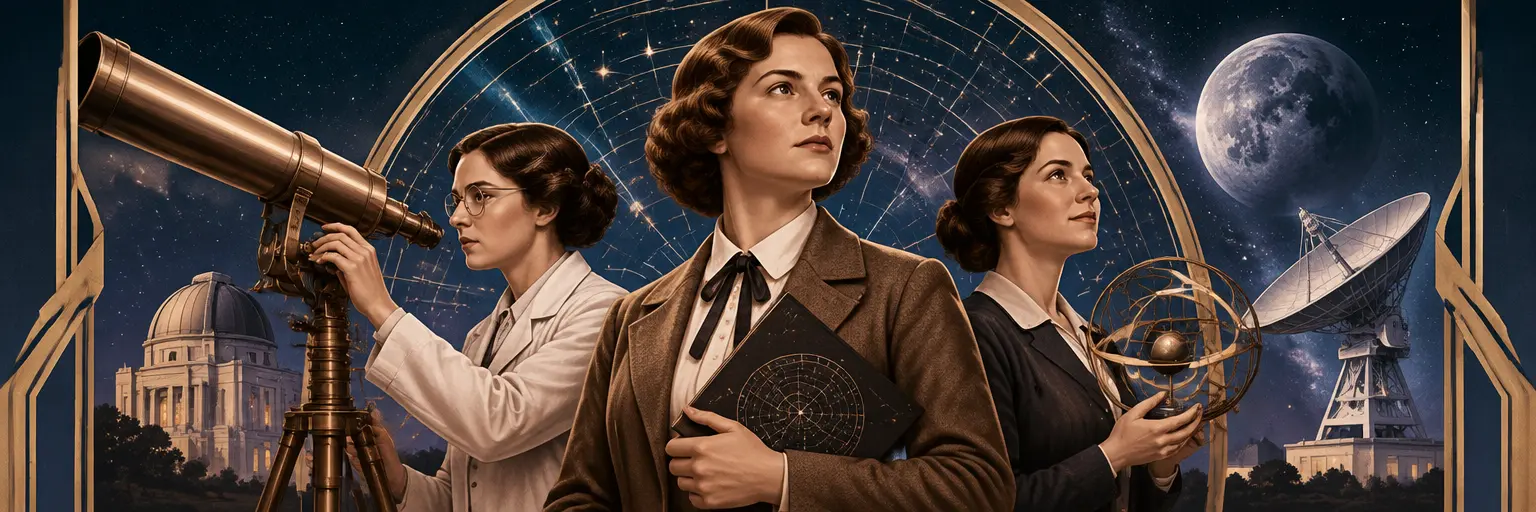
Between 1900 and 1950, as humanity first gazed beyond Earth’s atmosphere, a remarkable cohort of women quietly rewrote the rules of space science and astronomy—often without the spotlight they deserved. From computing stellar spectra by hand to pioneering photometry and cataloging distant galaxies, these trailblazers laid the mathematical and observational groundwork for modern astrophysics. Despite systemic barriers, they earned doctorates, directed observatories, and mentored future Nobel laureates, proving that the heavens were never meant to be a male-only domain. Their work in solar physics, variable star classification, and celestial mechanics not only advanced our understanding of the cosmos but also challenged the era’s rigid gender norms. This page uncovers the lives and legacy of these early 20th-century pioneers—women like Henrietta Swan Leavitt, Annie Jump Cannon, and Cecilia Payne-Gaposchkin—whose discoveries still underpin every modern star chart and deep-space probe. Dive in to see how their relentless curiosity and resilience turned astronomical odds into monumental breakthroughs, inspiring generations of women to reach for the stars.
✨ Discover the inspiring stories of women astronomy pioneers facing historical challenges from 1900 to 1950, highlighting their groundbreaking contributions and the…
Read article
🌟 Women solar observation early 20th-century pioneers meticulously documented sunspots, challenging gender norms and contributing vital insights to solar science. Their groundbreaking…
Read article
🚀 Celebrating women’s early rocket research, this article highlights pioneering female scientists who overcame gender barriers, contributed groundbreaking insights, and paved the…
Read article
🌟 The Women's telescope observation time struggle (1900-1950) highlights pioneering women overcoming gender barriers in astronomy, fighting for recognition and access, and…
Read article
🌟 Before the rise of silicon, early space human computers—primarily women—played a crucial role in pioneering space science. Their calculations and analytical…
Read article
🌟 Explore how women in astronomy research careers from 1900 to 1950 transitioned from assistants to influential figures, overcoming societal barriers and…
Read article
🌟 Women’s early space mentorship challenges often went unnoticed, yet female pioneers supported each other silently, breaking barriers in a male-dominated field.…
Read article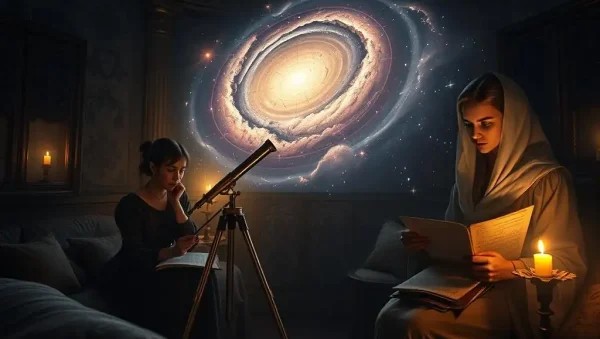
🌟 Celebrating women’s pivotal role in science, "From Pickering's Harem to Cosmic Discoveries" highlights women’s contributions to Women astronomy historical discoveries, showcasing…
Read article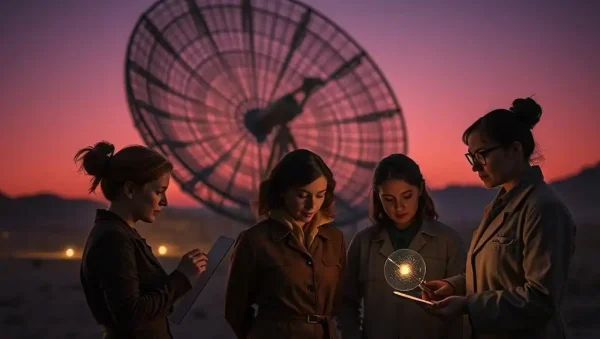
🚀 Early women space scientists broke barriers in a male-dominated field, fighting for recognition and paving the way for future generations. Their…
Read articleBefore NASA, before the first satellites, women were already charting the stars, calculating orbits, and decoding the universe's secrets. The period from 1900 to 1950 was a transformative era where a handful of brilliant women broke through academic and institutional barriers to lay the mathematical and observational groundwork for modern space exploration. This subcategory on WomenInScienceHistory.com delves into these overlooked pioneers—their lives, their discoveries, and the legacy they forged in astronomy and astrophysics. Expect engaging biographies, technical insights, and contextual history that highlight how these women shaped our understanding of the cosmos, all while overcoming systemic gender discrimination. Explore their stories and see the celestial footprints they left behind.
At the turn of the 20th century, the Harvard College Observatory hired dozens of women—often called "computers"—to process astronomical data. Under Edward Pickering’s direction, these women, including Williamina Fleming, Annie Jump Cannon, and Henrietta Swan Leavitt, performed tedious spectral classifications and discovered thousands of stars. Their work was crucial for early celestial cartography, yet they were paid less than male staff and initially denied recognition. This section highlights their daily labor, the rigorous methodology they developed, and how their systematic approach transformed stellar cataloging into a science.
These women didn't just crunch numbers; they invented new classification systems. Cannon’s stellar classification scheme (O, B, A, F, G, K, M) remains a cornerstone of astronomy today. Leavitt’s discovery of the period-luminosity relation for Cepheid variables gave astronomers the first yardstick for measuring intergalactic distances. Their contributions are central to understanding early 20th-century space science. Through original archives and modern analysis, we reveal the collaborative, often undervalued, yet absolutely brilliant work that forged the foundation for galaxies-scale astronomy—proving that progress in space science was never solely a male enterprise.
In 1925, Cecilia Payne-Gaposchkin published a doctoral thesis that fundamentally altered astrophysics: she demonstrated that stars, including our Sun, are composed primarily of hydrogen and helium. Despite initial dismissal by prominent male astronomers—notably Henry Norris Russell—her finding was later vindicated and became a foundational principle of stellar physics. This subcategory explores her early years at Cambridge, her struggle to formalize her education as a woman, and her move to Harvard, where she would eventually become the first female full professor in the faculty of arts and sciences. Her story is one of brilliant insight against rigid orthodoxy.
Payne-Gaposchkin’s work went beyond composition; she also analyzed stellar atmospheres and variable stars, publishing extensive catalogs and textbooks. Her perseverance in the face of institutional sexism is a hallmark of this era. Her meticulous spectroscopy and her ability to synthesize data paved the way for our modern understanding of stellar evolution. In this section, we also examine her mentorship of future women scientists, her role in opening Harvard’s doors, and the delayed recognition she received. Her life exemplifies how early 20th-century space science advanced despite pervasive obstacles, highlighting the intellectual tenacity of women in astronomy.
Beyond the Harvard Computers, other women made significant strides in observational astronomy and celestial mechanics between 1900 and 1950. Figures like Annie Russell Maunder, who studied sunspots and co-founded the British Astronomical Association, and Maria Mitchell’s successors, who pushed for women’s education in the sciences, shaped the field. This section examines women like Antonia Maury, who developed advanced stellar spectral classification, and Margaret Harwood, the first director of the Maria Mitchell Observatory. Their work in solar physics, star catalogs, and variable stars expanded empirical knowledge during a period of rapid telescopic advancement.
These women not only observed but also theorized, often collaborating with male counterparts while fighting for their own recognition. Their stories reveal a network of dedicated researchers who traveled, observed, and published, despite limited access to large telescopes and university positions. From measuring solar activity to tracking asteroids, their observations contributed directly to celestial navigation and astrophysical modeling. This narrative emphasizes the diversity of roles women played—observers, calculators, editors, and theorists—and how their collective yet individualistic contributions were vital to transforming astronomy from a descriptive science into a dynamic astrophysics discipline before the space race began.
The early 20th century saw women systematically excluded from PhD programs, observatory access, and academic faculty positions. Yet, through persistence and strategic alliances, several broke through. This subsection examines institutions like Vassar College, which despite being a women’s college, produced extraordinary scientists; and the role of benefactors and female philanthropists who funded research positions for women. We also discuss the gradual opening of graduate schools—women like Payne-Gaposchkin earned Harvard’s first PhD in astronomy awarded to a woman, but only after Harvard’s Radcliffe College granted the degree. These institutional victories were hard-won and set precedents for future generations.
Legal and social hurdles included restrictions on women using major observatory telescopes and attending scientific conferences. Highlighting these barriers gives crucial context to their achievements. Strategies included publishing under initials, leveraging male mentors, or creating their own societies, such as the American Association of Variable Star Observers (AAVSO), which welcomed women. The resilience in this period was extraordinary—women formed informal networks, shared data generously, and supported each other’s careers. By examining these institutional fights, we understand that the intellectual progress of space science was deeply intertwined with social progress, and each barrier broken nudged the scientific community toward more inclusive practices that would later benefit the entire field.
The women of 1900–1950 laid essential groundwork that directly enabled the post-1957 space age. Their star catalogs, spectral classifications, and distance calculations were used by later engineers and mission planners. For example, Henrietta Leavitt’s Cepheid relation was critical in determining distances that led to Hubble’s discovery of the expanding universe. This section traces how their data and techniques were integrated into the first astronomical satellite missions and the early calculations for lunar and planetary trajectories. Their legacy is not merely historical; it’s computational—the algorithmic thinking they developed informed early computer science and data processing in space agencies.
Moreover, their successes inspired the next wave of women scientists, such as those who became “human computers” at NASA in the 1950s and beyond, including Katherine Johnson. The intellectual framework and empirical databases created in this half-century became the scaffolding for modern astrophysics and space exploration. By understanding this legacy, we appreciate how overlooked female contributions are often the silent engines of monumental scientific eras. This segment connects the dots from early 20th-century star charts to modern missions, showing that the universe’s exploration is a continuum, and women have always been integral navigators on that journey.
The most influential include Annie Jump Cannon, who classified over 350,000 stars and created a spectral classification system still used today; Henrietta Swan Leavitt, who discovered the period-luminosity relation essential for measuring cosmic distances; and Cecilia Payne-Gaposchkin, who determined that stars are mostly hydrogen and helium. Also notable are Williamina Fleming for discovering hundreds of variable stars and Antonia Maury for her advanced classification methods.
Women like the Harvard Computers performed painstaking data analysis—visual inspection of photographic plates, spectral classification, and calculation of stellar positions and magnitudes. They created comprehensive star catalogs and discovered thousands of stars and nebulae. Their work was crucial for early stellar astrophysics, but they were often underpaid and not credited as authors, though their contributions were indispensable in establishing foundational astronomical databases.
Women often attended women’s colleges like Vassar or Wellesley, which offered strong astronomy programs. For graduate degrees, they faced restrictions; for instance, Cecilia Payne-Gaposchkin earned her PhD through Radcliffe College, Harvard’s women’s affiliate, as Harvard itself did not grant degrees to women. Others studied at University of California, Berkeley, or took advantage of fellowships specifically earmarked for women, gradually opening doors to university observatories.
Major observatories like Mount Wilson denied women access to telescope time, citing safety and decorum. Women like Annie Maunder observed with smaller instruments or from their own homes. They were often excluded from formal research groups and conferences. To circumvent this, some collaborated with male relatives or colleagues who would present findings, while others formed independent organizations, such as the AAVSO, to continue observational work collaboratively.
The empirical data gathered—star catalogs, spectral types, variable star light curves, and distance measurements—became the foundational dataset for all later astrophysical research. Leavitt’s Cepheid relation, for instance, enabled Edwin Hubble to measure cosmic expansion, a cornerstone of Big Bang theory. Computational methods developed by these women also influenced early programming and data analysis, which were directly applied to the first satellite missions and lunar navigation in the space race.