Women Astronauts & Cosmonauts: Pioneers Beyond Earth
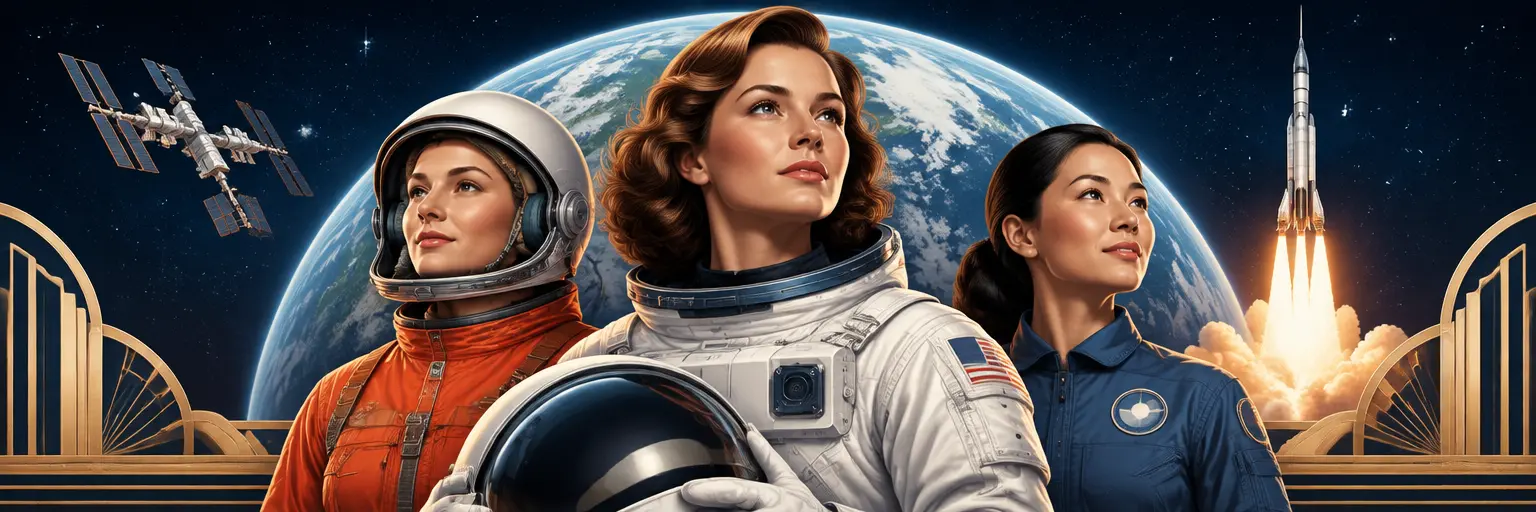
Welcome to our dedicated space on trailblazing women who shattered the stratosphere and the glass ceiling simultaneously. From Valentina Tereshkova’s first orbital flight in 1963 to the latest ISS commanders, this subcategory explores the lives, missions, and legacies of female spacefarers. Here, you’ll discover not just technical achievements, but personal sagas of resilience, training rigors, and the pivotal roles women play in advancing human spaceflight.
🚀 First Women in Space: Breaking the Ultimate Frontier
Dive into the historic firsts—Valentina Tereshkova (Vostok 6, 1963), Sally Ride (STS-7, 1983), and Svetlana Savitskaya (Soyuz T-7, 1982). We dissect their selection processes, the political and social climates they navigated, and how their missions changed public perception. Expect detailed timelines, rare quotes, and context on why their nations chose them.
Practical insight: These pioneers faced extraordinary medical and psychological testing, often more stringent than male counterparts. Their stories reveal systemic biases—like early NASA’s refusal to consider female pilots—and how determination, not just skill, carved the path. For educators and enthusiasts, this section provides primary-source anecdotes ideal for STEM history lessons.
🛰️ Modern Mission Specialists & Commanders
Focus shifts to the shuttle and ISS era: Mae Jemison (first African American woman in space), Peggy Whitson (record 665 days in orbit), Samantha Cristoforetti (first European female ISS commander), and Christina Koch (first all-female spacewalk). We analyze their mission roles—robotics, science experiments, EVAs—and leadership styles.
Key takeaway: Modern women astronauts are not anomalies but integral crew members. This section highlights logistical challenges (e.g., spacesuit sizing for female bodies) and collaborative successes, offering a behind-the-scenes view of NASA, ESA, and Roscosmos training regimes. Perfect for aspiring astronauts seeking real-world pathways.
👩🚀 Challenges & Barriers Overcome
Explore the discrimination, public scrutiny, and institutional hurdles—from the “Mercury 13” women denied official status in the 1960s to recent pushback on long-duration missions. We include archival correspondence, testimony from astronauts about sexism, and the evolution of inclusive policies like NASA’s 2013 STEM gender parity initiatives.
Why it matters: These narratives provide crucial historical context for current diversity programs. Readers gain empathy for the psychological toll, but also strategies used (mentorship, advocacy, legal challenges) that proved effective. This section is a goldmine for sociology and history papers on gender in STEM.
🔬 Contributions to Space Science & Medicine
Highlight female astronauts’ scientific output: Kathryn Sullivan’s Earth observation studies, Ellen Ochoa’s optical systems research, and Jessica Meir’s physiology experiments on microgravity’s effects. We detail specific experiments they conducted, data published, and how their work influenced space habitat design.
Educational value: This is a rich resource for science teachers—each astronaut’s bio links to peer-reviewed papers and mission logs. It underscores that women aren’t just passengers but principal investigators, engineers, and medical officers, reshaping how we understand long-term space living.
🌍 Global Perspectives: Beyond NASA & Roscosmos
Spotlight international women: Kalpana Chawla (India), Chiaki Mukai (Japan), Yi So-yeon (South Korea), and Sara Sabry (Egypt, first Arab woman). We examine how different national space agencies support female candidates, cultural barriers, and emerging programs like the UAE’s astronaut corps with Nora Al Matrooshi.
Broadened lens: This comparative approach reveals how sociopolitical contexts shape opportunities. It also showcases the global shift toward diversity, with increasing female representation in recent selection classes. Ideal for readers interested in international space policy and equality metrics.
Frequently Asked Questions
Who was the first woman in space?
Valentina Tereshkova, a Soviet cosmonaut, flew on Vostok 6 on June 16, 1963. She spent nearly three days in orbit, conducting biomedical experiments. Her selection was partly political, as the USSR aimed to outpace the US in the space race, but her parachuting background and training were vital to her success.
How many women have been to space as of 2025?
Over 80 women have flown space missions globally, with about 70 from NASA. This number grows steadily, with recent Artemis and private missions including female astronauts. Russia and China have had fewer, but China’s Wang Yaping and Liu Yang have flown since 2012.
Did NASA ever exclude women from astronaut selection?
Yes, NASA’s first astronaut class in 1959 was all-male, and women were formally barred until 1978, despite qualified female pilots like the Mercury 13 passing tests. The change came after the 1972 Equal Employment Opportunity Act and pressure from Congress and the Women’s Movement.
What was the first all-female spacewalk?
On October 18, 2019, Christina Koch and Jessica Meir conducted the first all-female extravehicular activity (EVA) outside the ISS. They replaced a power controller, marking a historic milestone and leading to improved spacesuit sizing for women.
Are there any physical restrictions for female astronauts?
No absolute restrictions remain. Early programs had arbitrary height/weight limits, but modern criteria based on task capability allow women to serve as pilots, commanders, and EVA specialists. Women’s lower average mass can even be advantageous for fuel efficiency on long missions.