Early Women in Astronomy (Pre-18th Century): Pioneers of the Stars
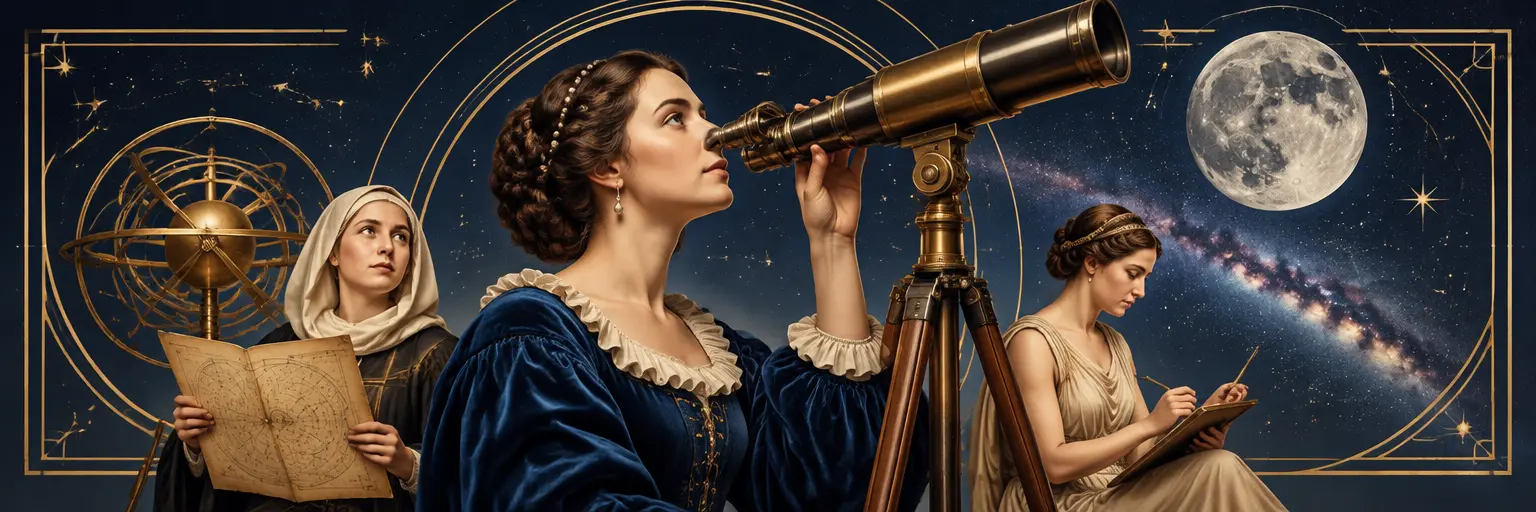
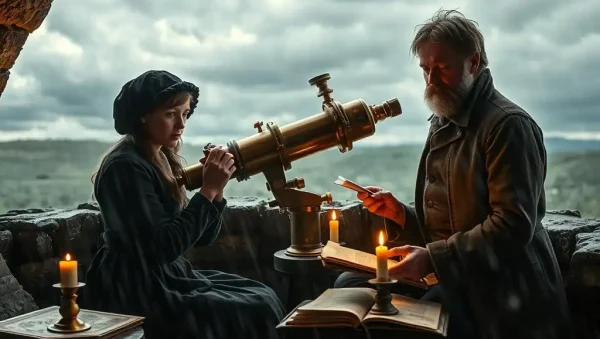
Before telescopes transformed our view of the cosmos, a remarkable group of women laid the groundwork for modern astronomy. From ancient priestesses who charted celestial cycles to medieval scholars who compiled star catalogs, these trailblazers overcame cultural barriers to observe, calculate, and interpret the heavens. On this page, we delve into their lives, their contributions, and the enduring legacy they left for future generations of female scientists.
🌟 Ancient Sky Watchers: Priestesses and Philosophers
In ancient Mesopotamia, Egypt, and Greece, women like Enheduanna (circa 2285 BCE) and Hypatia of Alexandria (circa 350–415 CE) played pivotal roles in early astronomy. Enheduanna, a Sumerian priestess, composed hymns that referenced lunar cycles and planetary movements, while Hypatia taught mathematics and astronomy, developing instruments like the astrolabe. These women worked within religious and academic institutions, translating and expanding astronomical knowledge despite societal restrictions.
Their work was not merely observational; they computed eclipses, tracked solstices, and developed calendars that guided agriculture and religious rituals. Hypatia’s commentaries on Ptolemy’s Almagest influenced later Islamic and European scholars. For visitors, this subcategory reveals how these early pioneers combined spiritual authority with scientific inquiry, proving that women’s engagement with the stars is as ancient as civilization itself.
🔭 Medieval Scholars: Preserving and Translating Knowledge
During the medieval period, women in convents and royal courts became key preservers of astronomical texts. Figures like Hildegard of Bingen (1098–1179) wrote extensively on cosmology, weaving theological and naturalistic observations of celestial phenomena into her works. In the Islamic Golden Age, women such as Mariam al-Ijliyah (circa 10th century) crafted precision astrolabes, essential tools for navigation and timekeeping.
These women translated Greek and Arabic astronomical works into Latin, ensuring that ancient knowledge survived Europe’s Dark Ages. They also recorded comets, supernovae, and planetary conjunctions, often within chronicles or medical texts. This section highlights how their meticulous documentation provided the foundational datasets later astronomers like Copernicus and Galileo would build upon, demonstrating that women’s intellectual labor was indispensable to astronomy’s continuity.
📜 Renaissance and Early Modern Contributors
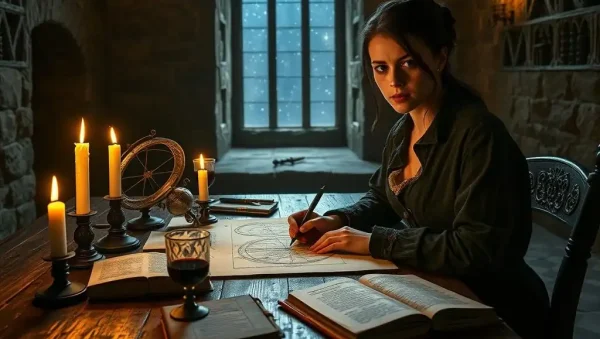
The Renaissance saw women like Sophia Brahe (1556–1643), who assisted her brother Tycho in making precise observations of planetary positions, and Maria Cunitz (1610–1664), who published Urania Propitia, a simplification of Kepler’s tables. Cunitz’s work made complex calculations accessible to practical astronomers, while Sophia’s meticulous records enabled Tycho’s model of the solar system.
These women operated at the edges of formal institutions, often working in family observatories or private laboratories. They faced accusations of witchcraft or scholarly theft, yet their contributions were critical to the shift from geocentric to heliocentric models. This subcategory explores their technical innovations, such as improved instruments and mathematical shortcuts, and how they navigated gender norms to secure their place in astronomical history.
📚 Challenges and Strategies: Overcoming Barriers
Pre-18th century women astronomers frequently lacked access to universities, telescopes, and publication channels. Many, like Elisabeth Hevelius (1647–1693), collaborated with husbands or fathers, yet performed essential observations and catalogs—Elisabeth co-authored the star catalog Catalogus Stellarum Fixarum. Others used pseudonyms or published under male patrons to share their findings.
Despite these obstacles, women developed unique coping strategies: forming intellectual networks through correspondence, conducting observations from rooftops or convent windows, and using artistic skills to create detailed sky charts. This section examines how these resourceful women turned limitations into strengths, producing high-quality data that rivaled contemporary male astronomers. Their resilience offers powerful lessons for modern scientists facing systemic barriers.
🌌 Legacy and Influence on Modern Astronomy
The early women of astronomy laid essential groundwork for later pioneers like Caroline Herschel (1750–1848) and Maria Mitchell (1818–1889). Their methodologies—systematic observation, meticulous record-keeping, and mathematical rigor—became standard practice. Moreover, their stories inspire current initiatives to increase female participation in STEM fields, as evidenced by named craters on Venus and lunar features bearing their names.
This subcategory emphasizes that the history of astronomy is incomplete without these women’s contributions. Educational institutions now include their work in curricula, and researchers revisit their notebooks for lost data. By celebrating these early pioneers, we enrich our understanding of scientific progress and challenge the misconception that women’s participation in science is a modern phenomenon. Their legacies continue to guide our exploration of the universe.
Frequently Asked Questions
Who was the first known female astronomer?
Enheduanna, a Sumerian high priestess around 2285 BCE, is often cited as the earliest named woman involved in astronomy. She composed hymns referencing lunar cycles and celestial events, demonstrating sophisticated observational knowledge. However, earlier unnamed women may have contributed to ancient calendars, which is why Enheduanna is considered the first recorded, not necessarily the first ever.
What tools did early women astronomers use?
Early women used simple instruments like sighting tubes, gnomons (shadow sticks), and water clocks to track celestial movements. Later, they employed astrolabes and quadrant devices. Hypatia and Mariam al-Ijliyah built precision astrolabes, while Sophia Brahe used naked-eye observation with compasses and sextants. These tools allowed accurate measurements of altitudes, angles, and time, forming the basis for their calculations.
Did women in medieval times contribute to astronomy?
Yes, notable medieval women included Hildegard of Bingen, who wrote about cosmology, and Mariam al-Ijliyah, an astrolabe maker. Additionally, many anonymous nuns copied and translated astronomical manuscripts, preserving Greco-Roman and Islamic knowledge. Their contributions were often integrated into religious or medical texts, but they significantly aided the transmission of astronomical data.
How did early women overcome the lack of formal education?
Many learned through family tutoring, as seen with Sophia Brahe, or in convents, which provided access to libraries and writing materials. Others self-taught via available texts and letters. They also formed collaborative partnerships with male relatives, allowing them to use observatories and equipment. Despite this, they often faced ridicule, so some published anonymously or under male names.
Why are early women astronomers often overlooked in history?
Historical records frequently credited male collaborators, erased women’s authorship, or dismissed their work as “assistance.” Additionally, women’s contributions in domestic or religious settings were undocumented. Modern historians, using archival research and reassessing manuscripts, are now recovering these narratives, but thousands of records remain lost or misattributed, perpetuating underrepresentation.