21st Century Women in Space Science & Astronomy
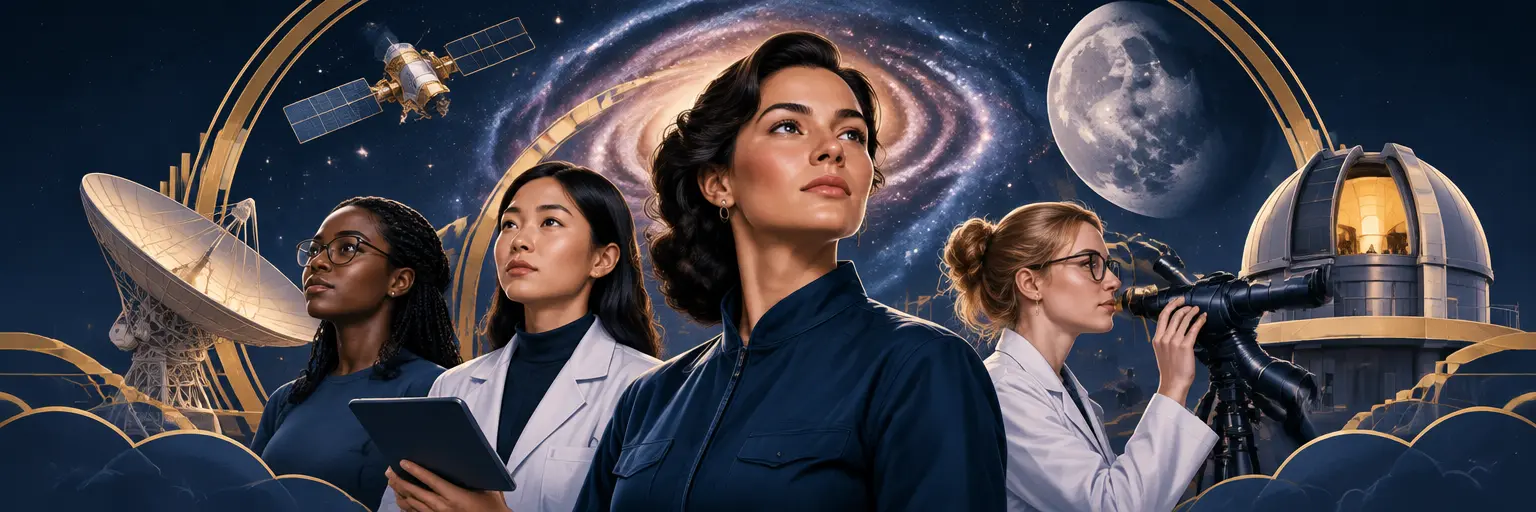
Discover the remarkable achievements of contemporary female scientists who are reshaping our understanding of the cosmos. From leading Mars rover missions to decoding black hole imagery, these women are breaking barriers and pushing the frontiers of space exploration. This page highlights their groundbreaking research, innovative technologies, and the inspiring paths they carved in a rapidly evolving scientific landscape.
🚀 Pioneering Mission Leaders and Engineers
Explore the women who command robotic explorers and design cutting-edge spacecraft. Figures like Dr. Swati Mohan, who guided the Perseverance rover’s landing, and Dr. Diana Trujillo, a flight director at NASA, exemplify technical mastery under extreme pressure. Their work involves orchestrating complex orbital mechanics, managing multi-billion-dollar projects, and solving real-time challenges millions of miles from Earth. These engineers are not just participants; they are decision-makers who shape mission success.
Beyond individual feats, these leaders foster collaborative teams across international agencies like ESA, CNSA, and private companies such as SpaceX. Their expertise spans propulsion systems, astrobiology sampling, and deep-space communication networks. By mentoring younger scientists and advocating for inclusive hiring practices, they ensure the next generation of space explorers reflects the diversity of our planet. Their careers demonstrate that leadership in space science requires relentless curiosity, resilience, and a visionary approach to problem-solving.
🔭 Unraveling Cosmic Mysteries: Astrophysicists & Cosmologists
Delve into the theoretical frontiers with women studying dark matter, gravitational waves, and galaxy evolution. Dr. Priyamvada Natarajan has pioneered models of black hole formation, while Dr. Gabriela González co-led the LIGO team that first detected ripples in spacetime. These researchers analyze vast datasets from telescopes like Hubble and James Webb, using supercomputers to simulate the universe’s earliest moments. Their work redefines fundamental physics and challenges previous assumptions about cosmic structure.
These scientists often translate abstract mathematics into tangible insights, such as mapping the distribution of unseen dark matter or calculating the spin of supermassive black holes. Their discoveries frequently make global headlines, yet they also engage in public outreach, explaining complex phenomena through documentaries and social media. By combining observational precision with creative theoretical modeling, they offer new perspectives on humanity’s place in the universe, inspiring both peers and aspiring physicists worldwide.
🛰️ Innovators in Space Technology & Instrumentation
Learn about the women engineering the sensors, cameras, and spectrometers that capture unprecedented cosmic data. Dr. Kenda Furr develops advanced optical systems for satellite imaging, while Dr. Asma Zaheer works on radiation-hardened electronics for deep-space probes. These innovators focus on miniaturization, energy efficiency, and reliability in extreme environments—from scorching Venusian heat to frigid lunar shadows. Their inventions enable new discoveries, from mapping exoplanet atmospheres to monitoring Earth’s climate from orbit.
Their work also bridges hardware and software, integrating machine learning algorithms that autonomously identify celestial objects. Many collaborate with commercial aerospace firms, accelerating the transition from laboratory prototypes to flight-ready hardware. By patenting novel designs and publishing open-source blueprints, they democratize access to space technology. These women exemplify how engineering ingenuity expands the boundaries of what telescopes can see and what spacecraft can achieve, making ambitious missions financially and technically viable.
🌌 Astronomers Decoding Exoplanets & Stellar Lifecycles
Meet the scientists searching for habitable worlds and understanding the birth and death of stars. Dr. Natalie Batalha, a key figure in the Kepler mission, helped confirm thousands of exoplanets, while Dr. Enrico Ramirez-Ruiz (a collaborator) studies stellar explosions. These astronomers use transit photometry, radial velocity, and direct imaging to characterize atmospheres, temperatures, and orbital dynamics. Their goal is to identify biosignatures—potential indicators of life—on rocky planets within habitable zones of distant star systems.
Beyond discovery, these researchers investigate how stellar phenomena like supernovae seed the universe with heavy elements essential for life. They often lead international observing campaigns, coordinating ground-based and space telescopes for simultaneous coverage. By analyzing the chemical fingerprints of atmospheres, they build robust models of planetary evolution. Their work directly informs future missions like the Habitable Worlds Observatory, shaping our search for life beyond Earth and deepening our understanding of our own solar system’s formation.
🛸 Advocates for Inclusive Space Policy & Education
Highlighting women who influence institutional change and public engagement in space science. Dr. Simeon Barber (an ESA scientist) and Dr. Aomawa Shields (an astrobiologist and advocate) merge research with activism, pushing for equitable access to data, funding, and career opportunities. They lead initiatives like the “Women in Planetary Science” network, mentor underrepresented students, and advise government agencies on diversity metrics. Their advocacy ensures that space exploration benefits all of humanity, not just a privileged few.
These leaders also design curriculum frameworks that integrate space science into K-12 education, using accessible tools like homemade spectroscopes and virtual planetarium software. They write policy briefs that influence national research priorities, ensuring that long-term projects receive sustained funding. By speaking at UN conferences and grassroots events, they bridge the gap between high-level science and community engagement. Their work proves that scientific progress is deeply intertwined with social justice, and that inclusive policies lead to more innovative and resilient space programs.
Frequently Asked Questions
Who are some prominent 21st-century female space scientists?
Notable figures include Dr. Swati Mohan (NASA JPL engineer), Dr. Gabriela González (LIGO), Dr. Natalie Batalha (exoplanet researcher), and Dr. Priyamvada Natarajan (black hole theorist). Each has made significant contributions to space exploration, from Mars rover landings to gravitational wave detection, serving as role models for aspiring scientists worldwide.
What challenges do women still face in space science careers?
Despite progress, women often encounter implicit bias, unequal access to funding, and fewer leadership opportunities. They may also struggle with work-life balance in high-demand roles. However, active mentorship programs, transparent hiring practices, and institutional policies on harassment are gradually mitigating these barriers, though systemic change remains an ongoing process.
How can I support women in space science?
You can support by donating to organizations like the Association for Women in Science, amplifying female scientists’ work on social media, and advocating for diverse speaker panels at conferences. Additionally, mentoring young girls interested in STEM and challenging gender stereotypes in classrooms and homes creates a more supportive ecosystem for future talent.
What are the biggest recent discoveries led by female astronomers?
Recent breakthroughs include the first direct image of a black hole (with Dr. Jessica Dempsey contributing to the EHT), the detection of gravitational waves from neutron star mergers (with Dr. Gabriela González), and the characterization of TRAPPIST-1’s Earth-sized planets (with Dr. Michaël Gillon’s team, including Dr. Elsa Ducrot). These discoveries have revolutionized our understanding of cosmic phenomena.
Are there specific scholarships for women in astronomy?
Yes, several exist, including the AAUW International Fellowships, the Google Women Techmakers Scholars, and the L’Oréal-UNESCO For Women in Science program. Additionally, many universities offer dedicated research assistantships and travel grants for female graduate students, and professional societies often provide awards to support early-career researchers in astronomy and aerospace engineering.