Women in Organic Chemistry: Pioneers of Molecular Discovery
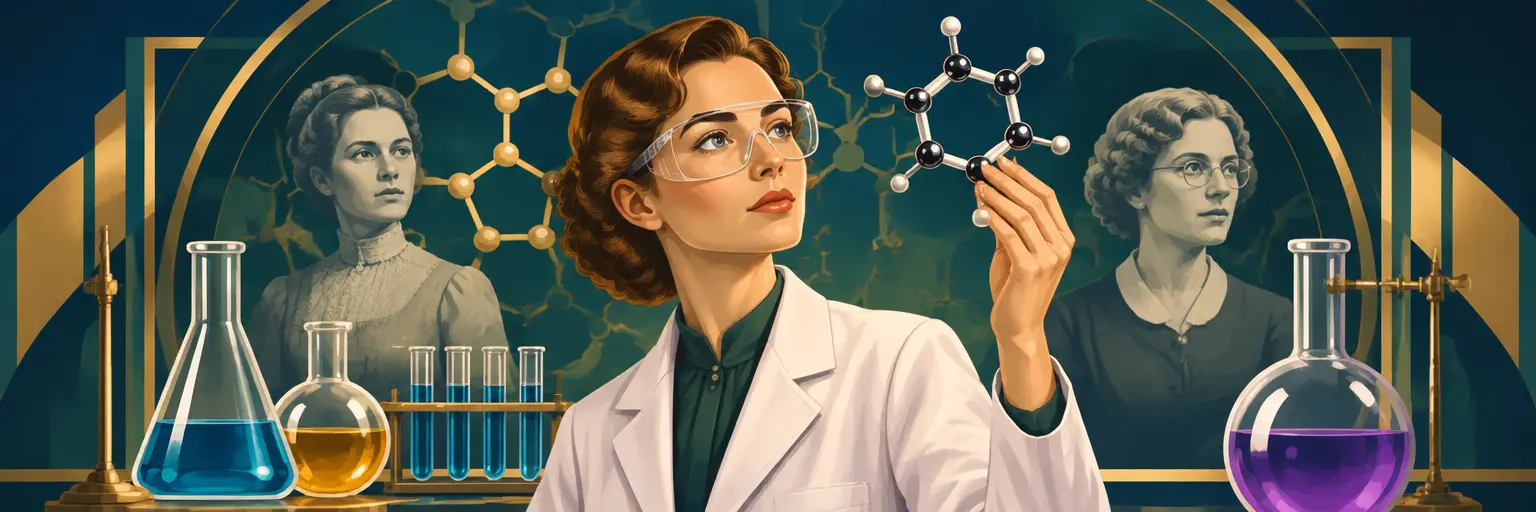
Explore the remarkable contributions of female chemists who shaped organic chemistry—from structural elucidation to synthetic methodology. This page honors their legacies, revealing how they overcame institutional barriers to decode molecular structures, devise catalytic reactions, and lay foundations for modern pharmaceuticals, polymers, and materials science. Their stories combine rigorous experimentation with resilience, offering invaluable lessons for aspiring scientists.
🔬 Trailblazing Structural Elucidation: Women Who Decoded Molecules
Women in organic chemistry have been central to determining the three-dimensional architecture of complex natural products, often before advanced spectroscopy existed. Dorothy Crowfoot Hodgkin, for example, used X-ray crystallography to map penicillin, vitamin B12, and insulin, earning a Nobel Prize in 1964. Her work required painstaking calculations and innovative heavy-atom techniques, proving that precision and perseverance overcome scarce equipment.
Similarly, Kathleen Lonsdale’s crystallographic studies on benzene and hexachlorobenzene clarified aromaticity and bond lengths, influencing modern understanding of resonance. These chemists also mentored younger women, creating informal networks that shared data and troubleshooting strategies. Their structural insights directly enabled synthetic routes to antibiotics and hormones, demonstrating that molecular mapping is not just academic—it is lifesaving. Expect to learn how these pioneers turned ambiguous diffraction patterns into concrete molecular truths.
⚗️ Synthetic Methodology Innovators: Building Bonds and Breaking Barriers
Organic synthesis owes much to women who invented or refined reactions now found in every textbook. Alice Ball developed the “Ball Method” for synthesizing chaulmoogra oil derivatives, the first effective treatment for leprosy in the early 20th century—though her credit was initially erased. This work required esterification and careful handling of unsaturated fatty acids, a breakthrough for medicinal chemistry.
Later, Mary L. Good pioneered organometallic catalysis, particularly for olefin polymerization, influencing industrial production of plastics and rubbers. Also notable is Linda M. Sweeting, who improved the synthesis of heterocyclic compounds used in agrochemicals. These chemists combined theoretical mechanistic reasoning with intuitive lab techniques, often working in underfunded settings. Their legacy includes not only new reactions but also robust methodological frameworks that prioritize reproducibility—a standard that modern labs still follow.
🧪 Natural Product Chemistry: From Plants to Pharmaceuticals
Natural product isolation is a domain where women excelled, transforming folk remedies into standardized medicines. Mary Lever née Hill identified the active alkaloid in ergot, leading to ergotamine’s use for migraines. Later, chemist Margaret Shepard Todd synthesized vitamin C analogs, though her male collaborator often received sole publication credit. These efforts required extraction, chromatographic separation, and spectral interpretation.
More recent contributions include the work of Yasmin Khambatta, who studied terpenoid biosynthesis in neem trees, enabling eco-friendly pesticides. Additionally, chemist Tsuneko Okura-Ryder characterized antifungal metabolites from marine sponges, opening avenues for new antibiotics. By bridging botany and organic chemistry, these women demonstrated that nature’s complexities could be translated into scalable, purified compounds. Their protocols for isolation and structure confirmation remain pillars of pharmacognosy.
🔗 Physical Organic Chemistry: Women Explaining Reaction Mechanisms
Beyond synthesis, women in physical organic chemistry advanced kinetic and thermodynamic explanations for how reactions proceed. Edith Aubrey, a contemporary of Ingold, offered foundational studies on nucleophilic substitution (SN1/SN2) pathways using isotopic labeling. Her meticulous kinetic measurements clarified carbocation stability and solvent effects—concepts now taught in introductory courses.
Similarly, chemist Marge Hofmann used computational methods in the 1980s to model pericyclic reactions, bridging experiment and theory. Her work on orbital symmetry rules helped predict stereochemistry, reducing reliance on trial-and-error. These researchers also championed safe handling of reactive intermediates, advocating for improved lab safety standards. Readers will appreciate how their mechanistic interpretations underpinned catalyst design and helped explain unusual rate orders, making organic chemistry more predictive and less empirical.
🏆 Overcoming Systemic Challenges: Advocacy and Mentorship
Equal to their scientific output, women in organic chemistry confronted exclusion from research societies, publishing bias, and lower pay. Figures like Gertrude B. Elion, who developed drugs for leukemia and herpes, fought for academic appointments and later championed open-access drug patents. Their activism created support groups like Women Chemists Committee (ACS) and forced data transparency in career progression.
Mentorship pipelines were crucial: senior women often sponsored junior researchers, ensuring skills transfer despite hostile departmental climates. For instance, Mildred Cohn trained many female postdocs in NMR techniques, and later mentored them into industry leadership. These efforts normalized women’s presence in labs and boardrooms. This section highlights practical strategies—negotiation tactics, collaborative research, and public outreach—that overcame glass ceilings. Expect inspiring anecdotes on how resilience plus scientific excellence broke institutional inertia, shaping today’s more inclusive chemistry community.
Frequently Asked Questions
Who was the first female Nobel laureate in organic chemistry?
Dorothy Crowfoot Hodgkin was the first woman to win the Nobel Prize in Chemistry (1964) specifically for organic structural analysis, using X-ray techniques on biomolecules. Previous female laureates, like Marie Curie, had not specialized in organic chemistry. Hodgkin’s award validated crystallography as essential to organic chemistry and inspired many women to pursue structural work.
What is the Ball Method and why does it matter?
Alice Ball developed the Ball Method in 1916 to create an injectable form of chaulmoogra oil, treating leprosy effectively for the first time. She converted the oil’s fatty acids into ethyl esters, making them water-soluble. Though she died young and credit was initially stolen, her method became standard until sulfone drugs appeared.
How did women contribute to organometallic chemistry?
Mary L. Good and other women advanced organometallic catalysis, notably for olefin polymerization and cross-coupling reactions. They optimized ligands and reaction conditions, improving catalyst turnover numbers. Their mechanistic studies aided industrial production of polymers, agrochemicals, and pharmaceuticals, proving women’s vital role in applied organic synthesis.
Are there women who pioneered computational organic chemistry?
Yes, Marge Hofmann and later scientists like Anna Krylov used quantum calculations to model reaction pathways and transition states. Their work predicted stereoselectivity and reactive intermediates, reducing laboratory trial-and-error. Their algorithms and databases are now integrated into software like Gaussian and ORCA, widely used for mechanistic predictions.
What modern challenges remain for women in organic chemistry?
Today, women still face publication bias, lower grant funding, and underrepresentation in senior academic ranks. However, mentorship networks, mandatory diversity reports, and equitable parental policies are improving retention. Initiatives like the WCC and #MyChemSciStory highlight successes, but structural fixes in hiring and promotion are ongoing. Supporting female-led labs and citing their work helps normalize equality.