Mid-Late 20th Century Women in Biology & Medicine (1950-2000)
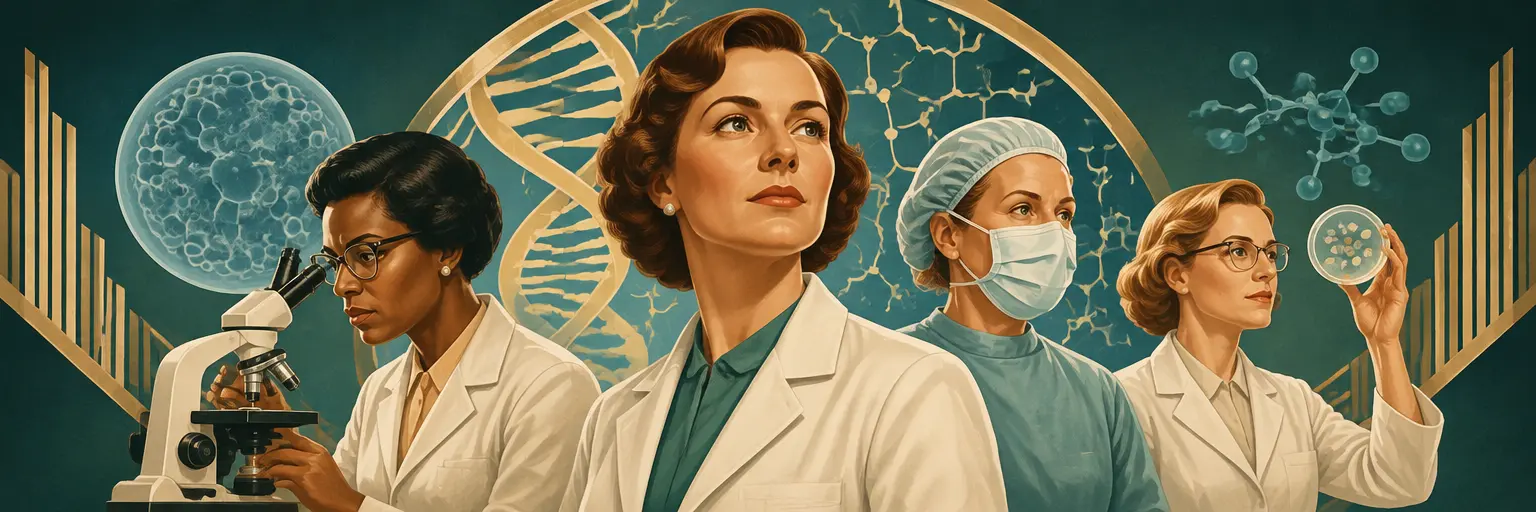
Welcome to our focused exploration of the remarkable women who shaped biology and medicine between 1950 and 2000. This transformative era saw female scientists break through institutional barriers, pioneer groundbreaking research, and redefine medical practice—yet many of their stories remain undercelebrated. Here, we honor their contributions, from genetic discoveries to public health innovations.
🔬 Pioneering Geneticists & Molecular Biologists
Key figures like Rosalind Franklin (whose X-ray diffraction images were critical to DNA discovery) and Barbara McClintock (Nobel Prize in Physiology or Medicine, 1983, for mobile genetic elements) epitomize this era. Their work laid foundations for modern genomics, but they often worked without credit or recognition. Our profiles detail how they navigated exclusion from labs and publications, and how their persistence transformed genetics.
Expect to find detailed timelines of their experiments, personal correspondence excerpts, and analysis of how their discoveries influenced later technologies like CRISPR. We also highlight lesser-known contributors, such as Esther Lederberg, who pioneered bacterial genetics and developed replica plating. Understanding their struggles—from denied tenure to erased authorship—provides crucial context for today’s equity debates in science.
🧬 Medical Innovators & Clinical Pioneers
Between 1950 and 2000, women like Virginia Apgar (creator of the Apgar Score) and Helen Taussig (founder of pediatric cardiology) revolutionized patient care. The era also featured microbiologist Gladys Hobby, whose work led to the mass production of antibiotics. Their bold clinical approaches saved millions of lives, yet many faced skepticism from male peers questioning their authority at the bedside.
Our narratives dive into the practical challenges—from restricted hospital access to unequal pay—while celebrating breakthrough procedures and diagnostic tools these women invented. We also chronicle how they mentored younger female physicians, building networks that supported future leaders. By highlighting their patient-centered philosophies, we show how their humanistic approach reshaped medical ethics, not just techniques.
🌍 Public Health & Epidemiology Champions
Women like Alice Hamilton (industrial toxicology) and Dame Cicely Saunders (palliative care) led crucial public health advancements during this period. Their work addressed occupational hazards, chronic illness, and end-of-life care, bringing equity dimensions into medicine. In the 1980s, epidemiologists like Donna Shalala (later U.S. Secretary of HHS) pushed for gender-inclusive research protocols that remain vital today.
Explore case studies of epidemic responses led by women—from polio vaccine trials to early AIDS activism—that demonstrate their role in shaping global health policy. We also profile pioneers in reproductive health, including Elsimar Coutinho’s collaborators, who fought for safe birth control options. Their community-centered approaches often challenged paternalistic models, advocating for informed consent and patient autonomy.
🧫 Organismal Biologists & Ecologists
This subcategory honors women who studied whole organisms and ecosystems, such as ecologist Rachel Carson (whose “Silent Spring” catalyzed the environmental movement) and marine biologist Sylvia Earle, who pushed deep-sea exploration. Their fieldwork was often physically demanding and underfunded, yet they produced foundational data on biodiversity and conservation. We highlight their transdisciplinary methods connecting biology with activism.
Expect field notes excerpts, expedition logs, and interviews with living scientists who continue their legacies. We examine how these women overcame stereotypes that dismissed their outdoor research as unladylike, and how they leveraged public communication to rally support for environmental protections. Their holistic view of organisms-in-habitats presaged today’s ecosystem medicine and climate-health intersections.
🏥 Institutional Barriers & Legislative Wins
Beyond lab work, these women fought systemic sexism—from equal admission to medical schools (e.g., the 1970s Title IX impact) to federally mandated inclusion of women in clinical trials (NIH Revitalization Act of 1993). Trailblazers like Bernadine Healy, first female NIH director, and Gertrude Elion, Nobel laureate pharmacist, exemplify policy-driven change. Their advocacy created pipelines for future generations.
Our deep dives cover specific policies, affirmative action milestones, and institutional reports they authored. We also feature oral histories from women who sued employers for discrimination and won. Their strategies—forming professional societies, lobbying Congress, and building mentorship programs—offer replicable models for todays’ diversity efforts. This section emphasizes that scientific progress is inseparable from social justice.
Frequently Asked Questions
Why focus specifically on 1950-2000 for women in biology and medicine?
This half-century saw dramatic shifts: antibiotics, DNA sequencing, and reproductive rights, yet women’s roles remain underdocumented. It bridges the heroic “first wave” pioneers and the modern era, capturing institutional reforms like Title IX and NIH inclusion laws. Understanding this period helps contextualize current gender gaps in scientific leadership.
Who are some lesser-known women from this era that deserve more attention?
Examples include Esther Lederberg (bacterial genetics), Dorothy Crowfoot Hodgkin (X-ray crystallography, Nobel 1964), and Mary Sherman Morgan, who developed rocket fuel (a chemical engineering spinoff). Also Susan Love, breast cancer surgeon advocate, and Jane Wright, oncology pioneer who developed chemotherapy methods. Our biographies unearth these hidden figures.
What were the main barriers these women faced?
Barriers included limited access to graduate programs, refusal of hospital privileges, wage gaps, and exclusion from male-only professional networks. They also faced “matilda effect” where male colleagues or supervisors received credit for their work. Marriage bans at universities were common until the 1960s, forcing many to choose between careers and families.
How did their work influence modern medicine?
Their innovations range from the Apgar Score (neonatal assessment) to the development of immunosuppressive drugs for organ transplants. They also championed evidence-based medicine, rigorous clinical trial protocols, and patient-centered care. Their advocacy led to mandatory inclusion of women and minorities in NIH-funded research, making treatments safer for all.
Are there any living legends from this period still active today?
Yes—for instance, Sylvia Earle (born 1935) continues ocean exploration, and Flossie Wong-Staal (1946-2020) co-discovered HIV as the cause of AIDS. Others like Linda Buck (Nobel 2004, but research largely in 1980s-90s) remain active. We provide updates on their current initiatives and foundations they support.