Global Impact: Women Biologists & Medics Beyond Borders (19001950)
🌍 Explore how women biologists and medics shaped global medical history (1900-1950), breaking barriers and pioneering innovations. This article highlights their vital…
Read article
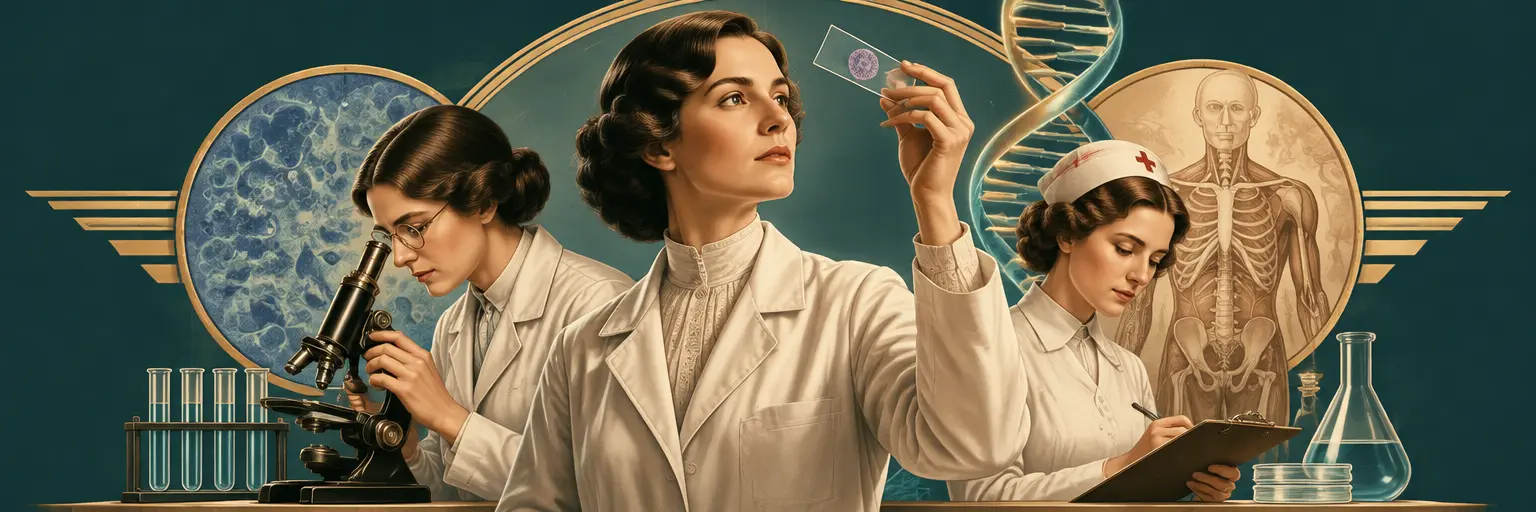
Step into a transformative era when pioneering women in biology and medicine broke through barriers to reshape healthcare and scientific understanding. Between 1900 and 1950, female scientists and physicians—often working against systemic exclusion—made groundbreaking discoveries in genetics, microbiology, endocrinology, and public health, from uncovering the mechanisms of cancer to developing life-saving vaccines. This collection highlights their relentless curiosity, resilience, and unheralded contributions, offering a powerful lens on how these trailblazers navigated a male-dominated world and laid the foundations for modern biomedical science. Explore their stories of innovation and advocacy, and see how their legacies continue to inspire diverse voices in STEM today.
🌍 Explore how women biologists and medics shaped global medical history (1900-1950), breaking barriers and pioneering innovations. This article highlights their vital…
Read article
🌟 Women scientists faced significant journal publishing challenges between 1900-1950, navigating male-dominated scientific communities. This article highlights their resilience and pioneering efforts,…
Read article
🌟 Women’s science motherhood early 1900s encapsulates the struggles and triumphs of pioneering women balancing groundbreaking research with societal expectations of motherhood,…
Read article
🌟 Discover how women's medical innovation historical recognition from 1900 to 1950 has often been overlooked, as pioneering women faced barriers and…
Read article
🌿 Celebrating women naturalists biology history, this article highlights pioneering female scientists from 1900-1950 who transformed science through fieldwork and laboratory research,…
Read article
🌟 Women discovering early drugs played a crucial role in shaping modern pharmacology before 1950, breaking barriers and pioneering lifesaving treatments. Their…
Read article
🔍 Discover the hidden medical research pioneer women behind "The Secret Lab," unveiling the clandestine work of a daring female scientist from…
Read article
🌟 Dr. Barbara McClintock's groundbreaking work in identifying a key genetic disorder before 1950 revolutionized genetics. Her pioneering efforts, often overlooked, exemplify…
Read article
🌟 Explore how women in medical school between 1900 and 1950 challenged gender norms, broke barriers, and paved the way for future…
Read article
✨ Discover how Dorothy Hodgkin's pioneering work in the 1940s unveiled the penicillin structure, a breakthrough that revolutionized medicine and showcased women’s…
Read articleBetween 1900 and 1950, women in biology and medicine broke through systemic barriers to make discoveries that redefined healthcare, genetics, and public health. Despite limited access to universities, funding, and professional recognition, these trailblazers—from cytogeneticists to epidemiologists—laid the groundwork for modern treatments and scientific methods. This subcategory explores their lives, their laboratory breakthroughs, and the enduring impact of their work, offering rich narratives for educators, students, and history enthusiasts. Here, you’ll find detailed biographies, contextual analyses of their challenges, and the legacy of women who turned adversity into scientific triumph.
This era saw women like Nettie Stevens, who discovered chromosomal sex determination in 1905, and Alice Ball, whose chemical extraction technique made chaulmoogra oil injectable for leprosy treatment. Their work often went uncredited, yet it underpinned advances in heredity and microbiology. You’ll explore how they navigated labs that excluded them from formal degrees, using persistence and mentorship to publish under male collaborators or in obscure journals. Expect detailed case studies of their experiments, the institutional resistance they faced, and how their findings were later validated by mainstream science.
Women such as Florence Rena Sabin, the first female full professor at Johns Hopkins, used cellular anatomy to map lymphatic and blood vessel development, directly influencing surgical practices. By spotlighting their methodology—from microscopy to chemical assays—this section reveals the technical rigor behind their achievements. It also underscores how their gender shaped both their research focus (often in genetics or pediatric medicine) and the dismissive critiques they encountered, making their successes all the more remarkable.
In clinical settings, women like Sara Josephine Baker transformed urban public health by creating child hygiene programs that reduced infant mortality in New York City by 40% between 1908 and 1923. Similarly, Virginia Apgar developed the Apgar Score in 1952, a rapid newborn assessment tool still used globally. This segment examines how these women moved from bedside roles to proactive population health leadership, often facing accusations of overstepping gendered bounds. You’ll find detailed narratives of their fieldwork, legislative advocacy, and the statistical methods they employed to prove their programs’ efficacy to skeptical male-dominated boards.
Expect profiles of physicians like Mary Lydia Hastings Shattuck, who pioneered tuberculosis sanatorium care, and pathologists like Alice Hamilton, whose industrial toxicology research led to workers’ safety laws. Each story is framed within the broader medical landscape—wartime shortages, epidemics, and the rise of antibiotics—showing how women adapted to and shaped urgent health crises. The section also highlights their teaching roles, as many trained future female doctors and nurses, creating networks that sustained women’s progress in medicine.
Women in this period confronted a triple bind: limited access to doctoral programs, exclusion from research fellowships, and salary discrimination, often paid half of male colleagues. For instance, biochemist Gerty Cori, despite winning the 1947 Nobel Prize, held an unpaid research position at Washington University for years. This section dissects these systemic hurdles, using archival records, personal letters, and academic memoirs to illustrate their daily struggles—from being barred from faculty dining rooms to having male peers claim credit for their findings. You’ll also learn practical strategies they used: creating all-female research labs, publishing under initials, and forging alliances with sympathetic male mentors.
Their resilience is evidenced in institutions like the Cold Spring Harbor Lab, which allowed female researchers in the 1930s, or the Women’s Medical College of Pennsylvania, which offered doctorates when Ivy League schools refused. This content provides a granular view of how they navigated visa restrictions, funding gaps, and family expectations, often delaying marriage and children. By foregrounding these barriers, we honor their grit and offer critical lessons for contemporary equity debates in STEM fields.
Many of these women were posthumously acknowledged—such as Nettie Stevens, whose chromosomal discovery was initially attributed to her male colleague, and later celebrated with a 2005 U.S. Postal Service stamp. This section traces how their legacies were reclaimed, from mid-century obituaries to modern databases like Wikidata and Wikipedia edit-a-thons. It also examines ongoing memorializations, including named lectureships, building dedications, and museum exhibits that correct historical erasure. You’ll discover how their work influenced later generations, including luminaries like Barbara McClintock, who cited Stevens’ research in her own Nobel-winning maize cytogenetics.
We also analyze the uneven nature of recognition—some women, like Florence Sabin, gained official accolades (Alfred Einstein Award, 1929), while others remain obscure due to lost records or early retirement. This content encourages readers to explore primary sources, such as oral histories or lab notebooks, to reconstruct forgotten contributions. By linking their stories to contemporary initiatives like the UNESCO Women in Science program, this section positions their legacy as both historical and actively evolving, compelling readers to continue the detective work of recovering overlooked scientific pioneers.
Beyond achievements, these women serve as powerful mentors across time. Their perseverance offers tangible lessons for young scientists: how to handle rejection (e.g., multiple denied scholarships), negotiate for fair credit, and pivot when research lines hit dead ends. This section distills actionable advice, based on their writing and interviews, such as Emily G. Boehme’s advocacy for collaborative research to circumvent isolation. We also include practical educational resources—lesson plans, primary source guides, and discussion prompts—ideal for teachers integrating women’s history into biology or medical curricula. Every profile includes a “What You Can Learn” box, connecting their struggles to modern issues of gender bias and work-life balance.
Additionally, we highlight how their paths diverged: some chose clinical practice, others academic research, a few went into public policy. This variety shows that “success” in science is multifaceted, not solely defined by publications or awards. Their stories, from the lab bench to legislative chambers, encourage readers to envision themselves in various roles—scientist, administrator, educator—while emphasizing that unconventional routes can yield profound impact. Through these narratives, we aim to spark curiosity and resilience, showing that determination, curiosity, and community can overcome even the most daunting professional barriers.
Gerty Cori received the Nobel Prize in Physiology or Medicine in 1947, alongside her husband Carl Cori, for their discovery of the catalytic conversion of glycogen. Their work explained how glucose is stored and released in the body, fundamental to metabolic research. Despite her equal contributions, Gerty initially held an unpaid research position, illustrating the era’s gender barriers.
Alice Ball developed the “Ball Method” in 1916, a chemical process to make chaulmoogra oil injectable and water-soluble, enabling the first successful treatment for leprosy. Her technique eased patients’ symptoms and reduced their contagiousness. Tragically, she died at age 24, and her contribution was credited to colleagues for years until being formally recognized in 2007.
Baker introduced public health measures such as training nurses for home visits, promoting breast milk over unsterilized cow’s milk, and establishing curbside clinics and birth registration systems. Through data-driven campaigns, she slashed the infant mortality rate by 40% from 1908 to 1923. Her work served as a global model for urban public health.
During that period, most universities had explicit policies barring women from faculty positions, research fellowships, or even enrollment in doctoral programs. Reasons included paternalistic views that women’s minds were unsuited for rigorous science, fears of competition for men, and social expectations of domestic roles. Women often worked as unpaid assistants or in “women’s colleges” until the mid-century.
Stevens’ 1905 research on mealworms proved that chromosomes determine sex—specifically, that sperm carrying an X or Y chromosome decides offspring sex. Her work countered earlier theories and laid the foundation for modern cytogenetics. Although frequently overshadowed by fellow scientist Edmund Wilson, modern historians recognize her as a co-discoverer of chromosomal sex inheritance.