Early Women in Biology & Medicine (Pre-18th Century): Forgotten Pioneers of Healing and Discovery
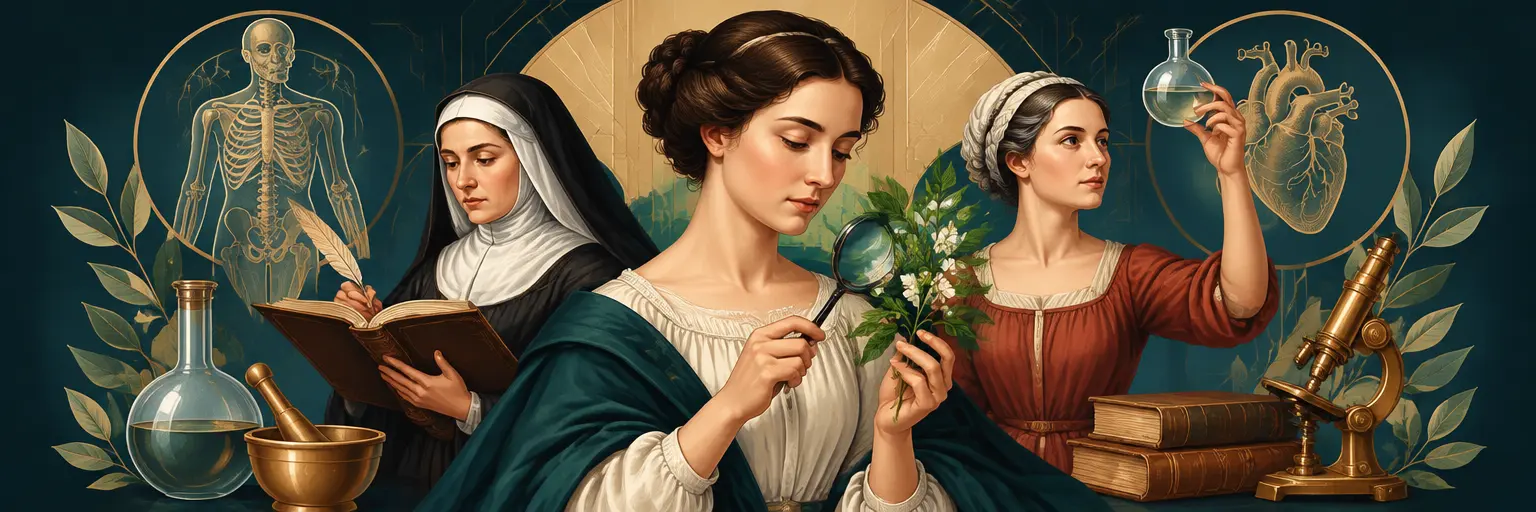
Long before modern laboratories or formal universities admitted women, female healers, botanists, and physicians were quietly shaping the foundations of biology and medicine. This subcategory uncovers the remarkable stories of women who practiced herbal medicine, studied anatomy, authored medical texts, and advanced obstetric care from antiquity through the 17th century. Their contributions—often dismissed or credited to male contemporaries—remain vital to understanding the true history of science. Here, you’ll discover how these resilient figures overcame societal barriers, using observation, tradition, and innovation to heal communities and challenge medieval and Renaissance norms.
🌿 The Herbalists and Root Doctors: Women as Early Pharmacologists
Women in pre-18th-century societies were often the primary custodians of botanical knowledge. Figures like Hildegard of Bingen (12th century) compiled extensive medicinal plant catalogs, while anonymous she-wisewomen passed down remedies through oral tradition. These herbalists understood plant chemistry, dosing, and toxicity—precursors to modern pharmacology. Their work was frequently documented in monastic gardens or village apothecaries, though often without formal credit. This segment explores how these women’s practical experiments with willow bark, foxglove, and other botanicals laid groundwork for later drug discovery. Expect detailed profiles of known figures and a respectful acknowledgment of the countless unnamed healers whose empirical methods shaped early medical practice.
Moreover, their knowledge wasn’t merely anecdotal; many kept meticulous records of patient outcomes, seasonality, and dosage adjustments. For example, Trotula of Salerno (11th century) authored texts on gynecology and cosmetics that were used in European medical schools for centuries—though male scholars later attributed her work to men. By analyzing such cases, this subcategory reveals a sophisticated early “clinical trial” culture embedded in domestic and monastic settings. You’ll also learn how colonial expansion disrupted these networks, yet women like Maria Sibylla Merian (17th century) still managed to document insect-plant interactions that challenged contemporary botanical classifications, proving that scientific rigor was never a male monopoly.
🩺 Midwives and Surgeons: Redefining Obstetric and Surgical Care
Childbirth was traditionally women’s domain, and midwives acted as de facto gynecologists and obstetricians. Figures like Louise Bourgeois (16th century), royal midwife to French queens, published manuals on childbirth that introduced new techniques for managing complicated deliveries. Similarly, women in Islamic Spain and the Byzantine Empire performed cesarean sections and treated fistulas, as recorded in medical archives. This section highlights how these practitioners combined anatomical knowledge with hands-on experience, often better educated in practical surgery than male university-trained physicians who lacked bedside exposure. Expect insights into their instruments, sterilization practices (albeit rudimentary), and the social authority they commanded in their communities.
Beyond obstetrics, some women—like the anonymous female surgeons of medieval Italy—performed cataract couching, wound debridement, and bone setting. Their training was apprenticeship-based, but their outcomes were frequently superior to academic physicians’ because they relied on direct observation rather than ancient dogmas. The subcategory goes further to discuss the systematic exclusion of these women from guilds and universities starting in the 13th century, forcing many to practice covertly. Yet, despite legal prohibitions, records show that women continued to perform surgeries well into the 17th century, as evidenced by court cases and hospital ledgers. Their resilience redefines what we consider “professional” medical practice.
📜 Women Medical Authors: Writing Against the Grain
In eras when female literacy was rare, some women dared to write and publish medical works. Notable examples include Cleopatra the Alchemist (3rd century) who wrote on gynecology and cosmetics, and the 13th-century Italian physician Jacobina Félicie, who practiced medicine after studying at university—though she was prosecuted for it. This section examines the content of these texts, from diagnostic guides to surgical instructions, revealing a level of scientific sophistication that contradicts stereotypes of medieval ignorance. Their writings were often sanitized or plagiarized by male scholars, but textual analysis has uncovered their authorship through stylistic markers and first-person accounts.
Furthermore, these authors challenged prevailing medical theories. For instance, Hildegard of Bingen introduced concepts of cause and cure based on “viriditas” (greenness), linking health to environmental factors—an early ecological perspective. Meanwhile, the 16th-century Italian noblewoman Isabella Cortese published “The Secrets of Signora Isabella Cortese,” containing recipes for medicines, perfumes, and alchemical processes, demonstrating how women translated “household secrets” into public scientific knowledge. By studying these works, readers gain a lens into the gendered gatekeeping of intellectual property, as well as the subversive strategies women used to assert expertise—such as couching medical advice within household manuals to avoid censorship.
🏛️ Social Exclusion and Survival: How Women Navigated Bans
While some women enjoyed patronage or monastic privilege, most faced legal and social prohibitions. The 14th-century French physician Jacqueline Félicie and the 17th-century English healer Mary Astell both encountered bans on women practicing medicine. This section illuminates the mechanisms of exclusion: university regulations, trade guild monopolies, and church edicts like the 1557 Statute of the College of Physicians, which fined anyone without a male license. Yet, women adapted—they formed underground networks, disguised as men, or worked in convents and royal courts where exemptions applied. Case studies include the Spanish physician Oliva Sabuco (16th century) who published under her own name but was later attributed to her father, and the anonymous “Doctress” of Montpellier who taught anatomy to male students under a pseudonym.
Importantly, this exclusion was not total; some regions, like Southern Italy and the Netherlands, were more tolerant. Women like Dorothea Christiane Erxleben (18th century) eventually earned doctoral degrees, but the pre-18th-century landscape was harsh. This subcategory also explores how women’s healing roles were simultaneously necessary and stigmatized—towns depended on them for epidemics, yet witch hunts targeted them as scapegoats. By examining trial transcripts and municipal records, we reconstruct a nuanced picture: these women were not passive victims but strategic actors who used communal value, religious rhetoric, and medical success to negotiate their legitimacy.
🔬 Intersections with Natural Philosophy: Women Observing the Living World
Beyond medicine, early women contributed to biological taxonomy and ethology. Maria Sibylla Merian’s 17th-century work on insect metamorphosis is celebrated, but she had predecessors like the 13th-century Beguine mystic Gertrude of Helfta who described plant growth cycles. This section shows how women’s roles in gardening, animal husbandry, and food preservation generated systematic knowledge about life cycles, genetics (via selective breeding), and ecology. For example, the 16th-century Italian botanist Leonora d’Este cultivated exotic plants and documented their reproductive structures, while Dutch women like Clara Peeters painted detailed still lifes that recorded entomological details before they were classified by men.
Furthermore, women’s observations often integrated the spiritual and empirical. Hildegard of Bingen’s works on natural history included descriptions of fish anatomy and bird behavior that prefigured ethology. The 17th-century English writer Elizabeth Isham kept natural history diaries noting seasonal changes and animal behavior, a precursor to phenology. By placing these women within the broader scientific revolution, we see how their domestic and monastic environments were incubators for systematic observation—undermining the notion that science only happened in academies. Readers will leave with a richer understanding of the empirical foundations of biology, and a deep respect for the resilience of women who pursued knowledge without institutional backing.
Frequently Asked Questions
What is the earliest known female physician in history?
The earliest recorded female physician is Merit Ptah (c. 2700 BCE), an Egyptian healer depicted in tomb inscriptions. However, in the Western canon, Agnodice of Athens (4th century BCE) is famous for disguising as a man to study medicine and practice gynecology. Her story highlights how women were forced into secrecy to serve patients, yet her contributions are remembered as foundational to obstetrics.
Were women allowed to study medicine in medieval Europe?
Rarely. Most medieval universities barred women, but exceptions existed in Salerno, Italy, where Trotula taught gynecology and in some convents that offered medical training. Apprenticeship outside formal institutions was common, though often illegal. Women like Jacobina Félicie practiced openly in Paris until prosecuted in 1322, showing both the possibilities and severe penalties.
Did early female scientists publish their work under male names?
Yes. Many did so to avoid persecution or ridicule. For example, the 16th-century Spanish physician Oliva Sabuco’s work was attributed to her father, and some medieval texts by women were later credited to male scribes. Modern textual analysis—such as analyzing writing style or marginal notes—has restored authorship to several of these “lost” women.
How did women acquire medical knowledge without formal education?
Through hands-on apprenticeships with family members, monastic training, oral tradition passed among healers, and personal study of ancient texts (often in translation). They also learned by observing patients and experimenting with remedies. Some, like Hildegard of Bingen, had access to extensive monastery libraries, which she used to compile her own encyclopedias.
Are there any preserved medical writings by pre-18th-century women?
Yes. Key works include Trotula’s “The Diseases of Women” (11th century), Hildegard of Bingen’s “Physica” and “Causae et Curae” (12th century), and Louise Bourgeois’s “Observations diverses sur la sterilité” (17th century). Many exist in later manuscripts or early printed editions, providing direct insight into their methods and knowledge.