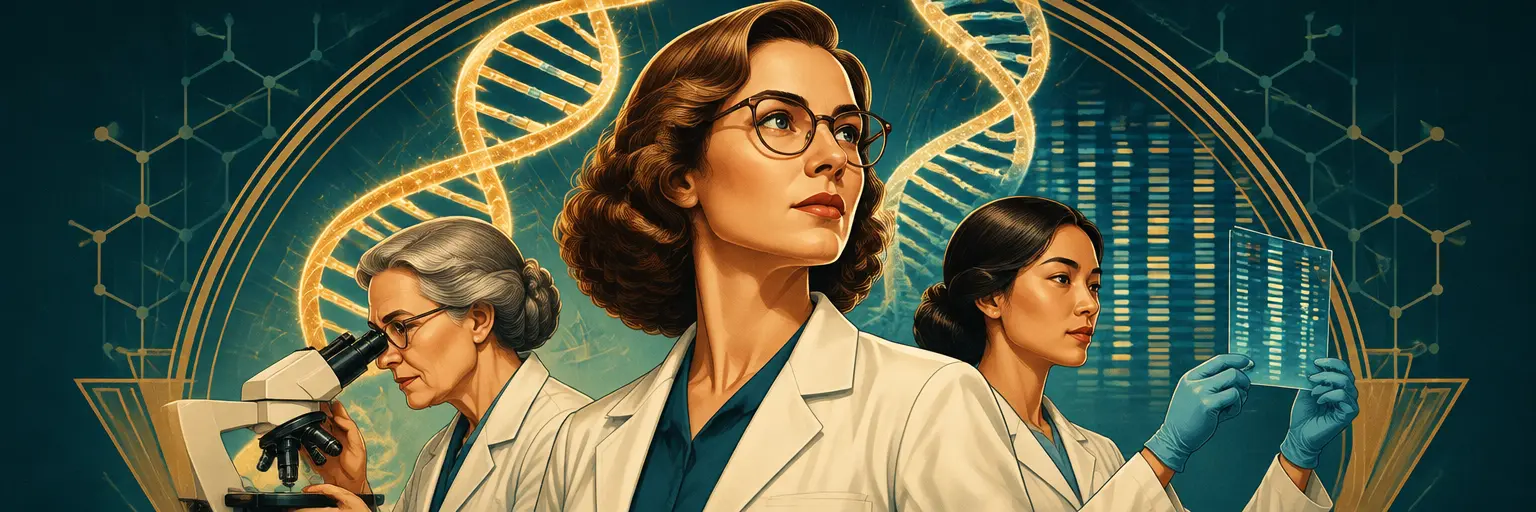
Discover the Pioneers of Heredity: Women in Genetics & Genomics
Welcome to our dedicated section on Women in Genetics & Genomics, part of the broader Biology & Medicine category. Here, we illuminate the remarkable contributions of female scientists who decoded the language of life—from the discovery of DNA’s structure to the latest CRISPR breakthroughs. These women overcame systemic barriers, yet their work underpins modern medicine, agriculture, and evolutionary biology. Explore their stories of resilience, intellectual courage, and transformative discoveries that reshaped our understanding of heredity and disease.
🧬 Trailblazers of DNA & Chromosome Research
This subsection highlights figures like Rosalind Franklin, whose X-ray diffraction images were critical to the DNA double-helix model, and Barbara McClintock, who discovered transposable elements (jumping genes) despite decades of skepticism. You’ll learn how their meticulous lab work laid foundational knowledge in molecular genetics. These narratives emphasize that recognizing patterns in nature often requires both genius and persistence, especially when your conclusions challenge the scientific orthodoxy.
Expect detailed profiles that contextualize their experiments within the limitations of mid-20th-century technology. We also discuss how their discoveries later enabled personalized medicine and genetic engineering. By understanding these pioneers, you’ll grasp why their recognition came late—often posthumously—and how their legacy fuels ongoing debates about credit and collaboration in science.
🔬 Innovators in Gene Mapping & Sequencing
Delve into the stories of women who drove the Human Genome Project and modern genomics. Figures like Jennifer Doudna (co-inventor of CRISPR-Cas9) and Mary-Claire King (who linked BRCA1 to breast cancer) exemplify how female-led research directly impacts clinical diagnostics. This section covers their breakthroughs in high-throughput sequencing, statistical genetics, and genome editing, showing how each advance opened new frontiers in targeted therapies and rare disease identification.
We also profile Evelyn Witkin and Miroslav Radman’s lesser-known collaborators, focusing on DNA repair mechanisms. You’ll find clear explanations of complex concepts like linkage analysis and CRISPR’s off-target effects, framed within the scientists’ personal journeys. These stories reveal that genomics is not just about big data—it’s about human curiosity translated into precise, life-saving tools.
🧪 Medical Geneticists & Rare Disease Pioneers
Here, we feature clinicians and researchers who applied genetic knowledge to patient care. Victor McKusick is famous, but his female counterparts like Mary Lyon (X-inactivation) and Charlotte Auerbach (mutagenesis) were equally pivotal. This segment explores how they identified inheritance patterns for cystic fibrosis, Huntington’s disease, and metabolic disorders. Their work bridged the lab bench and bedside, establishing genetic counseling as a vital medical discipline.
Expect case studies that illustrate diagnostic dilemmas and ethical considerations in prenatal testing. We emphasize how these women often worked in pediatric wards, advocating for families while pushing the boundaries of cytogenetics. Their combined efforts transformed genetics from an academic curiosity into a cornerstone of public health, influencing newborn screening programs worldwide.
📚 Mentors, Educators & Science Communicators
Not all contributions are Nobel-winning; some are catalytic. This subsection honors women like Ruth Sager (extranuclear inheritance) and Anne McLaren (developmental biology), who also mentored hundreds of young scientists. We discuss their roles in establishing genetics departments, writing seminal textbooks, and popularizing complex ideas for lay audiences. Their teaching methods emphasized open debate and reproducibility—values now central to scientific integrity.
You’ll read about their efforts to create inclusive lab environments, often against hostile institutional cultures. These profiles include archival quotes and teaching anecdotes that show how patience and clarity can be as revolutionary as a new laboratory technique. The takeaway: sustained mentorship amplifies a discovery’s impact, creating entire lineages of researchers who carry forward the torch.
🏅 Modern Leaders Shaping Genomic Ethics & Policy
This final substantive section focuses on contemporary figures like Katherine Pollard (conservation genomics) and Ewan Birney’s collaborators, but with a spotlight on Lisa D. Brooks and Jill Mesirov in computational genomics. They are navigating issues of data privacy, germline editing, and equitable access to therapies. Their work demonstrates that the next frontier of genetics is not just biological but sociological—deciding who benefits from genomic advances.
Explore their policy papers, public testimonies, and leadership in global consortia like the ELIXIR and GA4GH. We break down complex debates around CRISPR babies and ancestry testing, always highlighting these women’s principled positions. Their advocacy ensures that the women-in-genetics legacy continues, safeguarding scientific progress with humanity and foresight.
Frequently Asked Questions
Who is the most famous woman in genetics history?
Rosalind Franklin is arguably the most famous, though her recognition came posthumously. Her Photo 51 was critical for Watson and Crick’s DNA model. Barbara McClintock is equally renowned for transposons, winning the Nobel Prize in 1983. Both symbolize brilliance undermined by institutional sexism, yet their work defines modern molecular biology.
What major contribution did Barbara McClintock make?
She discovered transposable elements (jumping genes) in maize in the 1940s, showing genes can move within chromosomes. This was ignored for decades until the 1980s when it was confirmed in other organisms, earning her a Nobel Prize. Her work explains antibiotic resistance and genetic diversity.
How did women help map the human genome?
Women like Maynard Olson’s lab technician and bioinformaticians like Ewan Birney’s colleagues played key roles, but prominent contributors include Lap-Chee Tsui’s team (CFTR) and Mary-Claire King for BRCA1. They developed mapping strategies and computational tools that accelerated sequencing, ensuring accuracy and reproducibility.
Are there current women leading genomic innovation?
Yes—Jennifer Doudna (CRISPR), Vanessa Ruta (neural genomics), and Yasmin Farzan (viral genomics) are active. They lead labs, publish in top journals, and drive biotech startups. Their work on gene therapy and disease surveillance epitomizes the continuing female influence in genetics.
Why are women’s contributions often overlooked?
Historical biases, unequal lab opportunities, and male-dominated publishing contributed. Many women worked as assistants or had their data appropriated. Modern initiatives like “Women in Science History” actively correct this by preserving oral histories and re-evaluating archival evidence, ensuring a balanced narrative for future scientists.