Women in Environmental Sub-Disciplines: Biographies That Inspire Change
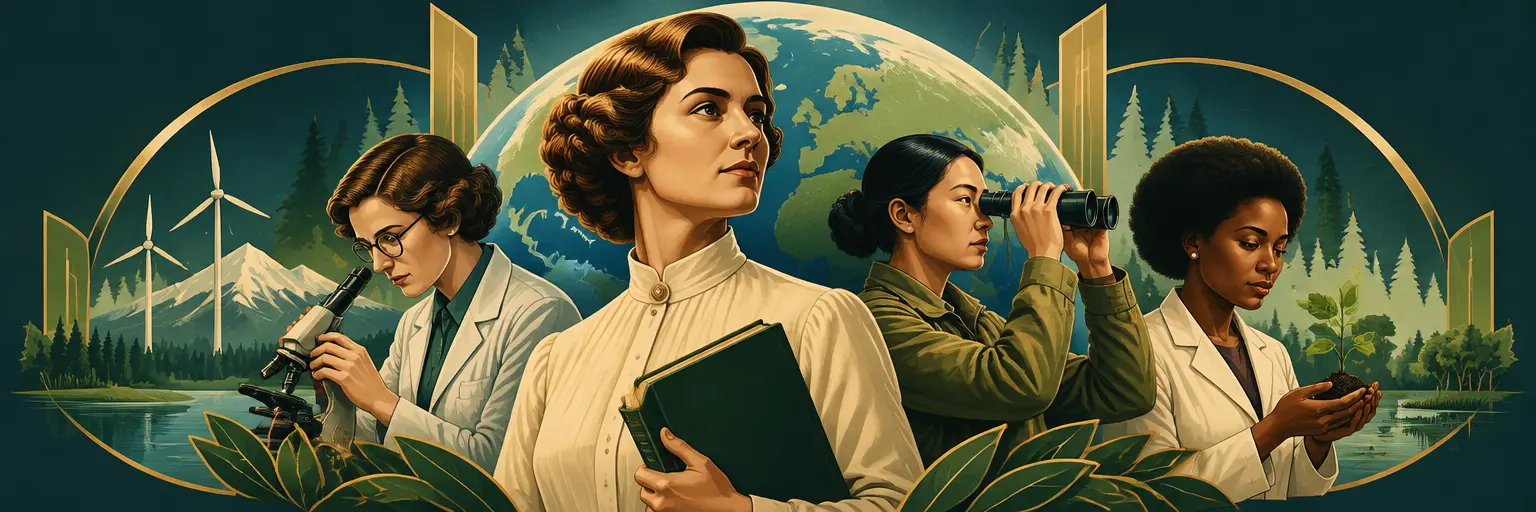
Explore the remarkable lives of women who shaped ecology, conservation, marine biology, climate science, and environmental engineering. This subcategory on WomenInScienceHistory.com highlights their field breakthroughs, resilience against systemic barriers, and enduring legacies—offering SEO-rich narratives for educators, researchers, and climate advocates.
🌿 Pioneers of Ecology & Conservation
Discover stories like Rachel Carson’s Silent Spring and Ellen Swallow Richards’ water quality research. These biographies reveal how women transformed ecology from descriptive study to actionable conservation. Expect deep dives into their methodologies, political battles, and how they braved skepticism to establish foundational environmental ethics. Keywords: ecology pioneers, conservation history, environmental activism.
Each profile pairs personal anecdotes with scientific context, showing how fieldwork and policy intersected. You’ll learn about lesser-known figures like Ruth Patrick, whose diatom studies became aquatic health benchmarks, and Margaret Murie, the “Grandmother of the Conservation Movement.” Their stories offer actionable lessons for modern environmental stewardship.
🌊 Marine Biology & Oceanography Breakthroughs
Dive into biographies of women like Sylvia Earle, whose deep-sea expeditions redefined ocean exploration, and Maria Mitchell, an astronomy pioneer who also catalogued marine life. This section emphasizes technical contributions—from designing submersibles to mapping ocean currents—while highlighting mentorship networks that amplified their work. Focus: marine science history, female oceanographers.
Readers will find chronicles of research voyages, data collection innovations, and legislative impacts (e.g., marine protected areas). Expect descriptions of challenges, such as exclusion from shipboard research until the late 20th century, and the alliances that helped circumvent these barriers. The content is optimized for educators seeking role models in STEM.
🌍 Climate Science & Atmospheric Research
Meet women like Eunice Newton Foote, who discovered CO2’s heat-trapping effect in 1856, and Inez Fung, a modern climate modeler. Biographies here trace how these scientists quantified atmospheric changes while navigating underrepresentation. Key themes: climate modeling history, gender equity in geosciences, carbon cycle research.
Each narrative unpacks specific discoveries—Foote’s experiments, Fung’s global circulation models—and their reception in male-dominated journals. You’ll also find contextual chapters on institutional discrimination, funding gaps, and how these scientists used teaching and advocacy to sustain momentum. This content serves as a robust resource for climate history courses.
🔬 Environmental Chemistry & Toxicology
Uncover profiles of women like Alice Hamilton, founder of occupational toxicology, and Theo Colborn, who identified endocrine disruptors. These biographies detail laboratory techniques, epidemiological methods, and regulatory victories. SEO angles: environmental health, chemical safety pioneers, feminist science studies.
Expect step-by-step recounts of hazardous substance testing, from lead exposure to pesticide effects, and the political courage required to publish adverse findings. The narratives also highlight collaborations with communities, illustrating how these scientists bridged lab and activism. This section is invaluable for public health researchers and policy students.
🌱 Botanical & Agricultural Innovators
Read about botanists like Ynes Mexia, who collected over 145,000 plant specimens, and Katherine Esau, a Nobel-nominated plant anatomist. These biographies cover field expeditions, genetic studies, and sustainable farming techniques. Key terms: botanical history, women agronomists, plant physiology.
Each profile reveals how these women improved crop resilience, documented endangered flora, or advanced cytogenetics—all while often funding their own research. Expect anecdotes about overcoming travel restrictions and institutional bias, plus diagrams of their classification systems. This content supports biodiversity and agricultural history curricula.
Frequently Asked Questions
Why are women’s environmental biographies historically overlooked?
Systemic barriers like exclusion from academic societies, limited publishing opportunities, and male co-authorship erased their credit. Many worked as unpaid assistants or under pseudonyms. This subcategory restores visibility by sourcing archival letters, lab notebooks, and oral histories to reconstruct their true contributions.
What sub-disciplines are covered under environmental science?
We cover ecology, conservation biology, marine science, atmospheric chemistry, toxicology, botany, and environmental engineering. Each biography specifies the niche—from soil microbiology to climate policy—so readers can explore specialized domains without sifting through broad science history.
Are these biographies suitable for classroom use?
Absolutely. Each profile includes primary source quotes, timelines, and cross-disciplinary connections. We provide age-appropriate summaries for middle school through university levels, plus discussion prompts on gender bias and scientific integrity.
How do these stories inspire current environmental action?
They model resilience, methodical research, and community engagement. For example, Carson’s legacy fuels modern pesticide regulation debates, while Foote’s rediscovery spurs equity in climate science. Readers draw direct parallels to ongoing environmental justice movements.
Can I suggest a woman to be profiled?
Yes—we welcome nominations via our contact page. We prioritize lesser-known figures, especially from underrepresented regions. Current suggestions include Indian river conservationist Chandi Prasad Bhatt’s peers and Caribbean marine biologists whose archives remain uncatalogued.