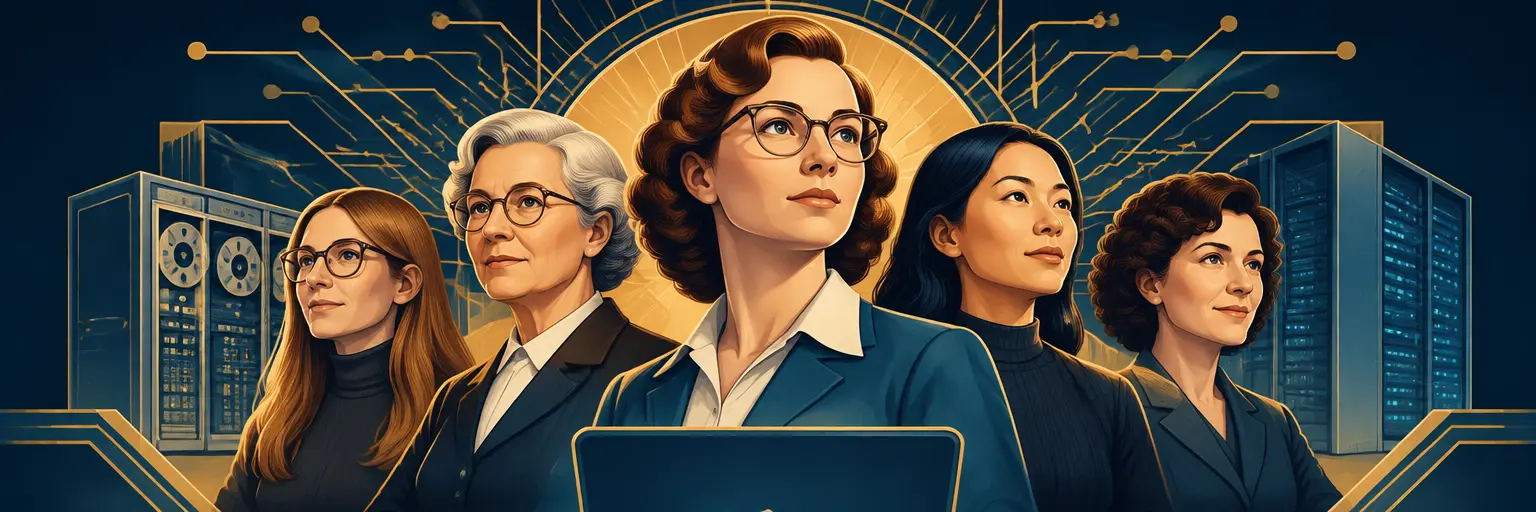
Discover the Trailblazing Women of Computer Science
Dive into the inspiring world of female pioneers who shaped the digital age. This subcategory of biographies highlights the remarkable lives, groundbreaking innovations, and enduring legacies of women in computer science—from codebreakers and software engineers to AI visionaries. Explore their struggles, triumphs, and contributions that revolutionized technology, offering a rich resource for students, educators, and tech enthusiasts eager to uncover the hidden figures behind our modern computing landscape.
🖥️ Early Pioneers and Codebreakers
Meet the foundational women whose mathematical genius laid the groundwork for computing. Learn about Ada Lovelace, who wrote the first algorithm in the 1840s, and the WWII codebreakers like Joan Clarke at Bletchley Park, whose work cracking Enigma saved countless lives. These biographies delve into their rigorous training, analytical brilliance, and the societal barriers they overcame at a time when women’s intellectual contributions were routinely dismissed.
Expect detailed timelines of their key achievements, personal anecdotes from letters and memoirs, and context on how their wartime or academic work directly influenced subsequent computer design. You’ll also discover lesser-known figures, such as the "ENIAC Six," who programmed the first general-purpose electronic computer, yet received no recognition for decades. This section is perfect for understanding the often uncredited origins of modern software engineering.
🛠️ Software Engineering and Programming Languages
Explore the women who built the core of software development, from Grace Hopper, who invented the first compiler and coined "debugging," to Barbara Liskov, whose work on programming languages earned her the Turing Award. These biographies cover their technical breakthroughs, teaching philosophies, and how they navigated corporate tech cultures that discouraged female leadership. Learn about their roles in creating COBOL, object-oriented programming, and distributed systems.
Expect accessible explanations of the technical concepts they pioneered, alongside their professional struggles against gender bias. For instance, discover how Hopper’s insistence on machine-independent languages transformed business computing despite repeated skepticism from male superiors. This section also highlights modern figures like Margaret Hamilton, whose error-detection software principles became standard for Apollo missions, demonstrating rigorous testing and reliability in high-stakes environments.
🤖 Artificial Intelligence and Modern Visionaries
Uncover the stories of contemporary trailblazers shaping AI, machine learning, and robotics. Featuring figures like Fei-Fei Li, who advanced computer vision through ImageNet, and Cynthia Breazeal, a pioneer in social robotics. These biographies investigate their research journeys, academic mentorship, and efforts to democratize AI ethics. Each profile connects their personal motivations—often rooted in childhood curiosity—to their game-changing contributions in data science and human-computer interaction.
Expect insights into their current projects, collaborative ventures, and advocacy for diversity in tech. Learn how Li’s work reduced biases in image recognition datasets, and how Breazeal’s Kismet robot helped machines read human emotions. The section also includes rising stars like Timnit Gebru, focusing on algorithmic fairness, revealing how these women challenge both technical limitations and institutional discrimination while mentoring the next generation of female engineers.
📚 Academic Innovators and Educators
This section celebrates women who transformed computer science education and research methodology. Profiles include Dorothy Vaughan, who taught herself FORTRAN to lead NASA’s computing staff, and Anita Borg, founder of the Grace Hopper Celebration and a fierce advocate for women in tech. Their biographies emphasize their dual roles as scholars and mentors, detailing curriculum reforms, laboratory leadership, and their push for accessible coding education in underserved communities.
Expect anecdotes about their teaching styles, grant-writing successes, and policy influence. For example, Fran Allen, IBM’s first female Fellow, advanced compiler optimization while pushing for gender equality in corporate research. These stories also reveal how they built supportive networks—like Borg’s Systers mailing list—that provided career guidance and emotional resilience against systemic barriers. Ideal for educators seeking role models and historians analyzing institutional shifts in higher education.
🌍 Global Perspectives and Unheard Stories
Broaden your view with biographies of women from diverse geographies and cultural contexts, from India’s Sudha Murthy, who introduced computer networking to rural communities, to China’s Wei Xu, a search engine pioneer. This section addresses how cultural norms, political constraints, and economic factors shaped their paths. Each profile highlights their unique problem-solving approaches and how they adapted global technologies to local needs, often without formal support systems.
Expect comparative analysis of regional tech histories, such as the Soviet Union’s early female programmers or Africa’s mobile-banking innovators. You’ll read about women like Evelyn Berezin, who invented the first electronic word processor, but also grassroots activists teaching code to refugees. These biographies underscore that innovation thrives beyond Silicon Valley, offering inspirational counter-narratives to the typical Western-centric tech story while emphasizing intersectionality and persistence.
Frequently Asked Questions
Who is considered the first computer programmer?
Ada Lovelace, in the 1840s, is widely recognized as the first computer programmer. She translated an article on Charles Babbage’s Analytical Engine and added extensive notes, including an algorithm for computing Bernoulli numbers. This went beyond mere translation, representing a theoretical understanding that the machine could be programmed, not just calculate numbers.
Why were women historically excluded from computer science careers?
Early computing was often viewed as clerical work, so women were hired for programming during WWII. However, as the field gained prestige and profit potential in the 1960s-80s, it became male-dominated. Social biases, lack of role models, hiring discrimination, and discouraging educational environments compounded the exclusion, pushing many women out despite their initial contributions.
What is the Grace Hopper Celebration?
It is the largest gathering of women in computing, founded by Anita Borg in 1994. Named after pioneering computer scientist Grace Hopper, this annual conference provides networking, technical sessions, and career opportunities. It was created to combat isolation and attrition rates, showcasing achievements and mentoring thousands of women in tech globally.
Are there any modern female Turing Award winners?
Yes. Frances Allen (2006) won for compiler optimization, Barbara Liskov (2008) for programming language design, and Shafi Goldwasser (2012) for cryptography. These awards highlight their foundational contributions. Additionally, multiple women have received ACM prizes and other top honors, though they remain underrepresented, making these recognitions especially significant.
How can I use these biographies to inspire students?
Use them as discussion starters on resilience and innovation. Highlight problem-solving methods over technical jargon, relate their early struggles to student experiences, and emphasize that failure was often a stepping stone. Pair biographies with hands-on coding activities or debate their ethical dilemmas. This approach helps learners see themselves in these narratives and pursue STEM confidently.