
The Courage to Gaze Upwards: Inspiring Tales of Pre1700s Female Astronomers

Welcome to WomenInScienceHistory.com!
Prepare to be amazed by the untold stories of scientific trailblazers. In our latest exploration, " The Courage to Gaze Upwards: Inspiring Tales of Pre1700s Female Astronomers," we delve into the captivating and often overlooked contributions of women who dared to chart the heavens in the 17th century and before. Discover their groundbreaking observations, the obstacles they overcame, and the lasting impact they had on our understanding of the cosmos. What secrets did these pioneering female astronomers unlock, and how did they challenge the conventions of their time? Read on to find out!
- Introduction: Unveiling the Overlooked History of Women in Early Astronomy
- Early Pioneers: Female Astronomers Before the 17th Century
- The 17th Century: A Period of Emerging Opportunities for Women in Astronomy
- Notable 17th Century Female Astronomers and Their Contributions
- The Challenges Faced by Female Astronomers in the 17th Century
- The Legacy of Pre-1700s Female Astronomers: Inspiring Future Generations
- Conclusion: Remembering the Courageous Women Who Gazed Upwards
-
Frequently Asked Questions
- What are some of the main challenges faced by female astronomers in the 17th century?
- Can you name a prominent female astronomer from before the 1700s?
- What kind of contributions did pre-1700s female astronomers make to the field?
- Why is it important to study the history of female astronomers?
- Where can I learn more about female astronomers from this period?
- Final Reflection: Reaching for the Stars
- Unveil Your Inner Astronomer!
Introduction: Unveiling the Overlooked History of Women in Early Astronomy
Celebrating WomenInScienceHistory.com's Focus on Pioneering Female Scientists
WomenInScienceHistory.com stands as a vital digital archive, dedicated to illuminating the often-eclipsed narratives of women who have profoundly shaped scientific progress throughout history. This platform is instrumental in bringing to light the contributions of pioneering female scientists, whose groundbreaking work might otherwise remain unrecognized in traditional historical accounts. By meticulously documenting their lives, discoveries, and the unique challenges they navigated, the website ensures that the full spectrum of scientific heritage is acknowledged and celebrated.
The ongoing effort to unearth and present these stories is not merely an academic exercise; it is a crucial endeavor that enriches our collective understanding of scientific evolution. Highlighting these forgotten figures, particularly those like the female astronomers 17th century history often overlooks, provides a more accurate and inclusive historical record. This dedication helps to correct long-standing biases, demonstrating that intellectual curiosity and scientific acumen were not exclusive to one gender.
The Significance of Acknowledging Pre-18th Century Women in Space Science
The period prior to the 18th century represents a foundational era in the development of modern astronomy, characterized by meticulous observations, the refinement of instruments, and the slow shift from geocentric to heliocentric models. Within this transformative period, women, despite immense societal barriers, were actively engaged in celestial observation and calculation, contributing significantly to the burgeoning field of space science. Their presence underscores that scientific inquiry was not confined to formal institutions, which largely excluded them.
Acknowledging these early female astronomers 17th century history is paramount because their experiences offer invaluable insights into the social and intellectual landscapes of their time. Their dedication, often pursued within the confines of domestic life or through private patronage, speaks volumes about their passion and resilience. By studying their lives, we gain a deeper appreciation for the courage it took for women to pursue scientific knowledge when such endeavors were often met with skepticism or outright opposition, paving the way for future generations of women in science.
Early Pioneers: Female Astronomers Before the 17th Century
Enheduanna: A Priestess-Astronomer's Hymns and Celestial Observations
Thousands of years before the formalization of modern astronomy, Enheduanna, circa 2300 BCE, served as the High Priestess of Ur in ancient Mesopotamia, a role of immense religious, political, and intellectual authority. Daughter of Sargon of Akkad, she is recognized as the earliest known author in history, having penned numerous hymns and literary compositions. Within these texts, particularly her famous "Hymn to Inanna," she frequently references celestial bodies, their movements, and their divine significance, indicating a profound understanding of astronomical phenomena linked to the Sumerian calendar and religious practices.
Her position as High Priestess would have necessitated a deep engagement with the heavens, as celestial observations were critical for maintaining the ritual calendar, predicting agricultural cycles, and interpreting divine omens. While not a "scientist" in the modern sense, Enheduanna's detailed descriptions of the stars and planets within her hymns demonstrate an acute awareness of the cosmos, positioning her as one of the earliest recorded female astronomers or at least a highly influential celestial observer whose work intertwined spiritual and astronomical knowledge, reflecting the integrated nature of ancient Mesopotamian thought.
Hypatia of Alexandria: Contributing to Astronomical Knowledge in Hellenistic Egypt
Hypatia of Alexandria, born around 350-370 CE, stands as a beacon of intellectual prowess in late antiquity, renowned as a Neoplatonist philosopher, mathematician, and astronomer. Based in Alexandria, a vibrant center of learning, she taught at the city's famous library, attracting students from across the Roman Empire. Her significant contributions to astronomy included lecturing on and editing seminal texts such as Ptolemy's Almagest and Euclid's Elements, thereby preserving and disseminating crucial astronomical knowledge for future generations.
Beyond her pedagogical work, Hypatia is also credited with inventing or improving several scientific instruments, including the astrolabe, a device used for measuring the positions of stars and planets, and the hydroscope, an instrument for measuring the specific gravity of liquids. Her public role as a scholar and teacher, openly engaging with complex scientific and philosophical ideas in a male-dominated society, was extraordinary.
Her tragic death in 415 CE at the hands of a Christian mob underscores the volatile intersection of intellectual pursuit and religious tensions, yet her legacy as a brilliant female astronomer and intellectual continues to inspire, highlighting the enduring presence of women in the pursuit of knowledge.
The 17th Century: A Period of Emerging Opportunities for Women in Astronomy
The Rise of Scientific Societies and their Limited Inclusion of Women
The 17th century witnessed a significant transformation in the organization of scientific inquiry, marked by the establishment of formal scientific societies. Institutions such as the Royal Society of London, founded in 1660, and the Académie Royale des Sciences in Paris, established in 1666, became central hubs for intellectual exchange, collaborative research, and the dissemination of new discoveries. These societies standardized scientific methods and fostered a community of scholars, fundamentally shaping the trajectory of modern science.
However, despite this progressive shift, these newly formed societies largely maintained exclusive memberships, effectively barring women from formal participation. Women were rarely, if ever, admitted as full members, preventing them from accessing crucial networks, resources, and recognition that male scientists enjoyed. This systemic exclusion meant that aspiring female astronomers 17th century history had to seek alternative, often informal, pathways to pursue their scientific passions, highlighting the significant societal barriers that still existed for women in 17th century astronomy.
Patronage and Private Observatories: Avenues for Female Astronomical Pursuits
Given the limited access to formal academic institutions and scientific societies, patronage and private observatories emerged as critical avenues for female astronomers to engage in scientific work during the 17th century. Wealthy individuals, often from aristocratic or mercantile backgrounds, would sometimes support scientific endeavors, either out of genuine interest or for social prestige. These patrons might fund instruments, libraries, or even entire observatories, creating spaces where science could flourish outside traditional academic confines.
Crucially, many prominent 17th century female astronomers gained their expertise and conducted their observations within family-run or private observatories. These domestic settings, often equipped with sophisticated instruments, allowed women to bypass the formal restrictions of universities and societies. Working alongside fathers, husbands, or brothers, these women learned observational techniques, mathematical calculations, and instrument maintenance, transforming private homes into vital centers for astronomical research and enabling a select few to make significant contributions to the history of female astronomers.
Notable 17th Century Female Astronomers and Their Contributions
Maria Cunitz: A Silesian Astronomer's Impact on Celestial Calculations
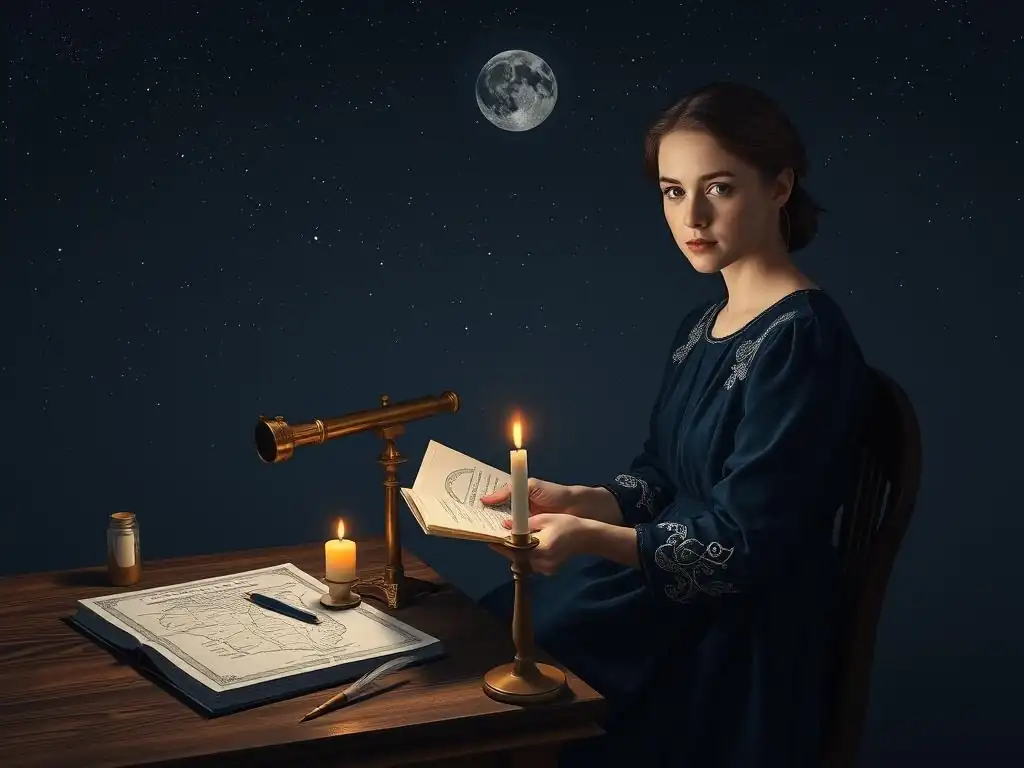
Maria Cunitz (1610–1664) was an extraordinary Silesian astronomer and mathematician, celebrated for her profound intellectual abilities in an era that largely overlooked women's scholarly contributions. Born into a highly educated family, she was a polymath who mastered seven languages, medicine, and mathematics, among other disciplines, from a young age. Her marriage to Elias von Löwen, also a scholar and physician, provided an environment conducive to her scientific pursuits, particularly in astronomy.
Cunitz dedicated herself to the arduous task of re-calculating and simplifying astronomical tables. She would often work tirelessly by candlelight, meticulously performing complex computations to correct existing data. Her self-taught mastery and relentless dedication positioned her as one of the most significant female astronomers 17th century history produced, demonstrating an unparalleled commitment to scientific accuracy and intellectual rigor.
Cunitz's "Urania Propitia": Simplifying Astronomical Tables
Maria Cunitz's magnum opus, Urania Propitia, published in 1650, is a landmark achievement in the history of female astronomers. This extensive work aimed to simplify and correct Johannes Kepler's Rudolphine Tables, which were notoriously complex and contained numerous errors. Cunitz devised a new, more accessible method of calculation, reducing the need for logarithms and making the determination of planetary positions significantly easier and more accurate for astronomers and navigators.
The book, written in Latin and German, was published at her own expense, a testament to her unwavering commitment to disseminating knowledge. Urania Propitia was highly regarded for its precision and utility, demonstrating Cunitz's exceptional mathematical prowess and observational skill. Its practical value for celestial navigation and mapping solidified her reputation as a formidable 17th century female astronomer and a crucial figure in the advancement of practical astronomy.
Challenges Faced by Maria Cunitz as a Woman in 17th Century Science
Despite her remarkable achievements, Maria Cunitz faced significant skepticism and challenges typical for female astronomers 17th century history. Upon the publication of Urania Propitia, there were initial doubts regarding her sole authorship, with many assuming her husband, Elias von Löwen, must have been the true author. This pervasive gender bias forced her to publicly assert her intellectual independence and authorship in a preface to a later edition, a courageous and rare act for a woman of her time.
Beyond issues of authorship, Cunitz, like other women in 17th century astronomy, contended with a general lack of formal educational opportunities and exclusion from established scientific networks. Her learning was primarily self-directed or through private tutelage, and her work was conducted outside the male-dominated university system. These systemic obstacles highlight the extraordinary talent and resilience required for a woman to achieve scientific recognition in an era that largely doubted female intellectual capabilities.
Elisabetha Hevelius: The "Mother of Lunar Maps" and Her Observational Skills
Elisabetha Hevelius (1647–1693), often referred to as the "Mother of Lunar Maps," was a distinguished Polish astronomer whose contributions were pivotal in the advancement of celestial cartography. Born into a prominent family in Danzig (Gdańsk), she developed an early passion for astronomy. At the age of 16, she married Johannes Hevelius, a renowned astronomer nearly 40 years her senior, and quickly became his indispensable collaborator at his sophisticated private observatory.
Elisabetha's role at the Danzig observatory was far from passive; she was actively involved in daily observational work, often operating large, custom-built instruments alongside her husband. Her meticulous observational skills and dedication were crucial to the observatory's prolific output. Her hands-on engagement in data collection and analysis established her as one of the most prominent female astronomers 17th century history produced, working at the forefront of astronomical observation.
Hevelius' Collaboration with Johannes Hevelius and the Danzig Observatory
The collaboration between Elisabetha and Johannes Hevelius at their private Danzig observatory was one of the most productive partnerships in 17th-century astronomy. They worked tirelessly, often late into the night, making precise measurements of star positions and meticulously mapping the lunar surface. Their observatory, equipped with massive, custom-made instruments, was a leading center for astronomical research in Europe, attracting visitors from across the continent.
Elisabetha's role in this partnership was deeply integrated, extending beyond mere assistance. She was a skilled observer, recording data, performing calculations, and assisting in the construction and calibration of instruments. Their joint efforts culminated in several significant publications, including the highly influential Selenographia (1647), a groundbreaking work on lunar topography, which, though primarily attributed to Johannes, fundamentally relied on Elisabetha's precise observations and tireless work, solidifying her place in the history of female astronomers.
Elisabetha Hevelius' Independent Contributions to Lunar Cartography
While much of Elisabetha Hevelius's work was collaborative, her independent contributions to lunar cartography and cataloging stars are increasingly recognized. Her meticulous observations were fundamental to the detailed lunar maps presented in Selenographia. Even more significantly, after Johannes Hevelius's death in 1687, Elisabetha took on the monumental task of completing and publishing their unfinished work.
She successfully brought to press Prodromus Astronomiae (1690), a comprehensive star catalog that included over 1,500 stars, along with its accompanying atlas, Firmamentum Sobiescianum. This achievement, undertaken solely by Elisabetha, demonstrated her profound scientific capabilities and unwavering dedication to astronomy. Her ability to independently manage and publish such a substantial astronomical work further cements her legacy as a pioneering 17th century female astronomer and a crucial figure in the accurate mapping of the celestial sphere.
Maria Clara Eimmart: An Engraver and Astronomer's Detailed Astronomical Illustrations
Maria Clara Eimmart (1676–1707) represents another unique facet of female astronomers 17th century history, combining artistic talent with scientific precision. Born in Nuremberg, Germany, she was the daughter of Georg Christoph Eimmart, a distinguished engraver, painter, and director of the Nuremberg Academy of Arts, who also maintained a private observatory. This dual environment—artistic and scientific—provided Maria Clara with an exceptional upbringing that fostered both her artistic skills and her keen interest in the heavens.
Her unique background allowed her to merge her artistic talents with her astronomical knowledge, leading to the creation of highly detailed and scientifically accurate astronomical illustrations. Unlike other astronomers who primarily focused on calculations or observations, Maria Clara's contribution lay in the visual documentation and dissemination of astronomical data, making complex celestial phenomena accessible and aesthetically compelling.
Eimmart's Production of Astronomical Drawings and Calendars
Maria Clara Eimmart's most notable contribution to astronomy lies in her extensive collection of over 350 exquisite drawings of the moon's phases, sunspots, and planetary observations. Executed between 1693 and 1701, these illustrations were not merely artistic renditions but precise scientific records, meticulously capturing the subtle changes and intricate details of celestial bodies. Her drawings served as invaluable documentation, demonstrating a keen eye for observational accuracy.
In addition to her lunar and solar observations, Eimmart also produced engravings for her father's scientific publications and contributed to the creation of astronomical calendars. These visual aids were crucial for communicating complex astronomical data and discoveries to a wider audience. Through her detailed and beautiful illustrations, Maria Clara Eimmart carved out a distinct and vital role for herself as a female astronomer, bridging the gap between scientific observation and artistic representation in the late 17th century.
The Challenges Faced by Female Astronomers in the 17th Century
Societal Constraints and Limited Access to Education
The 17th century was a period largely characterized by rigid societal norms that confined women primarily to domestic roles. Intellectual pursuits, especially in rigorous fields like astronomy, were often considered unfeminine or even detrimental to a woman's character. This pervasive societal constraint meant that formal educational institutions, such as universities, were almost entirely inaccessible to women, effectively barring them from the structured learning environments that shaped male scholars.
Consequently, any woman aspiring to be a female astronomer 17th century history had to rely on self-study, private tutors, or, most commonly, informal apprenticeships within their own families, often under the guidance of a scientifically inclined father or husband. This limited access to formal education created significant hurdles, making it exceptionally difficult for women to acquire the necessary foundational knowledge and scientific training, and often compelling them to work in the shadows of their male relatives.
Overcoming Gender Bias in the Scientific Community
Beyond educational barriers, female astronomers 17th century history faced pervasive gender bias within the nascent scientific community itself. The prevailing belief was that women lacked the intellectual capacity for rigorous scientific thought, and their contributions were frequently dismissed, undervalued, or even outright appropriated by male colleagues or family members. The idea of a woman as an independent intellectual, capable of original scientific discovery, was largely alien and often met with skepticism.
This bias manifested in various ways: scientific societies refused membership to women, their published works were sometimes attributed to male relatives (as initially happened with Maria Cunitz), and their findings were often scrutinized more harshly than those of their male counterparts. Overcoming such entrenched prejudice required not only exceptional talent and dedication but also immense courage and resilience, forcing these women in 17th century astronomy to constantly prove their intellectual legitimacy in a skeptical world.
A significant challenge for female astronomers in the 17th century was the struggle for proper recognition and authorship of their work. In an era where intellectual property rights were still developing and societal norms favored male authority, women who conducted scientific research often found their contributions uncredited or attributed to male family members. Even when they were actively involved in observations, calculations, or instrument design, their names might be omitted from publications, or their work might be subsumed under a husband's or father's name.
This lack of formal recognition meant that many brilliant 17th century female astronomers remained largely anonymous in historical records, their vital contributions often overshadowed or forgotten. The few who did manage to gain public acknowledgment, like Maria Cunitz asserting her authorship of Urania Propitia or Elisabetha Hevelius completing her husband's star catalog after his death, did so through extraordinary perseverance and often at significant personal cost, making their enduring legacies all the more remarkable in the broader history of female astronomers.
The Legacy of Pre-1700s Female Astronomers: Inspiring Future Generations
How Their Contributions Paved the Way for Later Women in STEM
The courageous efforts and intellectual prowess of female astronomers 17th century history and earlier periods, despite the immense societal and institutional barriers, laid crucial, albeit often unacknowledged, groundwork for future generations of women in STEM. Their very existence as active participants in scientific inquiry, even if their work was often confined to private spheres, demonstrated that women possessed the intellectual capacity and dedication required for rigorous scientific pursuits. Their achievements, however marginalized, served as quiet precedents.
These pioneering women, through their persistence in observing the heavens, performing complex calculations, and documenting their findings, helped to slowly erode the entrenched prejudices against female intellectualism. While immediate societal change was slow, their contributions provided a vital, though often unseen, foundation upon which later women could build, inspiring successive generations to challenge norms and pursue careers in astronomy and other scientific fields, fostering a gradual but significant shift towards greater inclusivity in science.
Preserving and Promoting the History of Early Women in Astronomy
Preserving and actively promoting the history of early female astronomers is an essential endeavor for a more complete and accurate understanding of scientific development. Platforms like WomenInScienceHistory.com play a critical role in unearthing these often-hidden narratives, ensuring that the contributions of women are integrated into the mainstream historical record rather than remaining as footnotes. Ongoing historical research continues to reveal new details about these remarkable individuals, shedding light on their methodologies, discoveries, and the unique challenges they overcame.
By making these stories accessible and prominent, we not only correct historical omissions but also provide powerful role models for contemporary and future generations. Highlighting the resilience and intellect of 17th century female astronomers inspires young girls and women to pursue their passions in science, challenging preconceived notions about who can be a scientist. This commitment to historical accuracy empowers individuals and enriches the broader narrative of human achievement in astronomy.
Resources for Learning More about 17th Century Women in Astronomy History
For those eager to delve deeper into the lives and work of 17th century female astronomers, a wealth of resources exists within academic and historical archives. Specialized books on the history of women in science, often found in university libraries or dedicated historical collections, provide detailed biographies and analyses of their contributions. Academic journals, such as those focusing on the history of science or gender studies, frequently publish new research on these often-overlooked figures.
Furthermore, exploring the records of historical scientific societies, even if women were not members, can sometimes reveal tangential connections or mentions of their collaborative work. Museum collections that house early astronomical instruments or manuscripts may also offer glimpses into the tools and methods used by these pioneers. Engaging with these resources allows for a richer appreciation of the challenges and triumphs of these courageous women who helped shape the early history of female astronomers.
Conclusion: Remembering the Courageous Women Who Gazed Upwards
Frequently Asked Questions
What are some of the main challenges faced by female astronomers in the 17th century?
Female astronomers faced significant obstacles including limited access to education, social prejudice against women in scientific roles, and lack of funding and recognition for their work.
Can you name a prominent female astronomer from before the 1700s?
While records are scarce, Maria Cunitz stands out. She was a Silesian astronomer who published "Urania Propitia," a simplification of Kepler's Rudolphine Tables, making astronomical calculations more accessible.
What kind of contributions did pre-1700s female astronomers make to the field?
They made contributions through observational work, mathematical calculations, and publishing astronomical tables. Their efforts often supported the work of male relatives but were crucial for advancing astronomical knowledge.
Why is it important to study the history of female astronomers?
Understanding their stories helps us recognize the historical contributions of women often overlooked, challenge gender biases in STEM fields, and inspire future generations of female scientists.
Where can I learn more about female astronomers from this period?
Websites like WomenInScienceHistory.com provide biographies, research, and discussions on the groundbreaking work and challenges faced by these pioneers. You can also find information in academic journals and historical texts.
Final Reflection: Reaching for the Stars
The stories of these pre-1700s female astronomers, often obscured by the dominant narrative of their time, are more than just historical anecdotes; they are a powerful testament to the enduring human spirit and the relentless pursuit of knowledge. Their courage to gaze upwards, despite societal constraints, resonates deeply in our modern world, reminding us that barriers, however formidable, can be overcome with passion and determination. We must continue to unearth and celebrate these narratives, ensuring that their contributions are not forgotten but rather serve as beacons for future generations.
The impact of these women extends far beyond the realm of astronomy itself. Their perseverance in the face of adversity has profoundly influenced the cultural landscape, challenging preconceived notions about women's capabilities and inspiring countless individuals to pursue their dreams, regardless of societal expectations. Their legacy reminds us that true progress lies in recognizing and valuing the contributions of all members of society. We are like dwarfs sitting on the shoulders of giants. We see more, and things that are more distant, than they did, not because we have keener vision or greater height, but because we are lifted up and borne aloft on their gigantic stature.
- John of Salisbury, a sentiment that applies perfectly to our understanding of these pioneering women.
As you reflect on the lives and accomplishments of these remarkable female astronomers, consider the challenges they faced and the unwavering dedication they displayed. Let their stories ignite within you a renewed sense of purpose and a commitment to breaking down barriers in your own life. Embrace the courage to gaze upwards, to question the status quo, and to pursue your passions with unwavering conviction. The universe of possibilities awaits, and like these pioneering women, you too can leave your indelible mark on the world.
Unveil Your Inner Astronomer!
Thank you for exploring the inspiring stories of these pioneering women! You've discovered their resilience and brilliance in the face of adversity. Now, it’s time to channel that inspiration into action.
- Embark on a journey of discovery and research one pre-1700s female astronomer in depth. Share your findings on social media using #WomenInAstronomyHistory.
- Visit our website, WomenInScienceHistory.com, and contribute a short biography of a lesser-known female scientist from any era.
- Start a stargazing journal. Dedicate each entry to a pre-1700s female astronomer, linking their story to what you observe in the night sky.
Which story resonated most deeply with you, and what small step will you take this week to honor their legacy?