When Physics Was "Natural Philosophy": Women's Early Inroads in the 19th Century
🌟 Discover how 19th-century women in physics reshaped scientific history, breaking barriers in a male-dominated field and paving the way for future…
Read article
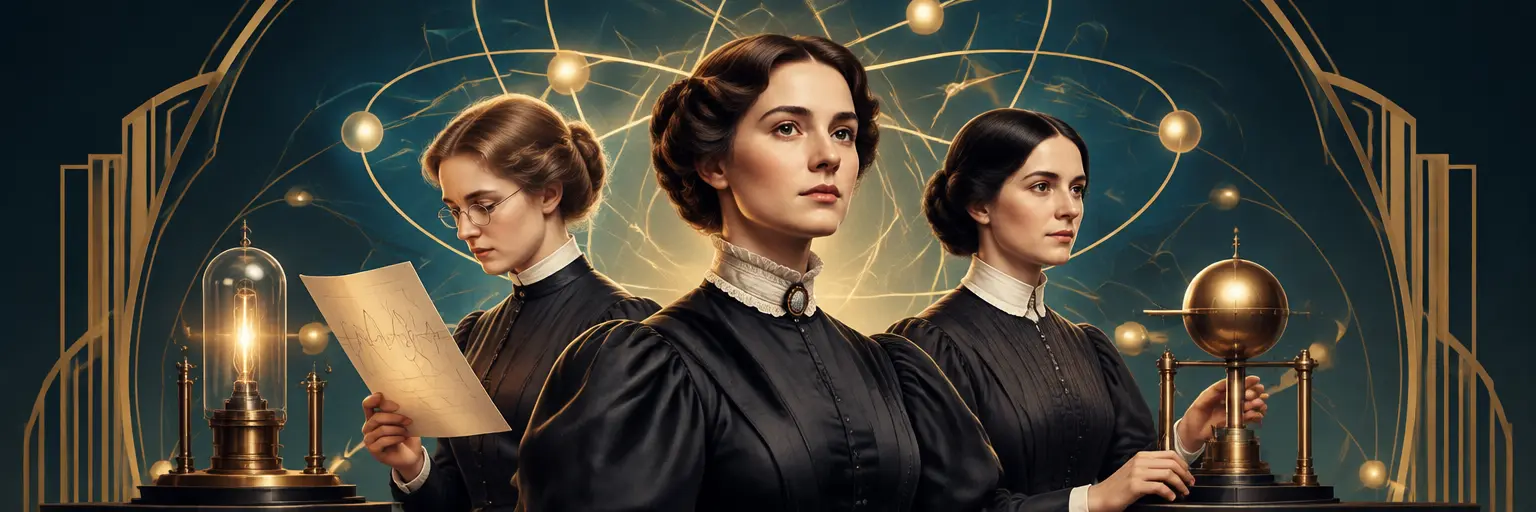
In the 1800s, a pioneering generation of women defied societal norms to illuminate the foundations of physics—often without formal recognition or university access. From calculating planetary motions to challenging the very nature of energy and light, these trailblazers used sheer intellect and perseverance to leave an indelible mark on modern science. Their stories are not just about equations and experiments; they are about resilience in the face of exclusion, curiosity that refused to be silenced, and discoveries that reshaped our understanding of the universe. Delve into the lives of these remarkable figures who transformed obstacles into opportunities—and whose legacies still empower scientists today. 🌌✨
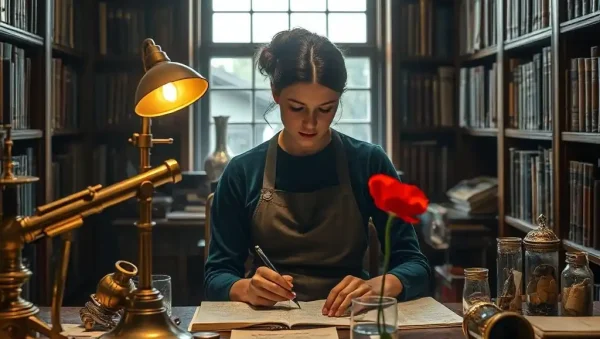
🌟 Discover how 19th-century women in physics reshaped scientific history, breaking barriers in a male-dominated field and paving the way for future…
Read article
🌟 Explore the often-overlooked pioneers of 19th Century Female Radioactivity Research, revealing early female scientists whose groundbreaking work laid the foundation for…
Read article
🌟 Women experimenting 19th century physics challenged gender norms and advanced scientific understanding, yet their stories remain underrecognized. This article celebrates these…
Read article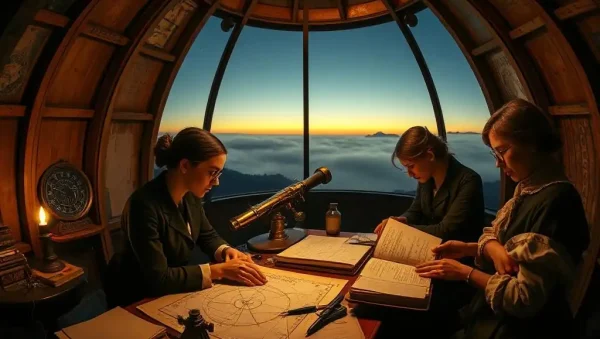
🌟 Discover the groundbreaking contributions of 19th Century Women Physics Discoveries, highlighting how these pioneering women challenged gender norms, made historic scientific…
Read article
✨ Discover the inspiring journey of a 19th century female astronomer who transformed amateur observations into groundbreaking scientific discoveries, challenging gender norms…
Read article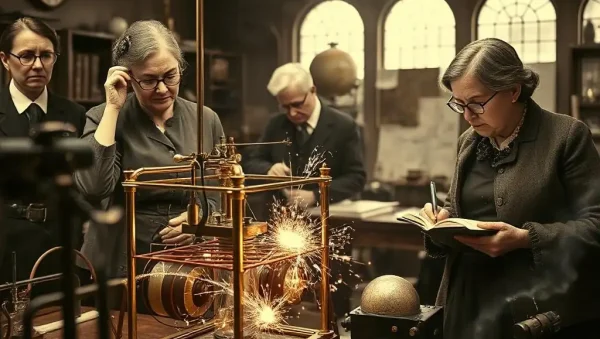
🌟 Celebrating Women’s 19th-century electrical magnetism pioneers, this article illuminates how female scientists revolutionized our understanding of electricity and magnetism, overcoming immense…
Read article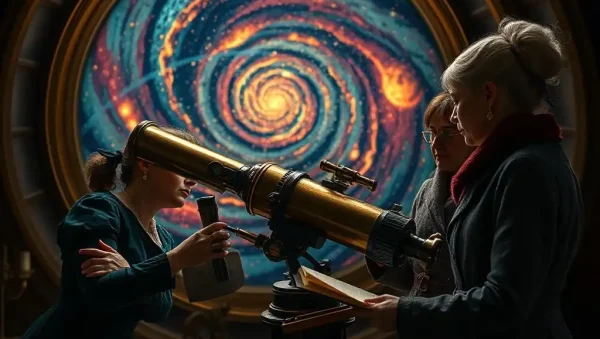
🌟 Discover how women in cosmology 19th century revolutionized our understanding of the universe, overcoming societal barriers to pioneer groundbreaking theories that…
Read articleThe 19th century was a transformative period for physics, yet the contributions of women remain largely overlooked in mainstream narratives. This subcategory on WomenInScienceHistory.com delves into the lives, struggles, and groundbreaking achievements of female physicists who navigated a world that denied them formal education, lab access, and recognition. From mathematical brilliance to experimental ingenuity, these pioneers laid foundations for modern physics while battling societal constraints. Here, you’ll uncover detailed biographies, contextual analysis of their work, and the enduring legacy of their discoveries—perfect for students, educators, and history enthusiasts seeking a richer, more inclusive scientific story.
In an era when women were barred from most universities, a handful used private tutors and family connections to master advanced mathematics. Figures like Mary Somerville, who translated Laplace’s celestial mechanics, and Sofia Kovalevskaya, who earned a doctoral degree in mathematics and physics, exemplify this struggle. Their theoretical work on differential equations and planetary motion directly influenced physics, yet they often had to publish under male pseudonyms or rely on male colleagues to present their findings.
Readers will discover how these women’s mathematical frameworks enabled later breakthroughs in electromagnetism and thermodynamics. The site provides primary source excerpts, timeline overlays, and comparative analysis of their methods versus contemporary male peers. Expect detailed explorations of their correspondence with leading scientists, revealing the intellectual networks that quietly sustained their careers despite institutional exclusion.
The 19th century’s electrical revolution saw women like Hertha Ayrton, who conducted pioneering research on the electric arc and ripple formation in sand. Despite facing the Royal Society’s ban on women fellows, Ayrton’s 16 patents and meticulous experiments on electric lighting were adopted in lighthouses and streetlamps. Similarly, mathematician and physicist Amélie Faraud’s work on electromagnetic induction expanded Faraday’s principles, though her lab notebooks were co-opted by male supervisors.
This section highlights hands-on techniques, reconstructed lab setups, and period illustrations of experimental apparatus. We break down how these women secured funding, built custom equipment, and overcame health and safety risks in makeshift home labs. For aspiring physicists, these case studies offer practical lessons in perseverance, meticulous observation, and innovative problem-solving that transcend historical barriers.
Women like Margaret Eliza Maltby, the first woman to receive a physics PhD from Columbia University, focused on precise measurements of electrical resistance and thermal conductivity. Her methods improved standard values used in industrial applications. Meanwhile, mathematician and physicist Emily C. De Pourtales developed equations for heat transfer in fluids, which later informed engine designs. Their contributions to the first law of thermodynamics were often absorbed into textbooks without attribution.
Here, you’ll find quantitative tables of their experimental data, alongside modern replications of their procedures. We also examine the socio-political climate—how women’s access to temperature-controlled labs and precision instruments was limited, forcing them to innovate with everyday materials. This section underscores the critical, yet uncredited, role of women in validating energy conservation principles that became pillars of classical physics.
While astronomy often allowed women roles as “computers,” several used this entry point to advance physics. Maria Mitchell, the first American woman to discover a comet, calculated orbital eccentricities and solar sunspot cycles, providing data for solar physics. Annie Jump Cannon, though more known for stellar classification, systematically categorized spectral types that underpinned atomic physics theories. These women’s meticulous observations led to the Harvard Spectral Classification System, vital for understanding stellar temperature and composition.
Expect deep dives into their observational techniques, including photographic plate analysis and logarithmic calculations. We highlight how they navigated gender-based restrictions to access observatory time, often working at night and during harsh weather. Their data became foundational for 20th-century astrophysics, and this section links their 19th-century work directly to contemporary cosmology, showing a direct intellectual lineage.
Beyond personal research, many 19th-century women physicists actively campaigned for education reform. Elizabeth Thackrah, a physicist and educator, founded evening classes for working women in Manchester, integrating physics demonstrations into curricula. Similarly, chemist and physicist Sarah Frances Whiting established a physics teaching laboratory at Wellesley College, training future female scientists. These advocates designed gender-inclusive pedagogies that emphasized experimentation and critical thinking over rote memorization.
This section showcases syllabi, exam papers, and photographs from their classrooms, revealing how they adapted male-dominated content for a female audience. We also discuss their public lectures, which demystified physics for non-specialists and encouraged young women to pursue science. Their advocacy created institutional pipelines that enabled later generations, and this content provides actionable insights for modern STEM educators seeking historical precedents for inclusive teaching.
Mary Somerville is often cited as the first influential female scientist, though she was more broadly a science writer and mathematician. Her 1831 translation of Laplace’s Celestial Mechanics introduced physics concepts to English audiences. For a more experimental physicist, Hertha Ayrton’s work on electric arcs makes her a leading contender, though no single woman can claim the title due to limited recognition.
They were barred from universities, scientific societies, and most paid research positions. They lacked access to laboratories, instruments, and publication venues under their own names. Social norms restricted them to domestic sphere, forcing many to work anonymously or under male mentors. Legal barriers also prevented them from owning patents independently until later in the century.
Many published under male pseudonyms, first initials only, or as co-authors on male colleagues’ papers. Others communicated findings via private letters that were later read at society meetings. Some like Hertha Ayrton used the Royal Institution as an open venue for lectures, bypassing journal submission rules that discriminated based on gender.
Yes, Hertha Ayrton’s discovery of the “Ayrton ripple” in sand and water is fully attributed to her. Also, Sofia Kovalevskaya’s theorem on the rotation of solid bodies was independently discovered. However, many women’s discoveries were reabsorbed into male colleagues’ theories, making attribution debates a complex historical area.
Present their biographies beside modern counterparts to show continuous progress. Use their experimental approaches as case studies for problem-solving under constraints. Highlight their advocacy and mentorship as models for collaborative science. Encourage students to source original papers and re-create simple experiments, connecting history to hands-on learning. This fosters a growth mindset and resilience.