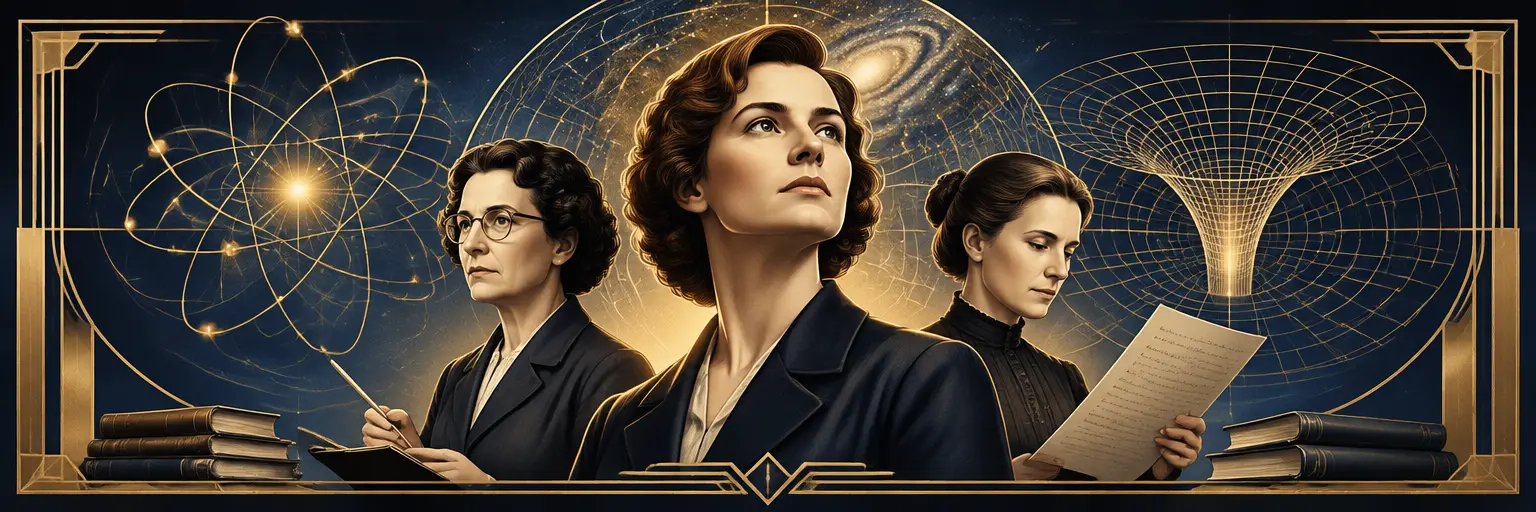
Women in Theoretical Physics: Pioneers of Abstract Thought
Welcome to our exploration of Women in Theoretical Physics, a subcategory of Physics on WomenInScienceHistory.com. Here, we delve into the minds of women who have reshaped our understanding of the universe through mathematics, quantum mechanics, and abstract reasoning. From Emmy Noether’s theorem to today’s string theorists, these scientists overcame barriers to unlock the secrets of reality. This page serves as a comprehensive resource for educators, students, and enthusiasts, offering biographies, breakthrough concepts, and contextual history. By highlighting these narratives, we aim to inspire a new generation and correct historical oversights. Explore the seminal contributions that define modern physics.
🔭 Foundational Contributions in Quantum Mechanics
Quantum mechanics, with its counterintuitive principles, was a fertile ground for female theorists. Women like Lise Meitner co-discovered nuclear fission, while Chien-Shiung Wu disproved the law of conservation of parity, fundamentally altering particle physics. Their work laid the groundwork for quantum field theory and the Standard Model. Expect to find detailed analyses of their experiments, theoretical frameworks, and the collaborative environments that fostered their discoveries. We also examine their struggles for recognition, such as Meitner being overlooked for the Nobel Prize, contextualizing their scientific achievements within societal constraints.
This section provides a technical yet accessible breakdown of their equations and hypotheses. For example, Wu’s experiment not only validated theoretical predictions but also opened doors to understanding weak nuclear forces. By reading these profiles, you gain insight into how these women navigated complex mathematics and institutional biases, proving that brilliance knows no gender. Their legacy is not just in formulas but in the resilience they demonstrated, inspiring future physicists to challenge orthodoxy.
🧮 Mathematical Physics and Symmetry: The Noether Legacy
Emmy Noether stands as a colossus in mathematical physics, with her theorem connecting conservation laws to symmetries—a cornerstone of modern physics. This segment explores her life and the profound impact of Noether’s Theorem on everything from classical mechanics to quantum electrodynamics. You will learn how her abstract algebra influenced Einstein’s general relativity and later gauge theories. We also highlight other female mathematicians, such as Mary Cartwright and Olga Ladyzhenskaya, whose work on differential equations underpins theoretical modeling. Their contributions often remained uncredited, yet they are indispensable.
Here, we simplify complex concepts without losing rigor, explaining symmetry groups and invariants for newcomers. More importantly, we discuss the collaborative intellectual climate of Göttingen and how Noether mentored others despite being denied formal academic status. This narrative underscores that theoretical physics is a collective endeavor, and these women were essential architects. Expect detailed timelines and family trees of ideas, illustrating how their mathematical insights continue to drive cutting-edge research in string theory and cosmological models.
🌌 Cosmology and Relativity: Mapping the Universe
In cosmology, women theorized about the universe’s origin and structure. Cecilia Payne-Gaposchkin proposed that stars are composed primarily of hydrogen and helium, a revolutionary idea initially dismissed but later proven correct. Similarly, Margaret Burbidge co-authored the famous B²FH paper on stellar nucleosynthesis, explaining element formation in stars. This section dives into their observations and theoretical models, linking them to modern dark matter and dark energy research. We also profile Vera Rubin, whose galaxy rotation curves provided strong evidence for dark matter, altering cosmological paradigms.
Readers will discover how these women used spectroscopy and gravitational theory to challenge established dogmas. Their stories include struggles for telescope access and publication rights, yet they persisted. We provide a behind-the-scenes look at their methodologies, from photographic plates to computer simulations, and how their insights paved the way for the Lambda-CDM model. By understanding their contributions, you appreciate the human element behind astronomical discoveries, realizing that the universe’s history is incomplete without them.
🔬 Particle Physics and Gauge Theories: Modern Masters
The latter half of the 20th century saw women leading advances in particle physics theory. Mary K. Gaillard became the first female tenured professor of physics at UC Berkeley, contributing significantly to the Standard Model, including the prediction of quark masses. Savitri Amritphale and Helen Quinn developed the Peccei-Quinn theory, proposing axions—candidates for dark matter. This section discusses their work on electroweak unification, CP violation, and supersymmetry. We explain how they navigated the high-stakes world of accelerator experiments and theoretical competitions, often as the only women in their departments.
Expect clear expositions of Lagrangian mechanics, renormalization, and spontaneous symmetry breaking tailored for a lay audience. More crucially, we highlight their leadership in international collaborations like CERN and Fermilab, showing how they shaped policy and mentored juniors. Their breakthroughs, such as the CKM matrix or the Higgs mechanism’s verification, are placed in historical context. These profiles demonstrate that theoretical particle physics is not just a male enclave but a discipline enriched by diverse perspectives, driving discoveries that define our elemental reality.
📚 Institutional Barriers and Resilience: A Social History
Beyond equations, this subcategory examines the systemic obstacles these women faced—from denial of university positions to exclusions from professional societies. For instance, Jocelyn Bell Burnell discovered pulsars but was omitted from the Nobel Prize nomination. We document these injustices while celebrating their coping strategies, such as creating alternative research networks or publishing under initials. This section integrates archival materials, correspondence, and oral histories to provide a vivid social history. It underscores how academic policy, funding mechanisms, and mentorship gaps shaped their careers, sometimes tragically, sometimes triumphantly.
Here, you find practical lessons for modern STEM institutions, including actionable recommendations for inclusive hiring and recognition. We also discuss the role of women’s colleges and informal salons that provided intellectual havens. By highlighting these struggles, we honor not only their scientific output but their activism for equitable treatment. This contextual lens enriches the technical content, making it clear that science progresses when talent is recognized regardless of gender. It is a call to action to continue dismantling barriers in contemporary physics.
Frequently Asked Questions
Who is considered the first female theoretical physicist?
While many attribute this to Emmy Noether for her foundational work in abstract algebra and physics, earlier figures like Sophie Germain in elasticity theory and Laura Bassi in experimental physics predate her. However, Noether’s theorem, formulated in 1918, is a paradigm shift that solidifies her as the first to bridge pure mathematics and theoretical physics systematically. Her influence remains unmatched in this regard.
Why were these women often overlooked for major awards?
Systemic gender bias in scientific institutions, combined with era-specific societal norms, led to exclusion from nominations and recognition. For example, Lise Meitner and Jocelyn Bell Burnell were denied Nobels despite their pivotal roles. Additionally, women’s positions as assistants or volunteers often rendered their contributions invisible to awarding committees, a pattern that persists in some forms today.
What impact did censorship or lack of publication access have?
Restricted access to journals and university libraries limited their ability to share findings promptly. Some women, like Emmy Noether, were barred from formal teaching, forcing them to rely on male colleagues to publish. This delayed scientific progress and sometimes led to credit being misattributed. The resilience shown in overcoming these hurdles underscores their extraordinary dedication.
Are there modern female theoretical physicists to follow?
Yes, many leading figures include Lisa Randall (warped extra dimensions), Shirley Ann Jackson (semiconductor theory), and Claudia de Rham (massive gravity). They continue to break ground while advocating for diversity. Following their work through academic publications and public lectures offers a live view of theoretical physics evolution.
How can I learn more about these women’s contributions?
Our website offers detailed biographies, primary source archives, and recommended reading lists. Additionally, academic databases like arXiv and institutional repositories host their original papers. For a narrative approach, books like "A Passion for Physics" by Joan Freeman or "The Age of Entanglement" by Louisa Gilder are excellent starting points.