Unveiling the Universe's Secrets: A Legacy of Women in Theoretical Physics
✨ Discover the inspiring legacy of women in theoretical physics, highlighting trailblazers who overcame adversity to unlock the universe’s secrets. Women in…
Read article
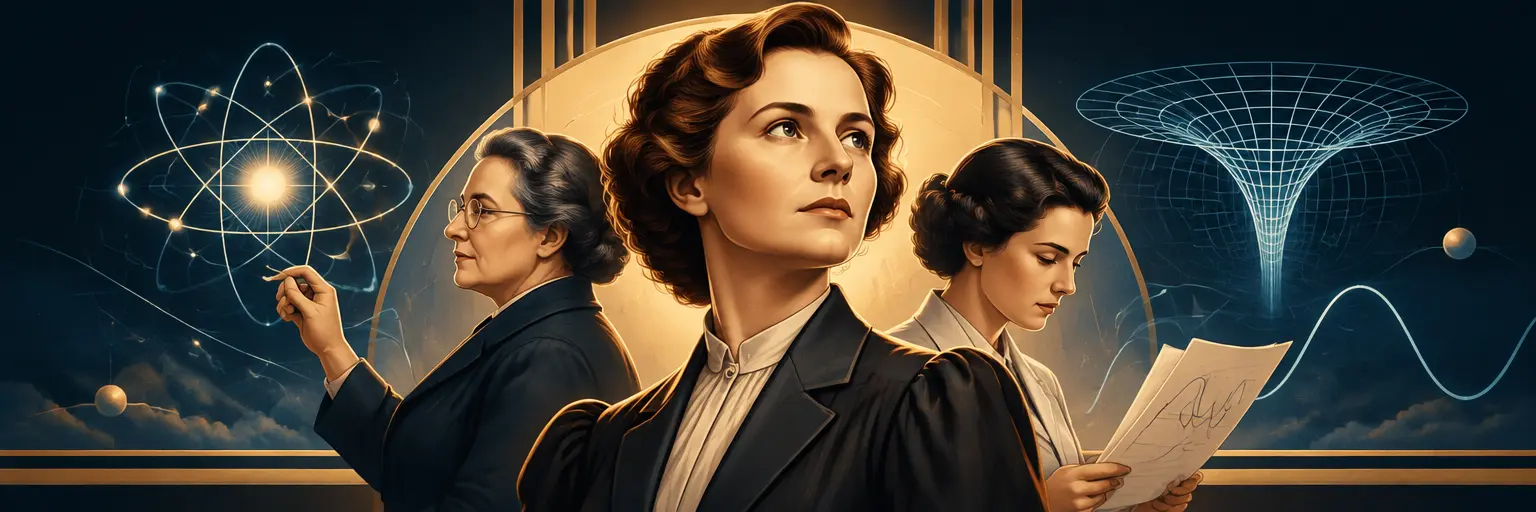
Discover how women have reshaped our understanding of the universe through bold theoretical breakthroughs and fearless inquiry. From challenging established norms to formulating revolutionary concepts, female physicists have quietly—and sometimes loudly—transformed modern physics. Their work spans quantum mechanics, relativity, cosmology, and particle physics, often overcoming systemic barriers to unlock profound insights that still guide today’s research. Dive into the untold stories of visionary minds who redefined space, time, and matter, proving that genius knows no gender. Explore their resilience, their radical ideas, and the lasting impact on how we perceive reality itself.
✨ Discover the inspiring legacy of women in theoretical physics, highlighting trailblazers who overcame adversity to unlock the universe’s secrets. Women in…
Read article
🌟 Celebrating the trailblazing women scientists behind dark matter theory, this article highlights Vera Rubin’s and Fritz Zwicky’s groundbreaking work, showcasing their…
Read article
🌟 Sau Lan Wu Quantum Chromodynamics revolutionized our understanding of particle physics, confirming key aspects of the theory. Her pioneering work in…
Read article
🌟 Celebrating Jocelyn Bell Burnell’s pioneering work, this article explores her groundbreaking discovery of pulsars and the profound implications of her pulsar…
Read article
🌟 Uncover the hidden history behind Einstein's groundbreaking theories by exploring the vital women’s role in relativity. This article highlights overlooked female…
Read article
🌟 Celebrating women in quantum mechanics, "The Quantum Queens" highlights pioneering female scientists whose groundbreaking work has shaped modern quantum theory. Their…
Read article
🌟 Donna Strickland Nobel Prize Physics recognition highlights her groundbreaking work on chirped pulse amplification lasers, revolutionizing laser technology. Her achievement not…
Read article
🌟 Emmy Noether's groundbreaking theorem in physics transformed our understanding of symmetry and conservation laws, yet her revolutionary contributions remain underrecognized. WomenInScienceHistory.com…
Read article
🌟 Celebrating Jocelyn Bell Burnell’s groundbreaking pulsar discovery, which revolutionized neutron star theory and highlighted the vital contributions of women in science,…
Read articleWelcome to our dedicated space exploring the profound yet often overlooked contributions of women to physics theories. From the mathematics behind quantum mechanics to the conceptual foundations of nuclear fission and stellar evolution, women have consistently challenged paradigms and expanded human understanding. This page illuminates their intellectual legacies — not just as assistants or calculators, but as the principal architects of theories that define modern physics. Prepare to discover how their brilliance, persistence, and unique perspectives have fundamentally altered our comprehension of spacetime, matter, and energy.
This section highlights women who built the theoretical scaffolding for quantum physics. Figures like Lise Meitner, who co-discovered nuclear fission and explained the process theoretically, and Emmy Noether, whose theorem linking symmetry and conservation laws underpins all modern physics, take center stage. You’ll learn how their insights clarified the chaotic early days of quantum theory, providing mathematical rigor and conceptual clarity that still guides research today.
Expect detailed narratives of their collaborative struggles and solo breakthroughs. We delve into how Meitner’s theoretical interpretation of Otto Hahn’s experimental data transformed chemistry and physics, and how Noether’s abstract algebra became the bedrock of particle physics. These women worked without formal recognition, often publishing under male colleagues’ names, yet their theoretical foundations remain unshaken. Understanding their work is essential for anyone grasping why modern physics relies on symmetry and probability.
Explore how women developed theories explaining the origin of elements and the lifecycle of stars. Cecilia Payne-Gaposchkin’s doctoral thesis, which posited that stars are composed primarily of hydrogen and helium, was initially dismissed and later proven correct. Margaret Burbidge, as part of the B²FH paper, co-authored the seminal theory of stellar nucleosynthesis, detailing how elements heavier than helium are forged in stellar cores and supernovae.
Here, you’ll find the untold story of how these theories transformed cosmology from speculation into a rigorous science. Payne-Gaposchkin fought against prevailing academic bias to assert that the universe’s simplicity (hydrogen) contradicted the assumed complexity of stellar composition. Burbidge’s work on element abundance tables provided observational evidence that still informs astrophysics. Their theoretical frameworks explain everything from the Sun’s energy output to the creation of gold in colliding neutron stars.
This focused area examines the theoretical work that unlocked atomic energy. Beyond Lise Meitner’s fission explanation, we explore the contributions of Chien-Shiung Wu, who experimentally disproved the conservation of parity — a cornerstone theoretical assumption — by showing that weak nuclear interactions do not obey symmetry. Her “Wu experiment” provided the evidence for the theory proposed by Chen-Ning Yang and Tsung-Dao Lee, earning them the Nobel Prize while she was overlooked.
Dive into the theoretical implications of their findings. We analyze how Wu’s precise measurements of beta decay shattered the left-right symmetry of physics, opening the door to understanding matter-antimatter asymmetry. Additionally, we cover lesser-known theorists like Maria Goeppert-Mayer, who developed the nuclear shell model, explaining why certain numbers of protons and neutrons are “magic” and more stable. Her theory, which won the Nobel Prize, remains critical for modern nuclear science and astrophysics.
This segment celebrates the women who provided the mathematical language for physics theories, particularly Emmy Noether’s theorem, which connects conservation laws (energy, momentum) to symmetries in spacetime. We also highlight Katherine Johnson, whose calculations of orbital mechanics made spaceflight possible, and Hertha Sponer, who contributed to the theory of molecular spectra and the Sponer-Teller rule for molecular dissociation.
Discover how their mathematical insights are not trivial ‘calculations’ but profound theoretical contributions. Noether’s theorem is now considered the most beautiful result in mathematical physics, guiding string theorists and particle physicists alike. Johnson’s work on the theory of orbital transfer and trajectory analysis was essential for the success of the Apollo missions. We explain these abstract concepts in accessible language, showing how symmetry and boundary conditions shape our predictive power in physics.
Finally, we look forward, discussing how current women physicists are extending theories in fields like loop quantum gravity, dark matter, and quantum information. Researchers like Sabrina Gonzalez Pasterski (a theoretical physicist known for her work on “quantum gravity explorer” probes) and Priyamvada Natarajan (who proposed early black hole formation theories) are pushing boundaries. Their modern theories address the universe’s most perplexing enigmas without relying on invisible forces.
This section offers a bridge from historical context to cutting-edge research. You will learn how these contemporaries mentor young girls, build open-source theoretical models, and challenge the ‘leaky pipeline’ in STEM. We also discuss the importance of remembering the past to create inclusive future theories — ensuring that no brilliant mind is again erased from the physics canon. Their work promises to redefine our next century of cosmological discovery.
While many contributed, Emmy Noether’s 1918 theorem on symmetries and conservation laws is often cited as the first major abstract physics principle by a woman. It profoundly shaped modern theoretical physics, though she was not recognized in her lifetime. Lise Meitner’s 1939 theoretical explanation of nuclear fission is another pioneering milestone, combining experimental chemistry with formal theory.
Systemic biases in academia and publishing historically relegated women to verification or computational roles. Their names were omitted from papers or credited to male collaborators, as seen with Meitner (whose work was credited to Hahn) and Wu (whose parity experiment earned her colleagues the Nobel). Institutional sexism, limited access to laboratories, and exclusion from professional networks further prevented proper acknowledgement.
Noether’s theorem states that for every continuous symmetry in nature (like translation in time or space), there is a corresponding conservation law (energy or momentum). For example, since physics laws don’t change over time, energy is conserved. This deep connection between symmetry and invariability underpins all modern particle physics and cosmology.
Yes. Maria Goeppert-Mayer won the 1963 Nobel Prize in Physics for proposing the nuclear shell model, which explains the magic numbers of protons and neutrons. Chien-Shiung Wu never received the Nobel despite her critical experimental confirmation of theoretical parity violation. To date, only two other women share physics Nobels: Marie Curie (1903) and Donna Strickland (2018, for laser chirped pulse amplification).
Start by reading biographies of Meitner, Noether, Payne-Gaposchkin, and Wu. Academic databases like NASA ADS or PubMed list their original papers. Books such as “A Passion for Physics” and “The Curies” provide deeper context. Following contemporary physicists on social media or attending public lectures by organizations like the American Physical Society’s Committee on Women in Physics also offers engaging pathways.