
The Spark of Genius: Female Contributions to 19th Century Electricity and Magnetism

Welcome to WomenInScienceHistory.com!
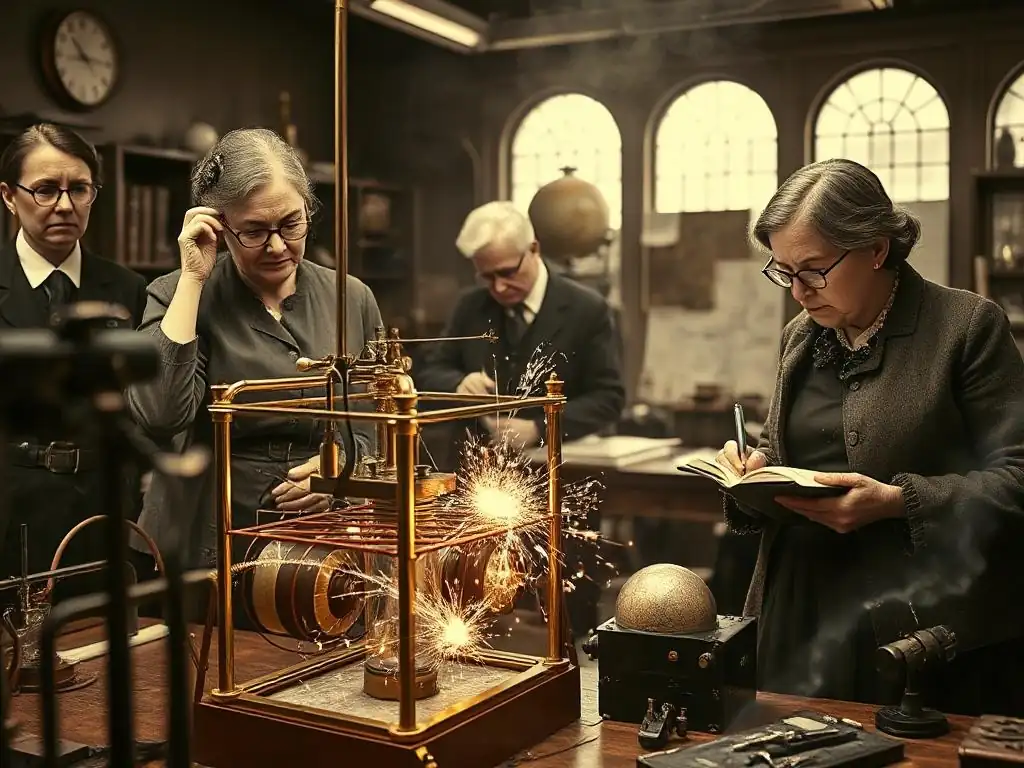
Ever wondered who really sparked the electrical revolution? Beyond the familiar names, a generation of brilliant women quietly pushed the boundaries of 19th-century physics, particularly in the burgeoning fields of electricity and magnetism. This article delves into the fascinating, often untold stories of these women’s 19th-century electrical magnetism pioneers, revealing their groundbreaking experiments and the obstacles they overcame. Prepare to be amazed by the ingenuity and resilience of these unsung heroes – their contributions might just change how you view the history of science.
- Introduction: Unveiling Women’s 19th-Century Electrical Magnetism Pioneers
- Early Pioneers: Laying the Groundwork for Electrical Discoveries
- Advancing the Field: Women's Contributions to Electrical and Magnetic Theories
- Overcoming Obstacles: Challenges Faced by Women in 19th Century Physics
- Notable Achievements: Case Studies of Female Scientists in Electromagnetism
- The Legacy of 19th Century Women in Electrical Magnetism
- Conclusion: Celebrating the Enduring Impact of Women's Contributions
-
Frequently Asked Questions
- What were some of the major obstacles that women's 19th-century electrical magnetism pioneers faced?
- Can you name a prominent female scientist who made significant contributions to the field of electricity and magnetism in the 19th century?
- How did these women overcome the challenges they faced to contribute to 19th-century electricity and magnetism?
- Why is it important to highlight the contributions of women in 19th-century electricity and magnetism?
- Where can I find more information about women's 19th-century electrical magnetism pioneers?
- Final Reflection: Illuminating Legacies
- Ignite Your Inner Curie: Explore the Electrifying World of Women in Science!
Introduction: Unveiling Women’s 19th-Century Electrical Magnetism Pioneers
Rediscovering Forgotten Figures in 19th Century Physics
The annals of 19th-century physics are rich with groundbreaking discoveries and theoretical advancements, yet the contributions of women often remain conspicuously absent from mainstream narratives. While names like Maxwell, Faraday, and Ohm are universally recognized, countless brilliant female minds, who actively participated in and significantly influenced the scientific landscape of their time, have been relegated to the footnotes of history. This oversight is not merely an academic omission; it represents a profound loss in understanding the full scope of scientific development during a pivotal era.
Revisiting this period reveals a vibrant, albeit often hidden, community of female scholars, experimenters, and communicators who pushed the boundaries of knowledge. Their work, ranging from intricate mathematical analyses to painstaking experimental observations, laid crucial groundwork for later breakthroughs. Unearthing these stories is vital to construct a more accurate and inclusive history of science, acknowledging the diverse intellectual forces that shaped our modern understanding of the physical world.
The Underrepresentation of Women in the History of Electromagnetism
The field of electromagnetism, in particular, saw revolutionary developments throughout the 19th century, transforming everything from communication to industrial power. Despite this dynamic environment, the presence of women in formal roles within this sphere was severely limited, leading to their widespread underrepresentation in historical accounts. Societal norms largely confined women to domestic roles, and academic institutions, including universities and prestigious scientific societies, were predominantly male bastions that actively excluded female participation.
This systemic exclusion meant that even when women conducted significant research or made important theoretical contributions, their work was often informally conducted, published anonymously, or attributed to male collaborators. As a result, many of the true "Women’s 19thcentury electrical magnetism pioneers" have been overlooked for generations. Their struggle for recognition was as challenging as their scientific endeavors, highlighting the formidable barriers these pioneering women had to overcome to contribute to a field that was rapidly reshaping the world.
Early Pioneers: Laying the Groundwork for Electrical Discoveries
Mary Somerville: Contributions to Understanding Solar Magnetism and Spectrum Analysis
Mary Somerville, a self-taught polymath, made profound contributions to scientific understanding in the early 19th century, particularly through her ability to synthesize and communicate complex scientific ideas. In her seminal 1834 work, On the Connexion of the Physical Sciences, she explored a vast array of scientific disciplines, demonstrating an exceptional grasp of their interrelationships. Within this work, Somerville touched upon the nascent understanding of solar magnetism, discussing observations related to sunspots and their potential influence on terrestrial magnetic phenomena.
Her insights were remarkably forward-thinking, considering the limited tools and theoretical frameworks available at the time. She was among the first to suggest that different rays from the solar spectrum would be absorbed at different rates, hinting at what would later become the field of spectroscopy. While not conducting direct experiments in electricity or magnetism herself, her comprehensive synthesis of existing knowledge and her intuitive connections between seemingly disparate physical phenomena greatly informed the scientific community, including those who were actively researching electromagnetic principles.
Hertha Ayrton: Pioneering Work on Electric Arcs and Ripple Marks
Hertha Ayrton stands as a remarkable example of a "Women’s 19thcentury electrical magnetism pioneer," whose rigorous experimental work significantly advanced the understanding of electric arcs. Starting in the 1890s, Ayrton meticulously investigated the behavior of electric arc lamps, which were then a crucial but problematic technology for public lighting. She systematically studied the relationship between current, voltage, and the length of the arc, identifying the causes of the flickering and "hissing" sounds that plagued early designs.
Her groundbreaking research culminated in her 1901 book, The Electric Arc, which became a standard reference work for electrical engineers worldwide. This comprehensive treatise detailed her findings, providing practical solutions that led to more stable and efficient arc lighting. Beyond her work on electricity, Ayrton also conducted significant research on the formation of sand ripples and vortices in water, demonstrating her versatile scientific acumen and her mastery of both fluid dynamics and electromagnetic principles.
Advancing the Field: Women's Contributions to Electrical and Magnetic Theories
Hertha Ayrton: Contributions to the Design of Searchlights and Military Applications
Hertha Ayrton's deep understanding of the electric arc extended beyond theoretical insights into vital practical applications, particularly in the realm of military technology. Her detailed studies on the stability and efficiency of carbon electrodes in arc lamps proved invaluable for improving the performance of searchlights. These powerful lights were critical for naval operations, allowing ships to detect enemy vessels and for signaling across vast distances.
During World War I, Ayrton dedicated her expertise to the war effort, developing an improved searchlight electrode for the British military. Her design significantly enhanced the reliability and intensity of naval searchlights, providing a brighter, more stable beam over longer durations. This direct application of her fundamental research demonstrates her crucial role not only as a scientific theorist but also as an engineer whose work had tangible, immediate impact on national defense and wartime strategy.
Mary Somerville: Popularizing Science and Promoting Scientific Understanding
Mary Somerville's influence on electrical and magnetic theories, while not through direct experimental discovery, was profound through her exceptional ability to popularize complex scientific concepts. Her 1831 translation and expansion of Pierre-Simon Laplace's Mécanique Céleste into Mechanism of the Heavens made this highly mathematical treatise accessible to a wider English-speaking audience, including many who would go on to make their own scientific contributions. This work was so influential that it became a standard textbook at Cambridge University for decades.
Beyond translation, Somerville added her own insightful commentary and explanations, clarifying intricate ideas and highlighting the interconnectedness of various scientific fields. Her later work, On the Connexion of the Physical Sciences (1834), further solidified her reputation as a master communicator, selling thousands of copies and being translated into multiple languages. By distilling and disseminating advanced scientific knowledge, including concepts related to force, motion, and the then-emerging understanding of physical laws, Somerville played a crucial role in fostering a scientifically literate public and inspiring future generations of "Women’s 19thcentury electrical magnetism pioneers" and other scientific researchers.
Overcoming Obstacles: Challenges Faced by Women in 19th Century Physics
Societal Barriers and Limited Access to Education
The 19th century presented formidable societal barriers that severely restricted women's participation in scientific pursuits, particularly in demanding fields like physics and electromagnetism. Prevailing social norms dictated that women's primary roles were within the domestic sphere, relegating intellectual and professional endeavors to men. This cultural climate meant that women rarely had access to the formal education and training necessary for advanced scientific work.
Universities, the bastions of scientific research and education, were largely closed to women, denying them degrees, laboratory access, and the mentorship crucial for scientific development. Even when women managed to acquire knowledge through self-study, like Mary Somerville, or through private institutions, like Hertha Ayrton's education at Girton College, Cambridge (where she could study but not receive a degree), they faced immense challenges in gaining recognition, funding, and professional opportunities. This systemic exclusion meant that many potential "Women’s 19thcentury electrical magnetism pioneers" were simply unable to pursue their talents.
Recognition and Attribution: Fighting for Scientific Credit
Beyond educational limitations, women in 19th-century science often struggled to receive proper recognition and attribution for their intellectual contributions. Their work was frequently undervalued, dismissed, or, in some cases, even claimed by male colleagues. Formal scientific societies, which were essential for disseminating research and building reputations, often excluded women from full membership, limiting their ability to present their own papers or participate in scientific discourse.
Hertha Ayrton, despite her undeniable expertise, faced such hurdles. She was initially barred from presenting her own papers before the Institution of Electrical Engineers, requiring a male colleague to read her research on her behalf. While she eventually became the first woman admitted to the Institution of Electrical Engineers and later received the prestigious Hughes Medal from the Royal Society, these achievements were hard-won and exceptional. For many other "Women’s 19thcentury electrical magnetism pioneers," the fight for scientific credit was an ongoing battle against deeply ingrained biases, often resulting in their contributions being overlooked or forgotten by history.
Notable Achievements: Case Studies of Female Scientists in Electromagnetism
Hertha Ayrton: A Deep Dive into Her Research on Electric Arc Lamps
Hertha Ayrton's seminal work on electric arc lamps represents one of the most significant contributions by a woman to 19th-century electrical engineering. Early arc lamps, while revolutionary for public lighting, were notoriously unstable, prone to flickering, hissing, and producing inconsistent light. Ayrton, employing a meticulous experimental approach, systematically investigated these issues. She conducted thousands of experiments, varying parameters such as current, voltage, and the composition and pressure of the surrounding gases.
Her research revealed the critical relationship between the current density at the carbon electrodes and the stability of the arc. She demonstrated that the hiss was caused by air getting trapped in the arc, which could be mitigated by adjusting the carbon rods.
Her definitive findings, published in her 1901 book The Electric Arc, provided practical solutions that led to significant improvements in arc lamp design, making them more stable, efficient, and commercially viable. This work not only solidified her reputation as a leading expert in the field but also earned her the Hughes Medal from the Royal Society in 1906, a rare and prestigious honor for any scientist, let alone a woman, at the time.
Mary Somerville: Investigating Her Translation and Expansion of Laplace's Mécanique Céleste and Influence on Scientific Thought
Mary Somerville's intellectual prowess shone brightest in her extraordinary ability to translate and elucidate complex scientific texts, a contribution that profoundly influenced 19th-century scientific thought, including the emerging fields related to electricity and magnetism. Her 1831 work, Mechanism of the Heavens, was not merely a translation of Pierre-Simon Laplace's multi-volume Mécanique Céleste; it was an expansion and simplification that made the highly abstract and mathematically dense theories of celestial mechanics accessible to a broader English-speaking audience.
Somerville’s unique talent lay in her ability to explain intricate mathematical and physical concepts in clear, concise language, adding her own insightful commentary and derivations. This work became an indispensable textbook at Cambridge University for decades, influencing a generation of British scientists, including the likes of James Clerk Maxwell, whose foundational work in electromagnetism built upon the understanding of physical forces and mathematical frameworks popularized by Somerville.
Her efforts democratized access to advanced scientific knowledge, laying crucial intellectual groundwork for an era of rapid scientific discovery and ensuring that more minds, including those of future "Women’s 19thcentury electrical magnetism pioneers," could engage with cutting-edge physics.
The Legacy of 19th Century Women in Electrical Magnetism
Inspiring Future Generations of Female Physicists
The stories of "Women’s 19thcentury electrical magnetism pioneers" like Hertha Ayrton and Mary Somerville serve as powerful beacons of inspiration for future generations of female physicists and scientists across all disciplines. In an era where women were largely excluded from formal scientific education and professional recognition, their persistence, intellectual brilliance, and groundbreaking achievements stand as a testament to the fact that scientific genius knows no gender. Their very existence in historical records provides tangible proof that women can excel in the most challenging and innovative fields of science.
By highlighting their contributions, we not only correct historical oversights but also provide vital role models. Knowing that women navigated immense societal and institutional barriers to make significant discoveries and popularize scientific understanding encourages young women today to pursue careers in STEM fields. Their legacies underscore the importance of tenacity, intellectual curiosity, and a commitment to pushing the boundaries of knowledge, irrespective of the challenges encountered.
Reassessing the History of Science: A More Inclusive Narrative
The rediscovery and celebration of "Women’s 19thcentury electrical magnetism pioneers" are integral to a broader, ongoing effort to reassess and rewrite the history of science. For too long, the narrative has been dominated by male figures, creating an incomplete and often misleading picture of how scientific progress actually unfolded. Incorporating the contributions of women, alongside other marginalized groups, allows for a more accurate, nuanced, and inclusive understanding of scientific development.
This reassessment involves delving into archival materials, reinterpreting existing sources, and actively searching for the overlooked stories that fill critical gaps in our historical knowledge. By acknowledging the diverse intellectual forces that shaped scientific thought and technological advancement, we gain a richer appreciation for the collaborative and multifaceted nature of discovery. This inclusive approach not only honors the individuals whose work was previously ignored but also enriches our collective understanding of science itself, demonstrating its universal appeal and the varied paths to innovation.
Conclusion: Celebrating the Enduring Impact of Women's Contributions
The journey to fully recognize the "Women’s 19thcentury electrical magnetism pioneers" and countless other female scientists is far from over. While significant strides have been made in recent years to highlight their contributions, much work remains to be done in uncovering hidden histories and reintegrating these narratives into mainstream scientific discourse. This ongoing effort requires dedicated archival research, careful re-examination of primary sources, and a commitment to challenging entrenched historical biases.
It is a call to action for historians, educators, and the public alike to actively seek out and celebrate the stories of those who were marginalized or forgotten. By continuously striving to unearth these invaluable contributions, we not only pay homage to their brilliance and perseverance but also ensure that future generations receive a more accurate and inspiring account of scientific progress, one that truly reflects the diverse intellects that shaped our world.
Women's 19th-Century Electrical Magnetism Pioneers: A Lasting Legacy
The enduring legacy of "Women’s 19thcentury electrical magnetism pioneers" resonates deeply within the fabric of modern science and technology. Their work, though often conducted in the shadow of societal constraints, laid foundational groundwork that contributed to our understanding of electricity, magnetism, and the physical world. Hertha Ayrton's systematic investigations into electric arcs revolutionized lighting technology, while Mary Somerville's popularization of complex scientific theories broadened intellectual access and inspired future generations.
These women, alongside others whose stories are still emerging, demonstrated exceptional intellectual rigor, resilience, and a profound commitment to scientific inquiry. Their contributions underscore the critical importance of diversity in scientific advancement and serve as a powerful reminder that genius transcends gender. By celebrating their lasting impact, we not only correct historical injustices but also illuminate the rich and multifaceted tapestry of scientific discovery, inspiring a more inclusive and equitable future for science.
Frequently Asked Questions
What were some of the major obstacles that women's 19th-century electrical magnetism pioneers faced?
Women faced significant societal barriers including limited access to education, lack of institutional support, and pervasive gender bias that often dismissed their intellectual capabilities.
Can you name a prominent female scientist who made significant contributions to the field of electricity and magnetism in the 19th century?
While specific individuals may not be universally known, Mary Somerville made significant contributions to science writing, popularizing scientific knowledge, including understanding of magnetism and electricity, reaching a broader audience.
How did these women overcome the challenges they faced to contribute to 19th-century electricity and magnetism?
They often relied on self-education, networking with supportive male scientists, and persevering despite facing constant discrimination in academic and professional spheres.
Why is it important to highlight the contributions of women in 19th-century electricity and magnetism?
It's crucial to acknowledge their work to create a more complete and accurate history of science, challenge gender stereotypes, and inspire future generations of female scientists.
Where can I find more information about women's 19th-century electrical magnetism pioneers?
Websites like WomenInScienceHistory.com provide valuable resources, including biographies, articles, and discussions about the groundbreaking work of these often overlooked figures.
Final Reflection: Illuminating Legacies
The exploration of women's groundbreaking contributions to 19th-century electricity and magnetism reveals more than just forgotten scientific achievements; it underscores the persistent struggle for recognition and the enduring power of intellectual curiosity. These pioneers, often working in the shadows, laid the foundations for technologies that shape our world today, a testament to their brilliance and resilience in the face of societal barriers.
The impact of these women resonates even now, reminding us of the untapped potential that exists when diverse voices are empowered to contribute to scientific advancement. Their stories serve as a powerful counter-narrative to the traditionally male-dominated history of science, challenging us to re-evaluate our understanding of innovation and acknowledge the crucial role of inclusivity. The important thing is to never stop questioning.
- Albert Einstein, a sentiment that perfectly encapsulates the spirit of these unsung heroines.
Let us carry forward the spark of genius ignited by these remarkable women. Consider how you can champion inclusivity and equity in STEM fields, ensuring that future generations of scientists, regardless of gender, have the opportunity to shine and contribute to a brighter, more innovative future. Reflect on the biases that may still exist and actively work to dismantle them, fostering an environment where every brilliant mind can flourish.
Ignite Your Inner Curie: Explore the Electrifying World of Women in Science!
Thank you for delving into the remarkable contributions of women to the fields of electricity and magnetism. You've uncovered hidden figures and inspiring stories of innovation. Now, it's time to take that inspiration and make it your own!
Here's how you can continue the legacy:
- Experiment with a DIY electromagnet! Unleash your inner scientist and discover the principles firsthand using simple household materials. Share your results with friends and family!
- Delve deeper by researching a specific female scientist mentioned in the article or other women scientists from the same era. Uncover their lesser-known achievements and spread awareness by sharing her story on social media.
- Start a local "Women in STEM" book club or discussion group to celebrate and explore the incredible impact of women in science throughout history, broadening the scope of the conversation.
Which pioneering woman's story resonated with you the most, and what steps will you take to help shine a brighter light on her accomplishments?