
The Apparatus and the Animus: Women Experimenters in 19th Century Physics Labs


Welcome to WomenInScienceHistory.com!
Delve into the captivating world where scientific innovation meets untold stories. Did you know that the 19th century, often perceived as a domain of men, actually saw remarkable women experimenting and making groundbreaking contributions to physics? Prepare to be inspired as we uncover the challenges and triumphs of these pioneering figures in " The Apparatus and the Animus: Women Experimenters in 19th Century Physics Labs." What secrets did their experiments hold, and what obstacles did they overcome? Read on to discover the fascinating narratives that have been historically overlooked.
- Introduction: Unveiling the Hidden Histories of Women in 19th Century Physics
- The Challenges Faced by Women Experimenting in 19th Century Physics Laboratories
- Pioneering Women and Their Experimental Contributions to 19th Century Physics
- The Apparatus: Tools and Techniques Used by Women Experimenters
- The Animus: Gender Dynamics and Discrimination in the Physics Community
- The Legacy of Women Experimenters: Inspiring Future Generations of Female Physicists
- Conclusion: Celebrating the Achievements of Women Experimenting in 19th Century Physics
-
Frequently Asked Questions
- What were some of the main challenges women faced when experimenting in 19th-century physics labs?
- How did "WomenInScienceHistory.com" aim to address the historical underrepresentation of women in 19th-century physics?
- Can you provide an example of a notable woman who conducted experiments in 19th-century physics, despite the challenges?
- What types of experimental work in physics were women typically involved in during the 19th century?
- Why is it important to recognize the contributions of women experimenting in 19th-century physics, even today?
- Final Reflection: Illuminating Forgotten Contributions
- Ignite Your Inner Curie: Pioneer Your Path in Physics!
Illuminating the Contributions of Female Physicists
Throughout history, countless women have made profound, often revolutionary, contributions to the scientific landscape. Yet, their narratives frequently remain obscured, overshadowed by male counterparts, or entirely omitted from conventional historical accounts. This persistent oversight not only diminishes the true breadth of human ingenuity but also deprives aspiring scientists of inspiring role models. Recognizing these forgotten figures is crucial for a complete and equitable understanding of scientific progress.
The 19th century, a period of immense scientific ferment, particularly in physics, saw the emergence of groundbreaking theories and experimental methods. Despite societal strictures and institutional barriers, a determined cohort of women engaged in rigorous scientific inquiry, pushing the boundaries of knowledge. Their work, often conducted under challenging circumstances, demonstrates an unwavering commitment to unraveling the mysteries of the natural world.
The Overlooked Role of Women Experimenters in 19th Century Physics: A Historical Perspective
The 19th century was a transformative era for physics, witnessing the formulation of classical electromagnetism, the development of thermodynamics, and pioneering work in optics and spectroscopy. Experimental verification was at the heart of these advancements, requiring meticulous observation, innovative apparatus, and rigorous data analysis. While the narrative often centers on figures like Maxwell, Faraday, and Joule, many women were actively involved in this burgeoning field, contributing through experimentation.
These women experimenters in 19th century physics navigated a landscape where formal laboratories and academic recognition were largely inaccessible to them. Their contributions, whether through independent research, uncredited assistance, or ingenious home-based setups, were vital to the advancement of specific subfields. Unearthing their stories provides a richer, more accurate historical perspective, highlighting the resilience and intellectual prowess of women in an often-hostile scientific environment.
The Challenges Faced by Women Experimenting in 19th Century Physics Laboratories
Societal Barriers and Gender Bias in Scientific Education
The 19th century was characterized by rigid societal norms that largely confined women to the domestic sphere, perceiving scientific and intellectual pursuits as unfeminine or even detrimental to their health. Formal education for women, particularly in advanced subjects like physics, was severely limited. Universities and established scientific institutions were predominantly male enclaves, often denying women admission to degree programs, lectures, or even basic laboratory access.
Even when women managed to gain entry to educational settings, they frequently encountered overt skepticism and condescension from male peers and instructors. Curricula designed for women were often less rigorous, focusing on "gentler" sciences or practical applications rather than fundamental theoretical or experimental physics. This pervasive gender bias created a formidable hurdle for any woman aspiring to be a serious physicist, let alone one actively engaged in experimentation.
Accessing Resources and Opportunities: Limited Access for Women in Physics
Engaging in experimental physics required access to specialized and often expensive equipment, dedicated laboratory space, and connection to a network of scientific peers and mentors. For women in the 19th century, these resources were exceptionally difficult to obtain. Lacking independent financial means, denied institutional affiliations, and excluded from professional scientific societies, their opportunities were severely curtailed.
Many women who did manage to conduct experimental work often did so by leveraging personal connections, working as unpaid assistants to male relatives (fathers, brothers, or husbands), or by creating makeshift laboratories in their own homes. This reliance on informal and often precarious arrangements severely limited the scope of their research and, critically, their ability to gain independent recognition for their findings. The pursuit of "Women experimenting 19th century physics" was a testament to their exceptional determination against immense odds.
Overcoming the Animus: Fighting for Recognition in a Male-Dominated Field
The "animus" faced by women in 19th-century physics was not merely passive exclusion but often active resistance and systemic discrimination. Their intellectual capabilities were frequently questioned, their work dismissed, and their presence in scientific spaces met with hostility. This deeply ingrained prejudice meant that even when women produced significant experimental results, their findings might be ignored, attributed to male collaborators, or dismissed as mere "women's work."
To overcome this animus, women employed various strategies. Many persevered through sheer tenacity, meticulously documenting their work to counter skepticism. Others sought out sympathetic male mentors who championed their cause, or they formed informal networks with other intellectual women. Some even published their findings under initials or male pseudonyms to ensure their work received unbiased consideration. Their fight for recognition underscores the extraordinary courage of "Women experimenting 19th century physics" in a profoundly unwelcoming era.
Pioneering Women and Their Experimental Contributions to 19th Century Physics
Hertha Ayrton: A Case Study of Experimental Physics Research
Hertha Ayrton, born Phoebe Sarah Marks in 1854, emerged as a formidable figure in electrical engineering and physics, defying the conventions of her time. Despite attending Girton College, Cambridge, in the late 1870s, she was denied a degree due to the university's policy against awarding degrees to women. Undeterred, Ayrton pursued a career as a scientific experimenter and inventor, demonstrating an unparalleled dedication to hands-on investigation and practical application of physical principles.
Her early career involved teaching mathematics and working on calculating machines, but her true passion lay in electrical engineering and the physics of the electric arc. She meticulously constructed her own experimental setups and conducted rigorous investigations, often working from her home laboratory. Ayrton's commitment to empirical evidence and precise measurement made her a leading authority on a critical industrial technology of the era.
Hertha Ayrton's Key Experiments and Discoveries
Hertha Ayrton's most significant experimental work focused on the electric arc, a vital component of early electric lighting and industrial processes. She systematically investigated the relationship between current, voltage, and the length of the arc, demonstrating that the arc's stability and light output were directly related to its current, rather than voltage, as previously believed. Her meticulous measurements revealed the complex phenomenon of the "hissing arc," a problem that plagued early arc lamps, and she developed methods to mitigate it.
Beyond electrical physics, Ayrton also conducted groundbreaking experimental research on the formation and movement of sand ripples in water, starting around 1901. Through careful observation and the use of ingenious tanks and wave generators, she demonstrated how ripples are formed by vortexes in the fluid, challenging existing theories. Her detailed diagrams and precise descriptions of these wave phenomena provided new insights into fluid dynamics and natural pattern formation, showcasing her versatility as an experimenter.
The Impact of Hertha Ayrton's Work on the Field
Hertha Ayrton's experimental findings on the electric arc had a profound practical impact, leading to significant improvements in the design and efficiency of arc lamps used for street lighting, lighthouses, and cinema projectors. Her work was instrumental in making electric lighting more stable and commercially viable. She became the first woman elected to the Institution of Electrical Engineers in 1899 and, notably, was the first woman to read her own paper before the Royal Society (though she was never granted full fellowship).
Despite her undeniable contributions and recognition by professional bodies, Ayrton still faced considerable resistance. For example, she was nominated for Fellowship of the Royal Society in 1902 but was deemed ineligible because, as a married woman, she was not considered a "person" in the eyes of the Society's charter. This highlights the persistent "animus" that continued to challenge even the most accomplished "Women experimenting 19th century physics" and beyond.
Marie Curie: A Female Physicist Breaking Barriers
Marie Skłodowska Curie, born in Warsaw in 1867, embodies the spirit of a female physicist who broke barriers through relentless experimental inquiry. Arriving in Paris in 1891 to pursue her education at the Sorbonne, she embarked on a scientific journey that would redefine fundamental physics. Her initial experimental work involved the magnetic properties of various steels, a detailed and meticulous investigation that showcased her innate talent for precision measurement and systematic research.
It was in 1896, however, that her focus shifted to the enigmatic "uranium rays" discovered by Henri Becquerel. Working in a rudimentary laboratory at the École Supérieure de Physique et de Chimie Industrielles de la Ville de Paris, a shed-like space that was poorly equipped and ventilated, Marie Curie began the foundational experimental work that would lead to her revolutionary discoveries. Her methodical approach and tireless dedication transformed a curious phenomenon into a new field of physics.
Marie Curie's Focus on Radioactivity
Marie Curie's experimental work on radioactivity began with a simple but profound question: could other elements emit similar rays to uranium? Using an electrometer, an instrument perfected by her husband Pierre and his brother Jacques, she systematically measured the faint electrical currents produced by various elements and minerals. This painstaking process led to her discovery that thorium also emitted these rays, and crucially, that certain uranium-bearing minerals, like pitchblende and torbernite, were far more radioactive than pure uranium itself.
This anomaly led her to hypothesize that these minerals must contain undiscovered, highly radioactive elements. What followed was a monumental experimental undertaking: the chemical separation of tons of pitchblende ore to isolate minute quantities of these new elements. Over several years, through arduous, physically demanding work of dissolving, precipitating, and filtering, she and Pierre succeeded in isolating polonium (in 1898) and then radium. This was a triumph of precise chemical physics experimentation, conducted under extremely challenging conditions.
Challenges Faced by Marie Curie and Her Strategies for Success
Marie Curie faced immense practical challenges in her experimental pursuit of radioactivity. Her laboratory was a leaky, unheated shed, lacking proper ventilation, where she processed tons of radioactive ore. This work was physically exhausting, requiring constant stirring of boiling vats and repeated crystallizations. She was unaware of the long-term health risks associated with radiation exposure, which would later take a toll on her.
Beyond the physical hardship, she faced the intellectual challenge of convincing the scientific community of her radical findings. Her strategy involved rigorous experimental verification, meticulous record-keeping, and the invaluable intellectual partnership with Pierre. While Pierre's support was crucial, Marie consistently maintained her intellectual independence. Her unwavering commitment to empirical evidence and her ability to perform highly precise measurements under rudimentary conditions allowed "Women experimenting 19th century physics" to make one of its most profound contributions, ultimately earning her the Nobel Prize in Physics in 1903 (shared with Pierre and Becquerel) and the Nobel Prize in Chemistry in 1911.
Other Notable Women Experimenters in 19th Century Physics
Mary Somerville (1780-1872)
Mary Somerville, while not a laboratory experimenter in the modern sense, was a pivotal figure in popularizing and translating complex scientific works, particularly in physics and astronomy. Her most famous work, Mechanism of the Heavens (1831), was a translation and simplification of Laplace's Mécanique Céleste.
This endeavor required an extraordinary understanding of advanced mathematics and physical principles, making the cutting-edge celestial mechanics accessible to a wider English-speaking audience. Her subsequent work, On the Connexion of the Physical Sciences (1834), presented a unified view of various branches of physics, demonstrating her comprehensive grasp of experimental observations and theoretical frameworks across different disciplines.
Laura Bassi (1711-1778)
Although primarily an 18th-century figure, Laura Bassi's legacy extended into the 19th century, serving as an inspirational precedent for women in science. As the first woman to earn a university professorship in physics (at the University of Bologna in 1732), she conducted numerous public experiments and delivered lectures on topics ranging from Newtonian physics to electricity.
Her commitment to experimental demonstration, often using apparatus she designed or modified, showed that women were capable of rigorous scientific practice. Bassi's pioneering role paved the way, however slowly, for future generations of "Women experimenting 19th century physics" by demonstrating that a woman could be a respected and active participant in the scientific community.
Agnes Pockels (1862-1935)
Agnes Pockels, a self-taught physicist from Braunschweig, Germany, conducted her groundbreaking experiments on surface tension in her kitchen. Without formal scientific training or access to a university laboratory, she devised ingenious yet simple apparatus using household items—a shallow pan, a ruler, and camphor dust—to study the properties of monomolecular films on water surfaces.
Her meticulous observations and precise measurements revealed fundamental principles about the behavior of molecules at liquid interfaces, a field that would later become crucial in colloid chemistry and biochemistry. Her work, initially published in the prestigious journal Nature in 1891 only after being brought to the attention of Lord Rayleigh by her brother, exemplifies the ingenuity and dedication of "Women experimenting 19th century physics" outside conventional institutions.
The Apparatus: Tools and Techniques Used by Women Experimenters
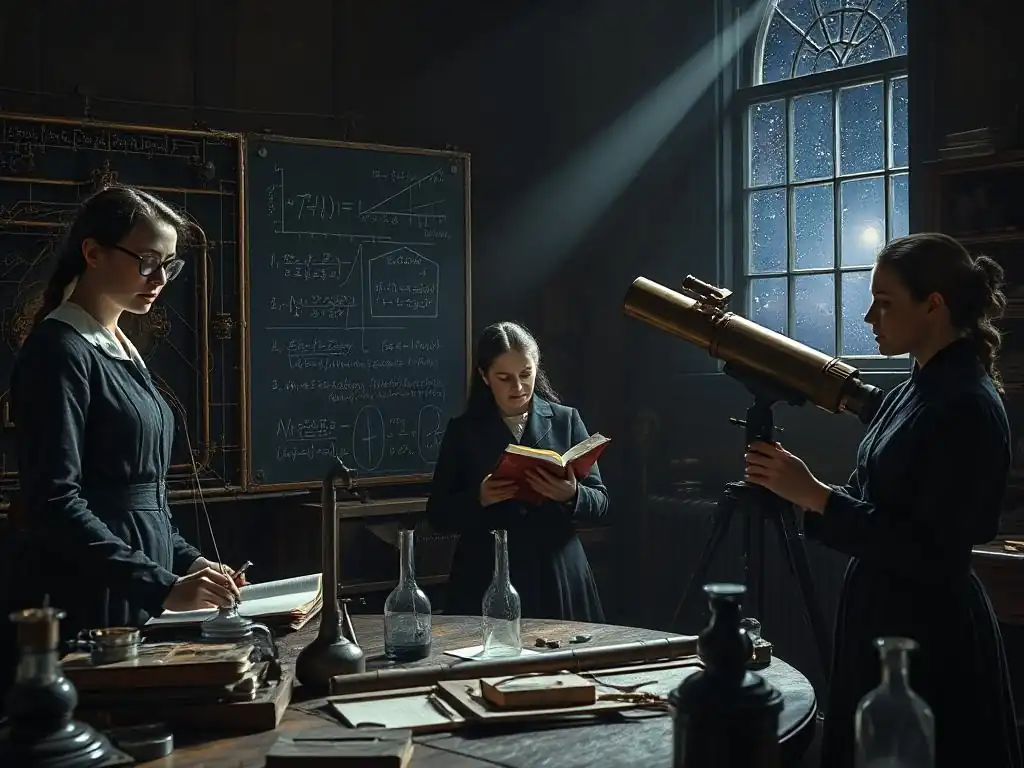
Common Experimental Setups in 19th Century Physics Laboratories
19th-century physics laboratories, whether formal university settings or makeshift home setups, employed a range of specialized apparatus designed to probe the physical world. Common tools included electrometers for measuring electric potential, galvanometers for detecting and measuring electric currents, and Leyden jars for storing static electricity. Optical experiments often utilized optical benches, prisms, and spectroscopes to study light and its properties.
Beyond electrical and optical equipment, thermometry involved precise thermometers for measuring temperature, and barometers were crucial for atmospheric pressure studies. Early X-ray tubes, while emerging in the late 19th century, represented the cutting edge of experimental physics. The precision of these experiments often relied heavily on the skill and dexterity of the experimenter in setting up, calibrating, and taking readings, as automation was minimal. This manual proficiency was a skill many women, accustomed to intricate domestic tasks, often possessed.
Adapting and Innovating: Women's Contributions to Experimental Design
Despite often lacking access to state-of-the-art institutional laboratories, many women experimenters in 19th-century physics demonstrated remarkable ingenuity in adapting existing apparatus or devising entirely new, low-cost methods to conduct their research. This innovative spirit was born out of necessity, transforming resource limitations into opportunities for creative problem-solving in experimental design. Their contributions were often overlooked due to their informal settings.
Agnes Pockels' kitchen experiments on surface tension are a prime example of this adaptation. By using a simple trough, a sliding barrier, and a precise balance, she created a sophisticated system for measuring surface tension that paralleled professional laboratory equipment. Similarly, Hertha Ayrton's rigorous work on the electric arc involved modifying existing electrical apparatus to achieve unprecedented precision in measuring the arc's characteristics, pushing the boundaries of what was possible with the technology of the day.
Overcoming Resource Limitations in Experimental Research
The severe limitations in resources—financial, institutional, and material—forced "Women experimenting 19th century physics" to be exceptionally resourceful. Many relied on personal funds, the patronage of family members, or the repurposing of domestic spaces like drawing rooms or kitchens into makeshift laboratories. This meant that the apparatus they used was often self-built, borrowed, or constructed from readily available, inexpensive materials.
The ingenuity required to conduct meaningful scientific research under such constraints highlights the extraordinary dedication and passion of these women. They often had to invent their own solutions to experimental challenges, demonstrating a deep understanding of physical principles and a practical skill for engineering. This resourcefulness not only allowed them to conduct valuable research but also showcased their capacity for innovation in experimental science, often with far fewer means than their male counterparts.
The Animus: Gender Dynamics and Discrimination in the Physics Community
The "Separate Spheres" Ideology and its Impact on Women's Scientific Pursuits
The 19th century was heavily influenced by the "separate spheres" ideology, which dictated that men belonged to the public sphere of work, politics, and intellectual pursuits, while women were confined to the private sphere of home, family, and domesticity. This societal framework actively discouraged women from engaging in professional scientific careers, viewing such endeavors as inappropriate for their perceived nature and role. The pursuit of physics, particularly experimental work requiring access to male-dominated spaces and intense intellectual focus, was considered especially unsuitable.
This ideology was often reinforced by pseudoscientific arguments that claimed women's brains were inherently smaller or less capable of complex abstract thought, or that intellectual exertion would harm their reproductive health. Such pervasive beliefs created a hostile environment, making it exceedingly difficult for "Women experimenting 19th century physics" to gain acceptance, secure educational opportunities, or be taken seriously within the scientific community.
Male Mentorship and Collaboration: Opportunities and Obstacles for Women
For many women in 19th-century science, male mentorship and collaboration provided crucial, sometimes the only, pathways into experimental physics. Figures like Lord Kelvin, who supported Hertha Ayrton, or Pierre Curie, who collaborated extensively with Marie Curie, offered invaluable access to knowledge, equipment, and intellectual exchange. These relationships could be instrumental in validating a woman's work and helping it gain a foothold in the male-dominated scientific world.
However, these collaborations often came with significant obstacles. Women were frequently perceived as assistants rather than equal partners, their contributions sometimes downplayed or uncredited in publications. The dynamic could be fraught with the risk of their work being absorbed into their male counterpart's legacy, making it challenging for them to establish an independent scientific identity. Even with supportive mentors, the systemic bias against "Women experimenting 19th century physics" often meant their independent recognition remained elusive.
A critical challenge for women experimenters in 19th-century physics was the process of documenting and publishing their research. The prestigious scientific journals and academies were overwhelmingly controlled by men, who often held preconceived notions about women's intellectual capabilities. Papers submitted by women might face higher scrutiny, be rejected outright without proper review, or require a male co-author or intermediary to be considered for publication.
A notable example is Agnes Pockels, whose groundbreaking work on surface tension was initially dismissed until her brother, a university professor, brought it to the attention of Lord Rayleigh, who then facilitated its publication in Nature. Similarly, Marie Curie's early papers were often presented by Pierre to the French Academy of Sciences, despite her being the primary experimenter and author. This systemic gatekeeping meant that the valuable contributions of "Women experimenting 19th century physics" were frequently suppressed or entered the historical record in a way that obscured their individual achievements.
The Legacy of Women Experimenters: Inspiring Future Generations of Female Physicists
Recognizing the Contributions of Women to the History of Physics
Recognizing the profound contributions of women to the history of physics is not merely an act of historical correction; it is essential for a complete and accurate understanding of scientific progress. By unearthing the stories of women like Hertha Ayrton, Marie Curie, and Agnes Pockels, we gain a richer, more nuanced picture of how scientific knowledge has developed, often through the resilience and ingenuity of individuals who faced immense societal and institutional barriers. Their struggles and triumphs provide powerful insights into the human endeavor of discovery.
Acknowledging these often-overlooked figures enriches the historical narrative and provides vital role models for contemporary and future generations. It demonstrates that scientific brilliance and dedication are not confined by gender, and that significant advancements have been made by "Women experimenting 19th century physics" despite systemic obstacles. This recognition is fundamental to building a more inclusive and equitable scientific community today.
The Importance of Historical Context in Understanding Scientific Advancements
Understanding the historical context in which these 19th-century women experimenters operated is crucial for appreciating the extraordinary nature of their achievements. Their discoveries were not merely intellectual feats but were accomplished against a backdrop of deeply entrenched gender bias, limited educational access, and a scarcity of resources. This context highlights that their success was not just about what they discovered, but how they managed to do it in the face of such adversity.
This historical perspective also illuminates the slow and arduous journey towards gender equality in science. By examining the specific challenges faced by "Women experimenting 19th century physics," we can better understand the roots of contemporary issues such as unconscious bias, underrepresentation, and the "leaky pipeline" phenomenon in STEM fields. This historical lens provides valuable insights into the persistent nature of systemic discrimination and the long-term effort required to dismantle it.
Continuing the Fight for Gender Equality in STEM Fields: Lessons from the 19th Century
The struggles of 19th-century women in physics offer powerful lessons for the ongoing fight for gender equality in STEM fields today. Their experiences underscore the enduring impact of societal expectations, institutional gatekeeping, and subtle biases that continue to affect women's participation and progression in science. Despite significant progress, issues like unconscious bias, lack of mentorship, and challenges in balancing career and family responsibilities still resonate with the historical struggles of these pioneers.
By studying the resilience, ingenuity, and sheer determination of "Women experimenting 19th century physics," we can draw inspiration and strategies for current and future efforts. Their stories emphasize the importance of advocacy, creating supportive networks, challenging discriminatory practices, and celebrating every contribution, however small or historically overlooked. Their legacy serves as a powerful reminder that the pursuit of scientific excellence demands equal opportunities for all, regardless of gender.
Conclusion: Celebrating the Achievements of Women Experimenting in 19th Century Physics
A Call to Action: Further Research and Recognition of Female Scientists
The stories of "Women experimenting 19th century physics" presented here represent only a fraction of the hidden histories awaiting discovery. Many more female scientists, who toiled in obscurity, contributed to our understanding of the physical world. There is an ongoing need for dedicated academic and public efforts to unearth these forgotten narratives, meticulously research their lives and work, and integrate their achievements into mainstream scientific history.
This call to action extends to institutions, educators, and individuals alike: to actively seek out, promote, and celebrate the visibility of these historical figures. By ensuring their legacies are properly acknowledged and integrated into curricula and public discourse, we can provide a more accurate and inspiring account of scientific progress, encouraging future generations to pursue their scientific passions without prejudice.
A Resource for Learning About Women in Physics
This article, and the broader WomenInScienceHistory.com website, serves as a vital resource for learning about the pioneering "Women experimenting 19th century physics" and their enduring impact. By chronicling their biographies, detailing their groundbreaking work, and shedding light on the challenges they overcame, the platform aims to be a comprehensive and accessible repository of knowledge. It is dedicated to inspiring future generations and correcting the historical record by highlighting the often-overlooked narratives of women in science.
The resilience, intellectual rigor, and unwavering dedication of these 19th-century women experimenters continue to inspire. Their achievements stand as a testament to the fact that scientific inquiry knows no gender, and that brilliance, perseverance, and a passion for discovery can overcome even the most formidable societal and institutional barriers. Their legacy reminds us that the pursuit of knowledge is a universal human endeavor, enriched by the contributions of all.
Frequently Asked Questions
What were some of the main challenges women faced when experimenting in 19th-century physics labs?
Women faced significant hurdles, including limited access to education, social biases against their intellectual capabilities, and exclusion from professional networks that were crucial for career advancement.
How did "WomenInScienceHistory.com" aim to address the historical underrepresentation of women in 19th-century physics?
The website aims to highlight the accomplishments of pioneering female physicists, share their biographies, and discuss their groundbreaking contributions to the field, thereby correcting historical omissions.
Can you provide an example of a notable woman who conducted experiments in 19th-century physics, despite the challenges?
While the specific article details are needed for a full answer, many women overcame adversity. "WomenInScienceHistory.com" likely profiles individuals who pushed boundaries and made significant contributions despite facing gender-based discrimination and limited opportunities.
What types of experimental work in physics were women typically involved in during the 19th century?
Women were involved in various aspects, including data collection and analysis, assisting male researchers, and sometimes conducting independent research when opportunities arose, often focusing on areas considered "suitable" for women.
Why is it important to recognize the contributions of women experimenting in 19th-century physics, even today?
Recognizing their contributions helps correct historical inaccuracies, inspires future generations of female scientists, and demonstrates that women have always been capable of making significant advancements in all scientific fields, despite societal barriers.
Final Reflection: Illuminating Forgotten Contributions
The narratives unearthed within this article serve as a potent reminder that history is rarely complete, and often skewed by prevailing biases. The stories of these women experimenting in 19th century physics, long relegated to the margins, resonate powerfully today as we continue to strive for equitable representation and recognition in STEM fields. Their dedication, ingenuity, and perseverance in the face of societal constraints offer invaluable lessons for aspiring scientists of all genders.
The impact of these forgotten pioneers extends beyond the laboratory. Their struggles and triumphs underscore the importance of challenging established norms and creating inclusive spaces where diverse voices can flourish. The very act of uncovering their contributions forces us to re-evaluate our understanding of scientific progress and acknowledge the vital role women played, even when denied formal credit. The history of science is not a linear progression of discoveries, but a complex tapestry woven with the threads of countless individuals, many of whom have been unjustly overlooked.
As we close this chapter on the lives and work of these remarkable women, let us carry their spirit forward. Consider the unseen contributions in your own field, in your own community. What biases might be obscuring the full picture? How can you actively champion inclusivity and ensure that future generations inherit a more complete and equitable understanding of the past? Let their legacy inspire you to challenge assumptions, amplify marginalized voices, and contribute to a future where every individual has the opportunity to reach their full potential, regardless of gender or background.
Ignite Your Inner Curie: Pioneer Your Path in Physics!
Thank you for delving into the inspiring stories of these groundbreaking women in 19th-century physics! Now, let's carry their torch forward and continue to amplify the voices of women in science.
Here's how you can get involved:
- Become a science storyteller: Share the stories of overlooked women scientists like these on your social media. Use the hashtag #WomenInScienceHistory to connect with others!
- Explore local science museums or universities for exhibits that highlight the contributions of women in STEM. Attend lectures or workshops focused on women's roles in scientific advancements.
- Surprise! Research a contemporary woman physicist whose work resonates with you and write a short blog post about her achievements on our site. Send your submissions to submissions@womeninsciencehistory.com!
What small action will you take today to celebrate and support women in science?