The Matilda Effect in Physics: Uncovering Overlooked Women (19001950)
🌟 Discover how the Matilda Effect in physics history has historically overshadowed pioneering women from 1900 to 1950, revealing overlooked contributions and…
Read article
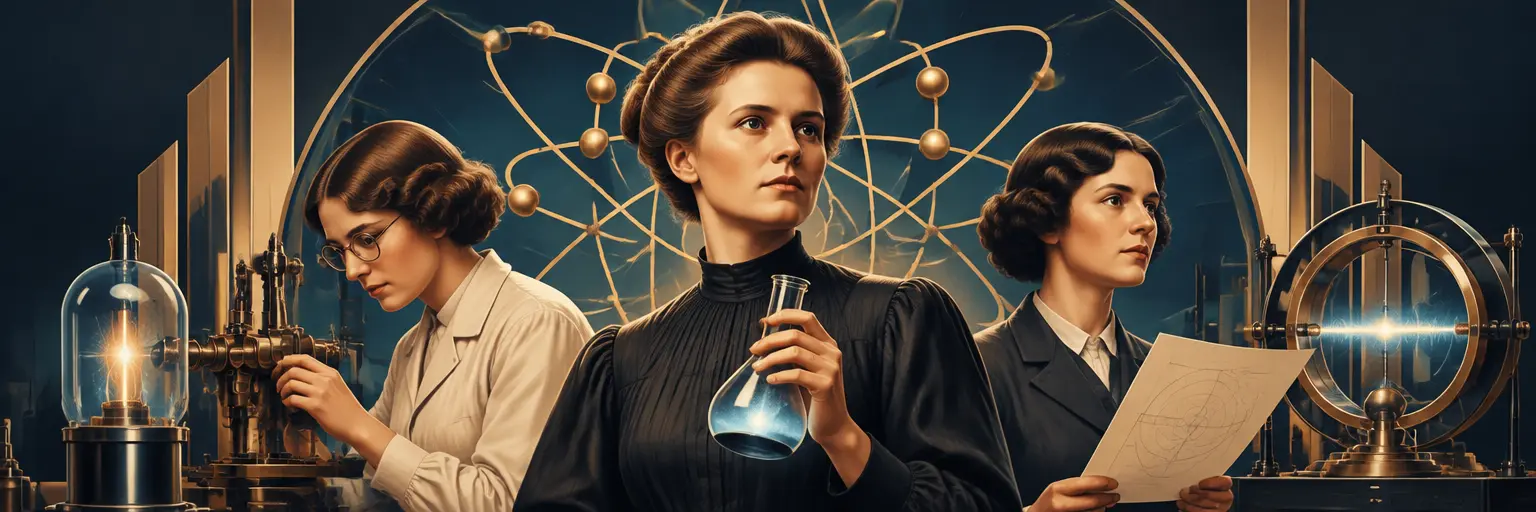
Discover the untold stories of trailblazing women in physics who shattered glass ceilings between 1900 and 1950, a transformative era when female minds defied societal norms to unlock the secrets of the atom, radiation, and the cosmos. From Marie Curie’s Nobel-winning radioactivity research to Lise Meitner’s pivotal role in nuclear fission and Chien-Shiung Wu’s exacting experiments that challenged fundamental laws, these pioneers navigated hostile laboratories, limited funding, and erased credits—yet their work laid the bedrock of modern physics. This period saw women like Irène Joliot-Curie and Kathleen Lonsdale redefine crystallography and particle behavior, while others like Marietta Blau pioneered photographic detection of cosmic rays. Their resilience transformed physics into a global collaborative pursuit, proving that brilliance knows no gender. Perfect for history buffs, STEM enthusiasts, and anyone seeking inspiring female role models, this collection highlights both celebrated breakthroughs and hidden victories, offering a compelling lens into the challenges—from institutional sexism to wartime displacement—that shaped their journeys.
🌟 Discover how the Matilda Effect in physics history has historically overshadowed pioneering women from 1900 to 1950, revealing overlooked contributions and…
Read article
🌟 Exploring the women’s physics history intersection impact, this article highlights how First Wave Feminism shaped opportunities for women scientists, breaking barriers…
Read article
🌟 Despite groundbreaking contributions, many women physicists have been denied Nobel recognition, highlighting persistent gender biases in science. Women physicists Nobel recognition…
Read article
🌟 Women physicists cosmic ray research has unveiled secrets of the universe, overcoming gender barriers to pioneer space particle detection. Their groundbreaking…
Read article
🌟 Explore how women’s role in quantum mechanics history has been pivotal yet overlooked, revealing their groundbreaking contributions and the challenges they…
Read article
🌟 Celebrating Emmy Noether's groundbreaking contributions, her theorem reveals the deep connection between symmetry and conservation laws, serving as the mathematical backbone…
Read article
🌟Hertha Wambacher's groundbreaking nuclear disintegration research using cosmic rays challenged scientific boundaries, highlighting her pivotal role in physics history. Celebrated on WomenInScienceHistory.com,…
Read article
🌟 Discover how Marie Curie’s groundbreaking contributions to physics revolutionized 20th-century science, highlighting her pioneering "Marie Curie physics biography" and inspiring future…
Read articleThe period from 1900 to 1950 was a transformative time in physics, marked by the birth of quantum mechanics, relativity, and nuclear science. Yet, women who contributed to these revolutions often worked in obscurity, facing institutional barriers, limited access to laboratories, and societal prejudice. This subcategory on WomenInScienceHistory.com delves into the lives and achievements of these remarkable early 20th century women in physics (1900-1950), illuminating their groundbreaking research, their resilience against systemic sexism, and their enduring legacies. From Nobel laureates to unsung lab assistants, their stories redefine our understanding of scientific progress.
Women like Lise Meitner, who co-discovered nuclear fission, and Marie Curie, who won two Nobel Prizes in physics and chemistry, exemplify extraordinary scientific courage. Meitner’s theoretical explanation of fission, published in 1939, was dismissed by her male colleague Otto Hahn, yet her work became the foundation of atomic energy. Meanwhile, Emmy Noether’s mathematical theorem connecting symmetries to conservation laws transformed theoretical physics, though she was denied a formal university position for years. Each breakthrough came with battles for recognition, often forced to publish under male initials or work without pay in borrowed laboratories.
These physicists not only advanced knowledge but also mentored younger women, creating quiet networks of support. For instance, Hertha Sponer, a pioneer in molecular physics, established the first female professorship in physics at Duke University. Their discoveries in radioactivity, spectroscopy, and cosmic rays shaped modern physics, yet their names are frequently omitted from textbooks. This section highlights their precise experiments, the intellectual climate of the era, and how their gendered experiences influenced their scientific paths.
Between 1900 and 1950, most elite universities, including Cambridge and Harvard, barred women from degree programs, and research institutes like the Cavendish Laboratory restricted female access to advanced equipment. Women such as Cecilia Payne-Gaposchkin, who pioneered stellar atmospheres, fought to be allowed to observe with the Mount Wilson telescope—a battle she won only after repeated petitions. Even after earning doctorates, many were offered low-paid assistant roles, like Henrietta Swan Leavitt at Harvard’s Observatory, whose period-luminosity relation became the key to measuring cosmic distances.
Despite these obstacles, women carved niches in “acceptable” fields like spectroscopy, crystallography, and radioactivity, which were considered tedious and precise—stereotypically “female” tasks. This segregation inadvertently allowed them to excel, as seen with Kathleen Lonsdale, who used X-rays to map benzene’s crystal structure. Yet, their promotions lagged decades behind male peers, and many taught at women’s colleges where research facilities were minimal. This section explores the strategies—petitions, collaboration, and relocation—that women employed to circumvent discriminatory policies.
Beyond famous names, many women made essential but overlooked contributions. For example, Mileva Marić, Einstein’s first wife, collaborated on early relativity work, though his letters hint at their joint research that was later credited solely to him. Similarly, Edith Wilson, a computational assistant, performed intricate calculations for Enrico Fermi’s reactor designs. In quantum theory, Charlotte Riefenstahl’s experiments on electron scattering provided empirical backing for wave mechanics, yet her career ended when she married and was dismissed from her post. These stories often surface only through private correspondence or lecture notes.
Key to understanding this era is recognizing that physics was a collective enterprise where women’s roles were frequently erased or minimized. The well-documented case of the “Women of the Manhattan Project”—like physicist Chien-Shiung Wu, who disproved a fundamental symmetry law but was excluded from Nobel recognition—reveals how institutional sexism intertwined with wartime secrecy. This section invites readers to rediscover these hidden figures, offering primary-source evidence from lab notebooks and oral histories to reconstruct their intellectual labor.
World War I and II inadvertently opened doors for women in physics, as male scientists were mobilized. During WWI, women like Rita Levi-Montalcini, later a Nobel laureate, and the Curies’ daughter Irène, worked on medical X-rays and radium applications. In WWII, the Manhattan Project hired thousands of women mathematicians and physicists for computing, but their roles were often clericalized. The physicist Leona Woods, however, was a core contributor to the first nuclear reactor’s design, combatting gender stereotypes in a high-security environment. These wartime roles offered training but rarely permanent employment.
The post-war period saw a backlash, with women pushed out of physics departments to make room for returning veterans. Many female scientists like Dorothy Hodgkin, who solved penicillin’s structure during the war, faced reduced funding or teaching-only contracts. Yet the war’s archives reveal that women’s computational and experimental expertise was indispensable for advances in radar, sonar, and nuclear physics. This section examines how these conflicts both enabled and constrained women’s professional trajectories, using case studies from Britain, France, Germany, and the United States.
Today, historians and physicists are actively reassessing the contributions of early 20th century women, often posthumously awarding honors and renaming institutes. For instance, the International Astronomical Union named an asteroid after Cecilia Payne-Gaposchkin, and Lise Meitner received the Fermi Award decades later. Scholarly biographies and digital archives now preserve their correspondence, making it easier for researchers to trace influence networks. This resurgence aims to correct the myth that physics was exclusively male, revealing a rich tapestry of female innovation.
Moreover, these women’s struggles for education, mentorship, and fair credit directly informed contemporary gender-equity policies in STEM. Their petitions to join elite societies like the Royal Society paved the way for today’s inclusion initiatives. By studying their lives, students and professionals gain not only historical insight but also practical lessons on perseverance, collaboration, and ethical conduct in science. This section serves as a springboard for exploring further resources, including digitized lab notebooks and oral interviews housed at institutions like the American Institute of Physics.
Systematic exclusion from academic records, male-dominated authorship, and societal norms pushed women into unpaid or assistant roles. Many published under male pseudonyms or were credited as spouses. Their work was often appropriated by supervisors, and institutional archives rarely preserved their contributions. Recent archival research is now recovering these narratives through correspondence and technical reports.
Lise Meitner is often cited for her role in explaining nuclear fission, though she was overlooked for Nobel recognition. Her collaborative work with Otto Hahn in Germany was truncated when she fled Nazi persecution in 1938. Despite this, her theoretical framework remains fundamental, and modern textbooks increasingly acknowledge her central role.
Some universities, like the University of Göttingen and Cambridge’s Girton College, informally permitted women to attend lectures but denied degrees. Women often studied abroad—Paris’ Sorbonne was notably open—or pursued evening classes. Scholarships specifically for women, such as those from the National Research Council, provided rare funding, but many relied on family support or teaching jobs.
Yes, Marie Curie received the Nobel in Physics (1903) and Chemistry (1911). Irène Joliot-Curie, her daughter, won the Nobel in Chemistry (1935) for synthesizing new radioactive elements. No woman won the physics prize during that window except Curie, though several, like Lise Meitner and Chien-Shiung Wu, were nominated.
Women were typically barred from prestigious labs or allowed only in separate rooms, with less powerful equipment. They were excluded from tea time discussions where ideas were exchanged. When they did gain access, they were often denied graduate degrees or were placed under male supervisors who took credit. This is documented in the diaries of several female researchers.