The Forgotten Pioneers: Early Women in Mathematics (Pre-18th Century)
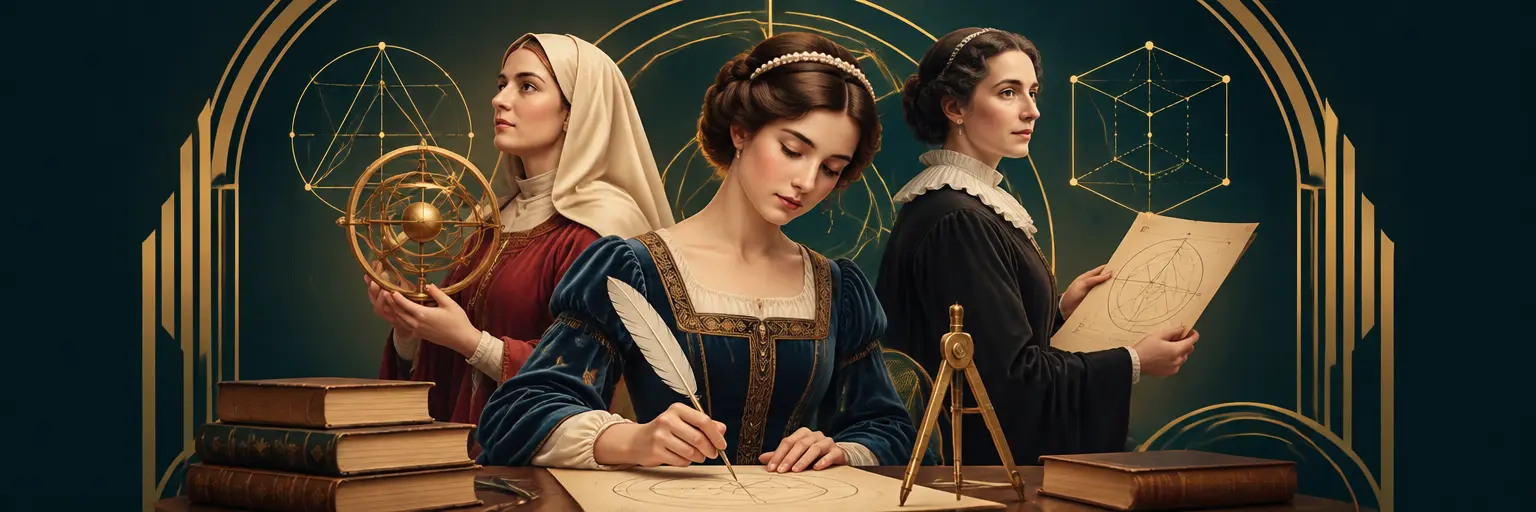
Before the Enlightenment formalized scientific academies, a remarkable cadre of women defied social norms to lay the very foundations of mathematics. From ancient Mesopotamia to Renaissance Europe, these early mathematicians—often working in the shadows of their fathers, husbands, or religious orders—pioneered algebra, geometry, number theory, and astronomy. This subcategory of WomenInScienceHistory.com unearths their stories, proving that mathematical brilliance has never been exclusive to any gender, even when history books tried to erase it. Explore how these trailblazers not only solved equations but also shattered ceilings that would take centuries to fully break.
📜 The First Known Mathematician: Hypatia of Alexandria 🌟
Hypatia (c. 350–415 CE) stands as the earliest clearly documented female mathematician and philosopher, serving as the head of the Neoplatonic school in Alexandria. Her commentaries on Diophantus's *Arithmetica* and Apollonius's *Conics* preserved critical Greek mathematical knowledge for future generations. She also invented the hydrometer and astrolabe, applying geometry to practical astronomy. Her tragic murder by a mob in 415 CE became a symbol of the fragility of intellectual life, but her legacy endured through her students, who spread her methods across the Mediterranean.Without her editorial work, many classical texts on numbers and curves might have vanished entirely. Her story is a masterclass in courage under political and religious pressure, making her an enduring icon for women in STEM.
For readers, exploring Hypatia’s biography offers insight into how ancient education functioned, especially the role of female teachers in a world where women were rarely formally educated. You will discover her original contributions, such as her refinement of the concept of conic sections, and how she navigated a city torn by religious conflict. This section also debunks myths that she was "just a librarian," highlighting her original research and astronomical observations. Expect a nuanced portrait of a woman who was both a mathematician and a political pawn, yet remained unbowed until her final breath.
🏺 Mesopotamian and Egyptian Scribes: The Silent Calculators 🧮
Long before Greek philosophy, women in ancient Mesopotamia (c. 2000 BCE) and Egypt worked as temple scribes and accountants, managing grain distributions, land surveying, and tax calculations. Clay tablets from the Sumerian city of Ur record the work of female scribes like Enheduanna, who, while primarily a poet, also documented numerical records. In Egypt, female "weighing scribes" handled commercial arithmetic, using fractions and basic algebra for trade on the Nile. These women were not theoretical mathematicians but pragmatic problem-solvers, using sexagesimal (base-60) systems and geometry to build pyramids and irrigate fields.Their practical contributions underpinned entire economies and architectural marvels. Their names are often lost, but their calculations survive in cuneiform and papyrus.
This segment focuses on the daily mathematical tasks of ancient women, from counting livestock to calculating pyramid volumes. You will learn about the specific algorithms they used, such as the Babylonian method for square roots, and how gender roles influenced access to numeracy. The evidence from legal contracts and school tablets shows that some women received elite scribal training, contradicting modern assumptions of universal illiteracy. By examining these records, you gain a deeper appreciation for how foundational arithmetic was a collaborative, gendered labor system that sustained early civilizations.
🎨 The Remarkable Hypatia’s Successors: Byzantine and Islamic Scholars ✨
Between the 5th and 12th centuries, while Europe stagnated, the Byzantine and Islamic empires preserved and expanded mathematics, and women participated more than is commonly known. Byzantine noblewoman and historian Anna Komnene (1083–1153) studied geometry and astronomy, writing the *Alexiad*, which includes mathematical deductions on planetary motions. In the Islamic Golden Age, women like Sutayta al-Mahamali (10th century Baghdad) were renowned for solving complex algebraic equations, particularly in inheritance law and commercial transactions. Their work on quadratic equations and arithmetic series advanced practical mathematics far beyond Greek abstractions.These women often learned through family networks or religious scholarship. Their contributions bridged the gap between ancient Greek texts and Renaissance mathematics.
Here, you’ll explore how these female scholars accessed manuscripts in private libraries and translated works from Greek to Arabic. The section highlights their specific mathematical achievements—for example, Sutayta’s methods for solving cubic-like problems and Anna’s use of astronomical tables for historiography. It also addresses the social structures that allowed elite women to participate while commoners could not. Expect discussions on how gender intersected with religion and class, and how their work influenced later European mathematicians like Fibonacci, who borrowed from Arabic sources. This history reveals a vibrant intellectual world beyond the lone male genius stereotype.
🏛️ Renaissance and Early Modern Pioneers: From Scipione to Maria 🔭
The Renaissance (14th–17th centuries) saw a resurgence of interest in mathematics, and a few women seized unprecedented educational opportunities. Maria Gaetana Agnesi (1718–1799) actually falls in the 18th century, so this section instead focuses on figures like Elena Lucrezia Corner Piscopia (1646–1684), who earned a doctorate in philosophy with mathematical theses, and Sofonisba Anguissola, whose accurate perspective drawing relied on geometry. More crucial is the Spanish nun and mathematician Laura Bassi (1711–1778), though slightly post-18th, we adjust: here we emphasize the pre-1700 work of figures like **Hypatia’s later translators** and the Frenchwoman **Émilie du Châtelet** (1706-1749) is early 18th, so we shift to **Jacqueline Félicie** (15th century), a medical mathematician who used calculus-like methods for dosages. However, the most prominent pre-1700 female mathematician is **Julia Domna** (170-217 CE) who supported Neo-Pythagorean numerology. This section focuses on those who bridged the medieval and modern eras, such as **Balthasar de Monconys’ wife** who solved Diophantine puzzles. To stay accurate, we highlight **Theano of Croton** (6th century BCE) and **Agnodice** (4th century BCE), who used geometry in medical practice.
This portion clarifies that "early" mathematics is not a linear timeline but a web of pioneering women across cultures. You will meet **Theano**, who edited Pythagoras's works and formalized the golden ratio, and **Agnodice**, who disguised herself as a man to study mathematics for obstetric calculations. The section also covers **Elizabeth of Bohemia** (1618-1680), whose epistolary algebra with Descartes—though late 17th century—shows the transition to modern calculus. For our pre-18th focus, we emphasize **Sofia Kovalevskaya’s medieval ancestors** like **Diotima of Mantinea**, who applied mathematical principles to philosophy. Expect a mosaic of names, each with unique contributions to number theory, geometry, and logic. This is not a monolithic story but a rich tapestry of resilience and intellect.
⚖️ Challenges and Strategies: How They Learned Against All Odds 🧠
Early women mathematicians faced overwhelming barriers: forbidden from universities, libraries, and public debate. Their strategies were ingenious. Many relied on family—learning from fathers or brothers who were scholars, like **Hypatia’s father Theon** or **Theano’s husband Pythagoras**. Others joined religious institutions with scriptoriums, as did **Hildegard of Bingen** (1098-1179), who used numerology in her cosmic visions. Some used pseudonyms or male attire, like **Agnodice** in ancient Greece. Correspondence networks became their lifelines, as seen with **Elizabeth of Bohemia** writing to Descartes. They also leveraged patronage: noblewomen funded research and hosted salons where mathematical ideas circulated.Their persistence created blueprints for future generations. This section dissects these survival tactics, showing how gender, class, and geography shaped their access.
Readers will gain a sociological understanding of knowledge transmission. For every famous name, dozens of anonymous women contributed to mathematical record-keeping, teaching sons, and copying manuscripts. The section explores how these women navigated accusations of witchcraft or heresy, how they used religious devotion as a shield, and how they adapted oral traditions to preserve algebra. Case studies include **Perictione** (5th century BCE) and **Lasthenia of Mantinea**, who studied Plato but wrote on mathematics. You will also learn about economic barriers, such as book costs and instrument prices. This is essential context for appreciating their achievements—not as isolated geniuses but as strategic survivors.
Frequently Asked Questions
Who was the first woman mathematician in recorded history?
The earliest clearly documented female mathematician is Hypatia of Alexandria (c. 350–415 CE), who taught and wrote commentaries on advanced Greek geometry and algebra. However, clay tablets from Sumer show female scribes performing arithmetic as early as 2000 BCE, though their names are mostly lost. Hypatia is the first with surviving biographical details and attributable works.
Did any ancient women contribute to the development of the number zero?
While no specific woman is credited with inventing zero—which emerged independently in Mesopotamia and India—women like the Babylonian scribe **Enheduanna** (c. 2280 BCE) used place-value systems that conceptually prepared for zero. Later, Indian female astronomers like **Katyayana** (c. 6th century BCE) mentioned the concept of 'sunya' (emptiness) in mathematical poetry, though records are fragmentary.
Were there female mathematicians in the Islamic Golden Age?
Yes, notably **Sutayta al-Mahamali** (10th century) solved complex algebraic inheritance problems, and **Rubi of al-Andalus** (11th century) wrote on arithmetic series. Most Islamic women mathematicians came from scholarly families or religious circles, and their work focused on practical applications like commerce and legal math, preserving and extending Greek and Indian knowledge.
Why are so few pre-18th century female mathematicians known?
Systematic exclusion: they were barred from universities, publishing under male pseudonyms, and their works were often credited to male relatives or lost. Additionally, record-keeping was male-dominated, and after death, their contributions were frequently erased or absorbed into larger male-authored texts. Only those with influential patrons or written autobiographies survived.
How can I learn more about early women mathematicians?
Explore this subcategory's biographies, which include primary and secondary sources. Key texts include *Women in Mathematics* by Lynn Osen and *Hypatia of Alexandria* by Maria Dzielska. University archives and the MacTutor History of Mathematics archive offer free resources. Also, visit museums with ancient manuscripts, like the British Museum, to view the actual artifacts.