Early 20th Century Women in Mathematics (1900-1950): Pioneers Who Redefined the Field
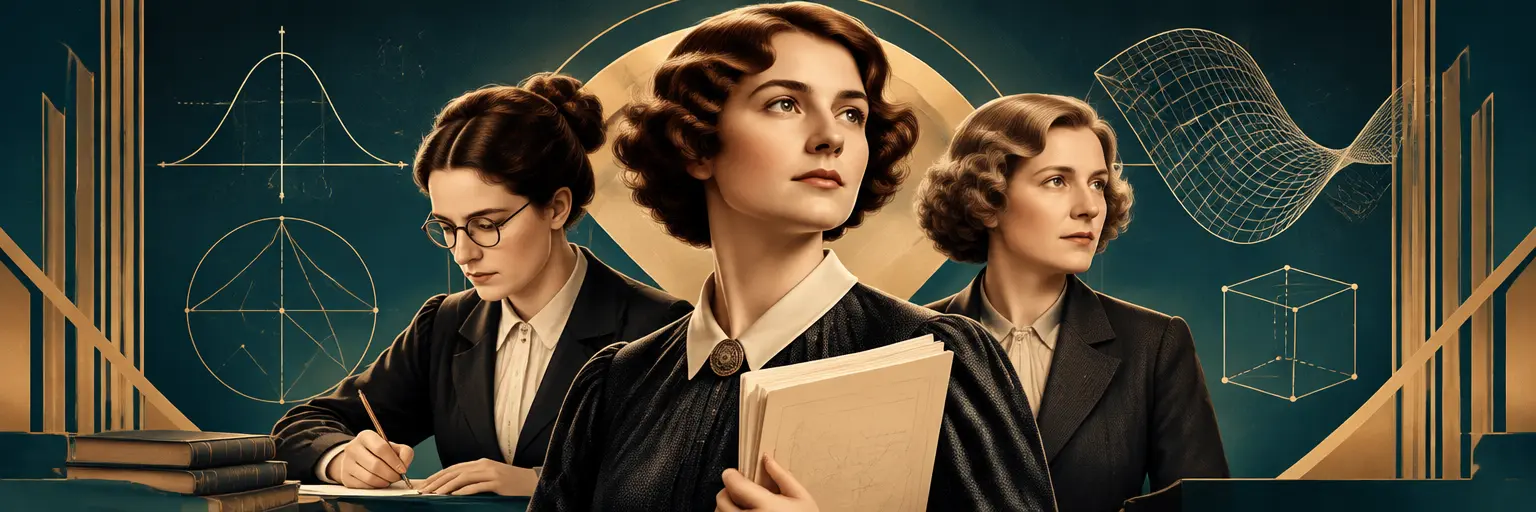
Between 1900 and 1950, a remarkable cadre of women mathematicians broke through institutional barriers, wartime restrictions, and societal prejudices to make foundational contributions to algebra, topology, number theory, and applied mathematics. This subcategory of Women in Science History explores their lives, rigorous research, and the strategies they used to secure positions in universities, research institutes, and government laboratories—often without formal titles or pay. Discover how figures like Emmy Noether, Mary Cartwright, and Grace Hopper transformed mathematical practice while navigating a world that rarely welcomed their intellect.
📐 Emmy Noether and the Birth of Abstract Algebra
Emmy Noether’s work between 1915 and 1935 redefined modern algebra, particularly through her theory of ideals in rings and her famous Noether’s theorem, which links symmetry to conservation laws in physics. Despite being denied a paid professorship in Germany for years, she lectured unofficially at Göttingen, mentoring a generation of mathematicians. Her influence extended to topology and algebraic geometry, and her passionate, concept-driven teaching style remains legendary. Readers will learn how her persistence turned a hostile academic climate into a platform for revolutionary ideas that still underpin theoretical physics today.
Beyond her theorems, Noether’s story illuminates the gendered hiring practices of early 20th-century academia. She often worked without a salary, yet her seminars attracted leading minds like Hilbert and Weyl. This section also discusses her forced emigration to the United States in 1933 and her brief, impactful tenure at Bryn Mawr College, where she mentored female students before her untimely death in 1935. Her legacy demonstrates that mathematical genius cannot be silenced by institutional discrimination.
🔢 Sofya Kovalevskaya’s Legacy and the 1900s Vanguard
Though Sofya Kovalevskaya died in 1891, her theorem on partial differential equations and her prize-winning work on the rotation of a solid body profoundly shaped 20th-century mathematics. This section explores how her achievements inspired early 1900s women like Charlotte Angas Scott, who led Bryn Mawr’s mathematics department, and Grace Chisholm Young, who co-authored influential texts with her husband but often received secondary credit. Readers will discover how these pioneers built a transatlantic network of female mathematicians, publishing in elite journals and securing research positions despite pervasive skepticism about women’s mathematical ability.
The narrative highlights the importance of women’s colleges as safe havens for research and teaching, where many of these figures cultivated their careers. We examine how Kovalevskaya’s example—her European doctorates and professorship in Stockholm—served as a proof-of-concept for later generations. The section also discusses the first international congresses of mathematicians, where women were gradually granted a visible, if sometimes token, presence. Understanding this vanguard helps contextualize the systemic barriers that would later be challenged head-on.
🧮 Wartime Codebreakers and Applied Mathematicians
During World War II, women mathematicians found unexpected employment in cryptanalysis, ballistics, and operations research, contributing to Allied victories while still facing wage disparity and contract-based roles. This subcategory profiles figures like Elizabeth Friedman, who broke Japanese and German codes, and Grace Hopper, whose work on Harvard’s Mark I computer laid foundations for modern programming. Learn how government agencies, such as the U.S. Army’s Ballistic Research Laboratory and the British codebreaking center at Bletchley Park, hired hundreds of women with degrees in mathematics to perform complex computations and analyze enemy communications.
These applied roles were often classified, meaning many of these women’s contributions went unrecognized for decades. The section explores the tension between patriotic service and professional marginalization: women rarely received promotions or credit, yet they gained practical experience that fueled post-war careers. Hopper’s later invention of the compiler and her advocacy for user-friendly programming languages exemplify how wartime mathematics led to peacetime innovation. Readers will appreciate the behind-the-scenes intellectual labor that shaped modern computing and military intelligence.
📚 Women in Topology and Analysis: Building New Frameworks
This segment focuses on women who advanced pure mathematics, particularly topology and analysis, during the first half of the century. Mary Cartwright solved a nonlinear differential equation problem posed by the Radio Research Board, which later contributed to chaos theory, while Olga Taussky-Todd worked on matrix theory and promoted a rigorous approach to numerical analysis. Also featured are Pauline Sperry and Helen C. Smith, who expanded projective geometry and abstract analysis respectively. Their publications in top-ranked journals testify to their deep technical skill.
The subcategory examines how these women navigated the rarity of female role models, often finding mentorship from male advisors while simultaneously contesting discriminatory policies such as marriage untils that barred married women from teaching positions. Cartwright’s election as the first female president of the London Mathematical Society in 1961 is highlighted as a milestone that rooted itself in her earlier wartime and interwar research. Readers will see how pure mathematics offerings at women’s colleges and rare research fellowships created niches for building original frameworks that influenced fields as diverse as economics and physics.
👩🏫 Educational Pioneers and Mentorship Networks
Beyond individual research, these women were transformative educators who built curricula, wrote influential textbooks, and mentored subsequent generations. Figures like Evelyn Boyd Granville (one of the first African American women to earn a PhD in math) and Marjorie Lee Browne focused on enriching K-12 and university-level instruction, creating opportunities for students of color in STEM. Meanwhile, organizations like the Mathematical Association of America and the American Mathematical Society began including women in leadership roles, partly due to persistent advocacy by these pioneers. This section details their pedagogical innovations and community-building efforts.
Readers will discover how mentorship occurred both formally and informally, from summer institutes to reading groups, often bridging isolation across male-dominated departments. The narrative stresses the importance of all-female academic environments such as Mount Holyoke and Smith, which offered research opportunities and collaborative climates. These educators also wrote popular books explaining complex concepts to broader audiences, thereby demystifying mathematics and inviting young women to see themselves as potential mathematicians. Their collective efforts created a pipeline that slowly increased female participation in doctoral programs by the mid-century mark.
🌟 Legacy, Recognition, and Institutional Change
This final thematic section surveys the delayed honors, archival preservation, and policy shifts that followed the careers of these pioneers. From Noether’s posthumous recognition to the 1945 establishment of the Association for Women in Mathematics (though formally later, its roots lie here), we see how early achievements paved the way for institutional change. Key milestones include the first female full professorships at major research universities and the gradual acceptance of joint appointments. This section also discusses the role of national research councils in funding women’s work, albeit often at lower rates than their male counterparts.
The narrative highlights how histories are being re-evaluated, with digital repositories and biography projects now commemorating these mathematicians’ lives and contributions. Awareness of their struggles—such as lack of access to advanced seminars or library borrowing privileges—yields deeper appreciation for their resilience. Readers will learn how modern initiatives, from lecture series named after these pioneers to documentary films, keep their intellectual legacies alive. Ultimately, this subcategory showcases that the seeds planted between 1900 and 1950 blossomed into the contemporary, albeit still imperfect, landscape of gender equality in mathematics.
Frequently Asked Questions
What was the biggest challenge faced by women mathematicians from 1900-1950?
The most pervasive challenge was exclusion from formal academic positions, including lectureships and professorships, often justified by claims of intellectual inferiority. Many worked as unpaid assistants or held temporary posts, like Emmy Noether, who taught without salary at Göttingen. Marriage restrictions, limited access to research libraries, and biased admission to doctoral programs compounded these barriers, while wartime roles offered temporary opportunities but rarely long-term recognition.
How did wartime (WWI and WWII) affect women's participation in mathematics?
Both World Wars dramatically increased demand for computational work, codebreaking, and ballistic calculations, leading governments to hire women en masse. These positions provided practical experience and some financial independence, but were generally contract-based and lacked prestige. After the wars, many women were dismissed to make room for returning veterans. Yet wartime work significantly expanded the professional networks and technical confidence of women mathematicians.
Did any women mathematicians receive major prizes during this period?
Some but not many. Emmy Noether was never awarded a formal prize, though she was invited to speak at international congresses. Sofya Kovalevskaya won the Prix Bordin from the French Academy of Sciences in 1888, before this period, and Mary Cartwright later received the De Morgan Medal (1968) and Sylvester Medal (1964). These recognitions often came posthumously or after decades of work.
What roles did women's colleges like Bryn Mawr or Smith play in advancing their careers?
Women’s colleges were crucial as refuges offering full-time faculty positions, mentorship, and a collaborative research environment when coeducational institutions barred women. For example, Bryn Mawr hosted Noether, and Smith supported Charlotte Angas Scott’s pioneering leadership. These institutions allowed women to supervise dissertations, publish extensively, and build professional networks, thereby shaping the field even without mainstream academic recognition.
Why is Emmy Noether often called the most influential woman in mathematics?
Noether transformed abstract algebra through her development of ideal theory and her theorem linking symmetry to conservation laws, which is fundamental to modern physics. Her teaching and mentoring shaped the work of many leading mathematicians, and her ideas continue to underpin major research areas. Her impact, despite severe institutional discrimination, demonstrates exceptional intellectual power and resilience—earning her the widely quoted title from Albert Einstein and others.