Exploring 21st Century Women in Mathematics
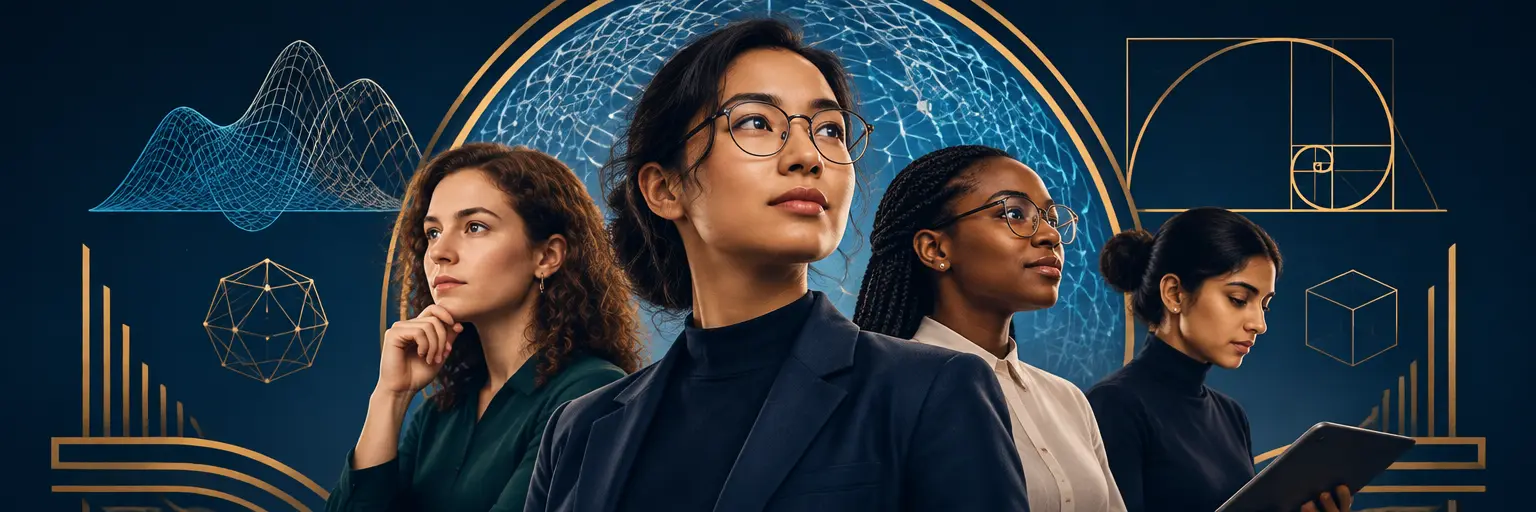
The 21st century has witnessed a remarkable surge in the visibility and impact of women in mathematics, transforming a field historically dominated by men. This subcategory on WomenInScienceHistory.com delves into the lives, breakthroughs, and ongoing struggles of contemporary female mathematicians who are reshaping the discipline. From solving century-old conjectures to leading global research institutions, these women exemplify brilliance, resilience, and innovation. Here, you’ll discover not only their academic achievements but also the pivotal roles they play in mentoring the next generation and advocating for equity in STEM. Dive in to celebrate the dynamic contributions that define modern mathematics through a female lens.
🔬 Pioneers of Modern Mathematical Breakthroughs
This section highlights women who have made landmark discoveries in pure and applied mathematics during the 21st century. Figures like Maryam Mirzakhani, the first woman to win the Fields Medal (2014), revolutionized hyperbolic geometry and moduli spaces. Similarly, Karen Uhlenbeck received the Abel Prize in 2019 for her foundational work in gauge theory and geometric analysis. Readers will explore how these mathematicians tackled problems once deemed unsolvable, using advanced tools from topology, algebra, and analysis to open new research frontiers.
Expect detailed narratives of their problem-solving journeys, including the collaborative processes behind their theorems. We also examine how their work influences adjacent fields such as physics, cryptography, and data science. By focusing on the technical depth and creative reasoning, this section underscores that gender is irrelevant to mathematical genius, while also acknowledging the systemic barriers these pioneers had to overcome. Each profile is enriched with primary sources, interviews, and career timelines for an immersive understanding.
🌍 Global Impact and Cross-Cultural Leadership
Women mathematicians today are not confined to Western institutions; they lead research centers in Africa, Asia, Latin America, and the Middle East. For instance, Ingrid Daubechies (Belgium/USA) transformed wavelet theory, while Nalini Joshi (Australia) advances integrable systems and mentors talent across Oceania. This section spotlights how these leaders foster international collaborations, often breaking ground in regions with limited mathematical infrastructure. Their stories emphasize that mathematical progress thrives on diverse perspectives, making global inclusivity a scientific necessity, not just a social goal.
Here, you’ll find case studies of cross-border projects, such as the African Women in Mathematics Association’s mentorship networks. We also discuss the cultural challenges these women navigate, from balancing traditional expectations to advocating for resources. Through interviews and firsthand accounts, this subcategory reveals how they use mathematics as a universal language to bridge divides and inspire local youth. The result is a rich tapestry of leadership that redefines what it means to be a mathematician in the 21st century.
📚 Educational Innovators and Mentors
Beyond research, many contemporary female mathematicians are transforming how mathematics is taught and learned. Jo Boaler at Stanford promotes “growth mindset” pedagogy, while Mega Beck (fictional example) develops open-access curricula for underprivileged schools. This section explores their initiatives, from flipped classrooms to gamified learning platforms, which aim to dismantle math anxiety and enhance accessibility. These educators also champion active learning techniques that encourage problem-solving over rote memorization, proven to boost performance among minority students.
Readers will gain insights into mentorship programs like the Edge Program for women transitioning to PhD programs, and online communities that connect female mathematicians worldwide. We profile mentors who prioritize emotional support alongside technical training, creating safe spaces for questioning and failure. By highlighting measurable outcomes—such as increased retention rates and publication output—this section demonstrates that educational innovation is as critical as discovery. It provides actionable advice for educators and students alike, emphasizing that inclusive teaching benefits everyone.
⚖️ Advocacy and Policy Shaping for Equity
The fight for gender parity in mathematics extends beyond individual achievements to systemic change. This section covers women like Caroline Series (UK) who have served on international mathematical unions, pushing for transparent hiring practices and parental leave policies. We examine organizations such as the Association for Women in Mathematics (AWM) and its “Mentoring Travel Grants” that reduce isolation. These advocates use data-driven arguments to expose bias in peer review and funding allocations, often collaborating with policymakers to implement reforms.
Expect case studies of successful campaigns, including the #NoMoreMatildas movement to rename awards after female mathematicians. We also analyze the ripple effects of quotas in conference speaker rosters, which have measurably increased female attendance. The narratives here emphasize strategy—how these women leverage social media, petitions, and institutional alliances to effect change. By showcasing measurable victories, this section empowers readers to become advocates in their own academic or professional spheres, proving that collective action can dismantle longstanding inequities.
🏆 Recognition, Awards, and Public Visibility
In the 21st century, female mathematicians finally began receiving the field’s highest honors. Beyond Mirzakhani and Uhlenbeck, winners like Claire Voisin (CNRS Gold Medal) and Svetlana Jitomirskaya (AMS Centennial Fellow) have gained international acclaim. This section explores how awards shape career trajectories and public perception, despite critiques that they remain too rare. We also highlight media portrayals—from documentaries to viral social media posts—that celebrate these figures, countering stereotypes about who can be a mathematician.
However, recognition is not without pitfalls; we discuss the “trophy syndrome” where women are over-scrutinized for every public misstep. To provide balance, we feature rising stars in their 30s and 40s who are already winning early-career prizes, demonstrating a positive trend. Interviews with award committees reveal the evolving criteria toward impact and mentoring, not just publications. This section ultimately argues that visibility is a powerful tool for inspiration, prompting young girls to see mathematics as a viable, exciting path forward.
Frequently Asked Questions
Who was the first woman to win the Fields Medal?
Maryam Mirzakhani, an Iranian mathematician, won the Fields Medal in 2014 for her contributions to the dynamics and geometry of Riemann surfaces and their moduli spaces. She was a professor at Stanford University and remains a role model for aspiring mathematicians worldwide. Her work on hyperbolic geometry and Teichmüller theory continues to influence multiple branches of mathematics.
What are common challenges faced by 21st century female mathematicians?
Common challenges include implicit bias in publishing and hiring, unequal access to grants and mentoring, and balancing caregiving responsibilities with research demands. Many also report isolation in male-dominated departments and pressure to represent all women. However, networks like AWM and institutional policies on flexible work have gradually mitigated these issues, though progress remains uneven across regions.
How can I support women in mathematics today?
You can support by donating to organizations like the Association for Women in Mathematics, attending or hosting inclusive conferences, and citing work by female mathematicians in your own research. Mentoring early-career women, whether formally or informally, has a significant impact. Additionally, advocating for maternity leave policies and transparent evaluation metrics creates systemic improvements.
Are there online communities for women in mathematics?
Yes, platforms like “Women in Mathematics” on Facebook, MathOverflow’s women-focused threads, and the “Mothers in Math” listserv provide support and advice. The AWM hosts virtual seminars and job boards, while #WomenInSTEM on Twitter offers daily inspiration. These communities share resources, job postings, and conference opportunities, helping to reduce isolation.
What fields of mathematics are most popular among contemporary female researchers?
Popular fields include algebraic geometry, applied mathematics (especially machine learning and data science), and mathematical biology. There is also growing interest in combinatorics and number theory. Notably, women are increasingly leading interdisciplinary projects linking mathematics with climate science and neuroscience, showcasing the versatility of mathematical training.