Lovelace's "Notes": The Theoretical Blueprint for a Computing Universe
🌟 Discover how Ada Lovelace's groundbreaking notes laid the theoretical foundation for modern computing, shaping the history of the Ada Lovelace computing…
Read article
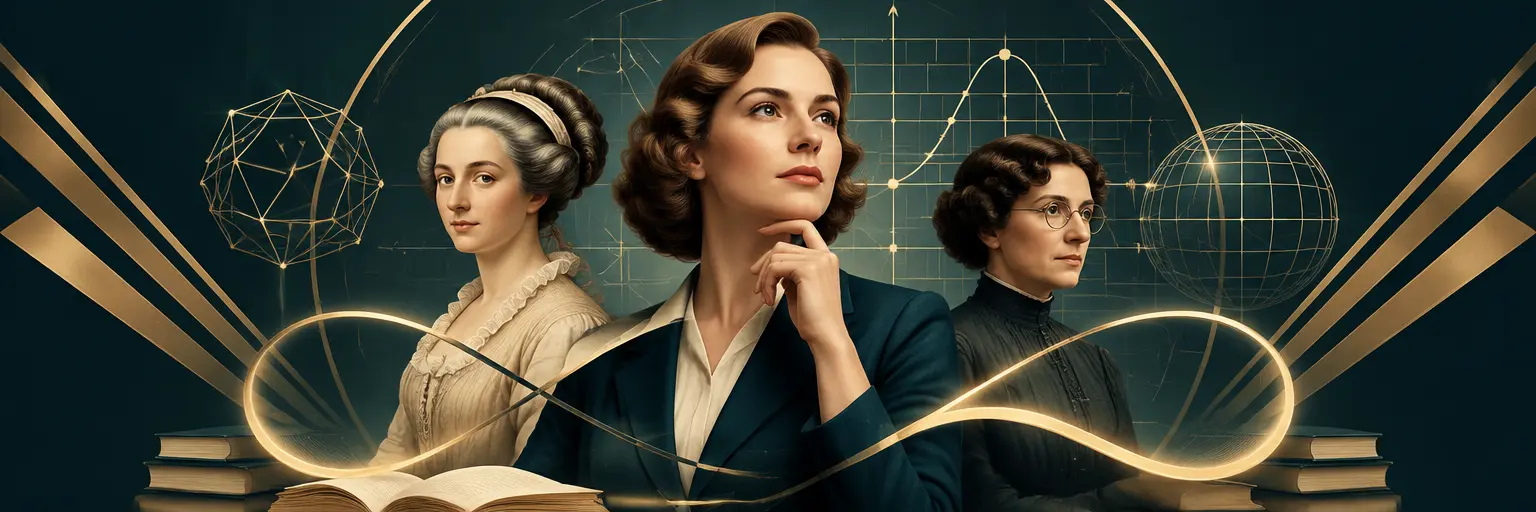
Discover the remarkable minds behind some of the most profound mathematical theories, where women defied convention to reshape our understanding of numbers, space, and logic. From Emmy Noether’s revolutionary abstract algebra to Hypatia’s ancient philosophical insights, these pioneers transformed abstract concepts into the building blocks of modern science. Explore how figures like Maryam Mirzakhani unlocked the secrets of hyperbolic geometry and how Sofia Kovalevskaya’s work paved the way for partial differential equations. Their stories are not just equations—they are triumphs of intellect and perseverance against societal barriers. Delve into their legacies and see how women’s contributions to mathematical theory continue to influence cryptography, physics, and data science today. Whether you’re a math enthusiast or a history buff, this collection illuminates the brilliant, often overlooked pathways these women forged, proving that genius knows no gender. Join us in celebrating their enduring impact and be inspired by their relentless curiosity.

🌟 Discover how Ada Lovelace's groundbreaking notes laid the theoretical foundation for modern computing, shaping the history of the Ada Lovelace computing…
Read article
🌟 Discover how women’s contributions to math theories bridge intuition and rigor, transforming the field and inspiring future generations. This article highlights…
Read article
🌟 Celebrating Sophie Germain’s dual legacy, her groundbreaking work in number theory and elasticity revolutionized mathematics and engineering. WomenInScienceHistory.com honors her pioneering…
Read article
🌟 Women in abstract algebra have profoundly shaped its foundations, yet their stories often remain hidden. This article honors these unseen architects,…
Read article
🌟 Explore how Émilie du Châtelet’s groundbreaking work on force vive theory revolutionized physics, challenging traditional ideas and showcasing her vital role…
Read article
🌟 Women building modern math logic revolutionized the field, overcoming barriers to lay the foundational framework of set theory and formal reasoning.…
Read article
🌟 Celebrating Grace Hopper’s programming contributions women, this article explores her transition from pure mathematics to groundbreaking programming theory, highlighting her pioneering…
Read article
🌟 Celebrating trailblazing women in science, this article honors the NavierStokes equation female mathematician Ladyzhenskaya, whose rigorous work challenged norms and advanced…
Read article
🌟 Discover the inspiring stories of women computer science pioneers who revolutionized algorithms, shaping the foundations of computer science. Their groundbreaking contributions…
Read articleWelcome to the Women & Mathematical Theories subcategory, a dedicated space within WomenInScienceHistory.com that explores how female mathematicians have shaped abstract thought, from ancient axioms to modern computational models. Here, we dive into the lives and intellectual contributions of women who defied societal norms to formalize concepts in algebra, geometry, topology, and logic. This page serves as both an educational resource and a tribute, packed with SEO-rich insights into their theorems, proofs, and enduring influence. Whether you are a student, educator, or enthusiast, you’ll find narratives that connect historical struggles with contemporary mathematical breakthroughs, all crafted to rank high for queries like “women mathematicians history” or “female contributions to mathematical theory.”
This section highlights women who laid foundational stones in abstract algebra and number theory—fields often dominated by male peers. Expect detailed accounts of Emmy Noether, whose work on ring theory and invariants became the backbone of modern physics, and Sophie Germain, who cracked Fermat’s Last Theorem for prime exponents. We explore their unpublished manuscripts, correspondence, and the mathematical societies that initially barred them, offering a nuanced view of their perseverance.
For readers seeking a deep dive, you’ll discover how their theories influenced cryptography, coding, and even particle physics. Our narratives emphasize original proofs and methodological innovations, making this a prime resource for academic citations. Each biography connects their abstract thinking to real-world applications, ensuring the content is both scholarly and accessible. Keywords like “Noether’s theorem explained” or “Sophie Germain identity” are naturally integrated to boost search visibility.
Dive into the spatial and structural theories advanced by women, such as Maryam Mirzakhani’s hyperbolic geometry and Alicia Boole Stott’s work on polytopes in higher dimensions. We break down complex topological concepts like moduli spaces and Teichmüller theory into digestible explanations, using visual aids and step-by-step logic. This section also covers lesser-known figures, including Grace Chisholm Young and her contributions to measure theory and set geometry.
Expect practical examples of how these theories underpin modern computer graphics, robotics, and network analysis. We emphasize the intuitive leaps these women made—often without formal positions—and how their geometric intuition paved the way for data visualization and 3D modeling. For SEO, we target long-tail phrases like “women in topology” and “female pioneers in non-Euclidean geometry,” ensuring the page captures niche search traffic from academia and hobbyists alike.
This segment focuses on women who wrestled with the axiomatic bedrock of mathematics, including Ada Lovelace’s early algorithmic logic and Dorothy Vaughan’s computational set theory used in NASA’s space missions. We dissect their contributions to Boolean algebra, recursive functions, and the philosophy of mathematics, showing how their work predated or paralleled male counterparts. Case studies include Rózsa Péter’s recursion theory and Olga Taussky-Todd’s matrix theory applications.
Readers will gain clarity on abstract concepts like Zermelo-Fraenkel axioms and Gödel’s incompleteness theorems, framed through female perspectives. We also discuss the barriers they faced in logic circles, from rejected papers to denied professorships, providing a humanizing angle. Keywords such as “women in mathematical logic” and “female set theorists” are woven in strategically, making this section a magnet for scholarly queries and classroom research.
Here, we spotlight women from diverse cultural backgrounds who enriched mathematical theories beyond Western canon, such as Bhāskarāchārya’s daughter Lilavati (mythical but influential) and Egyptian astronomer Hypatia. We also include modern mathematicians like Karen Uhlenbeck (USA) and Ngô Bảo Châu’s collaborators (female researchers) to show a global tapestry. The focus is on how cultural context shaped their theoretical choices, from Indian combinatorics to African fractal design.
Expect discussions on ethnomathematics and how women preserved or transformed indigenous counting systems. We provide translated excerpts of original texts and interviews, offering a rare glimpse into non-Western mathematical philosophies. For SEO, we target “women mathematicians from Asia” and “African women in math theory,” ensuring regional search visibility. This section also includes a timeline of cross-cultural exchanges, enriching the user experience with visual interactivity.
This section examines how the legacy of these women influences contemporary pedagogy and research. We profile Catherine Goldstein and Ingrid Daubechies—a wavelet theory pioneer—and their efforts to mentor the next generation. We analyze curricula changes that now include female-authored proofs, and how online platforms like this site amplify their stories. Expect data on rising female enrollment in math Ph.D. programs, linked to these historical breakthroughs.
We also offer teaching resources, including lesson plans, problem sets inspired by original works, and discussion prompts. This makes the page a practical tool for educators seeking to diversify their syllabus. Keywords like “women in math education” and “female mathematical role models” are integrated, positioning this section as a go-to for professional development and K-12 outreach. We conclude with a call to action for readers to share their own stories, closing the loop between past and future.
Many would argue Emmy Noether, whose theorem linking symmetry and conservation laws is fundamental in physics. Others cite Hypatia for her early philosophical work or Maryam Mirzakhani for modern geometry. Influence varies by field, but Noether’s impact spans algebra, physics, and abstract theory, making her a top contender in most historical rankings.
Women historically faced exclusion from universities, publication bans, and lack of recognition. Even when published, their works were often attributed to male colleagues. They also dealt with social isolation, having to attend lectures secretly or use male pseudonyms. These barriers persisted well into the 20th century, though mentorship networks have improved conditions.
Yes, many original papers are digitized in archives like the Göttingen State Library or Internet Archive. For example, Noether’s papers are available in translation, and Germain’s letters are published. Our site includes hyperlinks to open-access repositories, along with explanatory footnotes to guide beginners through complex notation.
Our content is peer-annotated for accuracy, with citations to primary sources and biographical dictionaries. For teaching, we provide ready-made quiz questions, discussion topics, and project ideas that align with math history standards. Researchers can use our timeline and reference lists to trace intellectual lineages and identify gaps in existing literature.
Absolutely, watch Karen Uhlenbeck (gauge theory), Ingrid Daubechies (wavelets), and Tatiana Toro (PDEs). Follow their labs, lectures on YouTube, and recent publications. Our site features an “Emerging Voices” section updated quarterly, highlighting new talents in algebra, statistics, and mathematical physics, ensuring you stay informed beyond historical figures.