Women in Applied Mathematics: Pioneers Who Shaped the Real World
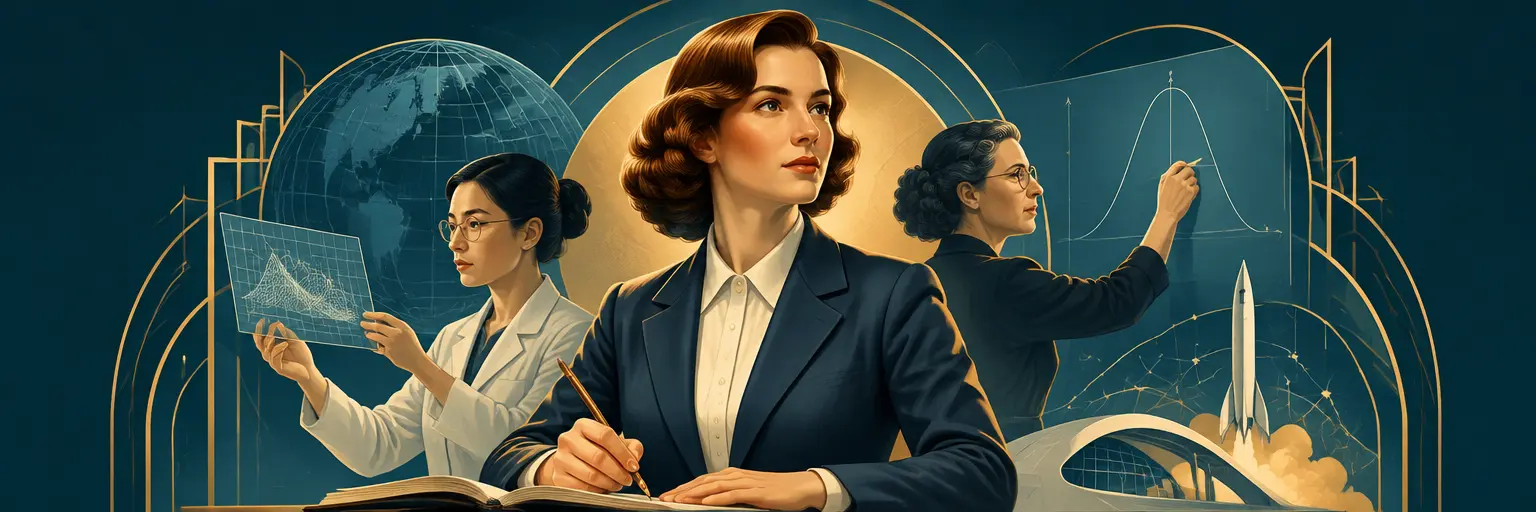
Applied mathematics is where abstract theory meets tangible solutions, and women have been instrumental in this field for centuries. From cryptography to fluid dynamics, these mathematical pioneers have transformed industries, defended nations, and decoded the universe. At WomenInScienceHistory.com, we delve into the lives and work of the brilliant women who applied mathematical principles to solve real-world problems, often without the recognition they deserved. Their legacy is a powerful reminder of the critical role women play in advancing science, technology, and society.
💡 Trailblazers in Early Applied Mathematics
The roots of women in applied mathematics reach back to the 18th and 19th centuries, when a few determined minds broke through barriers. Ada Lovelace, often considered the first computer programmer, wrote the first algorithm intended for Charles Babbage’s Analytical Engine, laying the foundation for modern computing. Her visionary work was not merely theoretical; she saw the potential for machines to go beyond calculation and manipulate symbols, a concept that birthed the digital age. Similarly, Sophie Germain, who faced severe gender discrimination, made groundbreaking contributions to elasticity theory and number theory, directly influencing the construction of the Eiffel Tower and modern architecture.
These women were not just mathematicians; they were applied scientists who understood that equations could predict physical phenomena. Their perseverance in a field that actively excluded them is a testament to their extraordinary intellect and grit. By studying their paths, readers gain insight into how early mathematical principles were translated into engineering, physics, and eventually technology, all while navigating a society that often dismissed their work outright. Their stories are essential for understanding the deep intellectual roots of applied mathematics.
🛡️ Codebreakers and Computational Legends
The 20th century saw women enter applied mathematics in unprecedented ways, particularly during times of war. Figures like Joan Clarke, who worked alongside Alan Turing at Bletchley Park, were pivotal in breaking the Enigma code, an achievement that shortened World War II and saved countless lives. Meanwhile, a cohort of women at NASA, including Katherine Johnson, Dorothy Vaughan, and Mary Jackson, performed complex trajectory calculations that were vital to the success of the Mercury, Gemini, and Apollo space programs. Their mathematical precision turned science fiction into reality, enabling human spaceflight with nothing more than pencils, slide rules, and sheer brilliance.
Beyond warfare and space, women like Grace Hopper pioneered computer programming, developing the first compiler and the COBOL language, which made computers usable for business and science, not just mathematical calculation. These computational legends proved that applied mathematics was not a sterile exercise but a dynamic force for national security, exploration, and commercial innovation. Their work underscores how women’s mathematical expertise was often a hidden engine behind some of the most significant technological breakthroughs of the past century.
🌊 Modern Innovators in Fluid Dynamics and Optimization
In the contemporary era, women continue to lead in applied mathematics, particularly in fluid dynamics, material science, and optimization. For instance, mathematician Mary Wheeler has made significant strides in numerical analysis and reservoir engineering, helping industries extract oil and manage groundwater more efficiently. Her work on computational methods directly impacts energy policy and environmental sustainability. Similarly, women-led research in stochastic modeling and artificial intelligence is shaping financial markets, healthcare analytics, and climate prediction models, proving that applied mathematics is a living, breathing field that addresses our most pressing modern challenges.
These modern innovators are not just applying existing equations; they are creating new mathematical frameworks to solve problems that were previously intractable. Their focus on optimization and data-driven approaches is crucial for everything from logistics to disease outbreak modeling. By highlighting their current efforts, we show that the legacy of women in applied mathematics is not a historical footnote but a vibrant, forward-looking movement. Their stories inspire budding mathematicians to see that their skills have immediate, world-changing applications, from predicting hurricanes to improving medical imaging.
📈 Overcoming Barriers: The Fight for Recognition and Inclusion
The history of women in applied mathematics is also a chronicle of resilience against systemic exclusion. Many early pioneers were denied formal education, forced to publish under male pseudonyms, or barred from faculty positions. Even the now-celebrated women of NASA were initially hired as "computers" in low-paying roles, with their names scrubbed from official reports. The fight for equal pay, credit, and professional standing has been a persistent theme. Organizations like the Association for Women in Mathematics (AWM), founded in 1971, have been instrumental in challenging these biases and creating networks of support and mentorship that continue to open doors for women today.
While progress has been made, modern women in applied mathematics still report higher rates of attrition and underrepresentation in senior roles. The barriers are not just explicit discrimination but also implicit biases, isolation, and the challenge of balancing a demanding career with family responsibilities. Understanding these struggles is vital, as it humanizes the mathematical achievements and highlights the contextual factors that either foster or stifle innovation. By acknowledging these barriers, we can better advocate for policies and cultures that truly value diverse mathematical talent, ensuring that the next generation of female mathematicians has fewer hurdles to cross.
🔬 The Future of Applied Mathematics and Women’s Leadership
Looking ahead, the role of women in applied mathematics is more critical than ever. As we face global challenges like climate change, pandemics, and cybersecurity threats, applied mathematicians are the architects of the predictive models and algorithms we rely on. Women are already at the forefront of machine learning ethics, computational biology, and quantitative finance. Their unique perspectives and collaborative approaches are essential for creating robust, equitable, and innovative solutions. Encouraging more girls and young women to pursue this path requires visible role models, accessible curricula, and active dismantling of the stereotypes that mathematics is a male domain.
The future is not just about including women in applied mathematics; it is about recognizing that their contributions improve the field’s quality and scope. Diversity in problem-solving teams leads to more creative and comprehensive outcomes. As institutions and industries increasingly understand this, we anticipate a shift towards more inclusive practices. Our goal at WomenInScienceHistory.com is to accelerate this transition by sharing inspiring stories that show mathematics is for everyone. The next breakthrough in applied mathematics is just as likely to come from a woman’s mind, and we are here to ensure her story is celebrated.
Frequently Asked Questions
What is the difference between pure and applied mathematics?
Pure mathematics explores abstract concepts and theories for their own sake, without direct application. Applied mathematics uses mathematical methods and principles to solve concrete problems in science, engineering, business, and industry. While pure math focuses on logic and proof, applied math models real-world systems, often using computational tools to predict outcomes and optimize solutions.
Who is considered the first female computer programmer?
Ada Lovelace is widely credited as the world’s first computer programmer. In the 1840s, she wrote detailed notes and an algorithm for Charles Babbage’s Analytical Engine, a mechanical general-purpose computer. Her insight that the machine could process symbols, not just numbers, laid the conceptual groundwork for all modern software development.
How did women contribute to the Apollo space missions?
African American women mathematicians, including Katherine Johnson, Dorothy Vaughan, and Mary Jackson, performed complex trajectory and orbital mechanics calculations at NASA. Katherine Johnson’s calculations were critical for astronaut John Glenn’s orbit, and her accuracy was so trusted that he requested she verify the computers’ numbers before his 1962 flight, directly ensuring the mission’s success.
Can applied mathematics lead to careers in data science and AI?
Absolutely. Applied mathematics provides the core foundation for data science, machine learning, and artificial intelligence. Skills in linear algebra, calculus, probability, and optimization are essential for building algorithms, interpreting large datasets, and developing predictive models. Many leading AI practitioners hold degrees in applied mathematics, making it a powerful launching pad for tech careers.
What are common challenges women in applied mathematics still face today?
Despite progress, women face implicit biases in hiring and promotion, a lack of senior female mentors, and a workplace culture that can be isolating. They are often underrepresented in leadership roles and may face stereotype threat. However, targeted initiatives, inclusive policies, and growing awareness are helping to reduce these barriers, fostering a more equitable environment where their contributions are fully valued.