Ada Lovelace & Babbage's Engine: Did the 19th Century See the Genesis of AI?
🌟 Explore how Ada Lovelace AI history and her visionary insights into Babbage’s Engine hint at the dawn of artificial intelligence, showcasing…
Read article
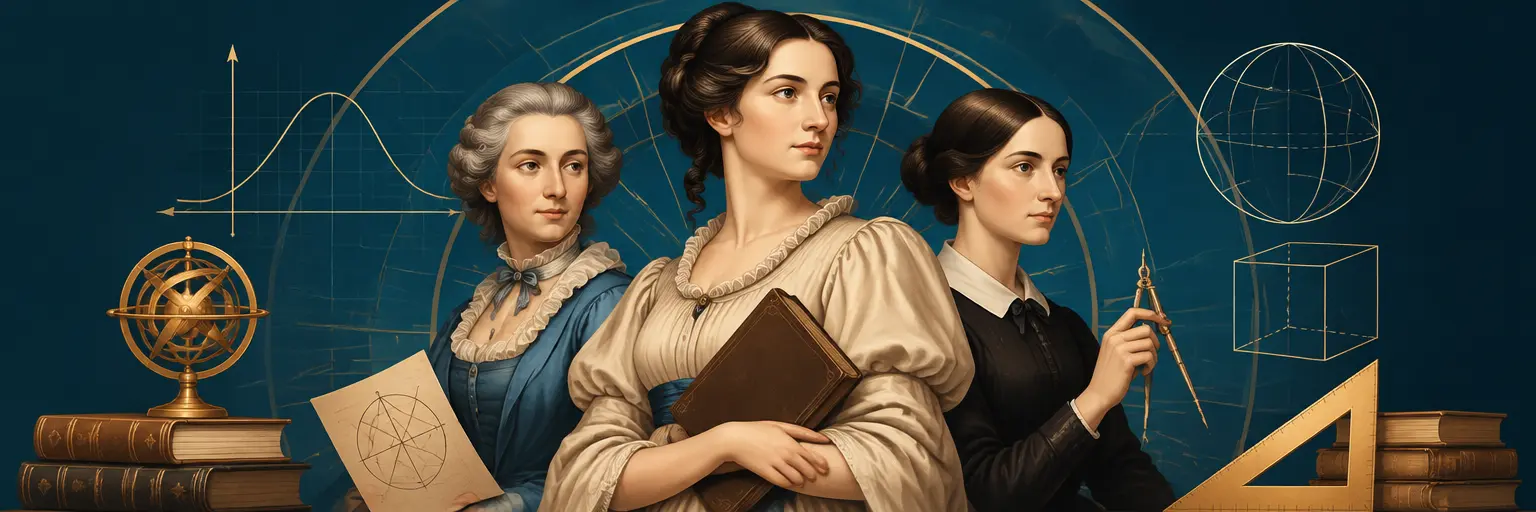
Discover the remarkable minds who defied societal norms to shape modern mathematics! From the 18th and 19th centuries, trailblazers like Émilie du Châtelet, who translated Newton’s works, and Sofia Kovalevskaya, the first woman to earn a doctorate in mathematics, broke barriers in a field dominated by men. This page honors their groundbreaking contributions—from calculus and number theory to mathematical physics—while exploring the immense challenges they faced, including limited access to education and recognition. Through vivid biographies and insightful analysis, we bring to life the perseverance, intellect, and legacy of these pioneers, ensuring their stories inspire the next generation of scientists. Dive into a world where passion met prejudice, and brilliance prevailed—perfect for history buffs, math enthusiasts, and anyone seeking untold stories of female achievement. Uncover how these women’s work not only advanced mathematics but also paved the way for future generations of women in STEM.
🌟 Explore how Ada Lovelace AI history and her visionary insights into Babbage’s Engine hint at the dawn of artificial intelligence, showcasing…
Read article
🌟 Discover how pioneering women broke barriers with their groundbreaking mathematical contributions in the 18th century, challenging male dominance and shaping future…
Read article
🌟 Discover how Ada Lovelace's algorithmic thinking notes revolutionized computing, highlighting her pioneering role in the 19th century. This article unveils her…
Read article
🌟 Discover how women's mathematical learning networks through historic correspondence fueled female scientists' pursuits, overcoming barriers and inspiring future generations. These vital…
Read article
🌟 Discover how the groundbreaking 18th and 19th-century female mathematicians paved the way for women in science, inspiring future generations and challenging…
Read article
🌟 Explore how historical biases shaped perceptions of women's mathematical prejudice history, revealing that women’s remarkable contributions to mathematics defy 18th and…
Read article
🌟 Discover the inspiring stories of women mathematicians in enlightenment history, whose groundbreaking contributions challenged gender norms and advanced scientific progress, highlighting…
Read articleDive into a transformative era when women began breaking through academic barriers to shape the foundations of modern mathematics. This subcategory on WomenInScienceHistory.com uncovers the lives, struggles, and epoch-making contributions of female mathematicians from the Enlightenment to the dawn of the 20th century. From Parisian salons to Russian lecture halls, these women not only computed but also theorized, taught, and published against all odds. Discover how their work influenced algebra, geometry, physics, and even astronomy, while navigating societal restrictions that denied them formal education and professional recognition. This page is your gateway to understanding their resilience, intellect, and enduring legacy.
Here, you will meet women like Émilie du Châtelet, who translated Newton’s Principia with her own commentary, and Sophie Germain, who corresponded with Gauss under a male pseudonym to win a Paris Academy prize. These stories reveal how self-study, private tutors, and intellectual networks became their lifelines. Expect detailed narratives on how they navigated prohibitions against university attendance, using wit and persistence to access advanced mathematical texts.
These pioneers didn’t just learn—they innovated. Victoire Lemoine and Maria Gaetana Agnesi authored textbooks that standardized mathematical education. Agnesi’s Analytical Institutions became a benchmark in calculus and differential equations. Their journeys highlight the critical role of family support and male mentors who recognized their genius, offering a nuanced view of collaboration across genders in an era of overt exclusion.
Focusing on interdisciplinary work, this section connects mathematics to astronomy and physics. You’ll explore how Nicole-Reine Lepaute calculated the return of Halley’s comet with remarkable accuracy, and how Mary Somerville translated Laplace’s Celestial Mechanics, making it accessible to English-speaking scientists. These women proved that mathematical modeling could predict planetary motion and tides, directly influencing navigation and timekeeping.
Their work wasn’t confined to theory. In Russia, Sofia Kovalevskaya earned a doctorate from Göttingen and later proved the Cauchy-Kovalevskaya theorem, a milestone in partial differential equations. She also analyzed Saturn’s ring stability, blending pure math with astrophysical inquiry. Expect insights into how their computational precision shaped scientific debates and why their names remain central to modern equations in mechanics and orbital dynamics.
This segment examines the transition from private study to public scholarship. Learn how Mary Fairfax Somerville’s On the Connexion of the Physical Sciences became a bestseller, bridging mathematics for a broad audience. Meanwhile, Ada Lovelace’s notes on Babbage’s Analytical Engine introduced the first algorithm, laying groundwork for computer science. These publications challenged the era’s norms, proving women could articulate complex ideas with clarity and originality.
Also featured is the lesser-known story of Elizabeth Fulhame, whose 1794 Essay on Combustion proposed novel theories on reduction-oxidation reactions, using quantitative methods. This section emphasizes that publication was a radical act, often requiring patronage or anonymity. You’ll see how editorial choices, prefaces, and correspondence reveal gendered strategies for gaining legitimacy, from dedicating works to influential men to embedding mathematics within broader scientific narratives.
Discover how geographical mobility and social gatherings fostered mathematical exchange. The salons of Paris and Berlin, hosted by figures like Julie de Lespinasse, provided informal academies where women debated principles with luminaries such as Lagrange and Legendre. In Italy, Laura Bassi became a university professor, lecturing publicly on Newtonian physics and mechanics, while in England, the Hicks family supported self-taught protégés.
This network extended to transatlantic correspondence. German-born Sophie Germain communicated with Gauss, who initially suspected she was a soldier’s wife. Later, Olga Taussky-Todd in Vienna built bridges between algebra and computational number theory. Expect case studies on how letters, translations, and travel broadened their access to current research, and how collaborative peer review—informal but rigorous—operated outside institutional frameworks.
Despite systemic exclusion, some achieved formal recognition. Sophie Germain won a grand prize from the Paris Academy of Sciences in 1816 for her work on elastic surfaces, but she was barred from attending sessions. Sofia Kovalevskaya received the Prix Bordin from the French Academy and later a full professorship in Stockholm. These honors were hard-won, often following decades of unpaid labor and patron support.
Also highlighted are posthumous recognitions: medals, named theorems, and university chairs bearing their names. For instance, the Émilie du Châtelet Prize and the Germain Prize now celebrate contemporary women in science. This section reflects on how institutional memory has been corrected, and how current mathematicians, like Ingrid Daubechies, cite these foremothers as inspiration. Expect a balanced view of celebration mixed with critique of patriarchal gatekeeping.
Concluding the core content, this section links historical contributions to contemporary mathematics education. You’ll see how their methods—visualization, analogical reasoning, and interdisciplinary synthesis—are now celebrated in modern pedagogy. Programs like "Women in Math" scholarships and annual lectures honor these figures, ensuring their narratives inspire STEM careers today. Their life stories also feed into debates on implicit bias, contribution recognition, and academic culture.
Moreover, digital archives and translation projects are making their original works accessible, enabling new scholarly analyses. The resilience of these women serves as a case study for resilience in science, showing that talent persists regardless of systemic obstacles. This final section encourages you to reflect on how far the field has come and how much work remains, offering a bridge from history to actionable progress.
Émilie du Châtelet stands out as a polymath whose annotated translation of Newton’s Principia is still used today. She supplemented it with her own insights on conservation of energy and fundamental physics, making her work a cornerstone for later rational mechanics studies.
Yes, Sofia Kovalevskaya became a full professor at the University of Stockholm in 1884, after initial refusal in Russia. Laura Bassi earlier obtained a professorship in Bologna in 1732, but formal positions remained extremely rare throughout the century.
They relied on private tutors, family libraries, correspondence with leading mathematicians, and participation in scientific salons. Some, like Mary Somerville, self-studied from books, while others, like Sophie Germain, exchanged letters under pseudonyms to break into male academic circles.
Many received belated honors, such as the French Academy’s Germain Prize, established shortly after her death. Modern efforts include naming awards, lunar craters, and institutes after them, plus digitizing their writings to facilitate new biographies and research.
Partial differential equations, celestial mechanics, and early computer science all built on their work. Ada Lovelace’s algorithm foreshadowed programming, while Kovalevskaya’s theorem underpins modern analysis and even some machine learning stability studies.