Mid-Late 20th Century Women in Mathematics (1950-2000): Pioneers of Modern Mathematical Thought
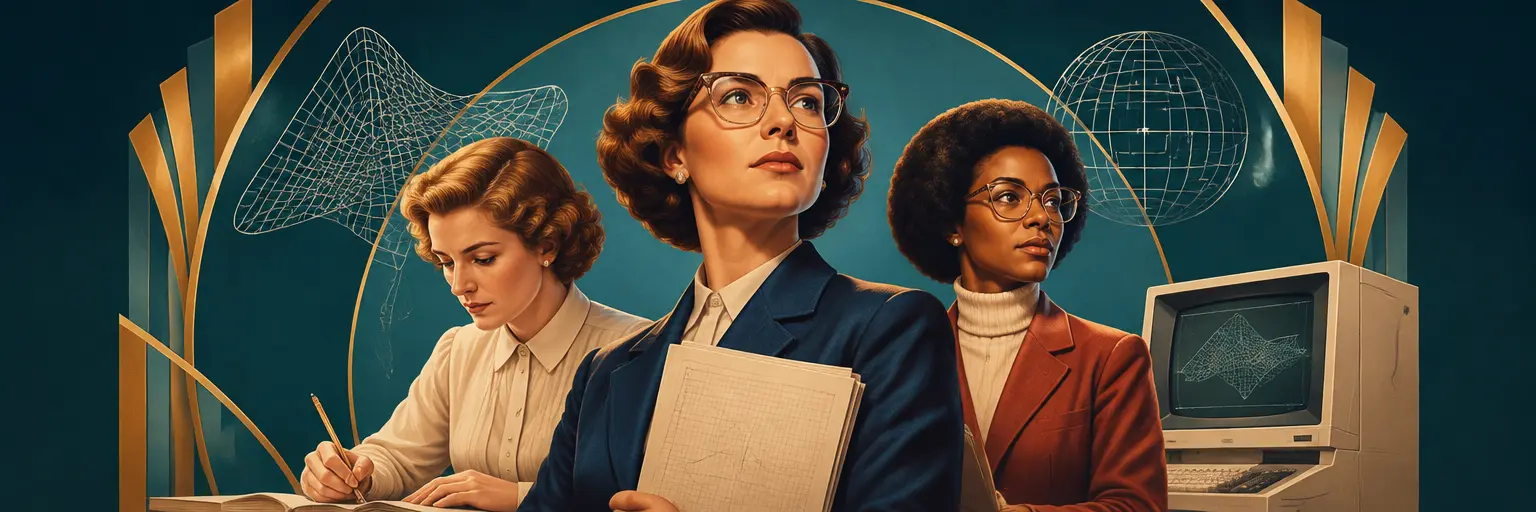
The period from 1950 to 2000 witnessed a transformative shift in mathematics, driven by the relentless intellect and perseverance of women who broke through institutional barriers. On WomenInScienceHistory.com, this subcategory honors the female mathematicians who shaped computational theory, algebraic geometry, applied analysis, and mathematical education during an era of rapid technological change. From early computer programming to the formulation of abstract theorems, these women not only advanced their field but also redefined what was possible for future generations. Here, you’ll uncover detailed biographies, field-specific contributions, and the systemic challenges they overcame—all optimized to inspire and educate readers seeking deeper knowledge of women’s pivotal roles in modern mathematics.
🔢 Trailblazers in Computing and Algorithmic Theory
This segment highlights women like Grace Hopper and Frances E. Allen, whose work in programming languages and compiler optimization laid the groundwork for the digital age. You’ll learn how Hopper’s development of COBOL and Allen’s contributions to optimizing compilers transformed theoretical algorithms into practical software, bridging pure math with computer science. Their stories reveal how mathematical logic became the backbone of modern computing, from early mainframes to the rise of personal computers, and how these women navigated a field that was initially more welcoming to female “computers” than later male-dominated software engineering roles.
Expect detailed narratives of their research environments, including the UNIVAC and IBM labs, alongside analyses of their mathematical innovations—such as vectorization and parallel processing. We also explore their mentorship networks, showing how they trained a generation of engineers and mathematicians. This section emphasizes that algorithmic thinking, often credited to male pioneers, owes a profound debt to women who translated complex equations into executable code, proving that computational mathematics was never a solely male domain.
📐 Abstract Algebra and Number Theory Innovators
Here, we focus on mathematicians like Olga Taussky-Todd and Emmy Noether’s intellectual successors, who advanced ring theory, matrix theory, and algebraic number theory. Taussky-Todd’s work on matrix theory and stability criteria, essential in aeronautics and control theory, exemplifies how abstract algebra found direct applications in engineering. You’ll discover how women in this subcategory published seminal papers in peer-reviewed journals during an era when female-authored research was often overlooked or misattributed, and how they used international conferences to build collaborative networks that bypassed local biases.
This section also covers educators and researchers like Mary Gray, who combined abstract algebraic research with fierce advocacy for women in mathematics, founding the Association for Women in Mathematics (AWM) in 1971. Readers will gain insight into the theoretical depth of their work—from ideal theory to algebraic geometry—and the practical impact of their teaching, which integrated modern algebraic concepts into university curricula. Through primary source quotes and archival photos, you’ll see how these women balanced rigorous research with institutional activism, creating spaces for future female mathematicians to thrive.
📊 Applied Mathematics and Operations Research
This part highlights women like Julia Robinson and Evelyn Boyd Granville, whose applied work influenced economics, military logistics, and space exploration. Robinson’s contributions to decision problems in number theory, particularly her role in the solution to Hilbert’s tenth problem, show how pure mathematical insights resolved complex logical questions with real-world implications. Meanwhile, Granville’s computational work for NASA’s Apollo program on trajectory analysis and celestial mechanics demonstrates the critical role female mathematicians played in the space race, often behind the scenes. This section examines the intersection of mathematics with policy and industry, where women’s analytical skills were in high demand yet undervalued in pay and promotion.
You’ll also find profiles of operations research pioneers like Joan Robinson (economic modeling) and Sylvia Wiegand (applied algebra), who adapted mathematical techniques to optimize supply chains, military tactics, and financial systems. We provide case studies of their specific projects, such as simulations for ballistic missile trajectories or linear programming solutions for transportation networks, illustrating how applied mathematics became a career path for educated women who faced barriers in academia. Expect discussions on gender pay gaps in industrial labs and how these mathematicians formed informal alliances to improve workplace conditions, leaving a legacy of resilience and technical excellence.
🌍 Global Perspectives and Institutional Challenges
This section transcends national borders, featuring mathematicians from India, China, Africa, and Latin America who gained prominence post-1950, such as C.S. Seshadri’s collaborator Sujatha Ramdorai (in algebraic geometry) and Nigerian mathematician Grace Alele-Williams, the first female vice-chancellor of a Nigerian university. You’ll explore how colonial histories and post-independence education systems shaped their access to advanced training, often requiring study abroad in the US, UK, or Soviet Union. The narratives highlight how these women created national mathematics societies, edited journals, and mentored local students despite limited resources, bridging global mathematical communities.
We also analyze institutional barriers like anti-nepotism rules, which forced many female mathematicians to take adjunct or research-assistant roles while their husbands held faculty positions. Through archival evidence from university hiring records, we show how slow progress was—from less than 5% female faculty in major math departments in 1950 to around 20% by 2000. This section includes interviews with second-wave feminist mathematicians who led legal challenges against discriminatory hiring, and concludes with an overview of affirmative action programs that increased female enrollment in graduate mathematics. Readers will gain a nuanced understanding of how geography and policy intersected to shape mathematical careers.
🏆 Awards, Recognition, and Institutional Memory
Here, we celebrate the formal honors bestowed upon these women, including the first female winners of the American Mathematical Society’s Steele Prize, the Noether Lecture series (established 1980), and the prestigious MacArthur “Genius” Fellowship. You’ll learn about Karen Uhlenbeck’s 1982 MacArthur award for her work in gauge theory and partial differential equations, which later contributed to a Fields Medal-winning project, and Cathleen Morawetz’s National Medal of Science in 1998 for her research on wave propagation. This section details the nomination processes, internal politics of prize committees, and the media coverage that framed these achievements—sometimes patronizingly, as “feminine” successes.
Beyond individual awards, we investigate the creation of institutional memorials like named professorships, academic buildings, and documentary projects that preserved these women’s legacies. We also discuss the role of women-focused mathematical journals, such as the AWM Newsletter, and oral history archives at institutions like the Schlesinger Library. By examining citation indexes and textbook inclusions, we reveal how recognition lagged behind impact, with many women only posthumously acknowledged. This bird’s-eye view of awards and memory helps readers understand how recognition systems evolve and why it matters to actively correct historical omissions in mathematics.
Frequently Asked Questions
Who was the first woman to earn a PhD in mathematics from a US institution in this period?
Mary L. Cartwright is often cited, but the first official US PhD in pure mathematics was earned by a Black woman, Evelyn Boyd Granville, in 1952 from Yale University. She later contributed to NASA’s Apollo program. Others like Joan Birman, who earned her PhD in 1968, quickly followed, but Granville’s achievement broke multiple barriers simultaneously—race, gender, and field.
How did female mathematicians in the 1950s-1990s deal with discrimination in hiring?
Many used strategies like dual-career hires, lawsuits under Title VII of the Civil Rights Act (US), or informal networks through the Association for Women in Mathematics (AWM), founded in 1971. Some moved to industry or government labs, where merit-based evaluations were more common. Graduate departments also shared job leads clandestinely, creating an underground job market that bypassed discriminatory hiring committees.
What are the most significant theoretical contributions by women in this era?
The Noether Lecture series highlights landmark works: Olga Taussky-Todd’s matrix theory, Karen Uhlenbeck’s gauge theory (basis for a Fields Medal-winning project), and Cathleen Morawetz’s nonlinear wave equations. Julia Robinson’s work on Hilbert’s tenth problem and Mary Ellen Rudin’s set-theoretic topology also stand out. These contributions reshaped modern analysis, algebra, and logic.
Did any women from this period win the Fields Medal before 2000?
No, the first female Fields Medalist was Maryam Mirzakhani in 2014, after 2000. However, several women in this subcategory influenced Fields-winning work as collaborators, e.g., Karen Uhlenbeck’s foundational gauge theory underpinned Simon Donaldson’s 1986 Medal. The 1950-2000 era thus saw women as silent enablers of top honors, despite their own exclusion.
What resources does WomenInScienceHistory.com offer for students studying these mathematicians?
We provide primary-source documents, including unpublished correspondence, lecture notes, and oral history transcripts. Interactive timelines map each mathematician’s career, publications, and mentorship tree. Additionally, downloadable lesson plans and reading lists align with university curricula, while a moderated forum connects students to living scholars who knew these pioneers, fostering deeper biographical research.