Celebrating the Brilliance of Women in Pure Mathematics
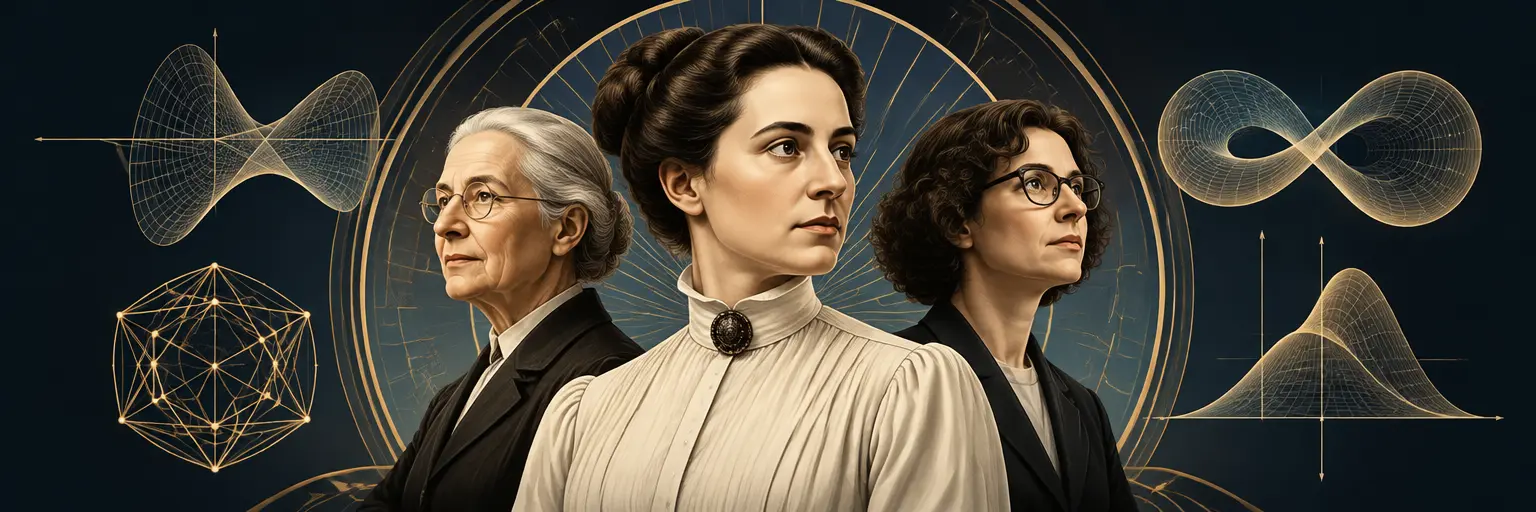
Pure mathematics is the poetry of logical ideas, and women have been writing its verses for centuries, often in the shadows of history. At WomenInScienceHistory.com, we illuminate the extraordinary minds who shaped number theory, algebra, geometry, and analysis—from Emmy Noether’s abstract algebra to Maryam Mirzakhani’s hyperbolic geometry. This subcategory uncovers their theorems, their perseverance against institutional barriers, and their enduring legacy in a field historically dominated by men. Whether you are a student, educator, or enthusiast, dive into these untold narratives that continue to redefine what is possible in mathematics.
🔢 Pioneering Theorems and Foundational Contributions
Explore the mathematical innovations that women introduced, from Sophie Germain’s work on Fermat’s Last Theorem to Katherine Johnson’s orbital calculations—though her work was applied, her pure math foundations were vital. Here, you will find deep dives into the structure of abstract algebra, topology, and number theory as advanced by women like Olga Ladyzhenskaya and Karen Uhlenbeck. These sections detail their proofs, papers, and the intellectual contexts that made their breakthroughs revolutionary.
Our profiles go beyond names and dates, breaking down complex concepts like Noether’s ring theory or Mirzakhani’s moduli spaces into accessible explanations. You’ll learn how each woman’s pure mathematical thinking solved abstract problems that later influenced physics, cryptography, and computer science. Expect rigorous yet readable analyses, complete with historical annotations and links to original publications, enabling you to follow the logical threads of their genius.
🏛️ Overcoming Barriers: Education and Institutional Hurdles
This section chronicles the systemic obstacles women faced in accessing higher education and academic positions in pure mathematics. From Sofia Kovalevskaya, who had to study privately and earn a doctorate without formal university attendance, to Emmy Noether, denied a paid professorship for decades despite her fame, we document their strategies for survival. These narratives use primary sources—letters, university records, and memoirs—to recreate the climate of exclusion and the clever workarounds women devised.
Readers will gain insight into how women found mentors, created informal study circles, and leveraged family resources to pursue mathematical research. We also highlight rare success stories, such as Mary Cartwright’s recognition at Cambridge, to show how persistence gradually cracked the ivory tower. This humanizing lens makes the mathematics more relatable and underscores the structural changes still needed in STEM today.
🌌 Legacy and Modern Influence in Pure Math
Here, we connect historical breakthroughs to contemporary mathematical practice, showing how women’s pure research underpins modern fields like algebraic geometry, dynamical systems, and category theory. For instance, Mirzakhani’s work now drives research in Teichmüller theory, while Noether’s conservation theorems are foundational in theoretical physics. This section also profiles living mathematicians like Ingrid Daubechies and Maryna Viazovska, illustrating a vibrant, ongoing lineage.
We analyze citation networks and research trends to demonstrate measurable impact, such as the Erdős numbers of these women or Fields Medal citations. Additionally, we discuss the ripple effects on education—how their textbooks, mentorship, and advocacy have diversified the pipeline. By framing their work as living mathematics, we inspire readers to see themselves as part of this continuing story, not just passive observers of history.
📚 Recommended Readings and Primary Sources
For those eager to dig deeper, this subsection curates a rich bibliography: letters between Sofya Janovskaya and her colleagues, published lecture notes from Noether’s algebra course, and recent biographies like A Passion for Mathematics on Mirzakhani. We also link to digitized manuscripts from the Smith College Archives and the Women in Mathematics Oral History Project. Each entry comes with a short annotation explaining its relevance and difficulty level, from beginner-friendly essays to advanced research papers.
These resources are designed to fuel both casual curiosity and serious research. You’ll find guides on how to access university repositories, request archival material, and join virtual seminars dedicated to women in math. We also list open-access journals and conference proceedings, ensuring that cost never becomes a barrier to learning. Whether you are writing a paper or seeking inspiration, this section serves as your scholarly springboard.
🌍 Global Perspectives and Cross-Cultural Achievements
Pure mathematics knows no borders, and neither do these stories. This section expands your view to women from India, Iran, Russia, and beyond—like Shakuntala Devi’s mental arithmetic (though more applied, her pure math advocacy mattered) and the pioneering work of African American mathematician Vivienne Malone-Mayes. We explore how cultural contexts shaped both the problems they tackled and their access to recognition, providing a decolonized history of mathematics that challenges Eurocentric narratives.
Each profile includes geopolitical context, such as how Cold War restrictions affected Russian women mathematicians or how census policies excluded Indian women’s contributions. We also celebrate collaborative networks across continents, showing how ideas traveled despite visa bans and mail delays. This global tapestry enriches your understanding of mathematics as a universal human endeavor, rebuking any notion that genius has a gender or nationality.
Frequently Asked Questions
Who is considered the first notable woman in pure mathematics?
Hypatia of Alexandria (c. 350–415 CE) is often cited as the first historically documented female mathematician, though she focused on commentary and education more than original pure research. Modern historiography, however, points to Émilie du Châtelet (1706–1749) for original work on calculus and physics, and later Sophie Germain (1776–1831) for number theory. Emmy Noether (1882–1935) is widely regarded as the most foundational modern figure in pure algebra.
Did any women win the Fields Medal?
Yes, only two women have won the Fields Medal, often called the Nobel Prize of mathematics. Maryam Mirzakhani (Iranian) won in 2014 for her work on moduli spaces and hyperbolic geometry. Maryna Viazovska (Ukrainian) won in 2022 for solving the sphere packing problem in dimensions 8 and 24. Both breakthroughs were pure mathematics, showing that the highest honor is attainable.
Why was Emmy Noether’s work so revolutionary?
Emmy Noether transformed abstract algebra by developing the theory of rings, ideals, and modules, laying the groundwork for modern algebraic geometry. Her Noether’s theorem in mathematical physics connects symmetries to conservation laws, a cornerstone of modern physics. Despite being denied a paid professorship at Göttingen, she mentored a generation and her concepts now permeate pure and applied mathematics.
How can I learn more about these mathematicians without a formal background?
Start with accessible biographies like Einstein’s Wife (by Ruth Lewin Sime) or A Devotion to Their Science (by Margaret Anne-Marie). Then, watch public lectures on YouTube from the Association for Women in Mathematics (AWM) and the European Women in Mathematics (EWM). Many university open courses, such as MIT OpenCourseWare, offer free introductions to abstract algebra and number theory using examples from these women’s work.
Are there any online communities dedicated to women in pure mathematics?
Yes, the Association for Women in Mathematics (AWM) hosts virtual seminars, mentoring programs, and a vibrant blog. The website Women in Mathematics: A Living History provides interviews and syllabi, while forums like MathOverflow have active threads on historical figures. Additionally, the Black Women in Mathematics society and the Society for Advancement of Chicanos/Hispanics and Native Americans in Science (SACNAS) offer inclusive spaces and resources for undergraduates and researchers.