
Hilda Geiringer: Resilience in Numbers – From Vienna to Applied Mathematics Pioneer (1920s1950s)

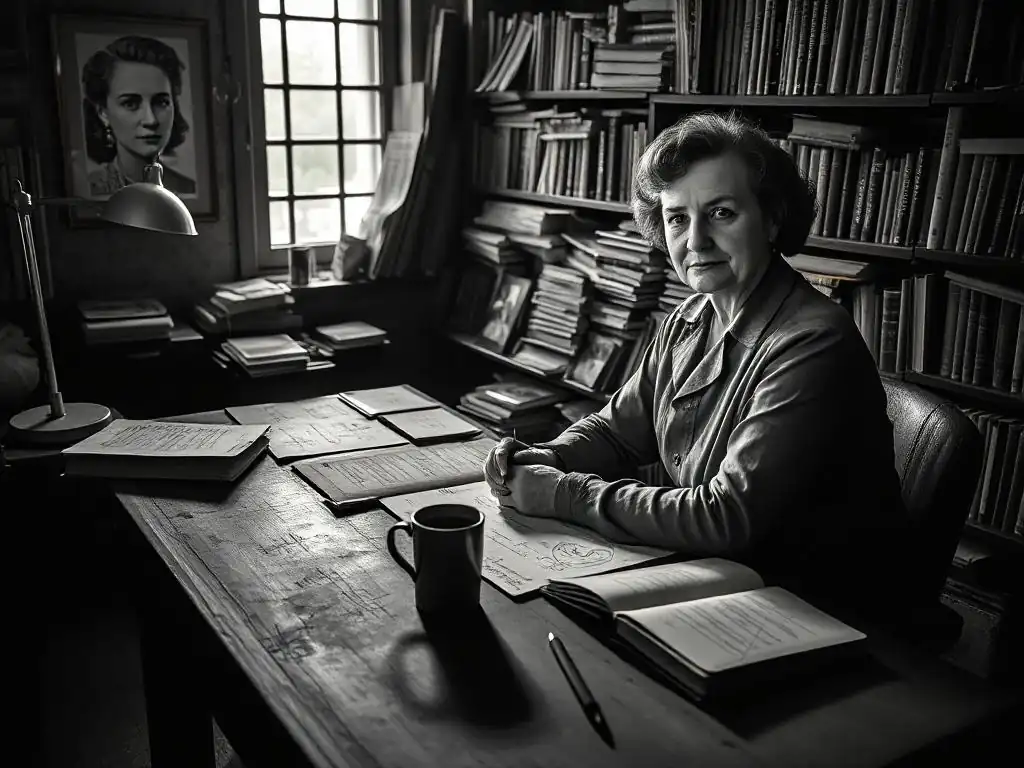
Welcome to WomenInScienceHistory.com!
Delve into the fascinating world of women who defied expectations and revolutionized science. Today, we spotlight Hilda Geiringer, a name that deserves to be celebrated alongside the greatest minds in applied mathematics. Discover the incredible journey of this true pioneer, from her early achievements in Vienna to her groundbreaking work shaping the field in the mid-20th century. What challenges did she overcome, and how did her resilience shape her extraordinary legacy? Join us as we uncover the story of a mathematical trailblazer.
- Introduction: Hilda Geiringer, a Trailblazer in Applied Mathematics
- Early Life and Education in Vienna (1893-1933)
- Overcoming Adversity: Exile and Academic Challenges
- Hilda Geiringer's Contributions to Applied Mathematics in the United States (1939-1950s)
-
Recognition and Legacy: Late Career and Enduring Impact
- Hilda Geiringer's Pursuit of Professorship and Academic Recognition
- Receiving a Professorship at the Freie Universität Berlin (After 1950s)
- The Enduring Legacy of Hilda Geiringer: Inspiring Future Generations of Women in Mathematics
- Hilda Geiringer's Influence on Modern Applied Mathematics and Statistics
- Conclusion: Hilda Geiringer, an Unsung Heroine of Applied Mathematics
- References and Further Reading
-
Frequently Asked Questions
- What were some of the major obstacles Hilda Geiringer faced as a woman in mathematics?
- What were Hilda Geiringer's key contributions to applied mathematics?
- How did Hilda Geiringer's early career in Vienna shape her later work?
- Where did Hilda Geiringer ultimately find a stable academic position?
- What is the significance of highlighting Hilda Geiringer's story within "Women in Science History"?
- Final Reflection: The Enduring Legacy of Mathematical Courage
- Discover Your Own Mathematical Journey
Introduction: Hilda Geiringer, a Trailblazer in Applied Mathematics
Hilda Geiringer stands as a monumental figure in the history of mathematics, her life story a testament to unyielding intellectual curiosity and remarkable resilience in the face of profound adversity. Born in Vienna, Austria, in 1893, Geiringer navigated a world often unwelcoming to women in scientific pursuits, yet she carved out a distinguished career, leaving an indelible mark on fields ranging from probability theory to plasticity.
Her journey from the academic halls of Central Europe to the United States highlights not only her personal fortitude but also the systemic challenges faced by many pioneering women in science during the tumultuous 20th century.
As a true Hilda Geiringer applied mathematics pioneer, her work bridged theoretical rigor with practical application, impacting areas critical to engineering, physics, and even biology. This article delves into the remarkable life and achievements of Geiringer, tracing her academic origins, her forced emigration due to the rise of Nazism, and her significant contributions that cemented her legacy as a leading applied mathematician. Her narrative is one of persistent dedication to knowledge, making her an inspiring figure for future generations.
Early Life and Education in Vienna (1893-1933)
Hilda Geiringer's Academic Beginnings: A Passion for Mathematics
Hilda Geiringer's intellectual journey began in Vienna, a vibrant center of scientific and cultural innovation at the turn of the 20th century. From an early age, she displayed an exceptional aptitude for mathematics, a field traditionally dominated by men. Despite societal expectations that often steered women away from rigorous academic disciplines, Geiringer's determination to pursue her passion was unwavering. Her enrollment in the University of Vienna marked the initial step of a groundbreaking career, setting her on a path that would see her become a prominent figure in applied mathematics.
Her early academic pursuits were characterized by a deep engagement with foundational mathematical concepts. She immersed herself in the demanding curriculum, demonstrating a keen understanding of complex theories and a remarkable ability to solve intricate problems. This foundational period in Vienna was crucial, providing her with the robust analytical skills and theoretical knowledge that would underpin her later, more specialized contributions to various branches of applied mathematics.
The University of Vienna: Doctoral Studies and Early Research
At the University of Vienna, Hilda Geiringer distinguished herself as a brilliant student. She pursued her doctoral studies under the renowned mathematician Wilhelm Wirtinger, a prominent figure in the field of function theory. Her dissertation, completed in 1917, focused on Fourier series, a topic requiring sophisticated analytical skills and a deep understanding of mathematical analysis. This early research showcased her capacity for rigorous mathematical inquiry and her ability to contribute to complex theoretical discussions.
Her doctoral work not only earned her the highest academic distinction but also established her as a promising young mathematician. The intellectual environment of Vienna, though challenging for a woman seeking an academic career, provided her with the foundational training necessary to embark on a path as a Hilda Geiringer applied mathematics pioneer. This period of intense study and early research laid the groundwork for her subsequent groundbreaking work in probability, statistics, and mechanics.
Geiringer's Contributions to Probability Theory and Mathematical Statistics in Vienna
While Hilda Geiringer's most extensive collaborative work in probability theory and mathematical statistics blossomed later in Berlin with Richard von Mises, her foundational understanding and initial conceptualizations in these fields were deeply rooted in her Viennese education. Her early studies at the University of Vienna provided her with a robust grasp of the analytical and theoretical underpinnings of these disciplines, which were then emerging as distinct and vital areas of mathematical inquiry. She developed a keen interest in the application of mathematical principles to real-world phenomena, foreshadowing her future role as a Hilda Geiringer applied mathematics pioneer.
This early exposure in Vienna equipped her with the essential tools to later contribute significantly to the frequency theory of probability, a cornerstone of modern statistical thought. Her analytical precision, honed during her doctoral studies, allowed her to approach statistical problems with a rigor that was critical for advancing the field. Though the bulk of her published contributions in these areas came after she left Vienna, it was the intellectual environment and rigorous training she received there that prepared her for the profound impact she would later have on the development of mathematical statistics.
Overcoming Adversity: Exile and Academic Challenges
The Rise of Nazism and Geiringer's Forced Emigration
The early 1930s brought a devastating turning point in Hilda Geiringer's life and career. As the Nazi regime gained power in Germany, their discriminatory policies systematically targeted Jewish academics and intellectuals, leading to widespread purges from universities and research institutions. Despite her distinguished career, including her habilitation in 1927 and her position as an extraordinary professor at the University of Berlin—a rare achievement for a woman at the time—Geiringer, being of Jewish heritage, was immediately affected. In 1933, she was summarily dismissed from her post, a cruel blow that abruptly ended her flourishing academic life in Germany.
This forced dismissal was not merely a professional setback but a profound personal upheaval, stripping her of her established intellectual community and the security of her academic position. The political climate made it clear that her life and work were no longer safe in Germany. This period of intense persecution compelled her to seek refuge elsewhere, initiating a tumultuous decade of displacement and uncertainty that would test her resilience to its limits.
Finding Refuge: From Brussels to Bryn Mawr College
Following her dismissal from the University of Berlin in 1933, Hilda Geiringer began a nomadic search for academic safety and continued intellectual engagement. Her first stop was Brussels, Belgium, where she secured a temporary research associate position at the Institute of Mechanics. However, the escalating political tensions across Europe meant that even this refuge was precarious. In 1934, she moved to Istanbul, Turkey, where she reunited with her former mentor and collaborator, Richard von Mises, at Istanbul University, finding a relatively stable environment for several years.
Despite the temporary stability in Turkey, Geiringer recognized the need for a more permanent and secure academic home. In 1939, as World War II loomed, she made the critical decision to emigrate to the United States. She eventually secured a position at Bryn Mawr College in Pennsylvania, initially as a lecturer in mathematics. This arduous journey, spanning multiple countries and continents, underscored her extraordinary resilience and unwavering commitment to her mathematical work, even in the face of profound personal and global crises.
Hilda Geiringer's Contributions to Applied Mathematics in the United States (1939-1950s)
Teaching and Research at Bryn Mawr: Overcoming Institutional Barriers
Upon her arrival in the United States, Hilda Geiringer began a new chapter in her academic career at Bryn Mawr College. While she found a haven from the persecution she faced in Europe, the American academic landscape presented its own set of challenges, particularly for women.
Despite her extensive experience, her habilitation, and her significant contributions to mathematics, she initially held a lecturer position, which typically offered less recognition and a lower salary compared to tenured male professors. This reflected the systemic gender biases prevalent in academia during the mid-20th century, even for a recognized Hilda Geiringer applied mathematics pioneer.
Nevertheless, Geiringer dedicated herself wholeheartedly to both teaching and research at Bryn Mawr. She taught a wide range of courses, from introductory calculus to advanced topics in probability and mechanics, inspiring a new generation of students. Concurrently, she maintained a prolific research output, continuing to publish important papers and advance her work in various branches of applied mathematics, demonstrating her unwavering commitment to her field despite the institutional hurdles.
Geiringer's Pioneering Work in Plasticity Theory
One of Hilda Geiringer's most significant contributions in the United States was her pioneering work in plasticity theory, a crucial branch of continuum mechanics. This field deals with the behavior of materials that undergo permanent deformation when subjected to external forces, a concept vital for engineering, metallurgy, and material science. Geiringer applied her profound mathematical rigor to develop sophisticated models that described how materials like metals deform and flow under stress beyond their elastic limit.
Her research provided fundamental insights into the mathematical formulation of plastic stress-strain relations, which are essential for designing structures and components that can withstand extreme conditions without fracturing. Her theoretical work on plasticity, particularly in the 1940s, significantly advanced the understanding of material failure and ductile behavior, cementing her reputation as a leading Hilda Geiringer applied mathematics pioneer whose work had direct practical applications in industry and defense.
Geiringer's Contribution to the Theory of Ideal Plasticity
Within the broader field of plasticity, Hilda Geiringer made particularly seminal contributions to the theory of ideal plasticity. This specific area focuses on materials that deform without hardening or softening under plastic flow, providing a simplified yet powerful mathematical model for complex material behavior. Geiringer developed rigorous mathematical frameworks, including a set of characteristic equations, to describe the stress and velocity fields within ideally plastic materials.
Her work provided a clear and concise mathematical description of plastic flow, which was crucial for solving practical problems in engineering design, such as analyzing the behavior of metals during forging, extrusion, or deep drawing processes. The "Geiringer equations" became a standard tool for engineers and material scientists seeking to predict and control the deformation of materials, further solidifying her status as a Hilda Geiringer applied mathematics pioneer whose theoretical insights had tangible real-world impact. Her precise formulations advanced the field significantly and remain foundational.
Statistical Applications: Geiringer's Contributions to Genetics

Beyond her work in mechanics, Hilda Geiringer also made substantial contributions to mathematical statistics, particularly through its application to genetics. Drawing on her deep expertise in probability theory, she recognized the potential of statistical methods to unravel the complexities of biological inheritance. Her work in this area involved developing mathematical models to analyze genetic data, predict hereditary patterns, and understand the probabilistic nature of gene transmission.
During the 1940s and 1950s, as the field of genetics was rapidly evolving, Geiringer's quantitative approach provided a much-needed rigorous framework. She explored how statistical distributions could describe the frequencies of genetic traits within populations and how probabilistic reasoning could explain the observed outcomes of breeding experiments. This interdisciplinary work showcased her versatility and her ability to apply sophisticated mathematical tools to diverse scientific problems, further establishing her as a versatile Hilda Geiringer applied mathematics pioneer.
Geiringer's Work on Mendelian Inheritance with Linkage
A specific and notable contribution by Hilda Geiringer in statistical genetics involved her work on Mendelian inheritance, particularly concerning the phenomenon of genetic linkage. While Gregor Mendel's laws described the independent assortment of traits, it was later discovered that genes located close together on the same chromosome tend to be inherited together, a concept known as linkage. Geiringer developed sophisticated mathematical models to quantify and analyze this linkage, moving beyond simple probabilistic calculations to more nuanced statistical descriptions.
Her research provided a rigorous mathematical framework for understanding how the recombination frequency between linked genes could be used to map their relative positions on chromosomes. This was a crucial step in the early development of genetic mapping and population genetics. By applying advanced statistical techniques to complex biological phenomena, Geiringer significantly advanced the quantitative understanding of heredity, demonstrating her unique capacity as a Hilda Geiringer applied mathematics pioneer to bridge theoretical mathematics with empirical biological observation.
Recognition and Legacy: Late Career and Enduring Impact
Hilda Geiringer's Pursuit of Professorship and Academic Recognition
Despite her prolific research output, her groundbreaking contributions, and her long tenure at Bryn Mawr College, Hilda Geiringer faced persistent challenges in securing a full professorship and commensurate academic recognition in the United States. For many years, she held adjunct or visiting positions at various institutions, including Wheaton College and Harvard University, where she continued her productive collaboration with Richard von Mises until his passing in 1953.
This continuous pursuit of stable, recognized academic employment highlighted the systemic barriers that often prevented highly qualified women from achieving the same status as their male counterparts, regardless of their intellectual prowess as a Hilda Geiringer applied mathematics pioneer.
Her struggle for full academic equity, despite her undeniable brilliance and extensive publication record, underscores the broader challenges faced by women in STEM fields during that era. It was only later in her career that she began to receive some of the recognition she so richly deserved, a testament to her enduring perseverance and the gradual, albeit slow, shifts in academic perceptions.
Receiving a Professorship at the Freie Universität Berlin (After 1950s)
In a poignant and somewhat ironic turn of events, Hilda Geiringer received an honorary professorship from the Freie Universität Berlin in 1956, the very city from which she had been forced to flee by the Nazi regime over two decades earlier. This gesture represented a significant, albeit belated, acknowledgment of her profound contributions to mathematics and an attempt to redress the historical injustice she endured. While she had established her life and career in the United States, this recognition from her former academic home was a powerful symbol of her enduring legacy and intellectual stature.
Geiringer returned to Berlin for a period, where she continued her mathematical work and engaged with the academic community that had once expelled her. This late-career recognition underscored the global impact of her work and the eventual triumph of scholarship over political persecution. It cemented her place not only as a Hilda Geiringer applied mathematics pioneer but also as a symbol of academic resilience.
The Enduring Legacy of Hilda Geiringer: Inspiring Future Generations of Women in Mathematics
Hilda Geiringer's legacy extends far beyond her specific mathematical theorems and applications. Her life story is a powerful narrative of perseverance, intellectual courage, and unwavering dedication to her passion, even in the face of immense personal and professional adversity. She stands as an inspiring figure for future generations of women in mathematics and other STEM fields, demonstrating that intellectual brilliance, combined with resilience, can overcome significant societal and institutional barriers.
Her journey from a pioneering student in Vienna to a distinguished scholar navigating exile and discrimination serves as a beacon for aspiring female scientists. Geiringer's ability to consistently produce groundbreaking research and maintain her intellectual vitality throughout a turbulent career offers a compelling example of how to thrive against the odds. Her story continues to motivate countless individuals to pursue their academic dreams, reminding them that the path of a Hilda Geiringer applied mathematics pioneer is often marked by both brilliance and tenacity.
Hilda Geiringer's Influence on Modern Applied Mathematics and Statistics
Hilda Geiringer's mathematical contributions have had a lasting and profound influence on modern applied mathematics and statistics. Her foundational work in plasticity theory, particularly her rigorous formulations for ideal plasticity, continues to be a cornerstone in continuum mechanics and material science. Engineers and researchers still refer to her characteristic equations for analyzing the deformation of materials, demonstrating the enduring relevance of her theoretical insights in practical applications.
Furthermore, her pioneering efforts in applying statistical methods to genetics laid crucial groundwork for the field of mathematical biology. Her work on Mendelian inheritance with linkage helped to establish quantitative approaches to genetic analysis, a field that has since blossomed with the advent of genomics and bioinformatics. Geiringer's ability to bridge disparate mathematical and scientific domains, combining theoretical rigor with practical utility, firmly establishes her as a Hilda Geiringer applied mathematics pioneer whose intellectual footprint continues to shape contemporary research and education.
Conclusion: Hilda Geiringer, an Unsung Heroine of Applied Mathematics
Hilda Geiringer’s life was a testament to extraordinary intellect and unwavering resilience. From her early academic triumphs in Vienna to her forced emigration and subsequent rebuilding of a distinguished career in the United States, she consistently pushed the boundaries of mathematical thought. Her pioneering contributions to probability theory, plasticity, and mathematical genetics not only advanced these fields significantly but also showcased her remarkable ability to apply rigorous mathematical principles to complex real-world problems.
Despite facing profound personal adversity and systemic gender bias throughout her career, Geiringer remained a prolific researcher and an inspiring educator. Her journey embodies the struggles and triumphs of many women in science history, highlighting the critical need to recognize and celebrate these often-unsung heroines. Hilda Geiringer stands as an enduring symbol of perseverance and a true Hilda Geiringer applied mathematics pioneer, whose legacy continues to enrich the scientific landscape and inspire future generations.
References and Further Reading
Frequently Asked Questions
What were some of the major obstacles Hilda Geiringer faced as a woman in mathematics?
Geiringer faced significant gender bias in academia, hindering her career advancement despite her expertise. She experienced discrimination in securing permanent positions and recognition for her work. This resulted in underemployment and limited opportunities.
What were Hilda Geiringer's key contributions to applied mathematics?
Geiringer made significant contributions to probability theory, mathematical statistics, and plasticity theory. Her work on the statistical analysis of textile structures is also particularly noteworthy.
How did Hilda Geiringer's early career in Vienna shape her later work?
Her early work in Vienna, particularly at the Institute for Applied Mathematics, provided a strong foundation in mathematical methods and real-world applications. This experience greatly influenced her later research and teaching.
Where did Hilda Geiringer ultimately find a stable academic position?
After facing difficulties in Europe, Geiringer eventually found a more stable, although still precarious, academic position at Wheaton College in the United States. She was later a visiting professor at various institutions.
What is the significance of highlighting Hilda Geiringer's story within "Women in Science History"?
Highlighting Geiringer's story helps to address the historical underrepresentation of women in STEM fields. It also serves as an inspiration for future generations of female scientists and mathematicians by showcasing her resilience and achievements.
Final Reflection: The Enduring Legacy of Mathematical Courage
The story of Hilda Geiringer, as we've explored, isn't just a historical account; it's a powerful reminder of the unyielding spirit of innovation in the face of adversity. Her journey from Vienna to becoming an applied mathematics pioneer resonates deeply today, as we continue to grapple with issues of gender equality and the recognition of marginalized voices in STEM fields. Her contributions, often overlooked, serve as a crucial foundation for modern statistical methods and applied mathematics.
The impact of Geiringer's work extends far beyond the academic realm. Her perseverance in the face of professional setbacks and personal tragedy underscores the importance of resilience, not just in mathematics, but in all aspects of life. It reminds us that true progress often requires challenging established norms and fighting for recognition. The essence of mathematics lies in its freedom.
This quote, though attributed to Georg Cantor, perfectly encapsulates the spirit with which Geiringer approached her work, refusing to be confined by societal expectations or academic prejudice.
As we conclude this exploration of Hilda Geiringer's life and work, I invite you to consider the lessons she offers. How can we, in our own lives, champion the underrepresented and foster a more inclusive environment for innovation? Let us strive to emulate her courage, her dedication, and her unwavering belief in the power of mathematics to shape a better future for all. Let Hilda Geiringer's story inspire you to be a pioneer in your own right, pushing boundaries and making a lasting impact on the world.
Discover Your Own Mathematical Journey
Thank you for exploring Hilda Geiringer's inspiring story of resilience and mathematical brilliance. Now, take the next step and make her dedication your motivation!
Here are a few ways to continue your exploration of mathematics and Geiringer's legacy:
- Dive deeper: Research one specific contribution of Hilda Geiringer, such as her work on plasticity or genetics, and present your findings to a friend or family member.
- Explore resources available on websites dedicated to women in STEM.
- Share this article with someone you know who might be inspired by Geiringer's perseverance and groundbreaking contributions!
What aspect of Geiringer's life and work resonates most with you, and how can you apply that to your own challenges?