
The Ghost in the Operating System: Her Ethereal Influence on Modern Tech

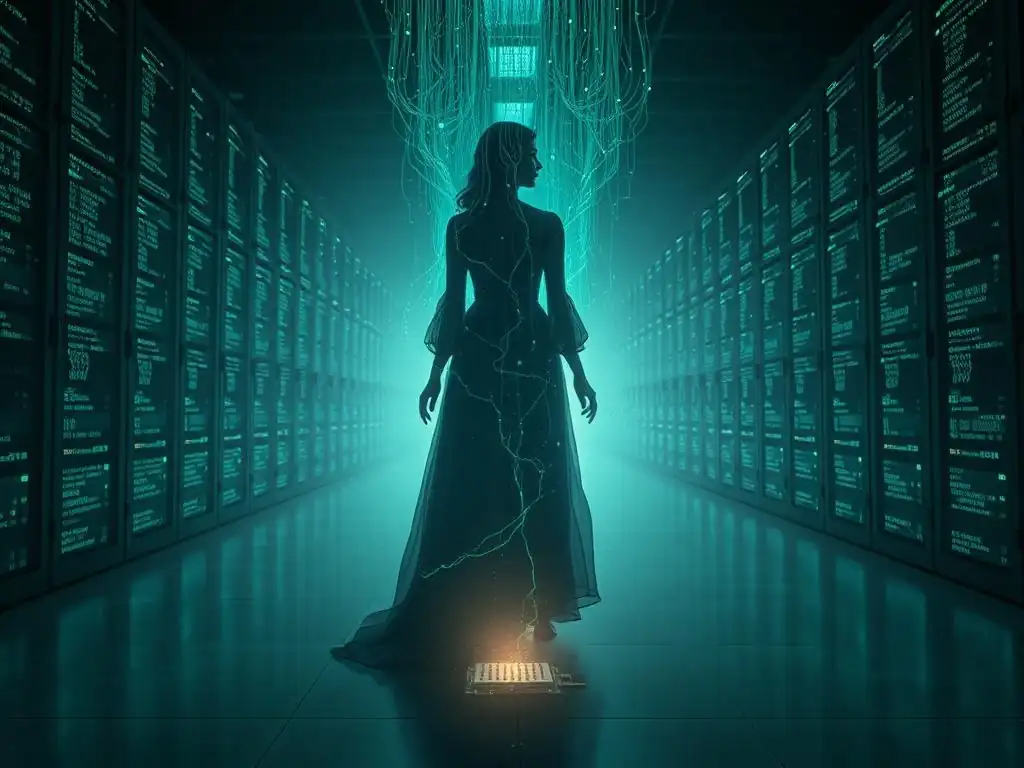
Welcome to WomenInScienceHistory.com!
Dive into the captivating world where groundbreaking discoveries meet untold stories. Ever wondered about the ghost in your operating system, the ethereal influence shaping the digital landscape we navigate daily? Explore Ada Lovelace’s programming legacy and uncover the remarkable journey of this visionary pioneer. Her story, like so many others we share, is one of brilliance, resilience, and enduring impact. Ready to unravel the secrets behind her enduring influence?
- The Ghost in the Operating System: Her Ethereal Influence on Modern Tech - Ada Lovelace’s Programming Legacy
- Introduction: Unveiling Ada Lovelace, the Visionary of Code
- Ada Lovelace: A Biographical Overview of a Computing Pioneer
- Ada Lovelace's Programming Legacy: The Analytical Engine and the First Algorithm
- Ada Lovelace's Vision: Transcending Mechanical Calculation
- Ada Lovelace's Impact on Modern Technology: A Lasting Influence
- Overcoming Obstacles: Ada Lovelace's Challenges in a Male-Dominated Era
- Ada Lovelace: A Symbol of Innovation and Female Empowerment in STEM
- Conclusion: Ada Lovelace's Enduring Influence on the Digital World
-
Frequently Asked Questions
- What is Ada Lovelace primarily known for in the history of science?
- What were some of the significant challenges that Ada Lovelace faced during her lifetime?
- How does "WomenInScienceHistory.com" aim to contribute to the understanding of women in science?
- Beyond her notes, what was Ada Lovelace's vision for the potential of computing machines?
- Why is Ada Lovelace's work relevant to understanding modern technology?
- Final Reflection: Echoes of Innovation
- Unveil Her Legacy: Become a Digital Pioneer!
The Ghost in the Operating System: Her Ethereal Influence on Modern Tech - Ada Lovelace’s Programming Legacy
Introduction: Unveiling Ada Lovelace, the Visionary of Code
Women in Computer Science History: Remembering Ada Lovelace
In the annals of scientific endeavor, countless women have made profound contributions, yet their stories often remain obscured by historical oversight. Among these pioneering figures, Ada Lovelace stands as a towering intellect whose insights into the potential of computing were centuries ahead of her time.
Her groundbreaking work, particularly her visionary "Notes" on Charles Babbage's Analytical Engine, firmly establishes Ada Lovelace’s programming legacy as foundational to the digital age we inhabit. Remembering her is not merely an act of historical correction but a crucial step in understanding the true origins of computer science and recognizing the pivotal role women played from its very inception.
Her narrative challenges the conventional, often male-centric, history of technology, demonstrating that women were not just passive observers but active architects of the future. By illuminating Ada Lovelace’s contributions, we not only pay homage to a remarkable individual but also inspire current and future generations of women to pursue careers in STEM, acknowledging that innovation knows no gender.
Setting the Stage: The Dawn of Computing and Ada's Unique Perspective
The early 19th century was a period of burgeoning industrial revolution and scientific inquiry, yet the concept of a programmable machine was largely confined to theoretical discussions and rudimentary mechanical devices. It was within this intellectual crucible that Charles Babbage conceived his Analytical Engine, a theoretical marvel intended to perform complex calculations far beyond human capability. However, Babbage, despite his genius, primarily envisioned his machine as a powerful calculator.
It was Ada Lovelace, with her unique blend of mathematical rigor and poetic imagination, who grasped the machine's deeper, more abstract potential. Born Augusta Ada Byron, the only legitimate child of Lord Byron, she was deliberately steered towards mathematics and science by her mother, Annabella Milbanke, herself an accomplished mathematician.
This upbringing provided Ada with a singular perspective, enabling her to transcend the purely numerical and foresee the Analytical Engine as a manipulator of symbols, capable of tasks far beyond arithmetic. Her unique vantage point allowed her to conceptualize the very essence of what we now call software, distinguishing it from mere hardware.
Ada Lovelace: A Biographical Overview of a Computing Pioneer
Early Life and Education: Nurturing a Mathematical Mind
Born on December 10, 1815, Augusta Ada Byron's early life was significantly shaped by her mother, Annabella Milbanke, who, having been abandoned by Lord Byron shortly after Ada's birth, was determined to prevent her daughter from inheriting her father's perceived poetic "madness." Annabella ensured Ada received a rigorous education heavily focused on mathematics and science, a highly unusual curriculum for a young noblewoman of that era. This deliberate cultivation of her analytical abilities proved instrumental in shaping Ada's future.
Her tutors included esteemed scholars such as Mary Somerville, a prominent Scottish scientist and polymath, who recognized Ada's exceptional mathematical aptitude and became a lifelong mentor. Another key figure was Augustus De Morgan, the first professor of mathematics at University College London, who, in letters to Annabella, described Ada's potential as "quite extraordinary, perhaps even unique" and noted her "powerful and original mind." These early influences nurtured a truly prodigious intellect, laying the groundwork for Ada Lovelace’s programming legacy.
Collaboration with Charles Babbage: The Analytical Engine and Beyond
Ada Lovelace's intellectual journey took a decisive turn in 1833 when, at the age of 17, she was introduced to Charles Babbage at a party. Babbage, a renowned mathematician and inventor, had already conceptualized his Difference Engine, a specialized mechanical calculator. However, it was his more ambitious, yet unfinished, Analytical Engine that truly captivated Lovelace. This machine was designed to be a general-purpose computing device, capable of carrying out any calculation or logical operation if properly programmed.
Their collaboration was not merely one of Babbage presenting his machine and Lovelace observing; it was a deep intellectual partnership. Lovelace possessed an uncanny ability to grasp the abstract principles of the Analytical Engine, seeing beyond its mechanical gears and levers to its potential as a universal symbol manipulator. Babbage himself referred to her as "the Enchantress of Numbers" and acknowledged her profound insights, recognizing that her understanding of the machine's capabilities surpassed his own in certain crucial aspects. This profound intellectual synergy laid the foundation for Ada Lovelace’s programming legacy, a legacy built on foresight and deep comprehension.
Ada Lovelace's Programming Legacy: The Analytical Engine and the First Algorithm
Understanding the Analytical Engine: Babbage's Dream and Lovelace's Insight
Charles Babbage's Analytical Engine, conceived in the 1830s, was a monumental leap in the history of computing, predating electronic computers by over a century. Unlike his Difference Engine, which was designed for specific mathematical calculations, the Analytical Engine was envisioned as a general-purpose machine.
It featured an "arithmetic mill" for calculations, a "store" for memory, and mechanisms for input and output, including punch cards, similar to the Jacquard loom. While Babbage himself was consumed by the mechanical design and the immediate practical applications of his machine, Ada Lovelace's genius lay in her ability to transcend this mechanical perspective and understand its broader, theoretical implications.
She recognized that the machine was not merely a number-crunching device but a symbolic manipulator capable of following a sequence of instructions. This crucial insight differentiated her understanding from Babbage's, who, for all his brilliance in engineering, primarily focused on the machine's capacity for complex arithmetic operations. Lovelace saw the potential for the machine to execute a series of operations, not just individual calculations, which is the very essence of what we now call a program.
The Notes: Ada Lovelace's Groundbreaking Contribution
Ada Lovelace's most significant contribution to computing history came in 1843 when she translated an article by Italian mathematician Luigi Federico Menabrea titled "Notions sur la machine analytique de Charles Babbage." However, her translation was accompanied by her own extensive annotations, nearly three times the length of the original article, published as "Notes by the Translator." These "Notes," signed with her initials A.A.L., are where Ada Lovelace’s programming legacy truly comes to light. They were not just explanatory; they were revolutionary.
Within these Notes, Lovelace elaborated on the Analytical Engine's capabilities, detailing how it could go beyond simple arithmetic to perform complex sequences of operations. She envisioned the machine as capable of handling not just numbers but any symbolic data, including musical notation or logical propositions, if encoded appropriately. This foresight, articulated in her Notes, was a crucial step towards the concept of general-purpose computing and the development of software as distinct from hardware.
Defining the Algorithm: Ada's Sequence for Calculating Bernoulli Numbers
Within her "Notes," specifically in Note G, Ada Lovelace meticulously detailed a step-by-step sequence of operations for the Analytical Engine to calculate Bernoulli numbers. This detailed plan is widely recognized as the world's first computer algorithm. It described how the machine would cycle through a series of instructions, using variables and conditional statements, to arrive at the desired result. This was not merely a mathematical formula but a logical sequence of operations designed for a mechanical processor.
Her algorithm demonstrated concepts such as looping (repeating a series of instructions) and subroutines (a sequence of instructions that can be called upon multiple times), which are fundamental to modern programming. By laying out this precise, executable procedure, Ada Lovelace’s programming legacy was firmly established. She moved beyond the theoretical potential of the machine to illustrate how it could be practically programmed to perform a specific, complex task, thereby defining the very essence of an algorithm.
Ada Lovelace's Vision: Transcending Mechanical Calculation
Beyond Numbers: Ada's Conceptualization of General-Purpose Computing
Ada Lovelace's genius extended far beyond the immediate mechanical capabilities of Charles Babbage's Analytical Engine. While Babbage saw his machine primarily as a powerful calculator, Lovelace envisioned its potential to manipulate symbols beyond mere numerical quantities.
She famously stated that the Engine "might act upon things other than number, were objects found whose mutual fundamental relations could be expressed by those of the abstract science of operations, and which should be also susceptible of adaptations to the action of the operating notation and mechanism of the engine." This profound statement reveals her understanding that the machine could process any form of data, not just arithmetic values.
She speculated that the Analytical Engine could compose elaborate musical pieces, create intricate graphics, or even be used for scientific modeling if the relationships between these elements could be translated into an algorithmic form. This conceptual leap—from a calculator to a general-purpose symbol manipulator—was a radical departure for her era and forms a cornerstone of Ada Lovelace’s programming legacy, anticipating the vast applications of computing we see today.
Ada Lovelace's Prescient Vision: Anticipating Modern Software
Lovelace's "Notes" are replete with insights that uncannily foreshadow modern software development. She clearly distinguished between the "operating notation and mechanism" (hardware) and the "abstract science of operations" (software), understanding that the machine's true power lay in its ability to execute flexible, changeable instructions rather than being hard-wired for a single purpose. This conceptual separation is fundamental to all modern computing, where software defines the functionality of versatile hardware.
Her ideas about the Analytical Engine's ability to "weave algebraic patterns" and "perform the most complex and intricate calculations" without human intervention provided an early conceptual framework for automation and artificial intelligence. Ada Lovelace’s programming legacy includes this remarkable foresight, recognizing that a machine could be programmed to exhibit intelligence and creativity, a notion that would not be seriously explored for another century.
The Implications of Ada Lovelace's Vision for Future Technology
The implications of Ada Lovelace's visionary insights for future technology are immense, even if their direct influence was not immediately recognized. Her conceptual framework, detailed in her 1843 "Notes," provided the philosophical underpinning for what would eventually become the field of computer science. She articulated the idea of a machine capable of carrying out a sequence of operations that could be changed and adapted, forming the very basis of programmable computing.
While the Analytical Engine was never fully built in her lifetime, Lovelace's detailed explanations and visionary projections laid a theoretical groundwork for subsequent innovators. Her emphasis on the machine's potential for symbolic manipulation, rather than just numerical processing, opened up avenues for understanding computing as a tool for logic, art, and even scientific discovery. This intellectual leap, forming a core part of Ada Lovelace’s programming legacy, provided a conceptual blueprint that would guide the development of the digital age, even if its true impact was only fully appreciated decades after her passing.
Ada Lovelace's Impact on Modern Technology: A Lasting Influence

Ada Lovelace's Programming Legacy in Modern Languages: A Direct Lineage?
While there isn't a direct line of code from Ada Lovelace's 1843 algorithm to contemporary programming languages like Python or Java, her conceptual contributions form an undeniable, albeit foundational, part of Ada Lovelace’s programming legacy. Modern programming relies entirely on the principles she first articulated: the idea of a sequence of instructions (an algorithm) that a machine can follow, the distinction between the machine itself and the instructions it executes (hardware vs. software), and the notion that a machine can manipulate symbols beyond just numbers.
Every time a developer writes a loop, defines a variable, or structures a program into logical steps, they are, in essence, applying the abstract principles that Lovelace first conceptualized. Her work provided the philosophical and logical framework upon which all subsequent programming paradigms were built, even if the practical implementation awaited the advent of electronic components.
The Ada Programming Language: A Tribute to Ada Lovelace's Vision
Perhaps the most explicit and enduring tribute to Ada Lovelace’s programming legacy is the "Ada" programming language. Developed in the late 1970s by a team led by Jean Ichbiah at CII Honeywell Bull, and standardized by the U.S. Department of Defense in 1983, Ada was designed to be a robust, high-level, general-purpose language suitable for large-scale, mission-critical systems. Its features, such as strong typing, concurrency support, and extensive error handling, were specifically engineered for applications requiring high reliability and safety.
The choice to name the language "Ada" was a direct acknowledgment of Lovelace's foundational contributions to computer science and her visionary insights into algorithms and programming. It is still widely used today in sectors where reliability is paramount, including aerospace (e.g., in avionics for commercial aircraft like the Boeing 777), railway systems, and military applications, ensuring that Ada Lovelace's name remains synonymous with cutting-edge, dependable technology.
Ada Lovelace's Influence on Software Engineering Principles
Ada Lovelace's visionary understanding of programming extended to principles that are now cornerstones of software engineering. Her detailed breakdown of the Bernoulli number algorithm, with its iterative steps and logical flow, exemplifies the structured approach to problem-solving that is essential in software development. She understood the importance of breaking down complex tasks into smaller, manageable units, a concept now known as modularity, which is crucial for creating maintainable and scalable software systems.
Furthermore, her emphasis on the abstract nature of operations, distinct from the physical machinery, laid the conceptual groundwork for high-level programming and the entire field of software design. The very notion that a program could be designed, debugged, and improved independently of the hardware it runs on owes a debt to her initial insights. Thus, Ada Lovelace’s programming legacy encompasses not just the first algorithm, but also the fundamental principles that underpin modern software engineering practices, ensuring her ethereal influence permeates every line of code written today.
Overcoming Obstacles: Ada Lovelace's Challenges in a Male-Dominated Era
Ada Lovelace pursued her intellectual passions in a 19th-century society that offered very limited opportunities for women, particularly in the male-dominated fields of science and mathematics. Women were largely confined to domestic roles, and formal education beyond basic literacy was rare, let alone advanced scientific training. Despite her aristocratic background, Lovelace faced an uphill battle for serious intellectual recognition. Her "Notes" were published under her initials, "A.A.L.," a common practice for women seeking to have their scientific work taken seriously without the immediate prejudice of their gender.
Her health, often fragile, further compounded these societal barriers, as did the prevailing attitudes that viewed intense intellectual pursuits as potentially detrimental to a woman's delicate constitution. The struggle to gain acceptance and publish her work, even with the support of Charles Babbage, highlights the immense personal and professional obstacles she had to navigate merely to make her groundbreaking contributions.
Recognition and Rediscovery: The Delayed Acknowledgment of Ada Lovelace's Genius
Despite the profound insights contained within her "Notes," Ada Lovelace's work remained largely obscure for nearly a century after her death in 1852. The Analytical Engine itself was never fully built during her lifetime, and the world was not yet ready for the concepts she articulated. Her contributions were overshadowed by the lack of tangible hardware and the prevailing scientific climate that often overlooked the theoretical and abstract.
It wasn't until the mid-20th century, with the advent of electronic computers, that her work was rediscovered and its true significance began to be appreciated. Key figures like B.V. Bowden, who republished her "Notes" in 1953, and others in the nascent field of computer science, recognized the astonishing foresight in Ada Lovelace’s programming legacy. This rediscovery cemented her place as the first programmer and a visionary whose ideas predated the practical realization of computing by decades, finally granting her the posthumous recognition she deserved.
Ada Lovelace: A Symbol of Innovation and Female Empowerment in STEM
Inspiring Future Generations of Women in Computer Science
Ada Lovelace's story transcends her technical contributions; she has become a powerful symbol for women in STEM (Science, Technology, Engineering, and Mathematics). Her narrative, of a woman defying societal norms to pursue her intellectual curiosity and make groundbreaking discoveries, serves as an immense source of inspiration. In fields where women are still underrepresented, particularly in computer science and engineering, Lovelace stands as a historical beacon demonstrating that innovative thinking and technical prowess are not gender-specific.
Her legacy encourages young women to pursue careers in technology, reminding them that they belong in these fields and can make significant impacts. Initiatives like "Ada Lovelace Day," celebrated annually on the second Tuesday of October, specifically aim to raise the profile of women in STEM and create new role models, directly channeling the spirit of Ada Lovelace’s programming legacy to empower future generations.
Ada Lovelace’s Programming Legacy: Celebrating a Computing Pioneer
The celebration of Ada Lovelace’s programming legacy is an ongoing and essential endeavor. Her conceptualization of the algorithm and her visionary understanding of the Analytical Engine's potential beyond mere arithmetic laid the intellectual groundwork for the entire digital age. She was not just a translator or an assistant; she was a co-creator of the very idea of software, distinguishing it from the physical machinery.
Acknowledging her as the world's first computer programmer is not merely a historical footnote but a recognition of her profound intellectual contribution and her role in shaping the trajectory of technology. By celebrating Ada Lovelace, we affirm the importance of diverse perspectives in scientific innovation and ensure that the foundational role of women in computer science is accurately and prominently featured in the historical record, inspiring continued progress and inclusivity in the tech world.
Conclusion: Ada Lovelace's Enduring Influence on the Digital World
The Ethereal Influence: Ada Lovelace's Continuing Relevance
Ada Lovelace's influence on the digital world is a testament to the enduring power of abstract thought and conceptual foresight. Though she lived in an era devoid of electronic computers, her "Notes" articulated principles that are fundamental to every piece of software and every digital interaction today. She was the "ghost in the operating system," a visionary whose ideas about algorithms, symbolic manipulation, and general-purpose computing permeated the theoretical foundations of computer science long before the hardware to realize them existed.
Her ability to see beyond the mechanical gears of Babbage's machine to its potential as a universal processor of information highlights her unique intellectual genius. Ada Lovelace’s programming legacy is not just a historical curiosity; it is a vibrant, continuing relevance that underpins the very architecture of our modern digital ecosystems, from artificial intelligence to data analytics.
Continuing the Legacy: Encouraging Women in Computer Science Today
The story of Ada Lovelace is a powerful reminder that diversity in scientific and technological fields is not just equitable, but essential for innovation. Her challenges and triumphs in a male-dominated 19th-century world resonate strongly with ongoing efforts to encourage and support women in computer science and STEM today. By continuing to highlight Ada Lovelace’s programming legacy, we inspire new generations of female technologists, programmers, and innovators.
Ensuring that women have equal access to education, mentorship, and opportunities in tech is crucial for building a more inclusive and innovative future. Just as Lovelace pushed the boundaries of what was thought possible with machines, today's women in computer science are driving advancements in AI, cybersecurity, data science, and more. Her legacy serves as a perpetual call to action: to foster environments where talent, regardless of gender, can flourish and contribute to the next great leaps in human progress.
Frequently Asked Questions
What is Ada Lovelace primarily known for in the history of science?
Ada Lovelace is primarily known for her notes on Charles Babbage's Analytical Engine, particularly her algorithm intended to be processed by a machine, making her considered by some to be the first computer programmer. She recognized the machine's potential beyond simple calculations.
What were some of the significant challenges that Ada Lovelace faced during her lifetime?
As a woman in the 19th century, Ada Lovelace faced social barriers and limited educational opportunities compared to her male counterparts. She had to navigate a male-dominated scientific landscape to pursue her intellectual interests.
How does "WomenInScienceHistory.com" aim to contribute to the understanding of women in science?
The website focuses on highlighting the overlooked contributions of women to various scientific fields throughout history. It aims to inspire future generations by showcasing the stories and accomplishments of pioneering female scientists.
Beyond her notes, what was Ada Lovelace's vision for the potential of computing machines?
Lovelace envisioned the Analytical Engine as being capable of far more than just calculations; she saw its potential for creating complex and creative outputs, including music and graphics. This demonstrates her understanding of general-purpose computing.
Why is Ada Lovelace's work relevant to understanding modern technology?
Ada Lovelace's insights into the potential of machines to manipulate symbols and create complex outputs laid the groundwork for modern programming concepts. Her work serves as an early example of computational thinking and its applications.
Final Reflection: Echoes of Innovation
Ada Lovelace's programming legacy isn't just a historical footnote; it's the foundational blueprint upon which our digital world is built. Her prescient vision of the Analytical Engine's potential, far beyond mere calculation, resonates powerfully today as we grapple with the complex ethical and creative possibilities of artificial intelligence.
The impact of Lovelace's insights continues to shape our understanding of technology, reminding us that innovation isn't solely about code, but also about imagination and foresight. Her story serves as a constant reminder that true progress lies in embracing both the technical and the humanistic aspects of our creations. That the engine might compose elaborate pieces of music of any degree of complexity or extent.
This quote encapsulates her revolutionary thinking, a vision that transcends the limitations of her time and continues to inspire us today.
Let us all take a moment to reflect on the profound influence of Ada Lovelace and strive to emulate her spirit of inquiry and innovation. Consider how you can contribute to a future where technology serves not just our needs, but also our highest aspirations. Let her legacy be a beacon, guiding us toward a more imaginative and ethically conscious digital landscape.
Unveil Her Legacy: Become a Digital Pioneer!
Thank you for delving into the inspiring story of Ada Lovelace and her profound impact on modern technology. Now, it's your turn to carry her torch!
Here's how you can keep Ada's spirit alive:
- Dive Deeper: Start a personal coding project inspired by Ada's vision of creative computing!
- Share this article on social media and help us bring her legacy into the spotlight.
- Research another forgotten woman in STEM and write a short blog post on WomenInScienceHistory.com!
How will you channel Ada's innovative spirit to shape the future of technology?