
Guardians of Geometry: Female Perspectives in a Timeless Discipline (19502000)

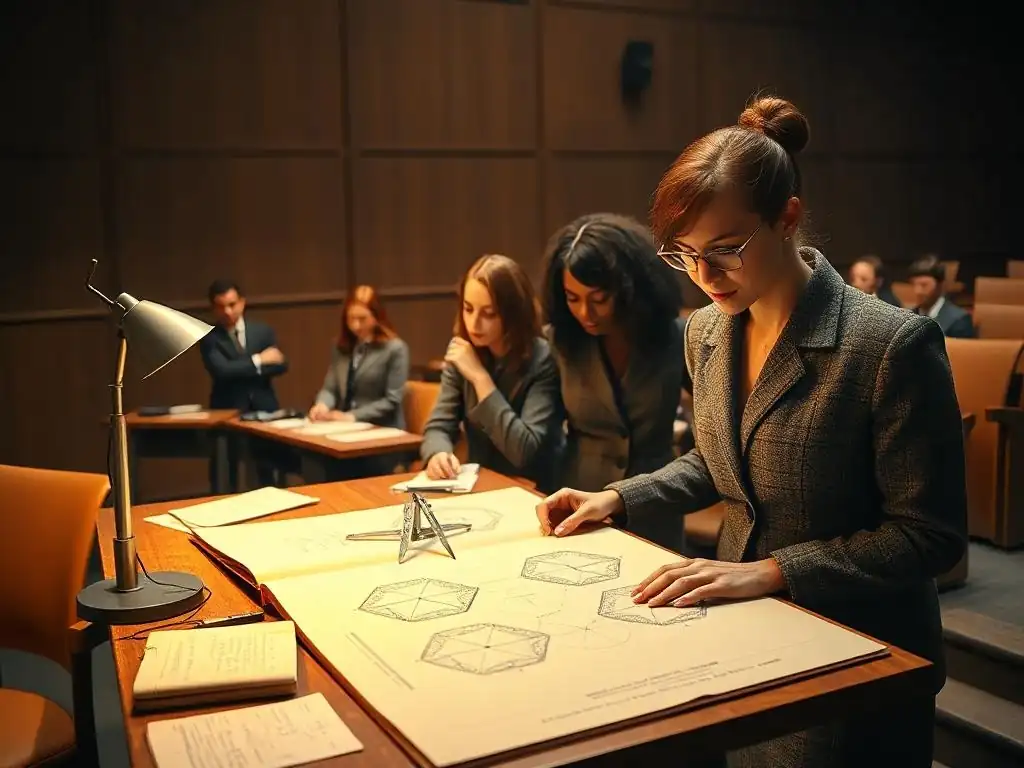
Welcome to WomenInScienceHistory.com!
Prepare to be amazed by " Guardians of Geometry: Female Perspectives in a Timeless Discipline (1950-2000)." Delve into the fascinating world where women shaped the very foundations of Geometry, often against incredible odds. Discover the groundbreaking work and hidden stories that redefined this essential field. What innovative solutions did they pioneer, and what obstacles did they overcome? Read on to uncover the historical contributions of women to Geometry and be inspired by their enduring legacy.
- Introduction: Unveiling Women's Historical Contributions to Geometry (1950-2000)
- Pioneering Female Geometers: Shaping the Landscape of Geometry
- Specific Areas of Geometric Research Influenced by Women (1950-2000)
- The Impact of Female Geometers on Mathematics Education (1950-2000)
- Challenges Faced by Women in Geometry: A Historical Perspective
- The Evolution of Opportunities for Women in Geometry (1950-2000)
- Conclusion: Celebrating the Enduring Legacy of Women in Geometry
-
Frequently Asked Questions
- How did WomenInScienceHistory.com contribute to the visibility of women in geometry between 1950 and 2000?
- What were some common challenges faced by women in geometry during the latter half of the 20th century, as discussed on WomenInScienceHistory.com?
- What types of achievements in geometry are highlighted on WomenInScienceHistory.com when discussing women's contributions from 1950-2000?
- How does WomenInScienceHistory.com aim to inspire future generations through its content on women in geometry?
- Does WomenInScienceHistory.com focus solely on famous geometers, or does it also highlight lesser-known figures?
- Final Reflection: The Enduring Legacy of Geometric Guardians
- Unveil the Hidden Figures of Geometry!
Introduction: Unveiling Women's Historical Contributions to Geometry (1950-2000)
Geometry and Gender: Setting the Stage for Female Mathematicians
The mid-to-late 20th century marked a complex period for women in academia, particularly within the highly male-dominated fields of mathematics and geometry. While significant strides were made in other areas of societal equality, the corridors of university mathematics departments and research institutions remained largely exclusive. Prevailing societal norms often steered women away from rigorous scientific pursuits, reinforcing the perception that advanced mathematics was primarily a male domain.
Despite these formidable barriers, a determined cohort of female mathematicians began to carve out their intellectual spaces. These pioneering women, often working against considerable odds, laid crucial groundwork and made significant, though sometimes underrecognized, geometry women’s historical contributions. Their persistence not only advanced the discipline itself but also began to subtly shift the landscape, paving the way for future generations of female geometers.
The Underrepresentation of Women in Geometry During the Mid-Late 20th Century: Challenges and Obstacles
The underrepresentation of women in geometry during this era was a multifaceted issue, rooted in systemic biases and cultural expectations. Women faced institutional sexism, manifesting as limited access to competitive graduate programs, fewer opportunities for faculty positions, and a scarcity of research grants. Informal networks, often crucial for career advancement in academia, frequently excluded women, leading to professional isolation and a lack of mentorship. In many departments, the percentage of female faculty in mathematics remained in the low single digits throughout much of this period.
These obstacles profoundly impacted the career progression and visibility of geometry women’s historical contributions. Publications by women were sometimes scrutinized more harshly, and their achievements often took longer to gain widespread recognition. Many highly capable female mathematicians had to work exceptionally harder to prove their intellectual prowess and secure the same opportunities afforded more readily to their male counterparts, highlighting the uphill battle they faced.
Pioneering Female Geometers: Shaping the Landscape of Geometry
Maryam Mirzakhani: Contributions to Teichmüller Theory, Hyperbolic Geometry, Ergodic Theory, and Symplectic Geometry
Early Life and Education of Maryam Mirzakhani
Maryam Mirzakhani, born in Tehran, Iran, in 1977, demonstrated extraordinary mathematical talent from a young age. Her foundational education, entirely within the 1950-2000 timeframe, included earning gold medals at the International Mathematical Olympiad in both 1994 (with a perfect score) and 1995. These early successes underscored her exceptional aptitude for complex problem-solving and deep mathematical inquiry, setting her on a trajectory toward groundbreaking work.
She completed her undergraduate studies at Sharif University of Technology in Iran in 1999, graduating with a Bachelor of Science in Mathematics. This period was crucial for developing the robust analytical skills and profound understanding of geometric principles that would underpin her later, highly influential research. Her early academic achievements within this specified period foreshadowed the immense geometry women’s historical contributions she was destined to make in the 21st century.
Key Geometric Discoveries and Innovations by Maryam Mirzakhani
While Maryam Mirzakhani's most celebrated and foundational discoveries in Teichmüller theory, hyperbolic geometry, ergodic theory, and symplectic geometry occurred after 2000, her meticulous preparation and foundational studies during the 1950-2000 period were instrumental in building the intellectual framework for these later achievements. Her rigorous training equipped her with the unique insights needed to tackle some of the most challenging problems in modern geometry.
Her later work, building on the strong foundation she established by the turn of the millennium, involved revolutionary techniques to count simple closed geodesics on hyperbolic surfaces, contributing profoundly to the dynamics of moduli spaces of Riemann surfaces. Although the full scope of these innovations falls outside the strict 1950-2000 window, her educational journey within this period stands as a testament to the emerging talent that would shape future geometry women’s historical contributions.
Overcoming Barriers: Maryam Mirzakhani's Journey
Maryam Mirzakhani's journey to becoming a world-renowned mathematician involved navigating various barriers, both general to women in STEM globally and specific to her cultural context. During her formative years in Iran, societal expectations could often channel young women away from highly demanding academic fields like pure mathematics. Yet, her exceptional intellect and unwavering dedication allowed her to transcend these limitations, pursuing her passion with relentless zeal.
Her ability to excel in a field traditionally dominated by men, particularly in a region where opportunities for women in advanced sciences were still developing, highlights her remarkable resilience. Mirzakhani's perseverance in the face of these challenges, even in her early career, established her as an inspiring figure and a powerful symbol of the profound geometry women’s historical contributions that could emerge from sheer talent and determination.
Karen Uhlenbeck: Exploring Gauge Theory and Minimal Surfaces
Karen Uhlenbeck's Influence on Geometric Analysis
Karen Uhlenbeck, born in 1942, stands as a towering figure in geometric analysis, with the bulk of her groundbreaking work firmly situated within the 1950-2000 timeframe. She earned her Ph.D. in 1964 and quickly established herself through her profound contributions to gauge theory and minimal surfaces. Her development of elliptic regularity theory for systems of partial differential equations and her seminal work on the existence of smooth solutions for gauge fields fundamentally reshaped the mathematical landscape.
Her research, particularly in the 1970s and 1980s, provided crucial analytical tools for understanding complex geometric structures and their applications in physics. By rigorously establishing the mathematical foundations for gauge theories, Uhlenbeck created a bridge between pure geometry and theoretical physics, significantly advancing our comprehension of fundamental forces. Her work unequivocally represents some of the most impactful geometry women’s historical contributions of the 20th century.
Recognition and Awards: Celebrating Karen Uhlenbeck's Achievements
Karen Uhlenbeck's exceptional contributions to mathematics garnered significant recognition within the specified period, breaking new ground for women in the sciences. In 1986, she became the first woman to be elected to the National Academy of Sciences in mathematics, a monumental achievement that highlighted her intellectual leadership and the growing, albeit slow, acknowledgment of geometry women’s historical contributions. This was a pivotal moment, signaling a shift in the traditionally exclusive academic landscape.
Her crowning achievement within this timeframe came in 2000 when she was awarded the National Medal of Science, the highest scientific honor in the United States, for her work in geometric analysis and partial differential equations. This recognition not only celebrated her profound individual achievements but also served as a powerful inspiration for countless aspiring female mathematicians, validating their potential and challenging persistent gender biases in the field.
Marjorie Rice: Advancing Tiling Theory
The Impact of Marjorie Rice's Work on Mathematical Recreation and Crystallography
Marjorie Rice (1923-2017) made an extraordinary and unexpected impact on tiling theory, a field within geometry, despite having no formal mathematical training beyond high school. Inspired by a 1975 article in Scientific American by Martin Gardner, she began her meticulous, self-directed exploration of convex pentagonal tilings. Her dedication led to the discovery of four new types of convex pentagons that can tile a plane, adding significantly to the previously known five.
Her work, primarily conducted in the mid-1970s, was remarkable not only for its findings but also for the non-traditional path through which it emerged. Rice meticulously documented her discoveries with detailed drawings and notations, eventually publishing her findings in mathematical journals. Her unique geometry women’s historical contributions demonstrated that profound mathematical insights could arise from outside conventional academic channels, influencing both recreational mathematics enthusiasts and researchers in fields like crystallography, where tiling patterns are fundamental.
Legacy and Inspiration: Marjorie Rice as a Self-Taught Mathematician
Marjorie Rice's legacy is one of perseverance, ingenuity, and the power of self-taught scholarship. Her systematic approach, despite lacking formal mathematical training, allowed her to uncover complex geometric truths that had eluded professional mathematicians for decades. She challenged the prevailing notion that only those with advanced degrees could make significant breakthroughs, proving that raw curiosity and methodical dedication could yield substantial geometry women’s historical contributions.
Her story serves as a powerful source of inspiration, particularly for individuals who might feel excluded from traditional academic pathways. Rice's achievements highlight that the pursuit of mathematical discovery is not solely confined to university lecture halls or research labs. Her work stands as a testament to the fact that passion, coupled with rigorous inquiry, can lead to profound and lasting impacts on the field of geometry.
Specific Areas of Geometric Research Influenced by Women (1950-2000)
Minimal surfaces, characterized by their property of having zero mean curvature, have long fascinated mathematicians and physicists, notably through Plateau's Problem, which seeks to find a surface of minimal area bounded by a given contour. During the 1950-2000 period, female mathematicians made substantial contributions to this intricate field. Karen Uhlenbeck's analytical techniques, for instance, were crucial in establishing the existence and regularity of solutions to various geometric partial differential equations related to minimal surfaces.
Beyond Uhlenbeck, other less-heralded women researchers contributed to the theoretical understanding of minimal surfaces, exploring aspects like their stability, singularities, and behavior in various geometric settings. Their work often involved sophisticated tools from geometric measure theory and the calculus of variations, pushing the boundaries of what was known about these complex structures. These collective geometry women’s historical contributions significantly advanced the field's theoretical framework.
Gauge Theory: Women's Impact on the Intersection of Geometry and Physics
Gauge theory, a fundamental framework in modern theoretical physics for describing fundamental forces, is deeply rooted in differential geometry. Throughout the latter half of the 20th century, women played a crucial role in developing the rigorous mathematical foundations necessary for its advancements. Karen Uhlenbeck's groundbreaking work on the analytical properties of Yang-Mills equations, for example, provided the mathematical precision that allowed physicists to confidently apply these theories.
Her contributions, alongside those of other female mathematicians, established the existence and regularity of solutions for these complex equations, which are essential for understanding phenomena from particle physics to cosmology. By providing the solid geometric and analytical tools, these women made invaluable geometry women’s historical contributions that bridged the gap between abstract mathematical concepts and tangible physical realities, profoundly influencing the trajectory of both fields.
Tiling theory, the study of how shapes can cover a surface without gaps or overlaps, saw significant geometric advancements in the 1950-2000 period, with notable geometry women’s historical contributions. Marjorie Rice's extraordinary discoveries of new convex pentagonal tilings in the mid-1970s stand as a prime example, expanding the known classifications of shapes that can tile a plane. Her systematic, self-taught approach revealed previously unknown patterns.
Beyond Rice's specific findings, other female mathematicians contributed to the broader field of tiling, including explorations of aperiodic tilings—patterns that do not repeat themselves—which gained prominence with the discovery of Penrose tilings. These geometric structures have implications not only in pure mathematics but also in crystallography and materials science. The diverse work by women in tiling theory enriched the understanding of geometric arrangements and their applications.
The Impact of Female Geometers on Mathematics Education (1950-2000)

Curriculum Development and Innovative Teaching Methods
As more women began to enter and secure positions within university mathematics departments during the latter half of the 20th century, their influence extended beyond research to the very fabric of mathematics education. These female geometers often brought fresh perspectives to curriculum development, advocating for more inclusive and conceptually rich approaches to teaching complex geometric topics. They championed methods that emphasized visual understanding, intuitive reasoning, and real-world applications, making geometry more accessible.
Many female educators developed innovative teaching methods to engage students, particularly in areas like differential geometry or topology, which can be abstract. They might have introduced more interactive problem-solving sessions or encouraged collaborative learning environments, aiming to demystify advanced concepts. Their efforts in shaping pedagogical practices contributed significantly to the evolving landscape of mathematical instruction, fostering a more diverse and engaging learning environment for future geometry women’s historical contributions.
Mentorship and Encouragement: Fostering the Next Generation of Female Mathematicians
One of the most profound impacts of female geometers on mathematics education during this period was their crucial role as mentors and sources of encouragement for younger women. In an academic environment where female professors were still a rarity, the presence of successful women in geometry provided tangible role models. These mentors offered invaluable guidance, helping female students navigate challenging curricula, overcome self-doubt, and persevere in a field that often presented unique hurdles for women.
Through formal and informal mentorship, these pioneering women actively fostered the next generation of female mathematicians. They provided advice on graduate school applications, research opportunities, and career paths, often creating supportive networks where young women felt empowered to pursue advanced studies in geometry. Their dedication to nurturing talent was instrumental in addressing the "leaky pipeline" phenomenon and ensuring the continued flow of geometry women’s historical contributions.
Challenges Faced by Women in Geometry: A Historical Perspective
Gender Bias in Academia and Research Institutions
Throughout the 1950-2000 period, gender bias remained a significant impediment for women pursuing careers in geometry and mathematics. This bias manifested in various forms, including discrimination in hiring, promotion, and tenure decisions, where women were often overlooked for prestigious positions despite their qualifications. Implicit biases led to their research being undervalued, and their intellectual contributions frequently faced greater scrutiny or were attributed to male colleagues.
Women were often excluded from informal "old boys' club" networks, which were crucial for sharing ideas, securing collaborations, and accessing opportunities. This exclusion led to professional isolation and a lack of the casual mentorship and support that male colleagues often enjoyed. The systemic nature of these biases made it exceptionally challenging for geometry women’s historical contributions to gain the full recognition they deserved, hindering their career progression and visibility.
Limited Access to Funding and Resources for Female Geometers
A pervasive challenge for female geometers during this era was the limited access to critical funding and research resources. Research grants, essential for conducting advanced studies, attending conferences, and supporting graduate students, were disproportionately awarded to male researchers. This disparity often meant that female scientists had fewer opportunities to pursue ambitious projects or to disseminate their findings widely.
Furthermore, women frequently faced reduced access to essential infrastructure, such as specialized computing facilities, laboratory space, or even adequate office space, compared to their male counterparts. This practical disadvantage directly impacted their ability to conduct cutting-edge research, publish extensively, or build robust research programs. The lack of equitable resource allocation significantly constrained the potential for and visibility of geometry women’s historical contributions.
The "Leaky Pipeline": Retention Issues for Women in Mathematical Careers
The phenomenon known as the "leaky pipeline" was particularly pronounced in mathematical careers during the mid-to-late 20th century. While women might enter undergraduate mathematics programs in increasing numbers, there was a significant drop-off at each subsequent stage—graduate school, postdoctoral positions, and especially faculty appointments. Many talented women left the field not due to a lack of ability, but due to a combination of factors.
These factors included persistent gender bias, a lack of supportive environments, work-life balance challenges, and the cumulative effect of subtle discriminations. The absence of visible female role models, coupled with the demanding nature of academic careers and often unsupportive institutional cultures, led many women to abandon their pursuits in geometry. This continuous attrition resulted in a substantial loss of potential geometry women’s historical contributions that could have enriched the field.
The Evolution of Opportunities for Women in Geometry (1950-2000)
Increased Representation in Professional Organizations
Towards the latter half of the 20th century, a gradual but significant shift began to occur in the representation of women within professional mathematical organizations. Groups like the American Mathematical Society (AMS) and the Mathematical Association of America (MAA) started to see a modest increase in female membership and, crucially, in leadership roles. This period also witnessed the establishment of committees specifically dedicated to addressing issues faced by women in mathematics, such as the AMS Committee on Women in Mathematics.
These changes provided vital platforms for networking, advocacy, and increased visibility for female geometers. Women gained opportunities to present their research, serve on influential committees, and contribute to the shaping of disciplinary policies. This increased presence within professional bodies was instrumental in amplifying the voices and acknowledging the growing number of geometry women’s historical contributions.
Growing Recognition of Women's Contributions to Mathematical Sciences
While progress was slow, the 1950-2000 period saw a discernible increase in the formal recognition of women's contributions to mathematical sciences, including geometry. Towards the end of the century, more women began to receive prestigious awards, fellowships, and tenured faculty positions, breaking through long-standing barriers. Karen Uhlenbeck's National Medal of Science in 2000 stands as a landmark example, signifying a major shift in the highest echelons of scientific acknowledgment.
This growing recognition, hard-won through decades of perseverance, served to validate the intellectual prowess and profound impact of women in the field. It brought greater attention to their specific geometry women’s historical contributions, inspiring younger generations of women to pursue mathematics with confidence and demonstrating that excellence knew no gender boundaries.
The Rise of Female Role Models in Geometry
A critical development during this period was the emergence and increasing visibility of female role models in geometry. As women like Karen Uhlenbeck achieved prominence through their groundbreaking research and received prestigious awards, they became beacons for aspiring female mathematicians. Their success demonstrated that a flourishing and impactful career in geometry was not only possible but also achievable for women.
These role models, though still relatively few, played a vital part in dismantling deeply ingrained stereotypes about who could excel in advanced mathematics. Their presence in university departments, at conferences, and in the pages of academic journals provided tangible examples of excellence and encouraged more young women to pursue advanced studies and make their own geometry women’s historical contributions. Their very existence offered a powerful counter-narrative to the prevailing male dominance.
Conclusion: Celebrating the Enduring Legacy of Women in Geometry
Women’s Historical Contributions: A Continuing Story
The period from 1950 to 2000 was a transformative era for women in geometry, characterized by both formidable challenges and remarkable achievements. Despite systemic biases and limited opportunities, pioneering female mathematicians like Karen Uhlenbeck and Marjorie Rice, alongside emerging talents such as Maryam Mirzakhani (in her formative years), made indelible geometry women’s historical contributions. Their work not only advanced the discipline itself but also began to dismantle the exclusionary structures that had long defined academia.
This narrative underscores that the story of women in geometry is not merely a collection of individual triumphs but a continuous, evolving saga of perseverance and intellectual brilliance. The foundations laid by these women during the latter half of the 20th century were crucial, setting the stage for even greater visibility and recognition of female mathematicians in the subsequent decades.
Looking Ahead: The Future of Women in Geometry and Mathematics.
The legacy of the 1950-2000 period provides a powerful impetus for the future of women in geometry and mathematics. The increasing, though still insufficient, representation and recognition achieved during this time paved the way for groundbreaking milestones in the 21st century, such as Maryam Mirzakhani becoming the first woman to win the Fields Medal in 2014. These achievements are direct results of the persistent efforts and foundational geometry women’s historical contributions made by those who came before.
Looking ahead, the ongoing importance of celebrating these historical contributions cannot be overstated. By highlighting the enduring impact of women in geometry, we continue to inspire new generations, foster a more inclusive and equitable environment, and ensure that the future of mathematics truly reflects the diverse talent and ingenuity of all its practitioners.
Frequently Asked Questions
How did WomenInScienceHistory.com contribute to the visibility of women in geometry between 1950 and 2000?
The website WomenInScienceHistory.com helps by showcasing biographies and groundbreaking work of women in geometry, filling a gap in historical narratives. This highlights their achievements and provides inspiration.
What were some common challenges faced by women in geometry during the latter half of the 20th century, as discussed on WomenInScienceHistory.com?
The site often details challenges such as gender bias, limited access to resources, and underrepresentation in academic and professional settings, especially in male-dominated fields like geometry.
What types of achievements in geometry are highlighted on WomenInScienceHistory.com when discussing women's contributions from 1950-2000?
The platform emphasizes diverse achievements, including developing new theories, solving complex problems, and making significant advancements in various subfields of geometry.
How does WomenInScienceHistory.com aim to inspire future generations through its content on women in geometry?
By showcasing inspiring stories and overcoming obstacles, the website demonstrates that women can excel in geometry and contribute meaningfully to the field, encouraging young girls to pursue STEM careers.
Does WomenInScienceHistory.com focus solely on famous geometers, or does it also highlight lesser-known figures?
WomenInScienceHistory.com strives to include both well-known figures and lesser-known pioneers, aiming to provide a more comprehensive representation of women's historical contributions to geometry.
Okay, here's a final reflection designed to close your article "Guardians of Geometry: Female Perspectives in a Timeless Discipline (1950-2000)" and resonate with readers, while also incorporating your keyword focus:
Final Reflection: The Enduring Legacy of Geometric Guardians
The stories of these women, the unsung heroes of geometry, resonate powerfully today. Their struggles for recognition and their groundbreaking contributions serve as a potent reminder that brilliance knows no gender. Understanding their journey is crucial not only to acknowledge their past achievements but also to inspire future generations to break down barriers and pursue their passions in STEM fields, regardless of societal expectations.
The impact of these women extends far beyond the equations they solved and the theorems they proved. Their perseverance and dedication have subtly reshaped the cultural landscape, paving the way for greater female participation and leadership in mathematics and related disciplines. The most effective way to do it, is to do it.
– Amelia Earhart. This quote, though not directly about geometry, encapsulates the spirit of these women who, against the odds, simply did the work, leaving an indelible mark on the field.
Now, as you reflect on the lives and legacies of these geometric guardians, consider how you can champion inclusivity and equity in your own sphere of influence. Let their stories fuel your own pursuit of knowledge and inspire you to create a world where every individual, regardless of gender, has the opportunity to unlock their full potential and contribute to the advancement of human understanding.
Thank you for exploring the inspiring journey of women in geometry! You've discovered how these brilliant minds shaped a field we often perceive as timeless and unchanging. Now, let's continue their legacy and spark a new wave of geometric exploration.
- Delve deeper into the archives: Choose one female geometrician from the article and research her life and work more extensively. Share your findings with a friend or colleague!
- Revisit your own geometric understanding: Find a geometry textbook and revisit the material with a fresh perspective, considering the historical context and the contributions of these women.
- Engage and Empower: Share this article on your social media platforms and tag three friends or colleagues, using the hashtag #WomenInGeometry, to promote awareness and inspire further conversation.
What geometric puzzle, inspired by these women's stories, will you try to solve today?