Women in Climate Science & Meteorology: Pioneers Who Predicted Our Future
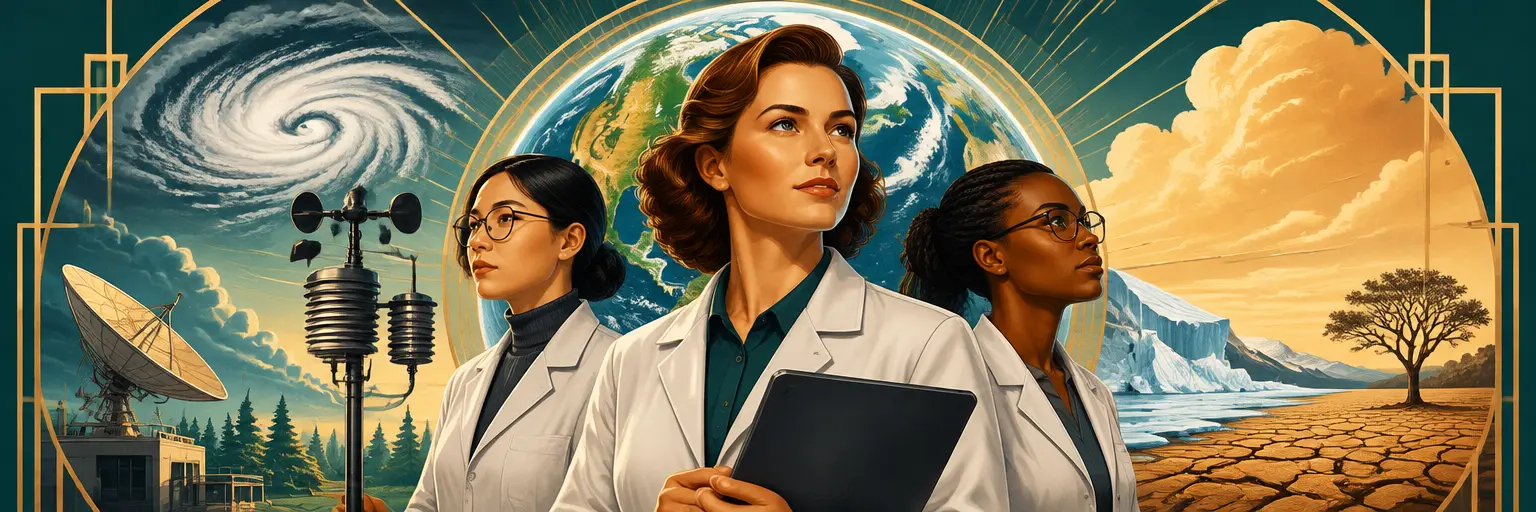
Welcome to our dedicated hub on Women in Climate Science & Meteorology, part of the Environmental Science category at WomenInScienceHistory.com. Here, we honor the female scientists who have decoded atmospheric patterns, warned of anthropogenic warming, and advanced forecasting technologies. These women navigated glass ceilings while analyzing jet streams, ice cores, and ocean currents. Their research forms the backbone of modern climate policy and disaster preparedness. Dive into their stories to understand how their resilience and intellect continue to shape our response to a changing planet, from early weather observation to cutting-edge satellite meteorology.
🌦️ Early Pioneers of Weather Observation
Long before supercomputers, women were systematically recording temperatures, pressures, and storm tracks. Figures like Eleanor Anne Ormerod and Margaret LeMone—the latter a groundbreaking cloud physicist—demonstrated that meticulous fieldwork was not an exclusively male domain. In the 1880s, amateur meteorologist Cornelia Clapp even contributed to storm tracking through coastal data collection, challenging the notion that women belonged only in domestic roles.
These early observers often worked without formal university posts, yet their data proved essential for agricultural planning and maritime safety. Their journals and tide logs provided the baseline datasets that later climate scientists used to identify long-term shifts. By examining their correspondence and notebooks, we learn that pattern recognition and relentless dedication were their primary tools—skills that remain vital in today’s climate crisis. Their legacy is a reminder that science starts with curiosity and a committed eye on the sky.
🛰️ Satellite Meteorology and Remote Sensing
The advent of space-based observation opened new frontiers, and women were quick to lead. Joanne Simpson, the first woman to earn a PhD in meteorology in the US, pioneered the use of satellite data to study tropical rainfall. Her work on cloud dynamics directly influenced NASA’s TRMM mission, which revolutionized how we measure precipitation globally. Similarly, Graciela Raga has used satellite imagery to track aerosol-cloud interactions, improving air quality models across Latin America.
For readers, this section explains how female scientists turned petabytes of raw sensor data into actionable climate models. They developed algorithms to interpret infrared and microwave signals, enabling accurate hurricane intensity forecasts. These women also championed open-access data policies, ensuring that developing nations could benefit from early warning systems. Their story demonstrates that technical acumen is gender-neutral, and that satellite meteorology is as much about creative interpretation as it is about hardware.
🧊 Climate Modeling and Paleoclimatology
Understanding future climate requires reconstructing ancient climates, a field where women have excelled. Katharine Hayhoe is a leading voice translating climate models for public audiences, while Lonnie Thompson (a male colleague) often credits paleoclimatologist Ellen Mosley-Thompson for breakthrough ice-core analyses. Mosley-Thompson’s expeditions to tropical glaciers proved that high-altitude regions are warming faster than global averages, reshaping our understanding of water scarcity.
This subsection highlights how women combine field endurance with computational skill. They drill through kilometer-deep ice, analyze trapped gas bubbles, and feed data into sophisticated General Circulation Models. Their findings link atmospheric CO2 levels to temperature spikes over millennia, providing the scientific foundation for carbon reduction targets. For students, these narratives illustrate that climate science demands patience, statistical rigor, and an interdisciplinary mindset—qualities abundantly present in these inspiring researchers.
🌪️ Disaster Risk Reduction and Public Policy
Women meteorologists have not only advanced theory but also saved lives through policy leadership. Maria Los, a Polish climatologist, worked with the Intergovernmental Panel on Climate Change to develop adaptation frameworks for Eastern Europe. Deborah Brosnan, an environmental scientist, has focused on hurricane resilience in the Caribbean, integrating social vulnerability data into evacuation plans. Their work emphasizes that forecasts are useless without community engagement.
Readers will discover how these women bridged the gap between laboratory and legislature. They conducted risk mapping, designed early warning systems, and advocated for gender-inclusive disaster relief—recognizing that women’s deaths in cyclones are disproportionately higher due to social norms. Their efforts have influenced UN policy directives, illustrating that a meteorologist’s role extends beyond prediction into human geography and ethics. This section is essential for anyone interested in the practical impact of climate science.
🌱 Intersectionality: Indigenous and Global South Voices
Finally, we spotlight women who merge traditional ecological knowledge with modern meteorology. Hindou Oumarou Ibrahim from Chad uses indigenous indicators (e.g., bird migrations, plant blooming) to predict drought, integrating them into national weather bulletins. In India, Minal Pathak has led research on urban heat islands in low-income settlements, revealing that heatwave mortality is a social justice issue.
These scientists challenge the Western-centric canon of climate research. They argue that local observational systems are not inferior but complementary, providing granular detail that satellite grids miss. By documenting their methodologies, we show how women can decolonize atmospheric science. Their work is vital for creating equitable adaptation strategies in regions most vulnerable to sea-level rise and desertification. This subsection broadens the definition of expertise and celebrates diverse knowledge systems.
Frequently Asked Questions
Who was the first female meteorologist?
The first widely recognized female meteorological scientist was Joanne Simpson, who earned her doctorate in meteorology in 1949 from the University of Chicago. She conducted pioneering research on cloud formation and tropical convection, paving the way for future generations.
How did women contribute to early weather forecasting?
In the 1800s, women like Cornelia Clapp and Ellen Harding collected daily temperature and precipitation records, which were shared via telegraph and used to create synoptic weather maps. Their unpaid or underpaid labor provided essential baseline data for modern weather services.
Do women still face barriers in climate sciences today?
Yes. Studies show that women hold less than 30% of senior research positions in atmospheric sciences. Barriers include implicit bias in funding, lack of mentorship, and fieldwork safety concerns. However, networks like Women in Climate and Meteorology are addressing these gaps.
What is the significance of ice core analysis in climate history?
Ice cores trap air bubbles from past millennia, allowing scientists to measure historical CO2 and methane levels. Women like Ellen Mosley-Thompson have used these cores to prove that current warming is unprecedented in 10,000 years, providing clear evidence of human influence.
How can I support women in this field?
You can mentor young students, advocate for equitable hiring committees, donate to scholarships for female atmospheric scientists, and amplify their research on social media. Additionally, teaching children about these pioneers encourages future interest.