Trailblazers of the Modern Environmental Era: Women in Environmental Science (1950–2000)
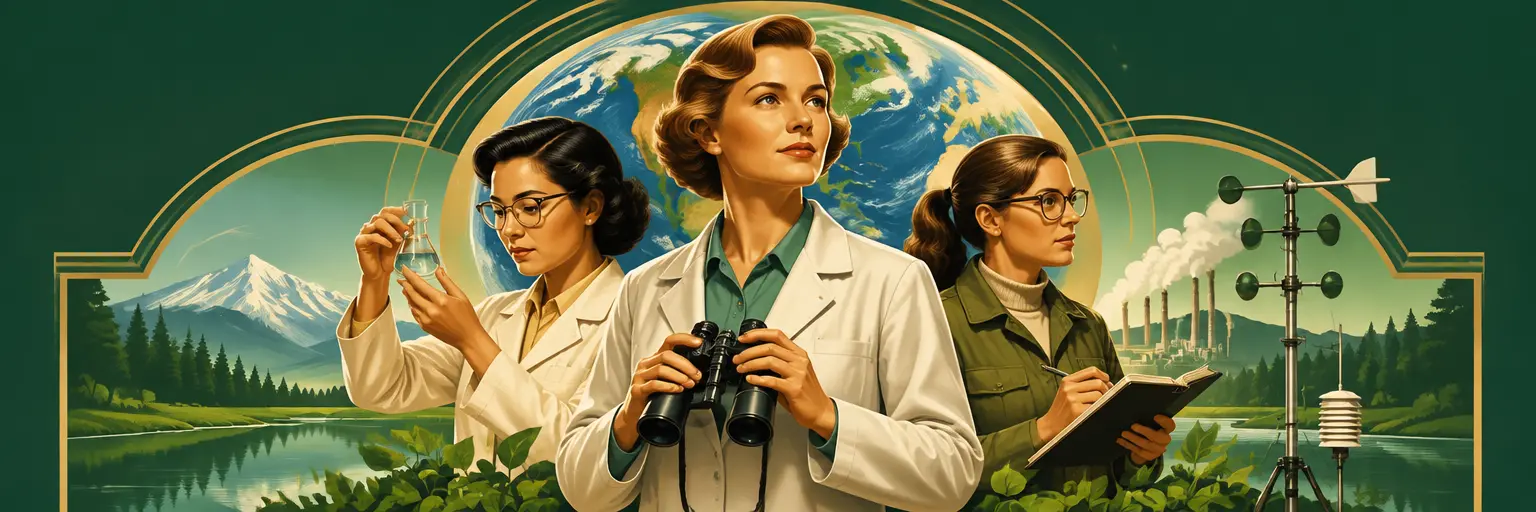
From the post-war boom to the dawn of the digital age, women in environmental science fundamentally reshaped how we understand ecosystems, pollution, conservation, and climate. This subcategory explores the pioneering female scientists, ecologists, oceanographers, and activists who worked between 1950 and 2000—often against institutional bias—to lay the groundwork for modern environmental policy. Discover their groundbreaking research, the barriers they broke, and the legacies that continue to influence sustainability science today.
🔬 Pioneering Ecologists and Ecosystem Thinkers
Between 1950 and 2000, women like Ruth Patrick (diatom-based water quality assessment) and Eugenie Clark (marine ecology) transformed field biology from descriptive natural history into quantitative, hypothesis-driven science. Patrick’s work at the Academy of Natural Sciences created the foundation for bio-monitoring, while Clark’s shark research challenged stereotypes about female oceanographers. These scientists emphasized that ecosystems are interconnected systems, not just collections of species.
Readers can expect detailed biographical profiles, primary research summaries, and analysis of how their methodological innovations—such as Patrick’s “diatom method”—became standard tools for assessing river health. The narratives highlight how these women navigated fieldwork constraints, secured funding in male-dominated institutions, and mentored the next generation of female ecologists, all while producing peer-reviewed work that still cites prominently in environmental management textbooks.
🌍 Rachel Carson and the Rise of Environmental Toxicology
No discussion of mid-century environmental science is complete without Rachel Carson, whose 1962 book Silent Spring catalyzed the global environmental movement. Carson’s rigorous synthesis of chemical toxicity data, particularly on DDT, led to the U.S. ban on the pesticide and the creation of the Environmental Protection Agency. Her work bridged scientific research and public communication, setting a new standard for evidence-based advocacy.
This section provides an in-depth look at Carson’s scientific process, her battles with chemical companies, and her legacy. You’ll also meet lesser-known contemporaries like Dian Fossey (primate conservation) and Jane Goodall, whose long-term field studies rewrote our understanding of animal behavior and habitat protection. Expect discussions on how their work inspired modern eco-toxicology, conservation biology, and environmental justice—all framed within the historical context of Cold War-era pesticide proliferation.
🌊 Oceanography, Climate Change, and Atmospheric Science
Women significantly advanced marine and atmospheric sciences during this period, often via interdisciplinary collaborations. Marie Tharp’s pioneering seafloor mapping (with Bruce Heezen) provided visual proof of plate tectonics, while Joan Feynman (solar wind and auroras) and Inge Lehmann (Earth’s inner core) pushed boundaries in geophysics. In climate science, Esther Boserup’s work on agricultural intensification and environmental change challenged Malthusian models.
Here, readers will find accessible explanations of their key discoveries—from the Mid-Atlantic Ridge to the discovery of the ozone hole’s chemistry. The subcategory highlights how these women integrated satellite data, deep-sea sampling, and computational models, often without formal acknowledgment. You’ll learn about the institutional sexism they faced in oceanographic ship allocations and lab leadership, and how their persistence shaped modern IPCC reports and marine conservation policies.
🌱 Conservation Biology and Policy Advocacy
From grassroots activism to high-level policy, women like Wangari Maathai (Green Belt Movement, 1977) and Sylvia Earle (“Her Deepness,” first female chief scientist at NOAA) merged scientific research with community-driven conservation. Maathai’s reforestation efforts linked environmental health to women’s rights, while Earle’s “Mission Blue” initiated marine protected areas worldwide. Their work demonstrates how environmental science is inseparable from social justice.
Expect case studies on how these leaders negotiated with governments, NGOs, and local communities to implement sustainable practices. The section also covers lesser-known policy scientists like Margaret S. Collins (first Black female entomologist) and Berta Cáceres (indigenous environmental activist), emphasizing the intersectionality of environmentalism. You’ll gain insight into the evolution of conservation from species-centric to ecosystem-based management, and how these women influenced major international agreements like the Convention on Biological Diversity.
⚡ Contamination, Toxicology, and Public Health
Women were central to linking environmental pollutants to human health impacts, a field now called environmental epidemiology. Alice Hamilton (though earlier, she set the precedent) in industrial toxics, Irma Rosenthal (radiation effects), and Harriet Hardy (beryllium disease) pioneered occupational and environmental medicine. In the 1970s–80s, Ellen Silbergeld’s research on lead poisoning in children led to bans on leaded gasoline, while Devra Davis (author of When Smoke Ran Like Water) exposed the health costs of pollution.
This segment offers detailed timelines of regulatory breakthroughs—Clean Air Act, Safe Drinking Water Act—and the scientific evidence women provided. Readers will explore how these scientists used longitudinal studies, biomonitoring, and risk assessment to prove causal links between toxins and disease. Their stories also highlight the tension between corporate interests and public health, showing how these women balanced rigorous methodology with advocacy in the face of industry pushback.
📘 Mentorship, Education, and Institutional Change
Beyond research, women environmental scientists of 1950–2000 actively reshaped academic institutions. Esther B. Smalls (first female dean at Howard University’s College of Engineering) and Ruth Hubbard (first woman to hold a chaired professorship in biology at Harvard) championed inclusive curricula. They founded journals, created interdisciplinary programs, and pushed for gender-disaggregated data in environmental health research.
This section profiles these educators and organizational leaders, detailing their roles in establishing environmental science departments, feminist science studies, and field courses accessible to women. You’ll learn about the founding of organizations like AWIS (Association for Women in Science) and how these networks provided grants, mentoring, and advocacy. The narrative includes oral histories and archival materials that show how systemic changes—from tenure policies to lab access—were negotiated, providing a blueprint for current diversity initiatives in STEM.
Frequently Asked Questions
Who is considered the most influential woman in environmental science between 1950 and 2000?
Rachel Carson is widely considered the most influential due to Silent Spring (1962), which sparked modern environmentalism and led to DDT bans. However, Marie Tharp’s seafloor mapping and Sylvia Earle’s marine conservation advocacy are equally transformative. The answer depends on your focus—toxicology, ecology, or oceanography—but Carson’s public impact remains unmatched.
What were the main barriers women faced in environmental sciences during this period?
Barriers included exclusion from ship-based fieldwork, lack of tenure-track positions, and dismissal of their fieldwork as “hobbies.” Funding disparities were rampant, and many women worked as unpaid assistants to husbands or male advisors. Institutional sexism also meant their findings were sometimes published under male coauthors, as happened with some of Tharp’s contributions.
How did women influence environmental policy in the U.S. and globally?
Through scientific testimony and advocacy. For example, Ellen Silbergeld’s data on lead helped pass the 1978 Lead Paint Poisoning Prevention Act. Globally, Wangari Maathai’s Green Belt Movement influenced the UN’s Sustainable Development Goals. Women also co-drafted major treaties like the Stockholm Convention on persistent organic pollutants.
What are some lesser-known but critical female environmental scientists from this era?
Consider Vera Rubin (though an astronomer, her work on galaxy rotation curves informs environmental radiocarbon dating), Ruth Patrick (freshwater diatoms), and Margaret S. Collins, who studied termites in the American Southwest. Also, Joan Berkowitz pioneered hazardous waste management, and Libby Hyman systematized invertebrate ecology.
How can I find primary sources about these women’s work?
Explore academic archives like the Schlesinger Library (Radcliffe), Smithsonian Institution Archives, and university libraries where they taught. The websites of organizations like AWIS and the Association for Women in Science maintain oral histories. For public-facing sources, the U.S. EPA’s history page and the Library of Congress’s “Women of the Environmental Movement” exhibit offer digitized letters and reports.