Early Women in Engineering & Invention (Pre-19th Century)
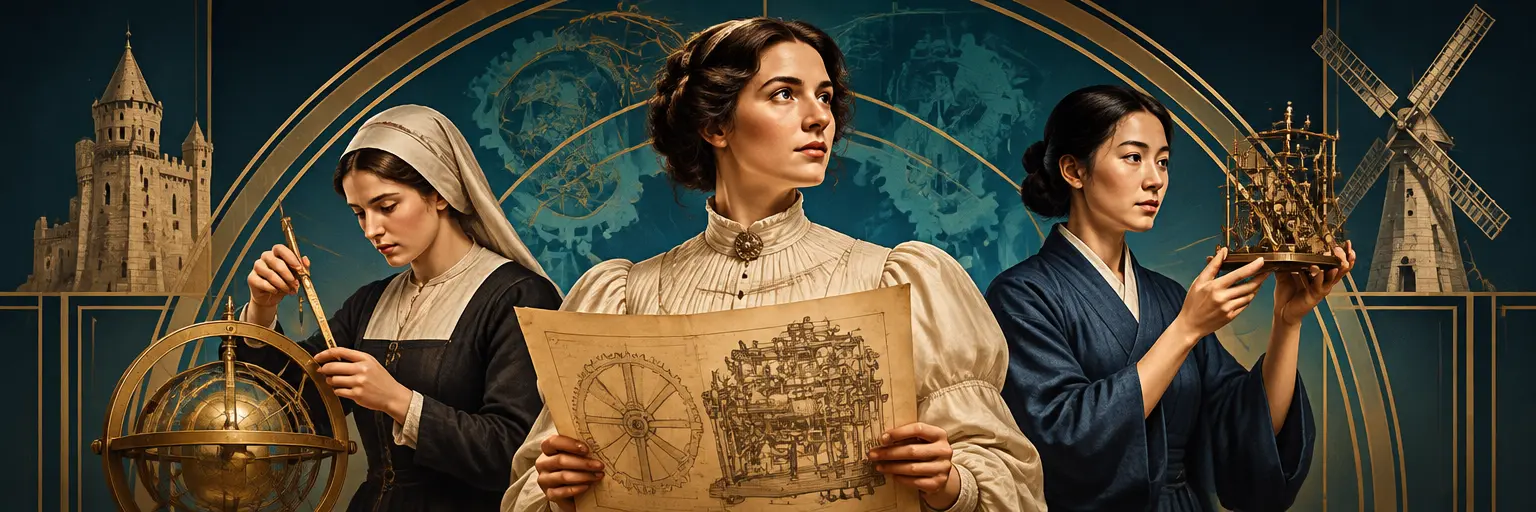
Long before the Industrial Revolution redefined technology, women were quietly shaping the world through ingenious engineering and invention. This subcategory uncovers the remarkable stories of female pioneers who designed irrigation systems, forged advanced alloys, built war machines, and patented groundbreaking devices—all while navigating societies that denied them formal education and legal rights. From ancient Greece to the Renaissance courts of Europe, these women defied convention to solve real-world problems. Their legacies, often erased or attributed to men, deserve recognition as foundational to modern engineering practice. Explore their innovations, struggles, and enduring impact on the fields we rely on today.
🔧 Ancient Innovators: From Water Systems to War Engines
In antiquity, women like Hypatia of Alexandria (c. 350–415 CE) developed astrolabes and hydrometers, merging mathematical precision with practical engineering. Earlier, Queen Semiramis of Babylon was credited with commissioning massive aqueducts and embankments to control the Euphrates River’s floods, demonstrating early hydraulic engineering. These women worked alongside male scholars but often received no formal credit, their designs attributed to rulers or anonymous artisans. Their contributions ranged from agricultural water management to military defenses, proving that engineering ingenuity was never gender-exclusive.
Archaeological evidence from ancient Egypt, China, and Mesopotamia reveals female artisans crafting advanced pottery kilns, textile looms, and metallurgical furnaces. For instance, Pythias of Greece (4th century BCE) collaborated with her husband Aristotle on natural philosophy, but her applied research on mineral processing and tool making influenced early Greek technology. By examining surviving artifacts and fragmented historical records, we can reconstruct how these women solved structural, thermal, and mechanical challenges—laying groundwork for later breakthroughs in civil and mechanical engineering.
🏺 Medieval Masterminds: Alchemy, Textiles, and Architectural Feats
The medieval period saw women like Hildegard of Bingen (1098–1179) document natural sciences, including early bridge and building designs, while Scholastica of Monte Cassino organized monastic water systems. In textile engineering, Christine de Pizan (1364–1430) wrote extensively on fortress construction and siege technology, blending practical advice with courtly knowledge. Meanwhile, anonymous female spinners and weavers developed looms that later inspired mechanized production. These women often worked within religious or noble households, leveraging their access to resources to experiment with materials like glass, iron, and timber.
Notably, Hrosvitha of Gandersheim (935–1002) composed plays that depicted mechanical inventions, including automata, reflecting a sophisticated understanding of gears and pulleys. In Islamic Spain, Lubna of Cordoba (10th century) managed a royal library and translated engineering manuals, spreading hydraulic and clock-making techniques across Europe. These medieval figures bridged classical knowledge and early modern science, preserving and enhancing engineering principles that would later fuel the Renaissance. Their work, often dismissed as “domestic craft,” was in reality advanced applied science requiring deep mathematical and material expertise.
⚙️ Renaissance & Enlightenment Thinkers: Blueprints and Prototypes
The Renaissance opened new avenues for women like Modesta di Pozzo (1555–1592), who published designs for fortifications and canals, and Catherine de Parthenay (1554–1631), a Huguenot mathematician who engineered defensive earthworks during religious wars. In the 17th century, Margaret Cavendish (1623–1673) theorized about air compressors and submarine propulsion, while Émilie du Châtelet (1706–1749) translated Newton’s Principia, clarifying foundational mechanics used in machine design. These women leveraged print culture to disseminate their ideas, though many faced ridicule or plagiarism by male contemporaries.
By the 18th century, Mary Dixon Kies (1752–1837) became the first American woman to receive a patent, for a process weaving straw with silk to improve hat durability—a manufacturing innovation. In England, Sarah Guppy (1770–1852) patented a bridge design incorporating railway supports and a method for preventing ships’ hulls from fouling. These inventors not only solved practical problems but also navigated restrictive property laws, often patenting under male relatives or as widows. Their prototypes and patents laid direct foundations for industrial-era machinery, yet history books rarely mention their names.
🌍 Cross-Cultural Contributions: Asia, Africa, and the Americas
Beyond Europe, women engineered remarkable systems. In China, Huang Daopo (c. 1245–1330) revolutionized cotton spinning and weaving, inventing advanced looms and pedal-operated machines that enhanced textile production efficiency. In West Africa, Queen Nzinga (1583–1663) designed defensive strategies and fortifications against Portuguese colonization, incorporating local materials and terrain knowledge. In the Americas, indigenous women like Malia (Hawaiian) developed sophisticated fishpond aquaculture systems with stone walls and tidal gates, showing hydraulic engineering expertise pre-contact.
These cross-cultural examples highlight that engineering knowledge was globally distributed, with women at the forefront of adaptation and innovation. Their work often interwove ecological understanding with construction skills, from Andean terraces built by female farmers to Arctic kayak designs perfected by Inuit women. By diversifying our historical lens, we recognize that early engineering was not a Western male monopoly but a collaborative human endeavor. This broader perspective enriches modern engineering education and honors the true breadth of human problem-solving.
📜 Legacy and Historiography: Recovering Erased Narratives
Why are these women largely absent from standard engineering histories? Systematic biases in record-keeping, legal restrictions on property ownership, and scholarly gatekeeping contributed to their erasure. Many inventions were credited to husbands, fathers, or anonymous “workshop” traditions. For example, Elizabeth Lucas Pinckney (1722–1793) developed an indigo dye extraction process that transformed colonial American agriculture, yet her engineering and chemical innovations are rarely taught. Historians now use court records, letters, patents, and archaeological finds to reconstruct these contributions with greater accuracy.
Digital archives and feminist historical projects, like the ones featured on WomenInScienceHistory.com, are actively recovering these narratives. By restoring their names and detailing their technical methods, we challenge the myth that women were passive observers in engineering history. This subcategory serves as a corrective, offering educators and enthusiasts accessible, evidence-based narratives. Understanding these women’s resilience not only enriches history but also inspires current and future engineers from underrepresented backgrounds to persist against structural barriers.
Frequently Asked Questions
What is the earliest known female engineer or inventor?
The earliest named figure is Enheduanna (c. 2285 BCE), a Sumerian priestess who designed temple complexes and irrigation channels, though her engineering role is inferred from inscriptions. More concretely, Semiramis (9th century BCE) is credited with major Babylonian hydraulic works. However, most early women worked anonymously, so the title remains debated.
Did women receive patents before the 19th century?
Rarely, due to legal restrictions. The first known patent to a woman by name was granted to Sybilla Masters in 1712 in England (for corn milling), though it was filed under her husband’s name. The first U.S. patent to a woman, Mary Dixon Kies, came in 1809, after the law allowed women to hold patents in their own name.
How did women learn engineering skills without formal education?
Most apprenticed in family workshops, convents, or royal courts, learning from fathers, brothers, or religious texts. Some, like Hypatia, received private tutoring. Others gained hands-on experience managing estates, shipyards, or textile mills, where practical mechanical knowledge was essential.
What inventions are attributed to women from this era?
Key inventions include Huang Daopo’s spinning and weaving machinery, Kies’s straw-and-silk hat weaving process, Guppy’s bridge designs, and du Châtelet’s clarifying work on kinetic energy. Many other inventions were misattributed to men, making exact lists difficult.
Why were these women’s contributions hidden for so long?
Cultural norms devalued female intellect, and legal restrictions barred women from owning property, signing contracts, or receiving patents. Scholarly histories often excluded them, and when mentioned, they were labeled as “helpers” or “patrons” rather than engineers. Recovering these stories requires examining archival gaps and questioning biased assumptions.