Pioneering Women in Engineering: 1900-1950
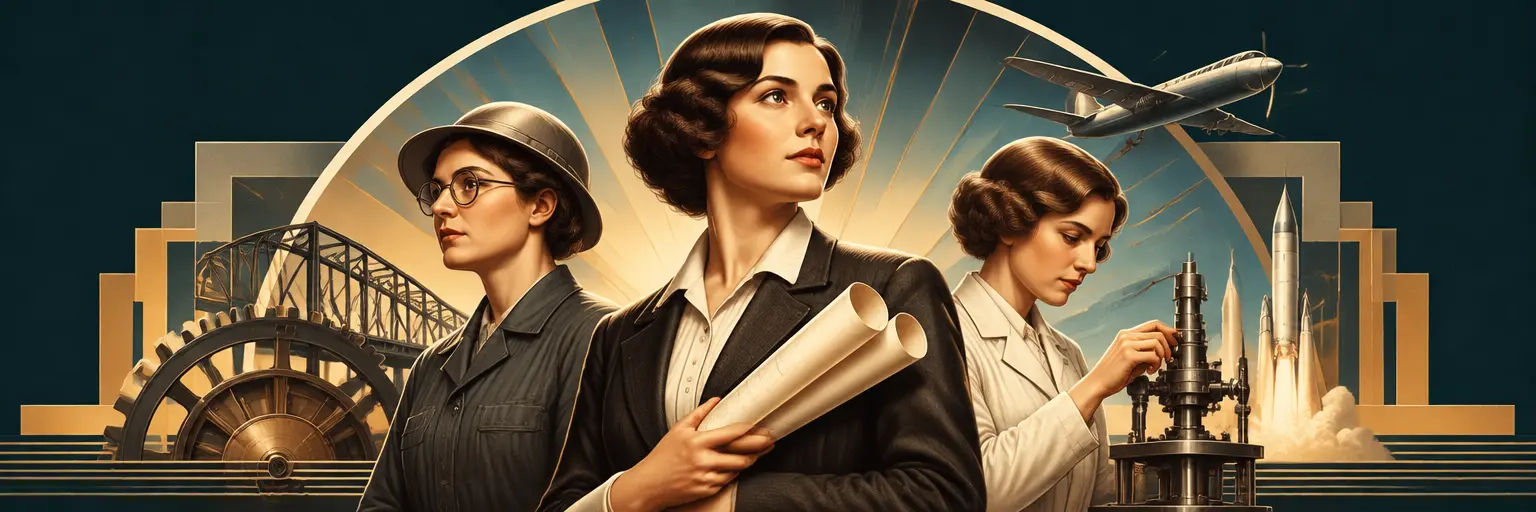
Step into the transformative era when women first cracked the concrete ceiling of engineering. Between 1900 and 1950, female engineers defied social norms, patented life-changing inventions, and helped build nations during two world wars—yet their names were often erased from history. This subcategory unearths their forgotten legacies, from early aviation design to industrial chemistry, highlighting the grit, genius, and strategic alliances that made their breakthroughs possible.
🚀 Breaking into Male-Dominated Classrooms and Workshops
At the dawn of the 20th century, engineering schools rarely admitted women. Pioneers like Nora Stanton Blatch Barney, the first female graduate in civil engineering from Cornell (1905), faced outright rejection when applying for professional roles. Many resorted to "backdoor" routes—studying abroad, taking night classes, or apprenticing under sympathetic male relatives. Despite systemic barriers, enrollment steadily climbed, especially after 1910, as universities began creating separate curricula for "home engineering" to appease tradition.
Expect to discover firsthand accounts of these trailblazers' perseverance. You'll learn how women leveraged legal loopholes, formed study circles, and even disguised themselves as men to gain lab access. Their academic victories weren't just personal wins—they broke precedents that later generations would build upon, transforming engineering from an exclusively male fraternity into a slowly opening professional field.
🛠️ Wartime Engineering: The Hidden Workforce of WWI and WWII
World Wars I and II were unexpected accelerants for women's engineering careers. With millions of men conscripted, industries desperate for technical talent turned to women for roles in ballistics calculation, aeronautical stress testing, and radio frequency design. The U.S. Army's "Computers at Langley" and Britain's wartime engineering corps included hundreds of female mathematicians and draughtswomen who secretly refined fighter planes and artillery trajectories. Their work often went uncredited to protect male colleagues' reputations.
This section reveals wartime technical bulletins, oral histories, and declassified blueprints. You'll meet women like Hazel Ying Lee, the first Chinese-American female military pilot, and Beatrice Hicks, who later founded the Society of Women Engineers. Their wartime contributions not only saved lives but also proved that women's analytical precision rivaled—and sometimes exceeded—their male counterparts, seeding post-war employment shifts.
⚙️ Industrial Revolution 2.0: Women in Manufacturing and Chemical Engineering
Between 1920 and 1940, the rise of mass production and chemical processing created new niches where women engineers thrived. Notable figures include Edith Clarke, who pioneered electrical power system analysis using graphical methods, and Katharine Burr Blodgett, who co-invented non-reflective glass at General Electric. In chemical engineering, women like Ellen Swallow Richards (though more a sanitary chemist) influenced industrial waste management. These roles often came with lower pay and limited advancement, but they offered rare, stable positions.
Dive into case studies of factory floor innovations and lab breakthroughs during the Great Depression era. You'll learn how women adapted complex machinery, developed quality control standards, and patented improvements despite corporate resistance. Their technical reports and patent filings demonstrate ingenuity under constraints—resourcefulness that later inspired Lean manufacturing philosophies. This facet also covers gender-segregated apprenticeship programs that quietly credentialed hundreds of female "assistant engineers."
📡 Early Electronics and Radio: Women on the Airwaves
As radio and electronics exploded after 1920, women found unexpected entry points. Operators, relay designers, and repair technicians were in high demand, and women excelled in meticulous soldering and circuit layout. Mary Sherman Morgan, later celebrated as a rocket fuel scientist, started as a lab assistant in electronics during the late 1930s. Meanwhile, "radio girls" like Gertrude Blanch calculated military tables for the Ballistic Research Laboratory, using early computers to crunch fire-control equations.
This subcategory highlights oral histories from ham radio clubs and technical colleges that taught morse code alongside Ohm's law. You'll uncover how women like actress Hedy Lamarr co-patented frequency-hopping technology (a precursor to Wi-Fi) in 1942, combining engineering with entertainment. Their contributions to radar jamming and communication encryption during WWII often remained classified for decades, but they laid foundational knowledge for modern telecommunications.
🧭 Academic Gatekeepers and Professional Societies
Forming professional networks was critical, yet women were barred from groups like the American Society of Mechanical Engineers. In response, they created alternative institutions—most notably the Society of Women Engineers (SWE), founded in 1950 by a group that included Beatrice Hicks and Lou Alta Melton. Academic barriers also persisted: MIT did not formally admit women until 1961, though some audited classes earlier. Universities like Iowa State and Purdue, however, offered home economics engineering degrees that subtly legitimized technical training for women.
Readers will explore records of early conferences, mentorship circles, and the formation of women's engineering dormitories. You'll see how these groups lobbied for fair hiring practices and public recognition. The SWE's archives contain letters of encouragement between isolated female engineers who used newsletters to share job openings and combat isolation. This section also covers the rise of female professors who quietly mentored undergraduates, ensuring a pipeline for future decades.
Frequently Asked Questions
Who was the first licensed female engineer in the U.S.?
Lillian Moller Gilbreth, though best known as a psychologist, became the first woman elected to the National Academy of Engineering in 1965. However, for the earliest licensed professional engineer, Nora Stanton Blatch Barney received her degree in 1905 but was denied membership in the American Society of Civil Engineers, eventually working as a designer and journalist.
Did women engineers serve in World War II combat roles?
No, women were generally barred from combat engineering units. However, they served as civilian contractors, military technicians, and codebreakers. Notable examples include the Women Accepted for Volunteer Emergency Service (WAVES) who handled radar calibration and the U.S. Navy's female "computers" who designed torpedo trajectories from stateside labs.
What were "home economics engineering" programs?
These were degree tracks offered by land-grant universities like Iowa State, combining domestic science with mechanical engineering. Courses included kitchen efficiency design and food preservation engineering. While criticized as gender-stereotyped, they granted legitimate engineering credentials and enabled women like Rose Winifred Elliott to later transition into industrial quality control.
How did women patent inventions if they lacked corporate support?
Many used family or husband's names to file patents, while others partnered with male colleagues who fronted the paperwork. For example, Hedy Lamarr used her married name to patent frequency hopping. Some saved small funds to pay attorneys, and independent inventors like Mary Anderson (windshield wipers) funded their patents from personal savings.
What is the significance of the Society of Women Engineers (SWE) today?
Founded in 1950, SWE now boasts over 47,000 members globally, offering scholarships, mentorship, and advocacy. Its archives preserve early pioneers' papers and annual conference proceedings. The organization continues to push for pay equity and inclusive workplace policies, directly tracing its roots to the era of 1900-1950 that this subcategory celebrates.