
Cleopatra the Alchemist: Beyond the Serpent, Her Pre18th Century Chemical Innovations


Welcome to WomenInScienceHistory.com, where we uncover the untold stories of remarkable women who shaped the world of science!
Delve into the fascinating world of Cleopatra the Alchemist, and discover the surprising chemical innovations attributed to this legendary queen, often overshadowed by tales of power and intrigue. Her contributions predate the 18th century and challenge conventional narratives. Intrigued? Join us as we explore her groundbreaking work and unravel the mysteries behind her chemical formulas, revealing a side of Cleopatra you've never seen before.
- Introduction: Unveiling Cleopatra's Alchemical Legacy
- Cleopatra's Life and Context: A Foundation for Chemical Pursuits
- Cleopatra's Alchemical Contributions: A Deep Dive
- Cleopatra's Practical Applications of Chemical Knowledge
- Cleopatra’s Influence on Later Alchemists and Chemical Practices
- Challenges in Reconstructing Cleopatra's Scientific Contributions
- Cleopatra’s Chemical Innovations History: Debunking Myths and Highlighting Facts
- Conclusion: Cleopatra, a Woman Ahead of Her Time in Chemistry and Alchemy
-
Frequently Asked Questions
- What evidence supports the claim that Cleopatra, beyond her political role, was involved in pre-18th century chemical innovations?
- What are some examples of the chemical formulations or practices attributed to Cleopatra in historical texts?
- How did the male-dominated scientific community of the time receive or acknowledge Cleopatra's contributions to chemistry?
- What challenges did Cleopatra likely face as a woman pursuing chemical knowledge and experimentation in the pre-18th century world?
- Why is it important to highlight Cleopatra's chemical innovations history, even if the historical evidence is not definitive?
- Final Reflection: Unveiling Cleopatra's Enduring Legacy
- Unearth Cleopatra's Forgotten Formulas!
Introduction: Unveiling Cleopatra's Alchemical Legacy
Reframing Cleopatra: More Than a Queen, A Pioneer in Early Chemistry
Cleopatra VII Philopator, the last active ruler of the Ptolemaic Kingdom of Egypt, is predominantly remembered for her political acumen and her relationships with Roman leaders Julius Caesar and Mark Antony. However, a less-explored facet of her remarkable life reveals a profound intellectual curiosity and engagement with the scientific pursuits of her era, particularly early chemistry and alchemy. Far from being merely a political figure, Cleopatra was a polymath who actively patronized scholars and was deeply knowledgeable about the natural sciences, including pharmacology, metallurgy, and the complex art of distillation.
This re-examination positions Cleopatra not just as a queen but as a significant, albeit often overlooked, figure in the nascent stages of chemical thought. Her intellectual background, coupled with unparalleled access to the vast resources of the Library of Alexandria, allowed her to transcend typical royal duties and immerse herself in scholarly endeavors. The exploration of Cleopatra’s chemical innovations history reveals a woman whose contributions to early scientific practice are worthy of recognition, challenging conventional narratives that often neglect the intellectual achievements of historical female figures.
The Significance of Pre-18th Century Alchemy and Cleopatra's Role
Before the formal establishment of modern chemistry in the 18th century, alchemy served as its foundational precursor, a rich tapestry of practical knowledge encompassing material science, metallurgy, distillation, and medicine, interwoven with philosophical and mystical elements. It was a holistic discipline where the manipulation of matter was often seen as a path to understanding the cosmos and achieving perfection. Within this intricate domain, women, despite facing significant societal constraints, played diverse roles, often leveraging their practical skills in domestic settings or, in rare cases like Cleopatra's, at an institutional and scholarly level.
Cleopatra's involvement in this pre-modern chemical landscape is particularly significant because it highlights the sophisticated intellectual environment of Hellenistic Egypt and the potential for female patronage and participation in advanced scientific pursuits. Her work, whether through direct experimentation or the commissioning of treatises, represents a critical chapter in the history of early chemical thought and practice. Understanding Cleopatra’s chemical innovations history is essential for appreciating the diverse origins of scientific inquiry and the often-eclipsed contributions of women to its development.
Cleopatra's Life and Context: A Foundation for Chemical Pursuits
Alexandria: A Hub of Scientific and Alchemical Knowledge
During the Hellenistic period, Alexandria stood as an unparalleled global center of intellectual and scientific learning, particularly renowned for its magnificent Library and the associated Museum (Mouseion). This vibrant metropolis served as a crucible for intellectual exchange, drawing scholars, philosophers, and scientists from across the known world. The city’s unique position at the crossroads of diverse cultures—Egyptian, Greek, Babylonian, and later Roman—fostered an environment where knowledge was actively pursued, translated, and disseminated.
This unparalleled intellectual ecosystem provided Cleopatra with extraordinary resources for her scientific inquiries. The Library of Alexandria housed an estimated 400,000 to 700,000 scrolls, encompassing virtually all accumulated knowledge of the ancient world, including extensive texts on natural philosophy, medicine, mathematics, and, crucially, alchemical and metallurgical practices. This rich repository, combined with a thriving community of resident scholars and experimenters, created a fertile ground for the development of early chemical thought and allowed Cleopatra to engage deeply with the science of her time, significantly impacting Cleopatra’s chemical innovations history.
Cleopatra's Education and Access to Scientific Resources
Cleopatra VII was renowned for her exceptional education, a rarity even among monarchs of her era. Unlike her Ptolemaic predecessors, she was fluent in several languages, including Egyptian, Greek, Aramaic, and potentially Latin, Hebrew, and Ethiopic, which granted her direct access to a vast array of scholarly texts without reliance on interpreters. Her education encompassed philosophy, mathematics, astronomy, and the natural sciences, preparing her for a comprehensive understanding of the world around her.
Crucially, Cleopatra enjoyed direct and unrestricted access to the vast collections and learned community of the Library of Alexandria. This access was not merely symbolic; it meant she could consult ancient treatises on metallurgy, pharmacology, botany, and alchemical processes from various cultures, including detailed Egyptian papyri and Greek philosophical texts. This unique foundation, combined with her innate intellectual curiosity, provided her with an unparalleled opportunity to delve into the chemical pursuits of her time, laying a strong groundwork for understanding Cleopatra’s chemical innovations history.
Cleopatra's Alchemical Contributions: A Deep Dive
The Chrysopoeia of Cleopatra: A Landmark Text in Alchemy
Among the most significant alchemical texts attributed to Cleopatra is the Chrysopoeia of Cleopatra, often translated as "Gold Making of Cleopatra." While the direct authorship by Cleopatra VII herself is debated among historians—a common challenge with ancient attributions—its association with her name firmly establishes her perceived authority and involvement in the field of alchemy. This treatise is considered one of the earliest and most important works in the Hellenistic alchemical tradition, predating many later European and Arabic texts.
The Chrysopoeia is not merely a collection of recipes; it is a complex work that blends practical chemical instructions with philosophical concepts, reflecting the holistic nature of ancient alchemy. It discusses the processes of material transformation, the use of various substances, and the symbolic representation of alchemical ideas. Its attribution to Cleopatra underscores her prominent intellectual standing in the ancient world, suggesting that her patronage or direct engagement was significant enough to warrant her name being attached to such a foundational work in Cleopatra’s chemical innovations history.
Analyzing the Chrysopoeia: Symbols, Diagrams, and Chemical Processes
The Chrysopoeia of Cleopatra is notable for its distinctive visual elements, which include detailed diagrams of alchemical apparatus and symbolic illustrations. Among these, the most iconic is the Ouroboros, a serpent devouring its own tail, accompanied by the inscription "One is the All." These visuals were not mere decorations but integral components for conveying complex alchemical principles and processes. The text itself describes various chemical operations, such as distillation, sublimation, and calcination, applied to substances like lead, mercury, and sulfur, aiming for their transformation or purification.
The diagrams within the Chrysopoeia provide valuable insights into the practical experimental setups of ancient alchemists. They depict sophisticated glassware and furnaces, suggesting a hands-on, empirical approach to material science. These illustrations are among the earliest known representations of alchemical equipment, indicating a developed understanding of chemical manipulation. The inclusion of such detailed practical elements alongside philosophical concepts within the Chrysopoeia reinforces the notion of a robust, experimental dimension to Cleopatra’s chemical innovations history.
The Ouroboros: Cleopatra's Alchemical Symbol and its Meaning
The Ouroboros, the ancient symbol of a snake or dragon eating its own tail, is prominently featured in the Chrysopoeia of Cleopatra and is often directly associated with her alchemical legacy. This powerful symbol, depicted in the text as encircling the words "One is the All," represents the cyclical nature of transformation, eternity, and self-renewal. In the context of alchemy, it embodies the idea of the opus circulatorium or "circular work," referring to the continuous process of heating, cooling, distillation, and recombination required to perfect matter.
The Ouroboros signifies unity and the cyclical processes of chemical change—how substances break down and are reborn, or how the end product of a reaction can become the starting material for another. For Cleopatra’s chemical innovations history, this symbol underscores a profound understanding of material cycles and the interconnectedness of elements. It suggests a philosophical depth to her alchemical pursuits, viewing the transformation of base metals into noble ones as a microcosm of universal cycles and the ultimate unity of all existence.
The Alembic: Cleopatra's Innovations in Distillation Apparatus
The alembic, a specialized distillation apparatus, was a cornerstone of alchemical practice, essential for separating and purifying liquids. While the basic principles of distillation were known in ancient Mesopotamia and Egypt, the Hellenistic period saw significant advancements in its design and application. The Chrysopoeia of Cleopatra reportedly contains some of the earliest detailed diagrams of such apparatus, suggesting that Cleopatra, or the scholars under her patronage, were actively involved in refining these critical tools.
These detailed schematics within the text indicate a sophisticated understanding of how to optimize distillation processes for greater efficiency and purity. This could have involved innovations in the design of the still head (the capitellum or ambix), the condenser, or the receiving flask, all aimed at improving the yield and quality of the distilled products. The focus on practical apparatus in a text attributed to Cleopatra highlights her deep engagement with the empirical aspects of early chemistry, marking a significant point in Cleopatra’s chemical innovations history.
Improving Distillation Techniques: Cleopatra's Experimental Approach
The pursuit of pure substances was central to ancient alchemy, whether for medicinal preparations, perfumes, or the elusive philosopher's stone. The improvements in distillation techniques attributed to Cleopatra, or those working under her patronage, likely involved a rigorous experimental approach. This could have included optimizing heating methods to ensure a steady and controlled temperature, refining cooling systems to maximize condensation, or experimenting with different materials for the apparatus itself to prevent contamination and improve durability.
For instance, the use of glass for certain parts of the alembic would have allowed for visual observation of the process, aiding in refinement. Such advancements would have been crucial for producing highly concentrated essential oils, potent medicinal extracts, or refined metallic solutions. This emphasis on practical, hands-on experimentation underscores the proto-scientific nature of alchemical work during Cleopatra's era, solidifying her role in advancing "Cleopatra’s chemical innovations history" through practical application.
The Influence of Cleopatra's Alembic on Later Alchemists
The detailed diagrams and principles of distillation apparatus found in the Chrysopoeia of Cleopatra are believed to have exerted a considerable influence on subsequent alchemical and chemical practices. As Hellenistic alchemical knowledge was transmitted, particularly through the Arab world during the Islamic Golden Age, these practical innovations were preserved, expanded upon, and eventually reintroduced to medieval Europe. Scholars like Zosimos of Panopolis, a prominent alchemist from the 3rd or 4th century CE, explicitly referenced Cleopatra's work, acknowledging her foundational contributions.
The principles of the alembic, as refined or depicted in texts associated with Cleopatra, became standard in alchemical laboratories for centuries. This continuity of knowledge demonstrates how early advancements, even if indirectly attributed, laid crucial groundwork for future chemical developments. Thus, Cleopatra’s chemical innovations history, particularly concerning distillation, played a pivotal role in shaping the trajectory of early chemistry and its practical applications across different cultures and time periods.
Cleopatra's Practical Applications of Chemical Knowledge
Dyeing Techniques and Pigment Production: Cleopatra's Expertise
Cleopatra's deep understanding of chemical processes extended beyond theoretical alchemy into highly practical applications, particularly in the production of dyes and pigments. The royal court of Egypt, renowned for its luxurious textiles and vibrant artistry, would have demanded sophisticated methods for creating rich, lasting colors. This required intricate chemical knowledge, including the extraction of natural pigments from plants and minerals, and the use of mordants—substances like alum or iron salts—to fix dyes permanently to fabric fibers.
For instance, producing the deep purple dye, Tyrian purple, a symbol of royalty, involved a complex extraction process from murex snails, requiring precise chemical control. Similarly, the creation of vibrant blues from lapis lazuli or reds from madder root involved grinding, purification, and mixing techniques that leveraged chemical principles. Cleopatra's patronage and likely direct involvement in these areas highlight her practical engagement with chemical science, a significant aspect of Cleopatra’s chemical innovations history.
Perfumery and Cosmetics: Chemical Formulations Attributed to Cleopatra
Cleopatra's legendary allure was not solely due to her political power but also her sophisticated use of perfumery and cosmetics, which were highly complex chemical formulations in antiquity. Her court was a center for the creation of exotic scents and beauty products, requiring advanced chemical processes such as enfleurage (extracting fragrance with fat), maceration (soaking in oil), and distillation of essential oils from various botanicals like frankincense, myrrh, and rose.
Historical accounts and archaeological finds suggest Cleopatra was a connoisseur and possibly an innovator in these fields. For example, kohl, the iconic black eyeliner, was typically made from galena (lead sulfide) or stibnite (antimony sulfide) mixed with fats or resins, requiring careful grinding and preparation. Her famous unguents and balms, such as kyphi, a complex incense perfume, involved dozens of ingredients meticulously blended and processed. These practices were not just about aesthetics but represented a sophisticated application of chemical knowledge, making them a crucial part of Cleopatra’s chemical innovations history.
Medical Applications: Exploring Potential Alchemical Remedies
The boundaries between alchemy, pharmacology, and medicine were fluid in the ancient world, and it is highly probable that Cleopatra's chemical knowledge extended into the realm of medicinal applications. Ancient Egyptian medicine, already highly advanced, utilized a wide array of herbal, mineral, and animal substances. Cleopatra's alchemical understanding would have provided her with the means to prepare more potent or purified remedies through processes like distillation for herbal extracts or calcination for mineral compounds.
While specific remedies directly attributed to her in this context are scarce, the general practice of the time included using chemically processed materials for therapeutic purposes. For instance, metallic compounds, often explored in alchemy for their transformative properties, were also used in ancient medicine. Cleopatra's access to the Library of Alexandria, with its vast medical texts, combined with her chemical acumen, would have allowed her to oversee or directly participate in the development of sophisticated pharmaceutical preparations, contributing to the broader scope of Cleopatra’s chemical innovations history.
Cleopatra’s Influence on Later Alchemists and Chemical Practices
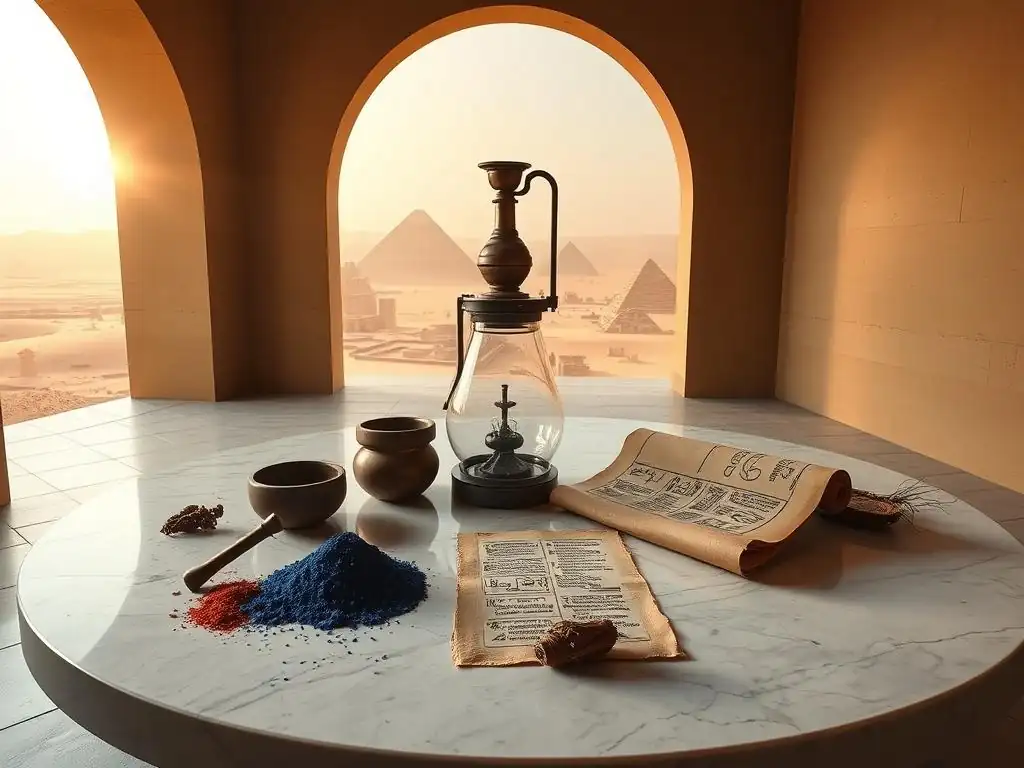
Transmission of Knowledge: From Alexandria to the Medieval World
The alchemical knowledge originating in Hellenistic Egypt, including works attributed to Cleopatra, embarked on a remarkable journey of transmission across centuries and cultures. Following the decline of the Roman Empire, much of this Greek and Egyptian wisdom was preserved and further developed by scholars in the burgeoning Islamic world. Arabic scholars, notably figures like Jabir ibn Hayyan (Geber) and Al-Razi (Rhazes), meticulously translated, commented upon, and expanded on these ancient texts, including the Chrysopoeia of Cleopatra.
This intellectual bridge ensured that the practical insights into distillation, material transformation, and philosophical concepts found in the Alexandrian tradition did not vanish. When these Arabic texts were subsequently translated into Latin during the High Middle Ages, they reintroduced sophisticated alchemical principles and apparatus designs, such as the alembic, to European scholars. This unbroken chain of knowledge transmission underscores the enduring legacy of early figures like Cleopatra in shaping subsequent alchemical and, eventually, chemical practices.
Cleopatra's Place in Alchemical History: Recognition and Legacy
Despite the historical debates surrounding the direct authorship of specific alchemical treatises, Cleopatra's name became inextricably linked with significant alchemical works, imbuing them with authority and prestige. Her association with texts like the Chrysopoeia positioned her as a foundational figure, a muse, or a wise patron in the alchemical tradition, particularly among Hellenistic and later Arabic commentators. She was revered for her perceived wisdom, intellectual prowess, and practical skill in manipulating materials.
Cleopatra's inclusion in this lineage of alchemical pioneers is crucial for understanding the historical recognition of women in scientific endeavors, even if that recognition was filtered through later attributions. Her legacy highlights that intellectual and scientific contributions from women were acknowledged, albeit sometimes symbolically, in historical contexts. The enduring presence of Cleopatra’s name in the annals of alchemy ensures her place in Cleopatra’s chemical innovations history, cementing her status as an early figure who inspired and influenced the development of chemical thought.
Challenges in Reconstructing Cleopatra's Scientific Contributions
Limited Primary Sources and Historical Interpretation
Reconstructing Cleopatra's direct scientific contributions presents significant challenges due primarily to the scarcity of undisputed primary sources from her immediate era that explicitly detail her laboratory work or scientific writings. Much of what is known or attributed to her comes from later commentaries, compilations, and literary interpretations, often written centuries after her death. These secondary sources, while valuable, can blur the lines between historical fact, popular legend, and allegorical attribution.
For instance, the Chrysopoeia of Cleopatra, while a pivotal alchemical text, is attributed to her long after her time, making it difficult to ascertain whether she personally authored it, commissioned it, or if her name was attached to lend authority to the work. The challenge for historians and scholars lies in meticulously sifting through these layers of accumulated narratives to identify concrete evidence of Cleopatra’s chemical innovations history, distinguishing genuine contributions from later embellishments or symbolic associations.
Separating Fact from Legend: The Myth of Cleopatra vs. the Alchemist
Cleopatra's image in popular culture is overwhelmingly dominated by her political acumen, dramatic romances, and tragic end, often overshadowing her profound intellectual pursuits. This pervasive mythical portrayal makes it particularly challenging to separate the historical figure of the queen from the dedicated alchemist. Ancient alchemical texts frequently employed allegorical language and attributed works to famous figures to lend credibility or encode deeper philosophical meanings, further complicating the task of precise authorship.
The alchemical tradition often revered legendary figures as patrons or originators of knowledge, and Cleopatra, with her reputation for wisdom and access to unparalleled resources, was an ideal candidate for such attributions. Therefore, discerning the reality of Cleopatra’s chemical innovations history requires careful critical analysis, scrutinizing historical records and alchemical treatises to identify where genuine engagement with chemical practices might have occurred versus where her name was invoked for symbolic or authoritative purposes.
Cleopatra’s Chemical Innovations History: Debunking Myths and Highlighting Facts
Common Misconceptions About Cleopatra's Alchemical Work
One common misconception surrounding Cleopatra's alchemical work is that her interest was solely driven by a desire for wealth through the transmutation of base metals into gold. While chrysopoeia (gold-making) was a central alchemical pursuit, early alchemy was far more holistic, encompassing a broad spectrum of proto-scientific inquiry into material properties, purification processes, and philosophical ideas about transformation. Her involvement was not merely symbolic or mystical; it stemmed from a genuine intellectual curiosity about the underlying principles of nature.
Another pervasive myth is that her contributions were entirely theoretical or passive. While direct evidence of her personally conducting experiments in a laboratory is scarce, the attribution of detailed practical texts like the Chrysopoeia to her suggests a deep engagement with the empirical side of alchemy. It is unlikely that such precise technical knowledge would be associated with someone who had no active interest or understanding of the processes involved. This underscores that Cleopatra’s chemical innovations history is grounded in real intellectual engagement, not just superficial interest.
The Reality of Cleopatra’s Chemical Achievements
The reality of Cleopatra’s chemical achievements, while complex to reconstruct, points to a significant role in the early development of chemical practices. While direct, undisputed proof of her personal laboratory work remains elusive, the consistent attribution of sophisticated alchemical texts and innovations to her, particularly concerning distillation apparatus and material transformations, strongly suggests her active involvement or substantial patronage. Her unique position as a multilingual monarch with direct access to the vast Library of Alexandria meant she possessed an unparalleled foundation for scientific inquiry.
It is highly probable that Cleopatra, given her intellectual curiosity and the scholarly environment of her court, either directly participated in chemical experiments, commissioned and oversaw their execution, or at the very least, fostered an environment where such knowledge flourished. Her legacy, as reflected in the enduring association of her name with foundational alchemical texts, firmly establishes her as a significant, albeit nuanced, figure in Cleopatra’s chemical innovations history, marking her as an early pioneer in the field.
Conclusion: Cleopatra, a Woman Ahead of Her Time in Chemistry and Alchemy
Celebrating Cleopatra's Contributions to Early Chemical Science
Cleopatra VII, often viewed through the lens of political drama and romantic intrigue, emerges as a truly remarkable figure when her intellectual pursuits are brought to light. Her deep engagement with early chemical science and alchemy, whether through direct authorship, significant patronage, or intellectual influence, positions her as a woman far ahead of her time. The attribution of foundational alchemical texts and innovations in distillation apparatus to her underscores her unique contribution to the systematic understanding and manipulation of matter in the ancient world.
Her story is a testament to the fact that sophisticated scientific thought and practical experimentation were not exclusively male domains, even in antiquity. By meticulously examining Cleopatra’s chemical innovations history, we celebrate not just her individual intellectual prowess but also the broader, often overlooked, presence of women in the foundational stages of scientific discovery. Her legacy challenges conventional narratives and enriches our understanding of the diverse origins of chemistry.
The Enduring Relevance of Cleopatra's Story for Women in Science History
Cleopatra's narrative holds profound and enduring relevance for the study of women in science history. Her story serves as a powerful reminder that intellectual agency and scientific engagement among women were present centuries ago, often in contexts that have been historically underappreciated or actively suppressed. By highlighting her contributions to early chemistry and alchemy, we bring into focus the often-eclipsed narratives of pioneering women who shaped the trajectory of scientific fields.
Uncovering and acknowledging Cleopatra’s chemical innovations history is not merely an academic exercise; it is an act of inspiration. It demonstrates that curiosity, intellect, and the pursuit of knowledge transcend gender and historical constraints. Her legacy encourages future generations to recognize the diverse origins of scientific thought and to continue challenging the biases that have historically marginalized the contributions of women in science, reinforcing the importance of a comprehensive and inclusive historical record.
Frequently Asked Questions
What evidence supports the claim that Cleopatra, beyond her political role, was involved in pre-18th century chemical innovations?
While direct evidence is limited, historical texts attributed to Cleopatra the Alchemist describe alchemical recipes and experiments, suggesting active participation. These texts survived through later alchemists and historians.
What are some examples of the chemical formulations or practices attributed to Cleopatra in historical texts?
Cleopatra is credited with formulas for gold dyeing, metallurgical processes, and cosmetics. The Chrysopoeia, an alchemical text, features an image attributed to her depicting the ouroboros, a symbol of cyclical renewal.
How did the male-dominated scientific community of the time receive or acknowledge Cleopatra's contributions to chemistry?
Historical records suggest that Cleopatra's work was often integrated into alchemical traditions without direct attribution or recognition of her gender. Her contributions were sometimes overshadowed.
What challenges did Cleopatra likely face as a woman pursuing chemical knowledge and experimentation in the pre-18th century world?
As a woman, Cleopatra would have faced significant societal barriers to accessing education and resources, and navigating a male-dominated field. Her status as a ruler might have provided some protection.
Why is it important to highlight Cleopatra's chemical innovations history, even if the historical evidence is not definitive?
Highlighting Cleopatra's potential contributions challenges the historical narrative that excludes women from scientific advancements. It inspires future generations by showcasing a powerful female figure in science.
Final Reflection: Unveiling Cleopatra's Enduring Legacy
The exploration of Cleopatra's alchemical pursuits reveals a facet of her intellect often overshadowed by romantic narratives. Her contributions to early chemistry, though fragmented in historical records, offer a compelling glimpse into a mind that transcended political maneuvering and embraced scientific inquiry. This rediscovery of her pre-18th century chemical innovations challenges conventional perceptions and underscores the importance of re-evaluating historical figures through a more holistic lens.
The impact of Cleopatra's legacy extends beyond the historical record, influencing our understanding of women in science and the interconnectedness of ancient knowledge. Her story serves as a powerful reminder that innovation knows no gender or geographical boundaries, and that the pursuit of knowledge is a timeless human endeavor. The most beautiful thing we can experience is the mysterious. It is the source of all true art and science.
- Albert Einstein, a sentiment that resonates deeply with Cleopatra's own quest for understanding the natural world.
As we conclude this journey into Cleopatra's alchemical world, let us carry forward the spirit of curiosity and intellectual courage that defined her. Consider how her example inspires you to challenge preconceived notions, to seek knowledge beyond the surface, and to recognize the hidden contributions of those whose stories have been marginalized. Embrace the opportunity to explore the world with a renewed sense of wonder, just as Cleopatra did, and contribute to a future where innovation knows no bounds.
Unearth Cleopatra's Forgotten Formulas!
Thank you for delving into the fascinating world of Cleopatra and her remarkable contributions to early chemistry. Now, it's your turn to explore her legacy and bring her innovative spirit to life!
Here's how you can connect with Cleopatra's alchemical genius:
- Recreate a simplified version of one of Cleopatra's beauty recipes, such as her famed hair dye or skin treatment, using only natural ingredients readily available today. Document your process and results!
- Share this article with friends and fellow history buffs who would appreciate learning about Cleopatra's scientific side. Let's get her recognized for more than just her political power!
- Dive deeper into the history of women in alchemy by researching other notable female alchemists of the ancient world. You might uncover even more unsung heroines!
What surprising discovery will you make while exploring Cleopatra's alchemical secrets?