Discover the Pioneers: Women in Physics Biographies
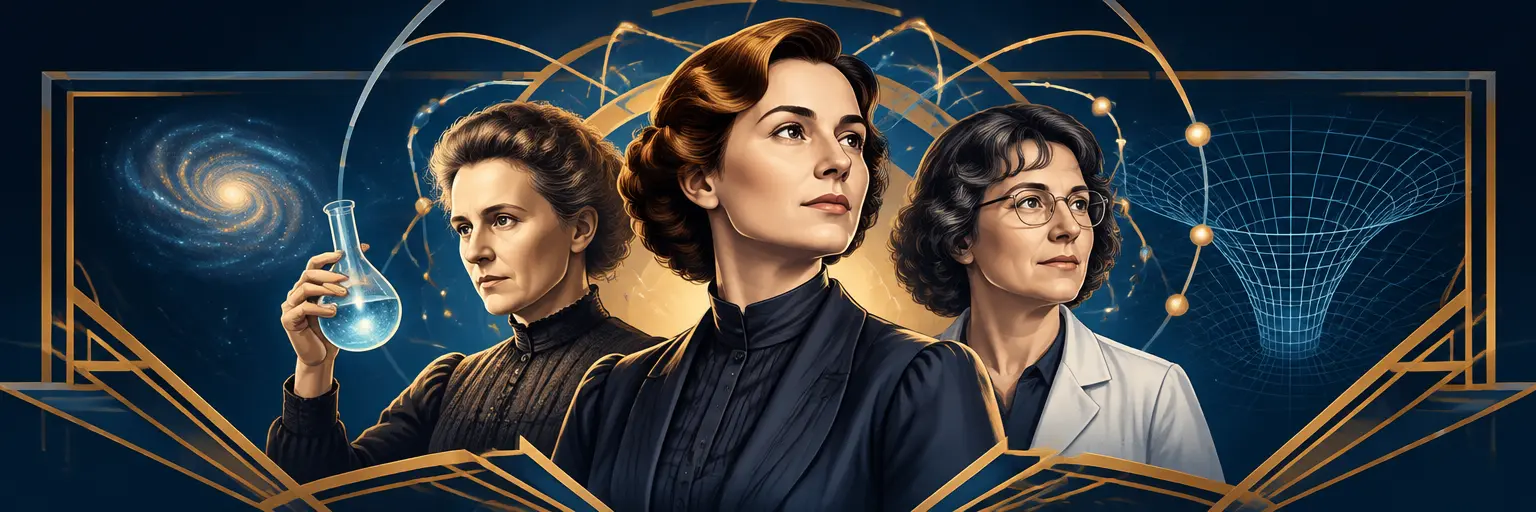
Welcome to our dedicated section on Women in Physics – Biographies, part of the broader Biographies category on WomenInScienceHistory.com. Here, we delve into the remarkable lives of female physicists who shattered glass ceilings, redefined fundamental laws of nature, and paved the way for future generations. From Nobel laureates to unsung heroes, these stories highlight resilience, intellect, and relentless curiosity. Whether you are a student, educator, or enthusiast, this resource offers a rich tapestry of achievements, struggles, and legacies, all optimized to inspire and inform.
🌌 Nobel Prize-Winning Physicists: Trailblazers of the Quantum Age
Explore the extraordinary journeys of women like Marie Curie, the only person to win Nobel Prizes in two different sciences, and Maria Goeppert-Mayer, who unraveled the nuclear shell model. These biographies detail their groundbreaking experiments, from radioactivity to nuclear structure, and the societal barriers they overcame to earn global recognition. Expect insights into their collaborative works, personal sacrifices, and the institutional sexism they navigated, providing a nuanced portrait of scientific excellence against all odds.
Each profile also contextualizes their discoveries within the wider physics landscape, showing how their contributions sparked new fields. You will learn about their mentorship, teaching philosophies, and the laboratories they built, often against resource scarcity. This section is perfect for those seeking role models or researching the history of physics, with SEO-rich content covering keywords like 'female Nobel physicists,' 'Curie biography,' and 'nuclear shell model pioneer.'
🔬 Hidden Figures: Unsung Women Behind Major Discoveries
Many women made pivotal contributions to physics yet remained in the shadows. This segment highlights figures like Lise Meitner, co-discoverer of nuclear fission, and Chien-Shiung Wu, who disproved the law of conservation of parity. Their stories reveal how peer-reviewed credit often excluded them, yet their experimental precision and theoretical insights were indispensable. We explore detailed timelines of their work, including wartime projects and post-war recognitions, offering a corrective lens on standard physics narratives.
Readers will also encounter astronomer Cecilia Payne-Gaposchkin, whose PhD thesis on stellar composition was initially dismissed, and engineer Kathleen Lonsdale, a crystallography pioneer. Each biography emphasizes the collaborative nature of science and the systemic biases these women fought. This section is ideal for inclusive education, with keywords like 'forgotten women physicists,' 'Meitner fission,' and 'Wu experiment,' ensuring search engines guide you to these vital, empowering accounts.
📚 Academic Pioneers: Building Departments & Curricula
Dive into the careers of women who didn't just do physics but institutionalized it. Profiles include Mileva Marić, whose role in early relativity remains debated, and Hertha Sponer, a quantum mechanics expert who established one of the first physics departments for women. Their biographies cover university appointments, textbook authorship, and advocacy for female students. Expect archival details on their lectures, conferences, and administrative battles, showing how they transformed academia from within.
Additionally, meet Miriam O'Brien Underhill, a physicist turned alpinist, and Sophie Germain, whose work on elasticity challenged normative physics despite no formal degree. This H3 section underscores perseverance in educational settings, with content rich in terms like 'female physics professors,' 'academic barriers,' and 'women in STEM education.' It serves both as historical reference and motivational material for aspiring scientists facing similar hurdles today.
🛰️ Space & Cosmology: Women Who Measured the Universe
From stellar classification to cosmic background radiation, this section chronicles women like Henrietta Swan Leavitt, whose period-luminosity relation enabled cosmic distance measurements, and Margaret Burbidge, co-author of the seminal B²FH paper on nucleosynthesis. Biographies detail their work at observatories, often as 'computers' with lower pay, yet their data underpins modern cosmology. Expect narratives about telescope access, publication biases, and their eventual recognition posthumously or late in life.
Also featured are Jocelyn Bell Burnell, discoverer of pulsars, and Vera Rubin, who found evidence for dark matter. Their stories illuminate the intersection of physics and astronomy, with keywords such as 'women astronomers,' 'pulsar discovery,' 'dark matter evidence,' and 'stellar spectroscopy.' This section aims to inspire with real-world impacts of their research, proving that dedication can transcend institutional discrimination.
⚛️ Modern Innovators: Contemporary Women in Applied Physics
This forward-looking segment profiles living or recent physicists such as Mildred Dresselhaus, 'Queen of Carbon Science,' and Shirin R. Saffari in semiconductor research. Biographies cover their patents, start-ups, and interdisciplinary collaborations in nanotechnology, materials science, and quantum computing. These women serve as living proof of changing landscapes, but still face pay gaps and underrepresentation in leadership. Expect interviews, career timelines, and their public advocacy for diversity in physics.
Detailed narratives include their breakthrough papers, mentorship networks, and awards like the Kavli Prize. This section is crucial for modern SEO, targeting phrases like 'current female physicists,' 'materials science pioneers,' and 'physics innovation women.' It provides actionable inspiration, showing how these scientists balance research with social impact, and encourages readers to pursue cutting-edge fields today.
Frequently Asked Questions
Why is it important to study biographies of women in physics?
Studying these biographies corrects historical omissions, offering role models and illustrating that scientific genius is not gendered. It also reveals systemic biases that still affect women in STEM, fostering advocacy for equity. By understanding their struggles and successes, readers gain resilience and a broader perspective on how scientific knowledge evolves through diverse contributions.
Which women in physics are featured most often in educational contexts?
Marie Curie, Lise Meitner, and Chien-Shiung Wu are frequently highlighted due to their major discoveries and dramatic stories. Recently, Jocelyn Bell Burnell and Vera Rubin have gained prominence for pulsar discovery and dark matter evidence. Their inclusion in curricula helps students see physics as a collaborative, human endeavor rather than a solitary male pursuit.
How can I verify the historical accuracy of these biographies?
Our site uses primary sources like lab notebooks, personal letters, and peer-reviewed papers, plus recent scholarship from journals like Physics Today. We cross-reference with archival holdings from institutions like the American Institute of Physics. Where historical debate exists, we present multiple perspectives, respecting nuance while clarifying factual consensus.
Are there any living physicists included in this subcategory?
Yes, we profile living innovators like Mildred Dresselhaus and emerging leaders in quantum computing. These entries are updated annually to reflect new awards, discoveries, and career moves. Inclusion criteria mandate documented, verifiable contributions, ensuring reliable inspiration for readers who prefer contemporary real-world examples.
Can these biographies support classroom lesson plans or research papers?
Absolutely. Each biography includes a timeline, bibliography, and discussion questions. We also provide thematic groupings—like 'nuclear physics pioneers' or 'space measurement innovators'—to aid project development. Teachers can use these for history of science units, while students can cite our cited references, making them academically robust companions to textbooks.