Evolution of Women's Science Networks: From Isolation to Global Collaboration
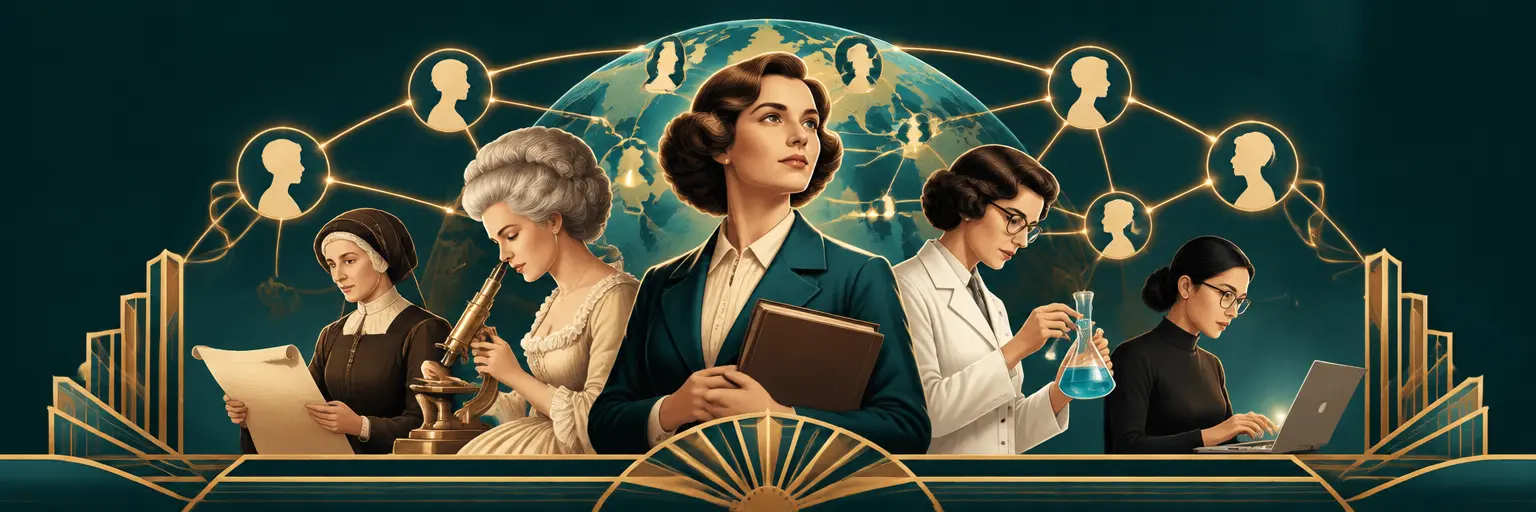
Discover how women in science transformed from isolated pioneers into interconnected communities that reshaped research, mentorship, and advocacy. This subcategory explores the historical milestones—from 19th-century informal salons to modern digital networks—that enabled women to overcome exclusion, share knowledge, and amplify their collective impact. Below, we unpack the key phases, influential organizations, and enduring legacies that define this evolution.
🌱 Early Informal Networks: Salons, Correspondence, and Learned Circles
Before formal institutions admitted women, they built their own intellectual spaces. In the 17th and 18th centuries, salons hosted by women like Émilie du Châtelet and Laura Bassi became hubs for scientific debate, while extensive letter-writing networks connected female naturalists across Europe. These informal ties allowed women to exchange findings, critique theories, and gain credibility without university access. For example, Caroline Herschel’s astronomical discoveries relied on correspondence with male colleagues but also on a supportive circle of female relatives and patrons who validated her work.
These early networks were fragile, often dependent on individual wealth or social standing. Yet they established a crucial template: women iteratively built peer support systems to compensate for institutional exclusion. By the 19th century, such networks had evolved into more structured societies, such as the British Association for the Advancement of Science’s women-only auxiliary groups, setting the stage for professionalization.
🏛️ Institutional Breakthroughs: The Rise of Women’s Scientific Associations
The late 19th and early 20th centuries witnessed the founding of enduring organizations like the American Association of University Women (1881) and the British Federation of University Women (1907). These bodies provided fellowships, research grants, and publication venues exclusively for women, bypassing male-dominated journals and universities. They also lobbied for equal access to laboratories, observatories, and field stations—often with measurable success, such as securing laboratory space at the Marine Biological Laboratory for female researchers.
These associations served dual roles: they were advocacy groups and de facto credentialing bodies. By publishing proceedings and organizing annual conferences, they created formal career pathways. For women like botanist Ethel Sargant, leadership in such networks enabled her to influence policy and mentor younger scientists, demonstrating that institutional structures could be repurposed for empowerment.
💻 Digital Revolution and Global Connectivity (1970s–Present)
The rise of email, databases, and social media fundamentally altered network dynamics. Online directories, such as the Women in Science Database (launched 1995), and platforms like 4000 Years of Women in Science made historical research accessible. More importantly, real-time collaboration tools allowed women in remote or conservative regions to join global conversations. Initiatives like the “Girls in STEM” LinkedIn groups and Twitter hashtags (#WomenInSTEM) now enable instant mentorship, job postings, and crisis support—something impossible in earlier eras.
This digital shift also decentralized leadership. While early networks relied on a few prominent figures, today’s networks thrive on crowdsourced knowledge and peer-to-peer learning. However, challenges persist, including the digital divide and online harassment. Modern networks increasingly pair virtual communities with offline events, ensuring sustained engagement and accountability.
🌍 Intersectional and Cross-Disciplinary Networks: Inclusivity as a Driver
Since the 1990s, networks have expanded beyond gender-only boundaries to embrace intersectionality—connecting women of color, LGBTQ+ scientists, and those from developing nations. Organizations like the Association for Women in Science (AWIS) now explicitly address how race, class, and geography compound barriers. This shift has spurred cross-disciplinary collaborations, such as bioinformatics communities that include physicists, sociologists, and data scientists. These networks foster innovation by merging methodologies and perspectives that homogeneous groups overlook.
The results are tangible: initiatives like Black Women in Science and the African Women in Science network have produced high-impact publications and patent filings. By prioritizing equity over representation, these groups challenge the “one-size-fits-all” model and create tailored support. This evolution also influences policy, as network leaders increasingly hold advisory roles in governmental and funding bodies, ensuring that diverse voices shape research agendas.
📜 Preservation and Education: Archiving the Legacy for Future Generations
Contemporary networks also serve as living archives. Projects like the Science History Institute’s “Women in Science” digital collections and oral history projects ensure that early network activities are documented. Educational outreach programs use these archives to create curricula, exhibitions, and public lectures. For instance, the “Hidden Figures” educational kit, developed via network partnerships, brings untold stories into classrooms worldwide. Such efforts not only preserve history but also inspire future scientists by presenting relatable role models.
Moreover, these networks are now training the next generation in digital curation and public science communication. By teaching women to manage their own narratives—through blogs, wikis, and video series—the networks ensure historical accuracy and diversity of perspective. This forward-looking approach positions them not just as historical records but as active agents in shaping tomorrow’s scientific landscape.
Frequently Asked Questions
What was the first formal women’s science network?
The first widely recognized formal network is the American Association of University Women (AAUW), founded in 1881. It originated as a fellowship fund to support women’s graduate research and advocacy for equal education. Earlier groups existed, like the Ladies’ Medical College in 1860, but AAUW is notable for its sustained national scope and institutional lobbying role.
How did women’s networks overcome exclusion from universities?
They created alternative credentialing systems—such as independent research journals, prize competitions, and extension classes—that were later validated by mainstream institutions. Networks also lobbied for co-education, which gradually opened doors. Legal strategies, like the 1884 campaign in Britain for women to sit medical exams, were organized through these networks.
Do modern networks exclusively serve women?
No, many are inclusive of all genders who support gender equity in science. For example, the European Platform of Women Scientists (EPWS) invites male allies as members. However, some groups remain women-only to provide safe spaces for marginalized individuals, ensuring confidentiality and a communal sense of belonging.
What impact did the internet have on these networks?
The internet massively scaled participation, enabling 24/7 mentorship and collaboration across continents. It also reduced publication bias through open-access repositories. Yet it introduced cyberbullying and surveillance risks, which networks address through moderators and ethical guidelines. Overall, the net effect has been a tenfold increase in documented collaborations.
How can current researchers join these networks?
Most organizations have online membership portals and offer reduced rates for students. For example, AWIS provides free student chapters, while ResearchGate communities like “Women in Science” allow instant connection. Joining involves filling a form, but active participation—commenting, presenting, or volunteering—deepens access to grants and collaborations. Annual meetings often offer travel fellowships for first-time attendees.