Evolution of Academic Opportunities for Women: A Journey Through Barriers and Breakthroughs
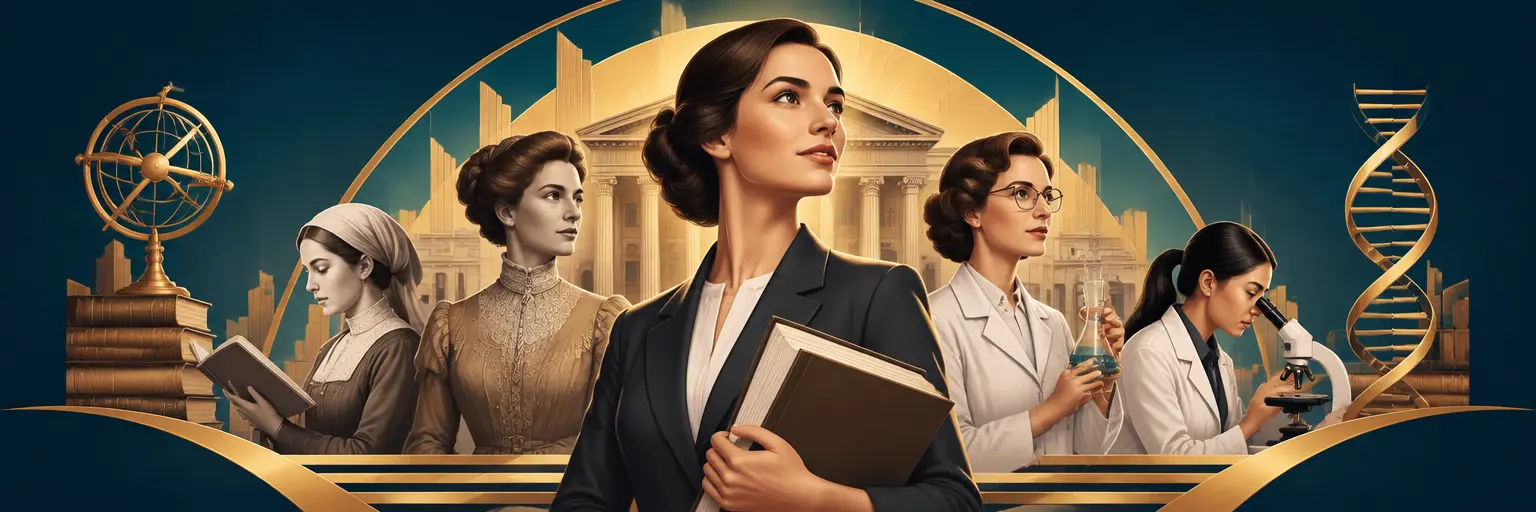
The subcategory Evolution of Academic Opportunities for Women within Women in Science History explores how educational access shifted from exclusion to inclusion across centuries. This page examines pivotal legal, social, and institutional changes that enabled women to enter universities, laboratories, and research networks. By tracing these transformations, readers gain a deeper appreciation for the pioneers who fought for seats in lecture halls and the systemic reforms that followed.
📜 Early Exclusions and the Fight for Entry
Before the 19th century, women were largely barred from formal higher education, with universities like Oxford and Cambridge reserving degrees for men. Medical and scientific faculties were especially restrictive, viewing female intellect as unfit for rigorous study. Early advocates like Laura Bassi (1732) and Émilie du Châtelet had to rely on private tutors or family connections to access knowledge, often facing public ridicule.
This era saw the rise of women's colleges and separate institutions, such as Mount Holyoke (1837) and Girton College (1869), which provided alternative pathways. These institutions became incubators for talent, proving that women could excel in mathematics, physics, and botany when given the chance. Their graduates then pushed for full integration, setting the stage for legislative reforms like the Sex Disqualification (Removal) Act 1919 in the UK.
🔬 Breakthroughs in Graduate Education and Research
The early 20th century marked a turning point as women began earning doctorates and joining professional societies. Figures like Marie Curie (Nobel laureate in Physics and Chemistry) and Lise Meitner (nuclear fission) demonstrated that advanced degrees were not only attainable but transformative. However, access remained uneven: while research universities in Germany and the US opened doors, many European institutions still imposed quotas or required special ministerial approval.
By the 1920s, women’s enrollment in science programs surged, yet they often faced “marriage bars”—policies forcing resignation upon getting married. Post-WWII, government-funded research and the G.I. Bill indirectly supported female scientists, though they were frequently channeled into teaching or assistant roles. The establishment of fellowships like the American Association of University Women (1881) provided crucial financial backing, enabling women to pursue advanced studies without familial support.
🌍 Global Perspectives and Policy Shifts
The evolution of academic opportunities was not uniform worldwide. In India, pioneers like Anandi Gopal Joshi (1886) became the first female physician, while Japan’s Kono Yasui (1927) broke ground in cytogenetics. Meanwhile, the Soviet Union and Eastern Europe offered near-equal access to university education from the 1930s, leading to a high proportion of female engineers and chemists, albeit under state control.
The late 20th century brought landmark policies: Title IX (1972) in the US barred sex discrimination in education, while UNESCO’s Grassroots projects targeted female literacy in developing nations. These shifts were accompanied by cultural changes—mentorship programs, gender-sensitive curricula, and anti-harassment policies—that made academic environments more welcoming. Despite progress, women still face subtle biases in funding, publishing, and tenure decisions, a reminder that formal access does not guarantee full equality.
🎓 Impact on Scientific Innovation and Leadership
Increased academic participation directly amplified women’s contributions to science. For example, Dorothy Hodgkin (Nobel Prize in Chemistry, 1964) advanced X-ray crystallography after earning her doctorate from Cambridge, while Barbara McClintock (Nobel Prize in Physiology or Medicine, 1983) redefined genetics through her maize studies. These achievements were possible only because institutions began offering research labs, journal access, and collaborative networks to female scholars.
Moreover, women’s presence in academia fostered new research questions—from Alice Hamilton’s occupational health studies to Rachel Carson’s environmental science—that addressed neglected areas. Today, women lead major research groups, edit prominent journals, and serve as university deans, but they remain underrepresented in physics and computer science. The evolution of academic opportunities thus continues, with current efforts focusing on retention, intersectionality, and work-life balance policies.
📘 Challenges Still Faced by Women in Academia
Despite legal and procedural advances, subtle barriers persist. The “leaky pipeline”—where women drop out at higher rates from PhD to full professorship—is linked to unconscious bias, lack of role models, and institutional cultures that prioritize overwork. Studies show that female scientists receive fewer research grants and are cited less often, partly due to homophily in networking.
Intersectional challenges compound these issues: women of color, LGBTQ+ scholars, and those from low-income backgrounds face multiple hurdles. However, recent movements like #MeTooSTEM and Equal Pay for Equal Work campaigns are prompting audits and policy revisions. Universities now adopt implicit bias training, transparent promotion criteria, and family-friendly leave—signs that the evolution is far from over but heading in a more equitable direction.
Frequently Asked Questions
When were women first allowed to attend university?
The first fully accredited women's college was Wesleyan Female College (1836) in the US, while the University of London admitted women to degrees in 1878, becoming the first UK university to do so. However, full integration into co-educational institutions was gradual, with most European universities admitting women between 1890 and 1920.
What was the “marriage bar” in academia?
The marriage bar was a policy, common in the early-to-mid 20th century, requiring female university staff and teachers to resign upon marriage. It was based on the assumption that married women should focus on domestic duties. The UK abolished it for teachers in 1944, and for civil servants in 1946, but some universities kept it into the 1960s.
How did women fund their education before scholarships?
Many relied on wealthy patrons, family savings, or teaching salaries. Some, like Elizabeth Blackwell, worked as schoolteachers to save for medical school. Philanthropic groups, such as the Association for the Education of Women (1867), provided loans and grants, while others resorted to crowdfunding through public lectures or sold handcrafted items.
Are there still any countries that restrict women’s university access?
In most countries, legal restrictions are gone, but practical barriers remain. For instance, in Afghanistan under Taliban rule, women are currently banned from higher education. Other nations may have cultural or logistical hurdles, such as long travel distances or safety concerns, that disproportionately affect female students, though not legally enforced.
What can modern institutions do to improve female academic participation?
Effective measures include establishing childcare facilities, flexible tenure clocks, and transparent promotion criteria. Also crucial are mentorship programs, gender-balanced hiring committees, and anti-harassment enforcement. Institutions should also collect and publish gender-disaggregated data to identify and address gaps in retention and advancement.